Episode 15 - From Grind to Balance: Sam Mahmood's Journey to Success
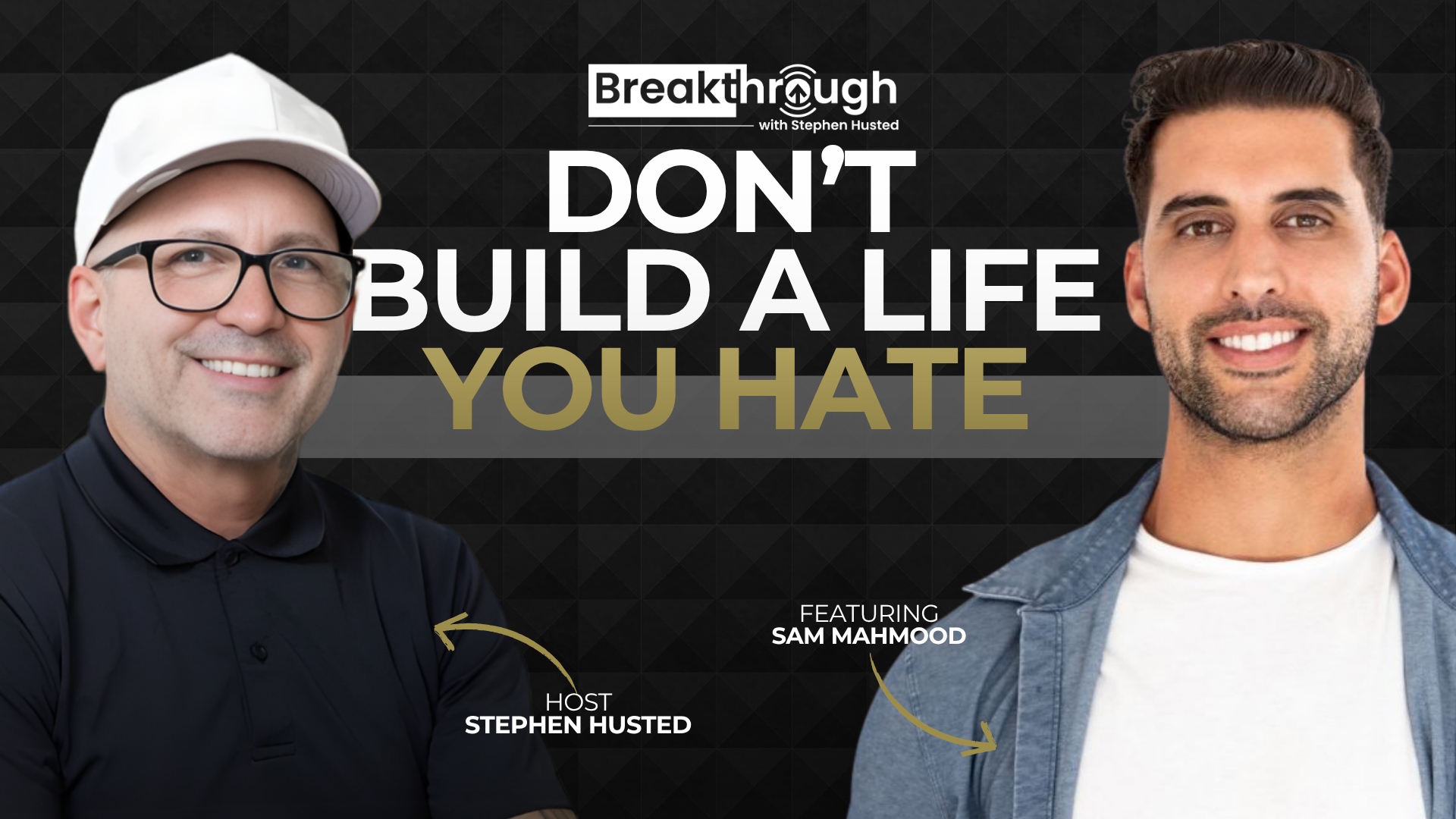
Welcome, Breakthrough enthusiasts! I'm your host, Stephen Husted, and you're about to dive into another enriching episode of "The Breakthrough." Today, I'm thrilled to be joined by the insightful Sam Mahmood for a candid conversation that spans the realms of real estate, investments, entrepreneurship, and the delicate art of balancing it all.
Takeaway 1: Automation in Property Investment: We kick off the discussion by exploring the landscape of property investment, with a special focus on the game-changing role of automation systems. Sam Mahmood sheds light on the intricacies of leveraging technology to manage properties, employing advanced property management platforms, and harnessing the power of AI tools for seamless operation and scalable success.
Takeaway 2: Stephen's Transformative Journey: As the conversation unfolds, I share my own experiences navigating the real estate industry. We delve into my strategy of integrating short-term, mid-term, and long-term rentals into a cohesive system. Moreover, we peel back the layers of my personal journey, shifting from a singular focus on monetary gains to a more balanced approach encompassing growth, health, and personal satisfaction. The key takeaway? The transformative power of focusing on one's immediate environment and taking incremental steps towards lasting change.
Takeaway 3: Media, Comparison, and Fulfillment: In the latter part of our dialogue, Sam and I unravel the powerful influence of media on self-perception and motivation. We delve into the pitfalls of comparison and the urgent need for individuals to carve their unique path to fulfillment. From the reverberations of entrepreneurship to the delicate balance of mental well-being, relationship management, and professional achievement, this segment encapsulates the essence of our conversation—a blend of business insights, motivational gems, and practical advice.
TRANSCRIPT
∎ Teaser / Highlighted Clip
[Sam Mahmood] (0:00 - 0:55)
I think the unfair advantage of digging your honey hole, and the honey hole to me is where you create your bees to do work for you, to put more honey back in your jar, is by creating an unfair advantage in your backyard. So I actually, in all my business that I do, I have a holding company of business that I acquire and own, and I have a portfolio of real estate right now, and it's all vertically integrated. And I do this for a reason that if I have to actually source something, that I'm going to build the system where I'm going to buy it and bring it because that's how you bring ultimate scale.
I saw Warren Buffett, who owns Berkshire Hathaway, who actually owned some of the medical device companies that I was representing at the time. And I saw that everything that he was doing, he was just buying things to fulfill another entity that would fuel that business. And I thought that was the smartest thing that you can do while scaling your real estate portfolio.
Probably the best acquisition you should do is buy a property management company, so it couples your real estate portfolio.
∎ Podcast Intro:
[Stephen Husted] (0:55 - 2:38)
Welcome to The Breakthrough with Stephen Husted, the show that takes you behind the scenes with successful entrepreneurs, real estate investors, and other movers and shakers in the business world. In each episode, we'll sit down with our guests to explore their personal and professional journeys, including the challenges they faced, the breakthrough moments that propelled them to success, and the strategies and the tactics they used to get there. Get inspired by new ideas and strategies and get to know our guests on a deeper level.
Join us for candid conversations, powerful insights, and plenty of breakthrough moments. Please help us grow by subscribing and sharing the podcast. And welcome to the show.
∎ Guest Introduction:
Welcome back to another episode of The Breakthrough. I'm Stephen Husted. And today we've got a seasoned real estate expert in the house, the insightful Sam Mahmood.
Sam brings a wealth of experience to the table, not just as an investor, but as someone with practical insights. We're delving into the world of property investment, uncovering the strategies behind automation systems, and Sam is generously sharing his secrets to scaling success. But it doesn't stop there.
Sam takes us on his journey from relentless pursuit of wealth to finding a harmonious balance between growth, health, and personal satisfaction. If you're ready for a genuine breakthrough in the realm of real estate, hit that play button and let's dive into this conversation with the remarkable Sam Mahmood.
∎ Podcast Proper:
All right, we're live.
It's awesome.
[Sam Mahmood] (2:38 - 2:38)
How's it going, Stephen?
[Stephen Husted] (2:39 - 2:41)
It's going good, man. I appreciate you jumping on.
[Sam Mahmood] (2:42 - 2:43)
I appreciate you bringing me on as well.
[Stephen Husted] (2:43 - 3:17)
Yeah, I thought this is a pretty crazy story. I don't know. I think it was a couple weeks ago I reached out to you.
I was driving up to Burlingame, going to meet a business partner to have dinner. And I was listening to the Furnace Finder podcast. And it was your episode.
And I was just listening the whole way up. I got an hour drive and I was like, oh yeah, I like this guy. He's got a lot of good information.
Do you listen to a lot of podcasts?
[Sam Mahmood] (3:18 - 3:19)
I do.
[Stephen Husted] (3:19 - 4:14)
Yeah. Do you ever have those moments when you're listening to a guest speak and they're just starting to resonate with you and you have a real deep connection on what they're saying and it just really sits? For sure.
You go through that? Okay. Yeah, it happens all the time.
And yeah, so I was listening to you speak and you were bringing up about your investment properties and about just working smarter, not harder, not having a ton of things on your plate, focusing on the right things. And that really did sit with me as far as what I'm going through right now because we scaled really quick. Bought a lot of single family homes and then learned all the lessons as we were going.
But yeah, I'd love to hear about your journey in real estate and how you scaled and where you are right now.
[Sam Mahmood] (4:15 - 5:52)
For sure. And just to touch on that point, I think in regard to scaling, it comes back down to decision-making. And I learned this early on that decision-making is a level of extremity of hierarchy in your life.
So what I mean by that is if you are making decisions towards talking to a contractor to get the plumbing job done, you are working in a low leverage capacity, correct? So not to distinguish myself from anyone else who maybe has to go do that, but you're trying to set yourself up of separations from those decisions. So I try to learn those things very early on in the sense that when I was growing and scaling my multi-family portfolio while building a medical device company, I wanted to make sure I was putting very good systems in place that had the least amount of input for a high amount of output.
And by doing so, it was by setting high infrastructure through integration systems, through Notion, Zapier, property management softwares that I put in, AI tools within short-term rentals, all these things where I can just wake up every day knowing these things are operated and I get to see these things continuously flowing and I have very minimal input. So I have one VA here in the US that manages three other VAs. And I highly recommend people do this as a scale for the mere fact that you do not want to be the layer to speaking to multiple different people.
It's better to speak to one person who can relay that message to multiple other people. So creating a chain of command. And the further you start distancing yourself from the chain of commands, the more freedom you have in life.
And that's all I'm really striving for.
[Stephen Husted] (5:52 - 6:10)
And how did you put all those tools in place? What was your thought process on doing that? Did you outsource to find somebody help you or is that something that you're just really good at doing?
Because I don't feel like everybody is good at those things.
[Sam Mahmood] (6:12 - 8:11)
Great question. So you and I both buy properties in Southern California, correct? We work off lower cap rates than most.
And if people don't know what cap rates are, it's the net operating income divided by the purchase price, meaning we have usually less cash flow to work with. In that sense, you have to be more creative on your systems to be able to continuously have more cash flow at the end of every single month. And by doing so, I can't externally outsource property management.
Unless you probably have hundreds of units, it does make sense. But I'm still sub 30 units right now. So I want to make sure I can vertically integrate property management through my own systems, through my own team.
So by doing so, all you need is a virtual assistant. And then pick the platform, whether you have long-term, short-term, or mid-term rentals. There's different platforms that you can use for those.
So find the platform that works for you. I use Hemlane for long-term. For short-term, obviously Airbnb and Hospitable or Guesty are great ones to use.
And you integrate software and systems, understand the software and explain that to your VA of how this is going to work. So your SOPs are everything. So I use system operating processes on when a tenant moves out, when a short-term rental tenant comes in.
Everything has a system. You set it up once and you train someone really well. It's better to have a virtual assistant that you pay a little bit premium for, because it's better to have someone who operates like a Tesla with a battery full of charge, ready to rock and roll rather than trying to train multiple different VAs.
And I've gone through that process and people have as well. You have to go find multiple different VAs over and over again. And it's a very daunting procedure during the Philippines, South America, whatever it may be.
I pay 22 bucks an hour for a VA here in the U.S. who manages other VAs in the Philippines at $6 or $8. So she knows exactly what I'm looking for. And we built that really strong relationship over three years.
So these things are very, very important to set up early on to give yourself more autonomy in the future.
[Stephen Husted] (8:12 - 8:30)
And when did you set this up? What part in the scale process? Did you do it right off the bat, your very first property, or did you go through...
Did you start with some issues that made you go, okay, hold on, let's put the brakes on here and let's build this out correctly from the beginning?
[Sam Mahmood] (8:32 - 11:25)
Great question. So let's go through the journey a little bit, where first property was FHA a fourplex. It's what I probably recommend everyone doing their first go around.
It's like your trump card. So I did that, bought my first fourplex on the Inland Empire, California. And then the first 30 days I had to do a cash for keys.
Unfortunately, that was a rough experience. I went out and did that. I had to give someone money.
Someone trashed my place. And that was a very daunting experience. Why people say, I don't want to invest in real estate.
But I still knew in the back of my head, I was like, there's people making millions of dollars who profit out of real estate, who don't deal with these issues. So in that sense, I said, okay, even though I have four units right now, I'm going to treat it like I have 400 units. So I'm going to set up the best, most automated systems today.
So this 40-unit property gives me the highest amount of leverage. And I have very minimal input for this. So the first system I put was Hemlane.
No tenants have my cell phone number moving forward. Every process that has to go through this platform, an issue goes through that platform. All the rental properties go through that platform.
All the payments go through that platform. And I mandate those systems. So when you start delivering those commands to your tenants, they respect you.
You don't want to have any sort of command of being able to have them reach out to you via your personal cell phone. I think that's one of the worst things that you can do because then people start taking advantage of the situation. So as I started to scale, I've started to buy more family all in Southern California.
I bought some stuff out of state. I realized that I lost power doing single family, short-term rental Airbnbs out of state for the mere fact that if I'm here in Southern California and I'm buying in the Poconos or Nashville, Tennessee, I'm still using external sources to go manage the properties, which they have leverage over me. And that will reduce my net operating income.
And I know people can do that today and they crush it. I think the unfair advantage of digging your honey hole and the honey hole to me is where you create your bees and do your work for you, but to put more honey back in your jar is by creating an unfair advantage in your backyard. So I actually, in all my businesses that I do, I have a holding company of businesses that I acquire and own.
And I have a portfolio of real estate right now, and it's all vertically integrated. And I do this for a reason that if I have to externally source something that I'm going to build a system where I'm going to buy it and Because that's how you bring ultimate scale. I saw Warren Buffett, who owns Berkshire Hathaway, who actually owned some of the Metaflow Vice companies that I was representing at the time.
And I saw that everything that he was doing, he was just buying things to fulfill another entity that would fuel that business. And I thought that was the smartest thing that you can do while scaling your real estate portfolio. Probably the best acquisition you should do is buy a property management company.
So it couples your real estate portfolio. So that's my whole methodology today is buy something to help with the thing that you just did.
[Stephen Husted] (11:26 - 11:37)
That's amazing. You know what's interesting? What would you say is your superpower?
Are you a visionary person or are you more of an integrator?
[Sam Mahmood] (11:38 - 11:39)
Yeah, that's an awesome question.
[Stephen Husted] (11:39 - 11:42)
I feel like you're both almost.
[Sam Mahmood] (11:43 - 13:30)
Yeah. Based off this conversation, you probably think I'm an integrator, but in hindsight, I'm more of a visionary. I like to think pretty big.
And with that, you still have to have integration skills to go do so. I'm a very who not how person. That book, Who Not How, if no one has read that book, it's phenomenal because if you create a to-do list of everything that needs to be done, you just tie a who to it, you can accomplish almost anything.
And I had this curiosity chronicle where I want to start different businesses. I want to go explore things. And by doing so, these things are all accomplishable if you know how to tie someone to that and a pure operator that you trust that allows you to scale.
Because we went back to the conversation, what allows scale? That's relinquishing control. That's all it really is.
Because you can't do the same mundane task for the next year or two or three years and think you're going to scale at the same time. You will divide and conquer your attention, which will allow you to have ultimate scale up the ladder. So I'm very big on being a visionary, understanding who my people are who are going to help me scale.
And I put a lot of emphasis and trust in them. So the most important things for me is ethics. That's the first thing I look at.
Because you can't buy a new reputation. Money is renewable, but you can never buy another reputation. So if I partner with someone or I hire someone, I can train them to become better.
And I know people always emphasize, shouldn't you just hire the best talent? I've done that before. And it's bit me in the ass for the mere fact that you hire someone so good that maybe it doesn't have the ethics on their side, that then come back and haunt you down the road in your business because maybe they learned your secret sauce and they want to come back and take what you've built.
And I think these are the lessons that I had to go through of understanding what's most important to me in creating business and creating leverage in my life.
[Stephen Husted] (13:31 - 13:59)
And how did you go about training? How did you look at that part of it? Did you get a system in place on how you're going to train them right off the bat?
Did you use loom and record and give it to them and then walk them through? Because unless somebody comes with a set of skills or if you have to train somebody out at, let's say, your VAs in the Philippines, there is definitely a learning curve there for a period of time. Would you agree?
[Sam Mahmood] (14:00 - 14:45)
There is. There is. But in every person, one thing that you should look for is a skill set that they have that maybe you do not have, that they're slowly filling that void.
So I'm not a very technical person. I'm more of an interactional face-to-face type of person. So the technical skills on my side are weak.
So if I can always find someone to leverage that in any sort of the business that I'm looking for, whether it's video editing, social media, implementing systems from that aspect, on the technical side, it's always a plus for me. And I try to focus on those attributes first and foremost, because I know that will give me more leverage for me to just deploy those resources to them. And I can know that I tell them that this needs to be done, and it's done.
And then you couple that with good ethics, we have a business in play now.
[Stephen Husted] (14:46 - 15:14)
Yes. And I think that everything you're saying, it's something you learn too over time. It's always, when I'm in the middle of trying to figure out a new direction, it's always, who can do this?
I have the vision. I'm going to get it in front of them. I want to tell them that vision, and then I want to get them to move in that direction.
I want to step, after that, I'm off to the next thing and where I can go from there.
[Sam Mahmood] (15:16 - 16:10)
And I move so quick, it's scary. Yeah. I mean, the highest forms of leverage are things with no marginal cost.
And if you start understanding that methodology early on in your career, where you can understand fixed costs and setting those things up really, really well, and then start implementing people into those roles, and that starts to compound, your life becomes a lot easier. And you don't want to go through those mistakes multiple times over and over again, and start feeling the burden of like, wow, I feel like I just did this already. Why am I doing this again?
At that point, you just put yourself in a reset, and you don't want to do that. So it's critical to understand that you have your SOPs in a very good place. And the mere fact that when you fly to Bali tomorrow, and you're gone for a week, you're going to know exactly what is demanded out of your business.
And real estate is a business. Every four-plex, multifamily, self-storage unit, whatever you have, is a business. It operates on its own P&L.
[Stephen Husted] (16:10 - 16:10)
100%.
[Sam Mahmood] (16:11 - 18:08)
Treat it like a business. Yeah. And that's exactly how I view real estate.
I am agnostic to the asset class these days, even though my whole portfolio today is actually all multifamily. But I look at real estate like a thermometer, because a cap rate is a thermometer. And it's all dependent on where we are in the markets today.
So two, three years ago, we saw that any investor made money. Now we're going to see who's a true talented investor, because people can't go buy multifamily real estate today and think they're going to get a nine cap and carry a 7.5%, 8% interest rate with two points down and make it work. But two years ago, they could.
So this is where you have to be a strategic business operator at all times, and a visionary to make sure your vision is understanding adaptability throughout the processes of building a business. Because it's very important to know that your business will change over time. There are very few businesses out there that you can stay in the same rhythm and cadence and see growth.
I think there's a few companies that I've been involved in. One is in healthcare that sometimes is not really distracted by the noise on the outside, and the mere fact of inflation, recessions, and so forth, that you can still do the same thing every single day for the next two to three years, and you'll have consistent growth. But in real estate, it drastically changes.
And I've learned that the hard way. Because rents change. We have this crazy rent growth over here in Southern California.
The Inland Empire, I bought over 20 units in Inland Empire because Amazon was building out there. And I have the Amazon model where I just follow wherever Amazon and Jeff Bezos build, I buy. And it's certainly so well over the last few years, but we've also seen a little bit of plateau.
Yeah, we've seen a little plateau on rent growth as well. And I don't want to be too cocky on continue buying in areas today, where if I follow that same methodology I did two, three years ago, I get my ass kicked today.
[Stephen Husted] (18:13 - 18:35)
You have to have a better vision with what you're buying right now. Is it a fourplex that you really thought out of the box on? I think you brought in another equity partner on it.
And is it the one that you're actually living in currently that you've got midterm, short term? You got a bunch of different strategies all bundled in one. Is that correct?
[Sam Mahmood] (18:36 - 18:38)
That's actually a triplex. That's coastal.
[Stephen Husted] (18:38 - 18:39)
It's a triplex?
[Sam Mahmood] (18:39 - 19:26)
Yeah, on the beach over here, where I bought it exactly a year ago. Interest rates were still high, above 7%. But I still, when I can see a value ideal on the equity side, I take action upon it.
So, I bought it for $1.65 million. The laws in Huntington Beach over here, you have to have owner occupancy to be able to Airbnb, meaning that I'm going to have more advantage of not being surrounded by so much competition on the Airbnb side, by all these different investors trying to just buy homes in Huntington Beach and Airbnb, while I will actually live in one and rent out the others. So, I did that methodology by raising half a million dollars, deploying that capital into renovation and the down payment.
And then today, this thing cash flows while I still get to live in it and pay back my investor.
[Stephen Husted] (19:28 - 19:37)
Yeah, that was brilliant. And you don't have a lot of competition, from what I remember hearing you talk about it, that there's not as many, it's not saturated as much.
[Sam Mahmood] (19:38 - 20:54)
It's not. And another methodology within the business model of my portfolio of real estate. So, I own a medical device company.
That's how I build majority of my wealth the last five, six years. And with that, I always try to find where can the root cause of my medical device company help serving other businesses. And I thought about, there's traveling nurses, there's traveling physicians, doctors do locums, which are, they get paid to go somewhere to do surgery for a few days and then you place a stay.
And I was like, how can I lubricate that process to have them use my units? Because I know those will be premium units. I won't have to worry about collecting rent and it's backed by multi-million dollars, billion dollars of healthcare, right?
So, with the relationships that I have in healthcare, and I currently already have contracts with the facilities that I work with, I can pick up a phone call and call people and find out and navigate who are the traveling nurses with the highest demand today while hospital healthcare systems. So, I've created contracts with them to get them into my units that I own here in Southern California, where I now have more of a midterm rental model rather than a majority long-term. And then, so now I have a diverse supply to S&P 500, you can call it, of long-term, midterm, and short-term rentals.
[Stephen Husted] (20:55 - 20:58)
Bullseye. That's exactly what we're doing.
[Sam Mahmood] (20:59 - 22:29)
Yeah. That goes back to adaptability, where you want to be able to adjust towards the market and continue to innovate. And by doing so, you want to look at the different strategies out there to see if they can be implemented into your current ecosystem that you built.
And continue to always try to squeeze the juice as much as possible. Because a lot of times, more income can be created within what we currently have. It's just sometimes we're always seeking something else.
And I'm very keen on trying to always squeeze the lemon as strong as possible before I move to something else. I've seen shiny objects and I've been caught in that myself. And these are lessons that we all learn as entrepreneurs.
It's the biggest kiss of death. And we want to make sure that... Have we explored and blue ocean all the opportunities within our business today before we look elsewhere?
Because the one thing about social media that goes on today is we see people starting big companies left and right, selling companies, right figures, nine figures, eCommerce, media, tech, SaaS, whatever it may be. And you want a piece of that. But then you start realizing that attention follows the wealth.
And if you don't understand that, you will dig yourself in five ways. And then you'll be only deploying 20% per each way while someone else is kicking your ass, deploying 100% one way. So it's really important to understand where your attention is going.
And I'm still trying to navigate that today for my own business. Yes, me too. I'm a victim of that myself.
[Stephen Husted] (22:29 - 25:04)
I agree with you on that. You definitely can get the shiny object syndrome, especially on social media. If you follow 20 different people that are doing 20 different strategies and you hear one minute video of how they're crushing this, you're just like, oh, that seems cool.
You really do have to stay hyper-focused until you feel like you really got to that point where like, okay, you know what? I got this moving correctly. I've worked through everything I need to work through.
Maybe it's time now I can move into something else. We started straight in single family homes. That was it.
Just single family homes. Then we bought a short-term rental. Couldn't do a short-term rental on this particular unit.
It was in a condo. HOA had some laws in there and they changed it. So we pivoted at that point.
We made it into a midterm. It wasn't called midterm back in 2015. It was corporate housing.
And we had people coming on contracts that worked in tech and they rented our place fully furnished. We just stumbled upon that. That was great.
We did that for a while, sold that property, moved into a short-term out in the Smokies, went through that cycle, still in that cycle. And now we're pivoting into midterms. But it's something that we've been into.
Yeah. You know what was interesting about back then was getting the agencies signing the lease agreements and then contacting us online. And I was like, whoa, okay.
They signed the lease checks. You're always guaranteed getting your rent on time. It was just brilliant.
Or they know that the contract was going to end and they said, hey, we have another two people coming into town. We'd like them to look at your property. It was smooth.
That was a really great point. But then COVID came and our tenant, we had it in there during COVID. They just packed up and left and property set vacant.
I'm like, all right, let's pivot. Let's get out of this. So we moved into short-term in the Smokies.
But yeah, I think doing all these systems, being really tight on your vision and understanding this, it's a learning scenario. It takes time. I know that what you just said, it sounds like, okay, you got it all together, but there's a lot to it in the back end.
You can tell us this, but you put a lot of time and effort in that. How do you go about doing your research? Do you research everything up front?
How do you get to those points where you put in, even the software you use, how do you do all that research?
[Sam Mahmood] (25:05 - 25:52)
Yeah. Just first and foremost, to give clarity to your audience, I do not have it all figured out whatsoever. So I'm still a sponge learning every single day.
I know what it takes and I have to implement those systems myself into my daily actions. So going back to your question on how do I do all my research? I do a lot of digging at night.
So I'm very keen on trying to find the optimal platforms out there that can fuel multiple different things within the business. So if one platform can do three things, rather than one platform just doing one thing, I usually go with the one that gives you more leverage. Again, I think the theme of this presentation will always be about how can I do just a little bit less for a lot more down the future?
So I try to find the platforms that can integrate towards that model.
[Stephen Husted] (25:53 - 26:36)
Yeah, that's smart. Yeah. So I was telling my VA that I wanted to get all our social media podcasts, everything, scripts, content ideas, all in one place.
I feel like I was jumping around in too many different places, going to Google Drive, going here. So we moved everything to Trello and we've been running everything right there, which now I can just look on the app and either put in content ideas, see where projects are at, kind of keep me focused. And it does more than one thing, which is the key.
I feel like that's truly a benefit to your business to find software that can do more than just one thing because also you have 10 of them.
[Sam Mahmood] (26:36 - 27:06)
Yeah. I think the one that actually is leading them all currently is Notion. Notion is coming probably the best SaaS platform of 2023 right now.
They have just found a way to centralize all the note-taking, all the CRM systems, all the to-do lists, all in one place, putting visionary boards. And you're starting to see a lot of people starting to use that platform. And I think that has become an ideal platform for me to take all my business.
[Stephen Husted] (27:08 - 27:09)
Have you checked out Trello?
[Sam Mahmood] (27:09 - 27:55)
For sure. Notion mastered something that many platforms did not have is they put multiple different templates for you to go in there and be able to automate things that you're looking for within your business. So a CRM software, to-do list, a visionary board, and they put it in so many different ways, especially even for engineers.
They made all these templates in there that are very tailored to engineers, to supply chain. So I think they've really been very methodical in their way of creating a platform that suits a wide TAM, a total addressable market. And now you're starting to see even on job boards, people are posting their Notion and ShareLink to the audience to be able to apply.
So they're very creative on this. Yeah. Very direct consumer aspect and a very B2B software aspect as well.
[Stephen Husted] (27:57 - 27:59)
Tell me how you're using it.
[Sam Mahmood] (28:00 - 28:02)
Every business I run. Yeah. Every business I run.
[Stephen Husted] (28:02 - 28:03)
Every business.
[Sam Mahmood] (28:03 - 28:49)
Yeah. It has its own Notion dashboard now. So we find ways of to-do lists, CRMs. We have vision boards on there. We have KPIs on there. So it's very easy to go one platform and then look at all the businesses that I'm working on and be able to go to Notion as my central hub to see where its systems are. And especially Zapier is very eco-friendly of integrating all that into Notion.
So even think about your profit and loss statements of your properties that can be all directly looked at at Notion. It's a very smart path. So that's a big thing for me.
I like snapshots and I want to go in there and look every day and see how things are performing. And if I can do that all on one platform, we're winning the game. Yeah, definitely.
[Stephen Husted] (28:50 - 28:59)
Explain to me, give me a breakdown of a daily routine of yours. Yeah. What's that look like?
[Sam Mahmood] (29:00 - 29:18)
Wake up around five. First thing I do before I even drink coffee is I go cold plunge in the morning. So I cold plunge for like three or four minutes, 40 degree water.
That's about the only little health hack morning routine that I have. And then I start getting- How'd you get onto that?
[Stephen Husted] (29:19 - 29:21)
How'd you get on the cold plunge scenario?
[Sam Mahmood] (29:22 - 31:24)
Yeah, as you can see, it's quite trendy these days. Well, I've been playing soccer for 20 years plus. Played in college, played a little bit after college as well.
And a part of our routine was always going to the cold tub. Now you're starting to see as this is one of the hottest direct-to-consumer products to buy. But I knew the effects of cold plunging and how I always felt afterwards.
So it gives me just a little rush in my body and I feel a lot fresher throughout the morning when I do so. The physical effects, to be honest, are good, but the mental effects are much better. And if I can just go soak myself in something a little bit difficult every single morning, I know I'm starting the day off very strong.
So it's a great way to start the day for me. I've accomplished somewhat of an audacious, tough task because nobody else wants to go in cold water at 43 degrees at four or five in the morning. So I automatically go do that.
And then I know I've accomplished something really good that day. So I can go now and accomplish bigger things throughout the day as well. And then I try and see a little bit of the to-do list that I have to do between what I'm working on that day, all in Notion.
And then I accomplish those to-do lists for the first two to three hours. On Mondays mornings, I usually do not work for the most part. I have just a methodology for that where stroke is the highest every single day, every single Monday, apologies, on Monday mornings at 8 a.m. So I really try to recreate that methodology of not having stress in my life as much as possible. And by doing so, I try to augment the best time to work for me is usually around 10 a.m. to 1 p.m. is where I have the strongest energy to go work. So I like to clear my mornings a little bit, at least a couple times a week, and just go for walks, get good sunlight. Health is a very big thing for me.
But then when I do get in deep work, you know, I'm working with the teams, I'm out in the field if I need to be, I'm doing a lot more on the visionary side these days of where I'm trying to build for the future than the day-to-day stuff.
[Stephen Husted] (31:26 - 31:29)
How far do you, how far does your vision go out?
[Sam Mahmood] (31:30 - 35:44)
Does it change? It does. But I think over the last six months, it's gone quite big.
So just a little summary, I said this earlier, I have a medical device company that I started called Surge for Public. We started as, you know, I was just a sales rep first and foremost for a company. And then I transitioned that to becoming a distributor of multiple different medical device companies.
In summary, if someone doesn't know what that means, basically imagine if Reebok, Adidas, Nike, Puma all came to you and say, you could have Southern California rights to go sell the products in that's given geographic area. And I was able to go do so. So I then took that model and start bringing a multiplication effect to that and started to expand my geographic area.
And then I started manufacturing instrumentation and implants therefore afterwards overseas in Germany. So I really got to see the layers of growth in a business by just starting out from selling to then distributing, to then becoming the manufacturer. And then now that I have those capabilities of growing a business, I said, how do I start doing that with other companies being consultant advisor, creating other companies myself.
And now I feel like those systems are not very hard for me to implement. So now I've started investing in other companies that fuel my main company and what I want to build. So I'm creating a holding company of what you might hear this term of a holding company of having multiple companies underneath your portfolio.
And I think having cash flowing business is a great asset to have. We look at the S&P 500 as something that's very enticing to invest in today. So for me, as we've talked about earlier, I like to bring everything in house.
So might as well create your own S&P and buy companies that you can put underneath your portfolio. So that's called S&P Ventures. I'm with a partner called Partha, who's also built a medical device company.
And he and I are growing this fund where we're going to raise capital and buy more businesses. And then on the real estate side, we're creating a fund, which is super exciting. There's been a lot of interest in this called MedVestor, which is a development fund actually outside the normal of my multifamily, which you see a lot of other syndications going out there that are mainly multifamily or self-storage focus more based off force value, where I think we're going to go and create the value.
And all of ours is focused in Hawaii actually to start. So I did this for a where it's called MedVestor. It's helping medical professionals invest in real estate.
And I wanted to tie that to something of high luxury in an area that is very desirable. And my developers are all in Hawaii. I've invested with them for the last several years.
We've gone out outstanding returns for the last several years as well. And I think in today's world, it's not about force value. It's about creating value.
So when we're buying Dura- And what do you mean by that? Yeah. Force value is by forcing the markets to where your property is going to go, rather than actually going and taking something and creating the value within that.
Because a lot of times we bake in appreciation. We bake in rent growth, where today you're not getting really good force appreciation or force value. So you have to go and create the value.
That's why I'm not buying any multifamily or self-storage or anything right now for the next bit, because things need to cool off. But what I will buy right now, or be an LPN or a GPN is luxury development. And I have this methodology that the capitalists dictate where the money goes.
And if they thrive through inflation, while we're in 9% CPI, and they want to go have seclusion in their life, they want to go buy stuff where no one else can buy. So we might as well tailor our assets to them, because they're not affected by 8% interest rates. So if we can go tailor a product to the 1% net worth, I think we're in the right business today.
Because selling to rich people is a lot easier than selling to the middle class or the lower class, because they just write checks. And they don't ask two questions about their $50,000 check. They write $500,000 checks.
[Stephen Husted] (35:45 - 36:01)
And what does that playbook look like? Like what do you vision? Yeah, I think one appraisal...
How did you stumble upon the vision, by the way? That's another thing. I like to understand that.
[Sam Mahmood] (36:01 - 39:08)
Let's dig into that. So the physician network that I was working with caught notice of the real estate portfolio that I was building. And they were very curious as well, because physicians are very good at making active income.
They're somewhat poor at doing passive income. And physicians also operate in a very linear mindset, meaning they're very one-to-one. So they go, they do their surgeries, they get paid for their surgeries, and they do that continuously.
As a young entrepreneur, I thought in a more quadratic fashion, where I was always a one-to-four ratio. So I do something once to get me four things, potentially. And because I'm not tied to just doing surgery whatsoever, just like a physician.
So I like to teach those methodologies to people that I'm currently working with and investments that I'm doing. I like to think that I like to be creative with my investments. And I've been serving as an LP in multiple different funds.
I love working with other fund managers to see what they're doing and other sponsors. And I've always wanted to have my own fund. So then finally, this came to conclusion where I've invested a fair amount of real estate.
I've syndicated deals before. I've given good returns back to my investors. I have a trustworthy ecosystem of medical device professionals, physicians, PAs, nurses, you know me.
And I'm surrounded by people who make good money, probably $150 to $1 million plus a year. And I said, why don't I just be in charge of capital markets? Again, do what I do best is talking to people and being in front of people that I'm seeing on a daily basis.
And then partner myself with the best operators I know. So my operators have done $200 million of real estate in Hawaii alone. So we're on a very focused avatar in the sense that we know exactly what we're doing in Hawaii.
We're not going to do a diversified fund right now of buying in five different states. We have an unfair advantage in Hawaii and the best island possible overlooking the ocean. So we're buying in Maui overlooking Jaws, the best surf spot in the entire world.
We're doing stuff in Kauai. These lots overlook the ocean. And if you ask any investor today, if you were to go back and change your investment thesis, what would you do differently?
Almost every real estate investor told me I would have bought on the beach and bought the dirt. And I'm taking that same methodology and applying that to our fund because there will only be one ocean and nothing else will disseminate the ocean whatsoever. So might as well go now and then give these returns back to our investors.
Now we're delivering the highest quality product out there. And we structured our fund in a very favorable manner where we're doing a 12% debt note. So to your audience, what that means is we're paying 1% back every single month back to our investors.
So you put $100,000 in, you get $1,000 a month in cashflow. And that's around three times as much as our treasury bond today. And you're part of a real estate LP fund that's backed by high quality real estate.
And we're doing a 25% equity round as well. So if you invest $400,000 or more, you can partake in our equity round that pays out once the project completes over an 18-month period.
[Stephen Husted] (39:10 - 39:19)
And that's phenomenal. And what a great spot too, right by Jaws. And tell me what the vision is.
What type of property do you want to build?
[Sam Mahmood] (39:19 - 40:26)
We're doing luxury development. So they're single family, and then there's more hotel, multiple properties on one piece of land type of model, but it's more or less always luxury development. So Hawaii does not care for affordable housing right now.
You can ask Brandon Turner, you can listen to the best guys who actually live in Hawaii, try to develop in Hawaii, building affordable housing over there. They just don't care right now that you would do that because they know what they sit on. Reality, even though it's covering back money, this is a business in the end.
And we all know that people want to have luxury assets in Hawaii because that will never go out of style. So we want to focus on something that's always going to be desirable. And then I wanted to lubricate that process with an avatar-focused group that I'm well-connected with, which is medical professionals and coupling that with the opportunity.
And by doing so, I think this makes the most sense of tying that towards something that's trusted, desirable, Hawaii real estate that people are always going to want to come visit. And then if we hold on to the properties, they get discounted rates to go there and stay there as well.
[Stephen Husted] (40:28 - 40:35)
Yeah, that's amazing. And with this, who's been helping you build out the team out there?
[Sam Mahmood] (40:36 - 40:48)
Yeah. So I partnered with my good buddy, Xander Kemp, who I've invested in his deals. He's had his own fund for the last several years.
He's raised millions of dollars. His expertise...
[Stephen Husted] (40:48 - 40:49)
Where is he based out of?
[Sam Mahmood] (40:49 - 42:43)
Hawaii. Yeah. Hawaii.
Okay. Yeah. And the entire team is based out of Hawaii.
So these are guys that I'm very focused on very good competitive advantage, digging your hole two inches wide and 10 feet deep. And that's exactly what they're doing. And I think even though we're in a high inflation period right now, that's only going to be a chart advantage over the next few years because people want to offset huge gains or huge capital gains in any sort of stock or other asset into something more desirable.
And we feel that if we cater this to the high net worth individuals, they will want to cater towards Hawaii real estate. And we've seen that model already where we've seen some of the developments have already happened. They're selling pre-construction right now.
And I saw this model where multifamily is sitting on the market a little bit longer today. Cap rates, you can call them a little bit over-compressed from what they really are. And it's harder for people to justify buying a 30 or 40 unit at an 8% cap rate.
And we don't know when the markets are actually going to go down and the interest rates will go down. So we said, let's focus on something that we can control, create the value in, and then give an actual product that we're gonna be super proud of as well. Oftentimes, we're buying these multifamily units and yes, they're okay, they're nice, but they're nothing to be lavish to show that we're super proud of this.
They're more just robust, you can call them. And I think in your lifetime, I'm very big on product as well, creating highly desirable product, something very visual. And you see people like TechFester doing this on the Airbnb side.
I tip my hat to them because they're creating an outstanding product today that's making it super appealing to investors that want to invest with them. And I find that if you can create really good product and then couple that with a good business model, you'll be in business for a long time.
[Stephen Husted] (42:44 - 43:08)
Yeah. And when you do this and you create an amazing product, this is another rinse and repeat. You could pull this in any really high-end luxury market and you could be in Jackson Hole, for an example.
And once you've done this first round, it's just like scaling too. You learn things over time and you rinse and repeat. It's in play.
[Sam Mahmood] (43:09 - 44:20)
Exactly. It's working with operators who have a time-tested methodology of knowing they can do this with their eyes closed. So again, what creates our competitive advantage rather than doing this in Jackson Hole is we source materials from Bali and Brazil at cost.
That allows us to put no drywall in there and a fraction of what other developers would have to go do that. Our developers over there have been exporting material for the last 20 years with the same suppliers. That allows them to have better opportunity to development in Hawaii than most people.
Again, it always goes into the competitive advantage. My manufacturing experience was exporting medical devices from Germany and bring them here and selling that at a higher margin where some companies today are working off 20%, 30%. Versus I said, I can go and probably sell a little bit less than they do, but operate off 70% or 80% margins today.
And that gives me a better lifestyle, more controlled narrative. I'm not having to push top line revenues so much. We have more baked in net profit on each deal.
And that allows me to have a little bit more freedom and breathing room to focus on just maximizing the juice of each deal.
[Stephen Husted] (44:21 - 44:25)
Yeah, that's great. What did you do when you grew up? What was your first jobs?
[Sam Mahmood] (44:27 - 46:33)
Oh man. So- I'd like to hear this. Yeah.
First job ever, I worked at Hollister and I was the guy at the front. And then I was folding a t-shirt and they told me that the tagline was, Hey, what's up? And I'll never forget the girl's name.
Her name was Rebecca and she was a manager and she walked in and she's like, Hi, Sam. I'm like, Hi, how are you? And then the next day I was fired.
And she said, you're not seeing a tagline of, Hey, what's up? And I said, well, I knew you. So I just want to say, Hi, how are you?
She's like, that's not the point. I'm here to test you to make sure you're following our guidelines. And then from then on, I knew I maybe wasn't cut from the corporate cloth.
And again, I was only 15 or 16 at the time, but then I started playing soccer. I took that very seriously. Um, I did some coaching, uh, one-on-one on that.
I did. I coach modern day high school over here, one of the best athletic programs, other high school varsity programs as well. And I loved coaching and giving back to a younger version of myself.
I thought that was always something so gratifying. The pay wasn't the biggest, but in the end it was so fulfilling. And then from that, you know, I got into medical device, um, after an inflection point where I was playing soccer, I traveled to Europe.
I didn't get a contract over there. I came back to the U S I was in Arizona on trial with a second division team here in the U S which is under the MLS. And, you know, we're looking at contracts and the contract offer for more or less is around a thousand dollars a month.
And at that point I had, I could have been offered a job from a very prestigious medical device company as well as a global supply chain manager is what I got my degree in. And I come from a middle Eastern background to look at sports as a hobby. And I probably had $47 in my bank account at the time.
And I was 24 years old, already like two years out of the college realm. And I was in an inflection point where I had to make this big decision. So I decided to just drop the soccer gig, go and take a medical device job and start building my career.
[Stephen Husted] (46:34 - 46:52)
It's interesting how things start to pivot as you go, as you start to see things, especially when you're younger and you have one of those corporate jobs and you just, you know, had that light bulb moment. Like, no, this is not going to work. And you slowly start going in the direction you should be going, you know, but it sometimes takes a little bit of time.
What do you like to do for fun?
[Sam Mahmood] (46:53 - 47:00)
So I'm a very health focused individual. So I'm very active. I work out a ton.
I do a lot of yoga. I run, I read a lot.
[Stephen Husted] (47:01 - 47:01)
Oh, you run?
[Sam Mahmood] (47:02 - 47:02)
I do.
[Stephen Husted] (47:03 - 47:46)
Tell me about, so yeah, that's funny that you bring that up. I know when I, you asked what are topics and I put in there like health and you're like, okay, you're, you're hitting on all the, all the topics I like to talk about. I, I race mountain bikes, like, like ultra endurance, a hundred mile races.
But lately I've been trying to find an exercise that I could do within the week that I don't need to like figure out a route, go on a two to three hour ride. I just want to do something where I can just not think too much and start, you know, basically start to run. And, uh, I've really enjoyed it.
Even 30 minutes of running feels so good. It's almost like a cold plunge in a lot of ways, like you just dopamine hit how long you've been running for.
[Sam Mahmood] (47:47 - 50:36)
So running was always a punishment for me, unfortunately, as an athlete, you know, usually you're, you know, in college, you're 17, 1730, um, which is disgusting for most. So let me just tell you. So the thought of running now is very hard to look at that in the same context of what I was doing before.
So I liked to just go on the beach on a sunset shirt off. If I can go run three miles, it's a dream for me. I'm also an avid cyclist as well, but again, I do it for more of a, if it's hot outside, I can wear the biker shorts.
I can go shirt off and go down PCH. That's a dream for me. Um, but right now I'm just, I'm on a big fitness trend myself.
I'm just trying to get an optimal shape. Um, now that you come to an inflection point in life where, you know, I wouldn't say like you're, you're grinding as hard as you were in your early twenties. That's not where a lot of the doing was.
And now I'm a lot more in the decision-making aspect of my business where I want to try to start to just free up more and more time to continue to have a better, healthy, a better health lifestyle. And they'll automatically just create more wealth. I started noticing the trend that the more I focus on my health, the more my wealth started to increase as well.
And it was just becoming a mindset thing where I just started thinking about more leverage on my time, more leverage in my business. And it's okay to work slower in order because those will be compounding returns over time. And if you start understanding what compound interest is of being a proper investor, and that's just not just monetarily, but it's also back into your health, into relationships, into knowledge.
I have a newsletter just talks all about this that I launch every single Friday, because those are the things that have changed me as individual overall today that I was not that person at 25. So I'm 31 today, but at 25 to 27, 28, I was burnt out. I was just purely a medical device rep solely focusing on monthly revenue.
And that defined who I was as an individual. So if I did not make X amount of dollars this month, I thought I was defeated as an individual. And I realized that that was a very harmful way of looking at myself.
And I do live in Southern California, Orange County, LA, which is one of the most competitive areas of just entrepreneurship out there today. So you wouldn't really see this potentially in the Midwest, but you're just surrounded by so many people who are always doing more and always want to do more. So you have this gap and gain perspective, which is another really good book if you haven't read it, The Gap and the Gain, where you're just so...
I haven't heard of that one. You're just seeking the next thing all the time and more, and you're never satisfied with where you're at. And it's the entrepreneurship curse.
So today, I think- Yeah.
[Stephen Husted] (50:36 - 50:38)
Is that a problem, Sam? Do you feel like that's a problem?
[Sam Mahmood] (50:39 - 50:41)
It's a huge problem. Yeah.
[Stephen Husted] (50:41 - 50:41)
Okay.
[Sam Mahmood] (50:42 - 52:25)
It's probably the biggest problem for the people that are doing what we're doing today. And it goes back to saying, it all depends what you're seeing on a daily basis. So when you're out there watching podcasts of Alex Crimozzi doing hundreds of millions of dollars, buying businesses, and you feel that you are insufficient because he is out there doing a thousand times or a hundred times more than what you're doing today, that makes you feel less than.
And if you continuously have that, you're probably operating on a four out of 10 every single day and feel like that's never enough. It's never enough. And you're not giving attention to loved ones.
And I was that person. So I was probably half-baked half the time because all I was focusing on is after a long day of work, surprisingly enough, I was only focusing on like, well, I gotta go make more money. I gotta go do more in my life.
And I started not being very close with my community of people. And that phase happened for about a couple of years. And my close friends know this.
And there's good and bad to it. Did I get ahead in life? Absolutely.
I think I bypassed a lot of my community friends where I have a different group of circle friends today than I probably did at my mid-twenties or early twenties. But what I did not see during that time was the detriment that I did mentally to myself because I was solely focused on one thing. And when you're solely focused on just a monetary aspect of who you are as an individual, you will never be fulfilled to that because there's no amount of money that will ever make you feel that you're good enough.
I will tell you that right now. And by no means am I some mega millionaire, but I've made a decent income for myself to be able to buy the extra guacamole when I want it or have a nice steak. And those are probably the only things in life that I really give a fuck about.
Sorry for saying.
[Stephen Husted] (52:25 - 54:09)
Yeah, no, you can go right ahead. But, you know, Sam, you're hitting real hard right now. And, you know, I think this goes right back to the reason why I actually reached out to you at that restaurant after I listened to the podcast you were on.
I literally DM'ed you in that parking lot. And I feel like what you just said is exactly what I've been going through. And I'm way older than you.
I mean, my 20s and 30s, I was a DJ going to rave parties. I wasn't on what you were doing, your level. So I've been playing catch up since 35.
Yeah. So I'm on a whole different type of, you know, page where what you just said, that is what I've been doing, because I'm trying to get to that point to get my time back. Like, I want to get to that point where I have all my systems in place.
And I, you know, I've worked on my health, my family, where I can get it for the weekend, take off and get in a sprinter van and take off and go to the coast and just chill out, not to do anything. Not have to think about that. Am I there yet?
No, absolutely not. But you, yeah, you hit hard on this one. It's true.
And I feel sometimes I feel really guilty coming home. And I'm just so worked over and sometimes really defeated. And then I bring it in front of the family.
It's not like a shut off valve where I'm like, okay, let's get into family time now. It's like, no, I'm, you know, destroyed. And now I'm going to, you know, fight another day.
So it's good to hear what you just said. Just good to hear it from somebody else.
[Sam Mahmood] (54:10 - 54:19)
So my dad to this day is 71 years old and he works six days a week, almost 10 hours a day. And he claims that he loves this.
[Stephen Husted] (54:19 - 54:20)
What's he do?
[Sam Mahmood] (54:20 - 56:50)
He's a hard money lender for, he does payday loans. He's done this thing for 40 years and he's very big on focus and going all in on one thing. But if I had to find my father today, outside of all the other good attributes that he has, if I were to resonate one thing with him is that all I remember is him working all day.
That's what I defined him as, right? Of a guy even leaving on a Saturday and like, I got to go work for a few hours today. And I don't ever want to be defined that for my kids one day.
I don't want to be the guy that's away and missing soccer games, you know, not traveling with them because I have to go work. So today it's purely about leverage in my aspect. And you don't need a ton of money to be able to go do that, to go enjoy time with your kids.
You got to remember that life's a game. And then one day someone will tap you on the shoulder and say, the game is over. And did you enjoy that game long enough to go and say, I got to go experience the awesome things that my kids got to do, my wife got to do and being those moments super present because true attention and wealth are coinciding with one another.
So wealth and attention are very, very conjunctional. Sorry. Wealth and attention go very hand in hand together, right?
So you want to make sure that when you're with someone in front of you, you're making sure you give them the utmost attention possible. Because when doing so, you're going to start noticing little golden nuggets by doing that. You start seeing that whether you're talking to someone, even within your family or outside of your family, you will notice things and hear things from them that maybe you can help as a service, or maybe you can benefit from, or they can benefit from you.
And maybe a business has started out of that. But half the time we're so unfocused because we're just chasing some shiny object that all we care about is some nut that we're trying to fulfill. And we bypass the people next to us.
And I started noticing that in my early 20s. And I said, I'm never going to do that again. When the 15-year-old kid comes up to me and wants to talk for 10 minutes, even though I'm busy, I'm going to talk to the kid if he really is genuinely want to know what I'm doing.
And those are the things that I think what life is really about. The thing that has disincentivated us is media. Media has fucked our minds up like no other because all it does is show us the highlight reels of the best of the best.
It makes us feel so insufficient. If we don't get enough likes, we don't get enough engagement. And that makes us feel insecure to who we are as individuals.
[Stephen Husted] (56:51 - 58:27)
Definitely. It puts you on the hamster wheel. It can definitely mess with you for sure.
But you know what? I'll tell you, it's things like this, this little conversation that really matter. It's really what can help.
Because I know I'm not the only one. What you just said, I know I'm not the only one that has gone down that rabbit hole and you have too. It's good.
It's refreshing to hear somebody say this the way you did. I think it's great. I really appreciate it.
100% man. You definitely made my day, man. Seriously, you made my day.
You made me think about some other things and just step back for a minute. I was talking this to my assistant and I was so critical on where we're going, the direction, the vision and everything. And she says to me, I told her in the beginning when we started this podcast, it sounded great, but I have the worst ADHD.
ADHD and doing a podcast, not the best thing, not the greatest combination. I have to sit here and listen to you talk, Sam. That's really hard.
And all the things that have to go along with doing a podcast. So, we get this year into it and she's like, you got to step back and enjoy what you do. Created a podcast.
You're doing this. Step back, relax, go do your things, be with your family, enjoy life instead of feeling like everything has to be about work. And I think you just helped me get me in a different direction.
Thank you.
[Sam Mahmood] (58:28 - 59:31)
Yeah. For sure, man. It's easier said than done.
It really is. Yeah, it is. And I know there is a dollar amount that is tied to that.
If you do have a little bit of coin in the bank, you can start having some breathing room. And I like to make sure that what is that dollar amount that will give you some breathing room. And let's be honest, because oftentimes the P&L that we're submitting to our CPAs at the end of the year don't justify the true P&L of our own life.
So, if you find out what truly your own P&L that makes you happy and you define those terms, that can be what you're really looking for in life. Because oftentimes the numbers on your P&L that you're giving to your CPA are fabricated in the sense that there's so many other expenses that are unnecessary that you start to bifurcate into your life and say, I need those things. So, for me, I started realizing that like, what do I actually need to be happy?
I know that it's just some good food, some sunshine, and a little bit of freedom. I don't need much. I really don't.
[Stephen Husted] (59:31 - 59:37)
From then on- I'm the same way. I'm the same way. Yeah, I'm the same way.
Exactly what you just said.
[Sam Mahmood] (59:37 - 1:03:14)
And I think the biggest things that you can do to focus on, whether you're in your young development, and I'm not sure who your audience is, but I started focusing on what are the things that Americans today struggle with the most and how can I remove those things? So, let's say a mortgage. So, I eliminated mortgage or rent from my life because this triplex that I live in today, cash flows, 15 grand a month to 20 grand a month.
And then my mortgage is $11,000, $12,000 a month. So, right from then and there, even if I flatline, I'm still flat or making a little bit of money every single month. I'm not worrying about some sort of liability.
I drive a Tesla that I charge at my house that costs me $40 a month to fill up. And I drive even 1,000 miles a month. I'm not paying $500 a month for gas.
Just doing little things like this are one of the acute things in your life that usually cause you duress that you can start eliminating first before you start thinking so far in advance. Oftentimes, we're thinking- Little steps. ...far ahead because all we're doing is comparing ourselves to the people who are way further ahead of us. And that does not give us the same limelight of actionary bias to go do the things that we're supposed to do. And that is probably the biggest deficit on media and what's going on today is we're doing the wrong things every single day. And I'm a victim of that myself.
I'm swinging with the basic. I think I can sometimes, but I should honestly focus on what's in front of me and solve those problems first before I go swing with a big dick. That's a very critical thing that young entrepreneurs need to go listen to and figure out what's the issues in front of them today.
That can be with your relationships with your girlfriend or wife. That can be with your expenses. Little things like that give you so much freedom and peace of mind.
I found this out because earlier this year, I ramped up production in my medical device company, and I was hemorrhaging money every single month. I was also renovating multiple different multifamilies at the same time. The burn rate that I was doing, I don't even want to mention on this podcast, but it was astronomical.
And by no means did I ever sleep well at night. And from that, I developed another company that focused on my sleep because I was sleeping too bad. And I realized I was like, what the fuck am I doing right now?
Trying to scale while not being able to accommodate to myself or what I eat first. I was coming towards everything else, but not myself. So you got to focus on what's in front of you, solve acute things, and then go take down an 800-pound gorilla.
It's like, how do you eat an elephant? One bite at a time. And just focus on those little things first.
And when you can automate and put systems around that, you can go accomplish bigger things. We forget those first three steps. I look at life like a chess match.
Chess is so similar to our life for one reason. The pawns work very linearly. They can only go one direction for the most part, right?
They can kill two directions. So we have to understand that we are all pawns when we first start. So from that, how do you develop into a knight, a queen, or a bigger role in your life?
It's by seeing what's in front of us, by taking down the other opponent, those little wins to become a better and bigger person, right? So you can't just go from a pawn to a queen. How often do you see a pawn beating a queen on a chess table?
It's very rare. So you want to be transformational in your life in steps that make sense for you, that can give you optimal growth for your health, for better wealth.
[Stephen Husted] (1:03:16 - 1:03:27)
Amazing, Sam. I got one last question for you. Go for it.
Can you give me one of your breakthrough moments? It could be at any point in your life. Just give me one breakthrough moment.
[Sam Mahmood] (1:03:30 - 1:04:22)
Yeah. My first indication to be able to go and raise money and give investors their money back and see them in the limelight where they looked at me and said, you've done very well here and taking on a big risk where you did not know the outcomes from that was a huge accomplishment. So from then on, you start taking bigger steps in your life and saying, I can do more now.
And in life, when you buy your first property, when you buy a business, start a business, there's no blueprint to this stuff. So the best thing that you can always do is just start and go for it. And then just look at worst case scenario.
You end up in your mama's basement, whatever, right? But the fact that you went for it and then on the other side of it, you can go create a great story out of that. Maybe when you're 78 years old and tell people, it's way better than being fearful and not getting started.
[Stephen Husted] (1:04:24 - 1:04:29)
Yeah, absolutely. So where can people find you? What socials are you on?
[Sam Mahmood] (1:04:30 - 1:04:42)
I'm on LinkedIn, Sam Mahmood. And then all my social media handles from Instagram, Twitter is the Sam Mahmood. T-H-E-S-A-M-M-H-M-O-O-D.
[Stephen Husted] (1:04:43 - 1:05:26)
Fantastic. We'll put it in the show notes. But yeah, this has been an amazing episode on a lot of different fronts, to be honest with you.
I was so entwined in listening to you talk for the whole, I just wanted to hear you talk. But that last part, I think it was really what just made this episode come to life for me, especially. And hopefully it does with the audience too, because I think it's definitely something that needed to be said.
And I'm glad it was said by you here. So I really appreciate you jumping on today. Hope you have a great Thanksgiving.
Hopefully we can stay in touch because a lot of great things going on. I really like your attitude and I really like your insights on things. It's just amazing.
[Sam Mahmood] (1:05:27 - 1:05:29)
I appreciate you having me on, Steven. And we'll stay in touch for sure.
[Stephen Husted] (1:05:31 - 1:05:34)
All right, buddy. You have a great day. Talk soon.
Okay. Bye.