Episode 25 - Wholesaling Real Estate: Expert Insights from David Johnson
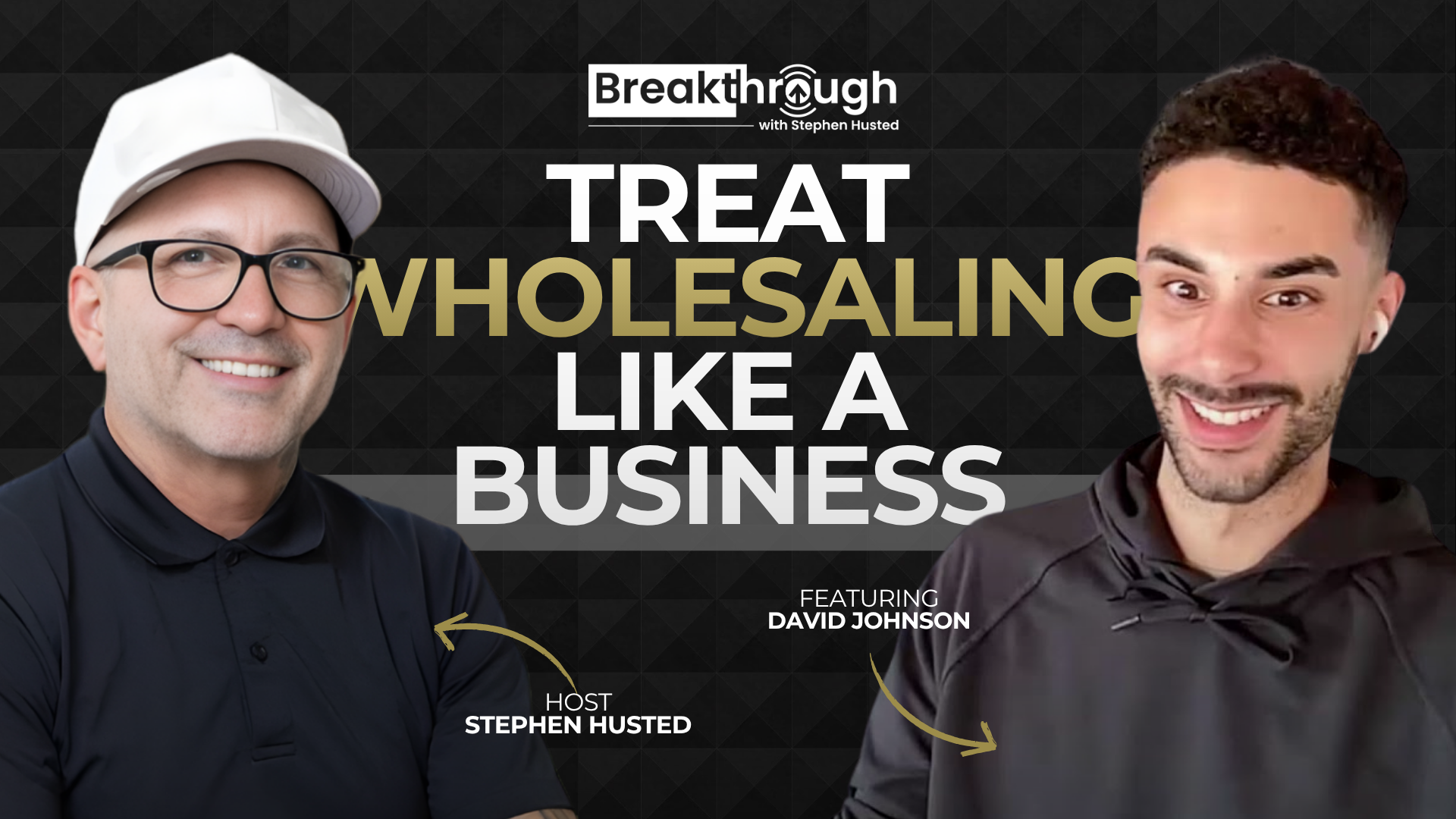
Welcome to another engaging episode of The BreakThrough Podcast! I'm your host, Stephen Husted, and today we have a special guest, David Johnson. David is a successful real estate wholesaler and entrepreneur who has mastered the art of sales and marketing in the real estate industry. In this episode, David shares his journey, insights on wholesaling, and his approach to personal growth and mental toughness.
Takeaway 1: The Power of Personal Growth and Consistency
David emphasizes the importance of daily routines and commitment to personal development.
He shares his experience with the 75 Hard program, which includes two daily workouts, drinking a gallon of water, reading 10 pages, following a diet, and more.
The program has helped David enhance his mental toughness and discipline, which translates into success in his business.
Takeaway 2: Effective Real Estate Wholesaling Strategies
David explains the fundamentals of real estate wholesaling, including building trust with sellers and providing accurate property information to buyers.
He highlights the importance of standing out as a reliable wholesaler by including detailed property inspections, accurate comps, and transparent communication.
David's approach focuses on solving problems for sellers and ensuring a win-win situation for all parties involved.
Takeaway 3: Mental Toughness and Overcoming Challenges
David discusses the significance of mental fortitude in achieving long-term success.
He shares how consistently pushing through challenges, both in fitness and business, builds resilience and confidence.
The importance of treating wholesaling as a business rather than a side hustle is emphasized, with a focus on providing excellent service and maintaining integrity.
TRANSCRIPT
∎ Teaser / Highlighted Clip
[David Johnson] (0:00 - 0:47)
What I've come up with was, I've always had something special in my heart. Like, I always had a seed, like I can do something big. I really can.
And I always believed that. And I thought it was a sport. Turned out it wasn't.
And, you know, I eventually got into real estate. And that's still to fill that void that I was having. Like, you need to do something big.
And where I really think it stemmed from was when I really hit that turning point. When I was at my lower, and I started working on self-development and self-improvement and trying to become the best version of myself. That's when I started to get gold because I was doing the things that I know I was supposed to do.
And I previously wasn't doing. And I'm like, well, now I feel great.
∎ Podcast Intro:
[Stephen Husted] (0:47 - 2:46)
Welcome to The Breakthrough with Stephen Husted, the show that takes you behind the scenes with successful entrepreneurs, real estate investors, and other movers and shakers in the business world. In each episode, we'll sit down with our guests to explore their personal and professional journeys, including the challenges they faced, the breakthrough moments that propelled them to success, and the strategies and the tactics they used to get there. Get inspired by new ideas and strategies and get to know our guests on a deeper level.
Join us for candid conversations, powerful insights, and plenty of breakthrough moments. Please help us grow by subscribing and sharing the podcast and welcome to the show.
∎ Guest Introduction:
Hey, it's Stephen. Welcome back to The Breakthrough. Today, I'm hanging out with David Johnson. You know, every once in a while you meet someone who really makes you think about the nuts and bolts of what we do in real estate.
And David is definitely one of those folks. David's been all over the real estate map, from flipping houses to navigating big investment deals. He's got a knack for making the complex seem simple.
We're going to unpack some of his biggest wins and the lessons learned from the hiccups along the way. He's also big on the personal side of the business, how to stay grounded when your career is anything but. We get into how real estate impacts personal life, and David shares some insights that are both inspiring and incredibly practical.
Whether you're deep into your real estate yourself or just fascinated by how people make it in this high stakes field, David's perspective is refreshing. He doesn't just talk the talk, he walks the walk, and he's here to share how he does it. So grab a coffee, settle in, and let's get into it with David Johnson.
∎ Podcast Proper:
Ready? Here we go. Thanks for having me.
[David Johnson] (2:46 - 2:47)
Let's do it.
[Stephen Husted] (2:50 - 3:03)
I think it's always funny when I get going on a podcast, we have those couple minutes to kind of talk to the guests beforehand. And sometimes they're like, either they're asking an email or it's beforehand. Like, what are the questions?
What are we thinking?
[David Johnson] (3:04 - 3:18)
Yeah. I told Lauren, I'm like, I don't care what it is. I just go.
I just go. I think it's better that way too, because you can get an organic answer from me rather than me looking at all the questions and then, okay, what do I want to say for this? What do I want to say for that?
[Stephen Husted] (3:18 - 3:18)
Yeah.
[David Johnson] (3:19 - 3:19)
I'm off the cuff.
[Stephen Husted] (3:20 - 3:41)
Yeah, absolutely. And I feel too lately, I've had some big guests on and I know they go on a lot of podcasts. And so I don't want them to talk about the same thing over and over and over.
That's pretty safe and easy, but sometimes it's really hard to get them to move in a different direction as well. I've noticed, even though I try to pivot them.
[David Johnson] (3:42 - 3:48)
Yeah. So, would you say you have a lot of real estate people on your podcast or just business people in general?
[Stephen Husted] (3:50 - 3:51)
Real estate focused.
[David Johnson] (3:51 - 3:52)
Real estate focused.
[Stephen Husted] (3:52 - 4:22)
Yeah, for the most part. And they could be doing short-term rentals, midterm rentals, building ADUs and DADUs, everything across the board. Contractors I've had a couple agents on that I've met through Instagram.
Yeah, just kind of across the... I don't know. And I'm getting to that point too, where I just want to interview all kinds of people.
[David Johnson] (4:23 - 4:41)
Do you know what I mean? And that's the cool thing too. When you interview a whole bunch of people, you're not dropped to one audience, right?
You can branch out and go so many different directions for it. I think that's cool too, because you can hear unique stories and maybe some other insights that you went to first outside of real estate.
[Stephen Husted] (4:42 - 5:41)
Yeah. But it's been very conflicting as well. It's almost the same as Instagram and TikTok and all these...
You want to make content and it's like, I don't want to sit around just talking about how to buy your first investment property. There's way too much. And there's all this conflicting content getting put out like, oh, you should talk about this.
But Instagram doesn't like that. They want you to stay in that pocket and do your thing. The minute you put something else out, they're like, nah, I'm not going to give you any views on that.
I don't know. It's kind of a strange thing. But I think one thing I've learned so far, and I'm relatively new to all this, is I'm just going to keep doing what I do.
I'm not going to sit here and have to make big adjustments because that's what the latest trend is for putting out content or what direction. I'm just going to kind of go and make mistakes, go on feel on it.
[David Johnson] (5:43 - 6:01)
You're also getting repped too at the same time. That's what I have to think of, is I know if I do 200 to 300 podcasts, eventually I'm going to get really good at it. I might not be good the first 50, but when I get to 200, 300, 400, it's going to start clicking.
It's a matter of time.
[Stephen Husted] (6:02 - 7:02)
Dude, you know what? It's so true. My first couple that I did, I would have another computer open with the intro of the guest, and they would write out something like a script or something, and I would just screw up big time, just right on the spot.
I'm just like, oh, I can't do it like this. We went to doing the intro on my own. Then we were using AI to kind of write the bios, and then the bios would have words that I would never really even say, and then I'd start to read it, and then I would screw up on the words.
It's just the phrasing of it just wasn't the way I would talk, and then that didn't feel right. It's just kind of this evolving scenario that's just kind of growing. I think at some point, I'm just going to get on and we're going to start just like this, and then I'm going to say, I know you do this.
That's going to be my intro. I'm going to kind of slowly get into a new vibe.
[David Johnson] (7:03 - 7:32)
If you look at some of the best podcasts out there, I'm going to use Rogen, for example, because he undeniably has the best podcast ever. What he does, he doesn't, all right, three, two, one, start. It's just, are we rolling?
That's what he asks because they're already having a conversation already. It's so raw and organic. He's so authentic, and that's why he has the best podcast in the world.
It's because he's him. It's himself. Literally, what we're doing right now, we're just rolling, having a conversation.
[Stephen Husted] (7:33 - 8:19)
Totally. I feel like it's the best approach. I don't know if you've started to do this, but yes, I watch Joe Rogan.
Rich Roll is another one who I listen to a lot. It's hard because Rich Roll, I'm like, I will never talk like this guy. His words and how he articulates things, and then I go back and I go, wait a minute, this guy has been doing a podcast forever.
He has put in the reps. There's a big learning curve. I almost wanted to get to a point of going back to his original ones and Joe's and just kind of seeing where it all started.
It's almost like looking at Gary V back in the days. You know what I mean?
[David Johnson] (8:20 - 8:22)
Those videos of him are crazy.
[Stephen Husted] (8:22 - 8:23)
They're crazy, right?
[David Johnson] (8:24 - 8:24)
Yeah.
[Stephen Husted] (8:25 - 8:56)
That's the way it should be. I think it should be when you look back, you go, oh God, that sucked. That was terrible.
But then that progression, and it's not just about the podcast. You know that we translate this into every other part of our lives, I think. Absolutely.
It's about that repetition and consistency on a lot of things. So, Anne basically recommended you to me. So, I didn't have any background on you.
So, how do you know Anne?
[David Johnson] (8:58 - 10:04)
I go to our church. I'm not sure how familiar you are with Anne and Dean and their family, but Dean owns the church here. So, I went to our church and basically I moved here.
And then through that process, I would kind of meet up with Dean every now and then, get lunch, go for a walk. And then Anne, I would just see her at church and we would talk back and forth because I'm in real estate. They're in real estate.
I'm right down the road from them in Ruston. And then eventually, it wasn't too long ago, we started doing some business together. So, I'm pushing her, all my leads that are retail, I'm pushing them to her, her team, because they're excellent.
They're great at what they do. And it's just kind of worked out perfectly for the stage that I'm in right now in business where I don't want any of our potential client to come out of our CRM if they want to sell their property. And I'm like, well, I need to find somebody.
And then ring, ring, ring, Anne Curry. So, very easy to join.
[Stephen Husted] (10:05 - 10:33)
Yeah. It was funny. I was out in Seattle in Tacoma about a couple of weeks ago, and we were cruising around the neighborhoods.
She's like showing me all her different projects and some of the flips. She's like, yeah, I bought that house. And then a wholesaler brought me the one next door.
So, I got that. And then we're driving through a neighborhood and I go, that house is cute. And she's like, oh, we flipped that house.
And it was just random. I just chose that one house.
[David Johnson] (10:34 - 10:40)
But yeah, she's super cool. She's the best. That whole family is amazing.
They're all rock stars.
[Stephen Husted] (10:40 - 11:27)
Yeah. It's cool. So, here's a crazy story.
I was listening to Furnished Finder's podcast, and I reached out to two of their guests just randomly. Listened to the podcast, went on Instagram, found them, DM them. And they both said yes.
And Anne was one of them. And yeah, that's how I got Anne. I just DM'd her and said, hey, I just got done listening to your podcast.
You're awesome. Can I get you on? And she said yes.
And I got done with that podcast. And I was like, why am I not looking in Tacoma and in Seattle's market to buy real estate and invest out there? And I got a team now, and team's half the battle.
So, jumped on a plane.
[David Johnson] (11:27 - 11:48)
It's the hardest part, building it. It is. I thought it was going to be easy.
When I got the office, I'm like, I'm going to hire so many people. No, it took me months to find the right... Because it's not just hiring anybody.
You have to find the right people, the right people that fit your culture, people that have a good attitude, people that want to work, that go above and beyond and go the extra mile. It's very hard to find people nowadays.
[Stephen Husted] (11:49 - 11:54)
It really is. And you're wholesaling, right? What else?
[David Johnson] (11:55 - 13:16)
Wholesaling completely? Wholesaling, yes. And I closed down a rental property a handful of weeks ago, and I'm just looking to buy more now.
It's not something I'm passionate about. When I look at myself, I don't want to be seen as a real... Because it's just what I do now, wholesaling, it's not absolutely real estate.
Sales and marketing, it's a back-end fulfillment. Yeah, that's true. That's what we're doing.
We're not buying a property. We're just selling a piece of paper. Right.
And I got really good at it, but I'm like, well, I'm sitting on this pile of cash and I need to put it somewhere. And I do want cash flow coming in every single month to pay for my expenses or whatever it may be. And I feel like it's a good thing to have.
So I'm slowly buying now. And I'm purchasing things. I'm not buying anything here.
But back to what I initially said, I don't want to be seen as a real estate guy. I truly don't. I'm an entrepreneur.
And the reason why I started the podcast was because I hold a very deep desire to help individuals my age and people older and younger become the best versions of themselves. That's I care about. It's not real.
[Stephen Husted] (13:18 - 13:30)
That's a good point. And how did you end up to that point to realize that growing up? I'm sure there was phases in your life, jobs and just different things.
How did you get to that point?
[David Johnson] (13:31 - 14:39)
Yeah, it's a good question. I have to reflect on this a lot too. Good.
Yeah. And what I've come up with was I've always had something special in my heart. I always had a seed, like I can do something big.
I really can. And I always believed that. And I thought it was a sport.
Turned out it wasn't. And I eventually got into real estate. And that's filled that void that I was having, like, you need to do something big.
And where I really think it stemmed from was when I really hit that turning point, when I was at my lower and I started working on self-development and self-improvement and trying to become the best version of myself, that's when I started to get fulfilled because I was doing the things that I know I was supposed to do and I previously wasn't doing. And I'm like, well, now I feel great. I feel great.
I'm fulfilled. But where the real fulfillment comes from for me is helping others do that same thing, become the best version of themselves. And that's the whole reason why we started to become the number one podcast, to become the best version of yourself.
[Stephen Husted] (14:40 - 16:45)
Yeah, that's cool. I think that it all, I think it does stem from kind of your own background, like where you came and at your darkest points and how you've come through it, you know, that you can kind of show the way and let other people know that, hey, you can make a lot of mistakes. You can come from being totally screwed up.
I don't want to go deep on my background, but I'll say that, you know, I definitely had a pretty checkered past growing up, you know, drug addiction. So, you know, I've kind of moved forward on that, you know, in my mid thirties. And that was a big battle to kind of claw back out, you know, with having people, you know, friends and family doubt me, you know, he's just a drug addict.
And I always knew that I was capable of big things, you know, I always knew that. I just needed to kind of get my bearings back and move forward. And it's taken a long time.
I'm 54. You know, this is a long game, man. You know, like I've been there through, been there, done that.
And, and it now came, it comes down to now with making content, being online, that I know that real estate is just one part of it. It's just more about how to help people. And you're totally right.
It is the most fulfilling part of the scenario, takes you out of the equation. And it's almost like you put that energy into them to give them belief so they can move forward. And that's like, you know, it's crazy.
It is so it's such a interesting feeling. And it came in the very beginning when I started making content with people like DM me and say, Oh dude, it was so great. You thank you.
You were kind of changing my life. I was like, Whoa, at first it took, took me by surprise a little bit. And then I had like the imposter syndrome kicked in.
Like, I'm not, I'm not worthy enough to do this. Who am I? You know what I mean?
I'm an ex-drug addict.
[David Johnson] (16:46 - 17:02)
Like, what do I know? And that's it. And that's exactly why you're worthy to speak on it.
It's because of your past, because of what you had to overcome, right? If you didn't overcome those things, then you wouldn't have a story worth telling, but now you have a story worth telling. And that's exactly why we're here today talking right now.
[Stephen Husted] (17:03 - 17:05)
Yeah. And it's interesting. So I didn't know a thing about you.
[David Johnson] (17:05 - 17:06)
Yeah.
[Stephen Husted] (17:06 - 17:25)
I left that out. You know, it was funny before we got on and I'm like, I don't know anything about my guest today. And I go, this is kind of cool.
And funny enough, I'll tell you, this is a, I was almost thinking about starting a podcast down the road. The fact that I'm thinking about another one is kind of wild where I don't know anything about the guest.
[David Johnson] (17:25 - 17:26)
Yeah.
[Stephen Husted] (17:26 - 17:38)
We just show up and it's like, Oh, who's today? And the conversation has to go where it goes. I thought it would be a kind of a cool idea because I think every podcast, you pretty much know who's in front of you.
[David Johnson] (17:39 - 17:53)
Especially if they're high caliber, right? If they're high caliber, then you obviously know about that person, but it's cool. I mean, and I can validate what you just said there.
We didn't know a damn thing about one another before that. We just hopped on and we started talking.
[Stephen Husted] (17:53 - 18:17)
Yeah. Yeah. And I left it that way.
I got a little bit of a summary from Ann's daughter. And I looked at it literally two minutes before we jumped on, but I did it on purpose. Like I'm like, I'm not gonna, today I just wanted to just jump on and go with the flow on our conversation and see where we end up.
So tell me a little bit about where you grew up.
[David Johnson] (18:18 - 19:04)
So I grew up in a small town in the middle of nowhere in Wisconsin, surrounded by cornfields. So 3,000 people, that was the population. It was a town called Baldwin, Wisconsin.
Nothing's going on there. The cool thing was I was only about 50 minutes from Minneapolis because it was on the border of Wisconsin and Minnesota. So when you grow up in a small town in Wisconsin, I was one of the only colored kids there.
Everybody knows everything about everyone. Everybody graduates, then they go to a school within a 50 mile radius, and then they come back and then they stay there for the rest of their life. And I always knew that I didn't want to stay there.
So as soon as I graduated, I moved to Scottsdale, Arizona. As soon as I graduated.
[Stephen Husted] (19:05 - 19:10)
What was your plan when you did that? Did you set a plan or just like, I'm out of here, I'm gonna figure it out?
[David Johnson] (19:10 - 20:15)
No. So I went there. Okay.
So I didn't move there the day after I graduated. I moved probably a month after. As soon as I graduated, I went and visited there.
So either I was going to move to Scottsdale or LA. And I went to Scottsdale, and I fell in love with it. I'm like, this place is awesome.
And I never did end up going to LA. But I was already going to do real estate. I was going to wholesale because I grew up with a couple of people that we were all going to move out there and do it together.
Unfortunately, that didn't work out after a while. But yeah, so I already had the plan of what I was going to do. But it was exciting.
It was a cool thing, right? I'm breaking the mold. I'm moving halfway across the country.
I'm doing something that no one's ever done before where I'm from. And it was a cool experience. It didn't go as planned necessarily.
I had a little too much fun at a young age. I mean, I was 18 living in one of the coolest places in the United States of America. And I learned a lot from you.
I learned a lot. And that had to happen to shape who I am today.
[Stephen Husted] (20:16 - 20:18)
That's good. How long did you stay there?
[David Johnson] (20:19 - 20:22)
I was there for two years. Two years.
[Stephen Husted] (20:23 - 20:29)
Two years. So then how did you end up moving to Washington?
[David Johnson] (20:30 - 20:30)
A female.
[Stephen Husted] (20:31 - 20:32)
Okay.
[David Johnson] (20:32 - 20:45)
Yeah. Yeah. A female.
It wasn't getting out of Wisconsin. It was the female. And I've been here for almost two years now.
It'll be two years from now.
[Stephen Husted] (20:46 - 20:49)
Wait. Completely different vibe.
[David Johnson] (20:49 - 21:23)
Oh yeah. Oh yeah. One-eighth.
One-eighth. It's good though because there's not a whole lot going on. I can just put my head down and I can work.
I can do what I need to do. But I will say I'm actually going to the stock sale tomorrow for a quick day. I have been able to build the discipline and the mental fortitude now where I can put myself in a situation and still do what I have to do.
Before when I was there, I couldn't do that because I wasn't able to develop that skill. Were you partying? Yeah.
Oh yeah. Yeah. A lot.
[Stephen Husted] (21:23 - 21:25)
How can you not? It's Scotchdale.
[David Johnson] (21:25 - 21:44)
It was fun. It was really fun. I don't regret it at all.
I do believe I needed that type of phase in my life to just get it out of my system. And now it's like, okay, I don't want to go back to that. I'm super into health, fitness, and I just, I don't want to put my body through that pain again.
[Stephen Husted] (21:45 - 22:22)
Yeah. And it's, it's good. You know, it's good to do it when you're younger.
Honestly. Yeah. I have a friend that her dad is old too.
And he's like starting to party like hard drugs in his sixties. It's like sixties going off the rails. And I'm like, that does not end well.
You're not, your body's just not ready or capable for it at that point. When you're younger, you know, you can bounce back from it and you can learn from it. And if you make any mistakes, you can, you know, you can move on.
You got plenty of time, but when you're older and you do it, it's just, it's never, never works out good. So yeah, it's good that you get it, get it out of your system now.
[David Johnson] (22:23 - 23:14)
Yeah, certainly. And then I guess to go back to a little bit about my upbringing, I was a, I was adopted by my grandparents when I was three weeks old. My real grandparents, those are mom and dad to me.
They raised me my whole life. And that was a unique situation for me. I always was.
I was always not insecure, but kind of jealous of other people that had a good family or like a typical family. And that was something that really bothered me. But when I moved to Arizona, I realized like those people did everything for me.
I could be on the street. I could be dead. I could be a drug addict.
I could be so many different things. But I had the right people in my life to provide me with a really good life. And I got really lucky.
[Stephen Husted] (23:15 - 23:17)
They set some foundations in there for you.
[David Johnson] (23:17 - 23:30)
Yeah. Yep. So my father was a truck driver, wasn't in real estate.
He was gone five days a week, Monday through Friday. I learned hard work from him. Never complained one time, always went to work, didn't matter how it felt.
[Stephen Husted] (23:31 - 23:31)
Yeah.
[David Johnson] (23:31 - 23:32)
I learned a lot from him.
[Stephen Husted] (23:33 - 23:53)
Yeah. That's really cool. What do you, so, you know, you just brought up about, you know, you're not really trying to be a real estate background scenario.
How did you end up with the whole sales and marketing aspect? Were you doing, what were you working on? So you got to Scottsdale, but you're wholesaling right off the bat there?
[David Johnson] (23:53 - 24:20)
Yeah. So I knew one of the people that I moved out there with, he was two years older than me, I want to say. And he moved to California.
Then he went back to Wisconsin and he learned wholesaling there. So we started doing it together. So that's where it all came to me, with him.
But like I said, eventually we kind of parted ways, did our own thing, but I didn't realize it was sales and marketing until about three years.
[Stephen Husted] (24:21 - 24:21)
Yeah.
[David Johnson] (24:22 - 25:01)
And once I had that perspective, everything changed. And how did it change? Well, I started treating it like it was sales and marketing.
And when I say sales, I have a different perspective on sales with a lot of people. And mine is providing a service to somebody. So what does that person need?
And then solving the problem. And that's what I train my team to do. That's what I do.
And that's what works, is you have to look at it from that perspective. So once I learned that, everything started to get more deals, started to bring in more revenue. And then the rest was kind of history after that.
And don't get me wrong, there's still a lot of work to do. Of course.
[Stephen Husted] (25:02 - 25:16)
Well, that's what's cool about being an entrepreneur. You're always behind the eight ball. Yeah, absolutely.
You've never solved the riddle. It's always like, okay. Always.
It's crazy, right? But that's a good thing because I think that if you solved it, you'd be bored.
[David Johnson] (25:17 - 25:18)
Absolutely.
[Stephen Husted] (25:18 - 25:18)
Yeah.
[David Johnson] (25:18 - 25:22)
Yeah. I can't go a day without doing something.
[Stephen Husted] (25:22 - 25:22)
Yeah.
[David Johnson] (25:23 - 25:23)
It's crazy.
[Stephen Husted] (25:23 - 25:36)
Yeah. I have to have a million things going on and there needs to be some chaos and some wins and losses and some self-doubt and all this. I need all those emotions in one day to make me feel whole.
[David Johnson] (25:38 - 25:43)
I feel you. And that's what high achievers need. They need to feel that.
[Stephen Husted] (25:43 - 25:46)
Yeah. How old are you?
[David Johnson] (25:48 - 25:48)
23.
[Stephen Husted] (25:49 - 25:55)
Okay. So you're 23. Yeah.
I was wild at that age.
[David Johnson] (25:55 - 26:01)
Yeah. Yeah. We all have a different path.
[Stephen Husted] (26:04 - 26:15)
And you know, it's funny. I think about back then, I had a career then too, but I was making good money. But yeah, partying was the thing to do then.
[David Johnson] (26:15 - 26:16)
Yeah. It was a priority.
[Stephen Husted] (26:16 - 26:19)
Where are you? You're in California. Yeah.
I'm in California.
[David Johnson] (26:20 - 26:25)
Have you always done that? Yes. Whole time.
Gotcha. Where at specifically?
[Stephen Husted] (26:26 - 27:00)
San Jose. So right by Los Gatos, you know, Mountain View, Santa Clara. You know, San Jose is a pretty big area.
I'm about 45 minutes to an hour away from San Francisco, 30 minutes away from Santa Cruz. So really cool spot. It's expensive, but you know, it's beautiful.
There's mounds. I ride mountain bikes and I run. So the outdoors, it's perfect, but you know, it's an expensive area to live.
[David Johnson] (27:01 - 27:08)
It's crazy. Well, you're paying for all the amenities in the area too, right? Yeah.
100%. Everything that you just mentioned.
[Stephen Husted] (27:09 - 27:33)
Yeah. Yeah. You pay for that and pay for all the things that, you know, people want to complain about, but you know, I've traveled a lot and I see how some people are living and you know, then I'm grateful, you know, even though I can slip at points and go, oh, we got this going on or this is going on.
It's like, you know, we live in the United States. We have it way better in some places. That's just the way it is.
[David Johnson] (27:33 - 27:56)
We have it better than any other place in the world. And we do not act like it. That is the issue.
We get to wake up every day. We get to choose the career we want. We get to speak freely.
We get to believe in anything that we want. We get to love anybody that we want. I mean, you can't do that in other places.
You can't.
[Stephen Husted] (27:57 - 28:10)
Yeah. It's very limited. You know, we get to have conversations and we can have our opinions and it's okay, which is sometimes a hard thing to do between people.
[David Johnson] (28:11 - 28:11)
Yeah.
[Stephen Husted] (28:11 - 28:17)
Especially social media. If you have an opinion, you could have the most lightest opinion, man, and get destroyed.
[David Johnson] (28:18 - 28:25)
Oh, absolutely. And it's kind of funny to see that sometimes, you know, if you agree with it, you just look at the conflict with guys getting toasted right now.
[Stephen Husted] (28:25 - 29:03)
Yeah. You know what I was thinking recently? You know, dude, it could be the most lighthearted.
It could be about a pet. It could be something so minor. And it's like the first comment is like the trigger comment, you know, that's like figuring out what's bad about that video.
And I come to, I started thinking, I'm like, is this Instagram? Is this Instagram's fake accounts that know that they're just going to throw this out here to get the ball rolling? You know what I mean?
Let's get the drama going. This is going to be too lighthearted. Like we got to show some bad sides to it.
[David Johnson] (29:03 - 29:09)
Yeah. Well, if you think about it, it's pretty strategic if you did that on your own video. Start some controversy.
Totally. Get the comment section.
[Stephen Husted] (29:10 - 29:40)
Yeah. I was just thinking about that. I'm driving over here.
I was thinking about a video idea and I was thinking of that, you know, trigger, you know, first, you know, lead into the video and how I would position it. And it's almost like you have to do something that has a hook that can get people's attention, good or bad to get them moving on it and to comment. And you could be thinking a completely opposite thing.
I still haven't gotten to that point.
[David Johnson] (29:41 - 29:43)
Do you know who amputated?
[Stephen Husted] (29:43 - 29:44)
Yeah.
[David Johnson] (29:44 - 30:01)
So love him or hate him. That guy was fast at doing it. Oh yeah.
And that's why he blew up crazy like we did, because you just trigger people. You just trigger people, but you would get all the engagement. Oh yeah.
[Stephen Husted] (30:01 - 30:03)
Oh yeah. He was crazy at it too.
[David Johnson] (30:04 - 30:06)
He was. He really was.
[Stephen Husted] (30:06 - 30:45)
There's this other guy that I follow on Instagram and I'm spacing his name and he's in real estate. He wholesales flips. He's done it all.
Now he does a lot of public speaking and he'll put out some random political ones or just some really random ones. And I know he does it on purpose. He gets a lot of engagement from it, but you just see the people jump, unfollow.
I like your real estate content. It's like, dude, it's a, it's a one minute video. Like step back.
Your day's going to go on. You're going to be okay. But it's always intriguing to see how it, how it goes.
Are you on Instagram?
[David Johnson] (30:46 - 30:58)
I am. Yeah. You can find me at I'm David Jay.
Okay. I am David Jay. I'll get you after.
Yeah. Yeah. We'll definitely have to connect to you when you come out here next.
We'll have to grab one.
[Stephen Husted] (30:58 - 31:12)
Yeah. Yeah. That'd be great.
Well, I'll be out there. I think I'm going to be coming out there a lot actually. So I'm currently really looking in Tacoma.
I'm actively looking at a couple deals right now in Seattle.
[David Johnson] (31:13 - 31:15)
So are you, are you buying and holding or are you flipping as well?
[Stephen Husted] (31:17 - 32:10)
I'm going to do the Dadu play and I'll flip them. Yeah. Yeah.
I don't know quite yet. I think with Tacoma from talking to Ann, you know, we're probably going to maybe buy a couple and just land bank them and hold them until all these laws pass that, you know, we can sell off the Dadus is kind of what we're thinking. I don't know quite yet how many I want to keep as rentals.
I don't know that whole play. I think what is going to happen if we go out there and, you know, we got three to four projects going and we're doing pretty good financially on them. We're going to get hit with a lot of taxes.
I'm in California. One of my partners is in them. It's just the reality of it.
So I'll probably end up just for a financial aspect, be holding some of them and doing some test strategies.
[David Johnson] (32:11 - 32:17)
I mean, would you, I mean, 1031 and something even bigger? Like a complex or anything like that?
[Stephen Husted] (32:17 - 33:06)
Yeah. Yeah. Yeah.
I had that conversation with Ann when we were speaking, you know, I told her, Hey, if you had a million dollars in cash, what would you do? And she was like, I'd buy an apartment complex. I don't think she'd say build one.
I think maybe buy one that she can, yeah, buy one and rehab it and, you know, force the appreciation and all that good stuff. But yeah, there's just so many different strategies. I think right now, I think the Dadu play seems very straightforward.
The numbers are easy to digest. I understand that if you buy the house, you might break even the front house if you sell it. And then the land in the back, it's essentially free.
And this is what it costs to build. This is the timeline. You know, the timeline is about a year and you can sell it for X.
Like I can get my brain around that.
[David Johnson] (33:06 - 33:19)
So what intrigued you about maybe this market and the Dadu play? Like was it, did you see a video? Did you already know Ann?
What kind of, what stuck that out to you?
[Stephen Husted] (33:19 - 35:01)
Yeah. So I think it was just a natural progression of where I'm at in my investing journey. We build ADUs out here in California and I know there's a need for them.
And I noticed out here, you know, we build affordable housing. Now we're, we need, we need housing. It needs to be solved.
And, you know, there's a lot of people that would say they don't like that direction of, you know, building a house in someone's backyard. And, you know, there's congestion with cars or whatever the case may be. But at the end of the day, not everyone's going to run out and do it.
So I think that it solves some affordability for, let's say a nurse that needs, you know, wants to buy a house and wants to live in a neighborhood that's close to someone where they work or two school teachers or something like that. So my brother used to build ADUs as well. So I've always liked them.
And I think what gravitated was I started meeting people on BiggerPockets and my podcast and started to see what they were doing out in Seattle. And it just kind of clicked, you know, and I was like, wait, well, I got to, I can build a team out in Seattle and Tacoma. I have, I got to have a good feeling with the people I have around me.
And then California passed AB 1033 to now allow you to sell the ADUs off just like Seattle. So that just passed in January. So I figured why don't start out there, learn the systems, do some deals, you know, go from point A to B and then bring all that knowledge back to California and help people do it.
Yeah.
[David Johnson] (35:02 - 35:02)
Yeah.
[Stephen Husted] (35:03 - 35:06)
Yeah. So it's been cool.
[David Johnson] (35:06 - 35:25)
One thing too, we can talk after this, but I have a, I just got into the Tacoma market probably about three weeks ago. So I'm newer to it. I did everything virtually.
So I'm in, like I told you earlier, south basically in Florida. But I have a couple of people here that I could hook you up with for market deal. Cool.
[Stephen Husted] (35:26 - 35:30)
Yeah, that's great, man. So you've been in, tell me the markets you've been working on.
[David Johnson] (35:31 - 35:57)
Yeah. So Florida, Tampa, Jacksonville, and a little bit of Orlando, Memphis, Tennessee, that's my main market. I've been in that market for about three years now.
South Haven, Mississippi, Olive Branch, Mississippi, Horn Lake, Mississippi, Tacoma now, Indianapolis, that's one, North Carolina, so Fayetteville, Raleigh, Greensboro.
[Stephen Husted] (35:58 - 36:08)
Cool. What have you, what has been the pros and cons in some of those markets for you? Like what's been your favorite market to work in?
Memphis. Memphis?
[David Johnson] (36:09 - 36:10)
Yeah.
[Stephen Husted] (36:10 - 36:11)
Why? So much distressed?
[David Johnson] (36:12 - 37:17)
Yeah, but I just, it's hard to give you an exact reason. I'm just so damn good at it. I built, in Memphis alone, I built all the relationships that I need to do.
If I did a deal, I could make one phone call and have it sold. Now we're kind of taking a little bit of a different approach and trying to squeeze more out of our deal. And that's where I bought my first investment property, just because I've established all those relationships.
And I had boots on the ground there, kind of like you in Tacoma, you have a team there that can handle just about anything that you need. And the price points can go from, like right now we have a 35 grand deal that we're selling for like 50. So you have price points like that.
You'll have some price points at like 15,000 and then you'll have it at like 400,000. Right. So it's kind of all over, but you know, when you just know the market so well and you just hear a zip code or a street and you just know what price to get it at.
When you had that much knowledge about it, I think it was kind of rinse and repeat for what you're doing.
[Stephen Husted] (37:19 - 37:33)
Why don't we tell the audience what wholesaling is? So for the people that are following that maybe don't know what wholesaling is when it comes to real estate, let's give them a very basic version of what you do.
[David Johnson] (37:34 - 38:38)
So we'll say Stephen is an investor. Right. He is what he is now.
He's buying property for to either fix the flip, buy and hold the rental, maybe do a short-term rental, whatever, maybe he's an investor. And I call, which owns a home on 123 Main Street. I call Susie and I say, Hey Susie, would you sell your property?
Are you open to selling your property? She says, yes, I consider it. So what I do to Susie is I give her an offer for, let's just say a hundred thousand dollars on her home cash as is no closing costs, no commission that she has to pay, but she's walking away with that a hundred thousand.
She doesn't have a mortgage. And what I'm doing is I'm sending over an agreement to Susie to purchase her property with rights to be able to sign that contract with somebody else. In this case, it would be Stephen.
So we get it with the seller for a hundred thousand. I am selling it to Stephen for 110, 120, 130. And then we just make the difference.
We're really a middleman. And that's why I said earlier, I sell paper.
[Stephen Husted] (38:38 - 39:04)
I sell paper. That was a good one. Yeah.
And it's, you know, I didn't know much about wholesaling until I started investing out of state, out of California. Then I learned the whole scenario and was like, Oh, okay. I can buy properties off market.
I just have to know the ARV and what I'm going to put into it and what I can get it out. And it doesn't really matter to me what the wholesaler is making. I don't even care.
[David Johnson] (39:05 - 39:12)
As long as it's a deal for you. And that's what we tell everybody to do. If the numbers work for you and the numbers work for us, it's a win-win.
[Stephen Husted] (39:13 - 39:23)
Yeah. And that goes with everybody. I think the seller, the wholesaler, the investor, if it all makes sense, then it makes sense.
[David Johnson] (39:24 - 39:39)
And that's when you get in trouble too, is when a buyer starts counting how much money you're making. The deal just never usually worked out because they'll try to come back and negotiate with you just solely off of, you know, your assignment fee.
[Stephen Husted] (39:41 - 39:42)
Yeah. Yeah.
[David Johnson] (39:42 - 39:44)
It's not a fun thing to deal with.
[Stephen Husted] (39:44 - 39:49)
Well, let's face it. There's a lot of bad wholesalers out there.
[David Johnson] (39:49 - 39:50)
There's so many.
[Stephen Husted] (39:50 - 39:53)
A lot. A lot. So many.
[David Johnson] (39:53 - 40:55)
That is the hardest part about my guy's jobs is all of the other people- Screwed up. That called that homeowner and left them in bad shape. So the biggest thing on day one of training, what I tell everybody, they have to like you, trust you, and want to do business with you.
If you can do those three things, you'll get everything that you want. But with that comes you having to give them a great experience because you have to remember all these other people that are calling them, they don't know what they're doing. They're just giving them calls to, hey, what's the age of the roof?
What's the age of the HVAC? So on and so forth. All right, I'll call you back and give you an offer.
Right. And there's no, it's so repetitive for them at one time because that's what everyone's doing. So we come in and we do patterning around.
So we don't say the same thing everyone else does. We say something completely different. We don't even know we can purchase their property.
So we say that now because everyone else is calling them saying that, hey, we want to buy your property. Do you want to sell it? So we're throwing them off.
But giving them a great experience, if we can do that, we'll have everything that we want.
[Stephen Husted] (40:56 - 44:32)
Yeah. And I think that if people would start treating it more like a business and a business, how they approach investors as well, they would go a long way. I'll give you a couple of examples.
So we are buying most of our, we're in Michigan, Kansas City. We have a cabin out in the Smoky Mounds. So kind of spread out everywhere.
But in Kansas City, you know, we buy from the wholesalers and some were good, some were bad. You know, some don't even know how to, you know, run a transaction, you know, and you don't even have to deal with a clean title. There's all kinds of issues.
And then at some point, I decided to talk to one of my partners. I'm like, why don't we just start wholesaling ourselves? We can cherry pick some of these deals.
Keep them. We can assign some out. You know, I think I have a good understanding how to do this.
And I did. But it went back to what you were saying about your team is everything. The team wasn't on the same page.
And it's like it kind of fell apart. But we had this, they would run, we had two callers and they're both in the United States. And one lived in Oklahoma.
And he called and he called me, say, hey, I got this, I got this lady that wants to sell and this what's going on. Can you have a conversation with her? I'm like, how old is she?
She's like, she's 88. I'm like, okay, she wants to be by a club. Okay, well, we need to help her solve how she's going to move.
What does she need help with? Does she need to, do we need to help her find another place to live? We got to solve all her problems.
This is not about what can we get the property for? What can we assign it? How much are we going to make?
How much are we going to make? Start with just helping. And they really didn't understand that until I started really focusing on that part of it.
I even made some calls and my calls were definitely not, hey, you want to sell your house? Like, look, we're looking to buy in there. If you have any interest in selling, I'd get a dialogue going and I'd just talk to them.
Like, hey, if you're not, it's fine. Let them go. At the end, it's the interest.
And like, hey, do you have anything on your mind that you would, any hesitation? Is there anything that we should know? What can I do to help you go from point A to B?
And that would solve so much. Then the pricing would happen. And if it made sense with everybody, we'd move forward.
But it fell apart because I was doing too much work and I was like, eh, this is not where I want to put my time. So walked away from that. But I'll tell you something.
Last September, a lady in my office had a property that she's putting on the market. It was a fixer upper in Hayward. And I put it out to the, I was getting text messages like, hey, I'm looking for my next fix and flip.
Brought it to this investor. We got a contract on it. I was out in Kansas City doing a bunch of stuff.
And I was like, look, this guy's an investor. He knows what he's doing. I don't need to hold his hand on this.
But basically what he was, is a wholesaler. So he took it and assigned that contract over, was trying to assign it to somebody else. And he was making all these appointments saying, hey, I need to bring my contractor.
I need to bring my handyman. But he was just bringing other investors in. And he overpaid and the deal fell apart.
And it was just like this non-transparent bullshit that this dude did. And the way it ended, I was just like, this is why it should be illegal. Because you can't even be honest with your agent on what you're doing on this thing.
Not to mention the house was on the market. It wasn't even an off-market deal. It went to the MLS.
And he was trying to assign it to other people. It was so stupid.
[David Johnson] (44:32 - 45:40)
That's a pet peeve of mine. I hate when people do that. And it does give a terrible rep.
Oh, it was bad. People try to wholesale homes off the MLS. I'll have a wholesaler send me deals.
And I go and I Google it, because that's the first thing that you're going to do when you get an adverse, right? What do you know? It's on the MLS.
For, if not the same price, for like 10 grand underneath it. I'm like, God, you're not going to win this way. And to go back to what you said earlier, I've been thinking a lot about this recently.
If you treat it like a side hustle, you're going to get side hustle results. If you treat it like a business, you're going to get business results. And that's where a lot of people go wrong.
They're thinking more so in the hustler mindset, not much as the boss mindset. And when you think like the boss, your mind starts to make decisions like that person you would. Not the person that's just going to make all these phone calls and do this and that.
Because when you do that, you only have so much room to grow. When you're a boss, you're directing. Like, you're painting the vision, right?
And that's really, I worked really hard to put myself in that because I knew it was supposed to happen.
[Stephen Husted] (45:41 - 47:35)
Yeah. And I think part of it is there, I think some of these wholesalers that are in these markets, I don't think they have any mentors or any kind of, there's nobody holding their hand and kind of helping them do it the correct way. Um, I'll tell you this.
I just closed on, well, I helped facilitate closing on two properties in St. Louis for St. Louis. Yeah. For a new investor who I helped her sell her house here in San Jose and she wanted to become an investor.
She made a big chunk of money. So she got these two properties, but let me tell you how I got them. So that same Facebook group that I, that crazy wholesaler dude was on.
Um, I was just on there and I'm always on there here and there just looking at it. And 99% of everything on there is just crap. It's just, none of it is deals.
And this guy put one up and it was St. Louis, two properties, 115. He had the appraisal reports on both properties. He had the property inspections on both properties.
He had the, the PM reports. He had the T12s. He had everything lined out.
I looked at the thing. I'm like, Oh, these are, this is a good deal. These are good deal.
Googled it, looked at them, totally clean properties, looked at their appraisals. They praised higher, you know, like everything was clean. She bought them, but that guy ran that, that scenario so clean.
And now I talked to that guy, he lives in Atlanta and he's been doing it for a long time. He stays in one little pocket and he knows St. Louis. He buys there himself.
Uh, and you know, now we talk periodically. He's like, you know, I'm on his list. And I told him, Hey, if you have this, I'm looking for this.
Now, if you move into Kansas city, send me those deals too. But nobody talks about it.
[David Johnson] (47:35 - 48:36)
Yeah. You gotta, you gotta find a way, you know, as I'll speak more so for the new wholesalers, but also the ones that have been in the game for a long time, they still don't know what they're doing. You have to find a way to stand out, not only in your marketing, but how you deliberate.
So one thing that we started to do recently was pay a contractor to go out to each property and give an actual request because my sole sellers would just say, well, the property is 25 grand to work when it actually needs 50. Right. We, we have now a re-out quote that tells you exactly what needs to be done.
And if you you, you could use that contractor and that's helped us a lot as well. And also obviously including comps in that accurate comps, not one that sold a year ago, not one that are a mile away that are right next to the property. Yeah.
And then, yeah. So, and then we also have, we start a little bit lower on our price when we market in and we label that starting or start price, not asking price, but start price that usually drives the price.
[Stephen Husted] (48:37 - 48:44)
That's good. Yeah. And that, and that took time for you to get it to that point, right?
You made your mistakes and then learn from them. Yeah, absolutely.
[David Johnson] (48:45 - 48:52)
Like I said, the rehab quote was something I just started doing. I just started doing it. And that just comes with time and experience.
[Stephen Husted] (48:53 - 49:01)
Yeah. And some people don't put that type of work in, you know, they just want the quick buck and they don't want to really want to treat it like a business, as I said, and they typically will burn out.
[David Johnson] (49:02 - 49:21)
You know, most people don't have the money to pay for every, you know, if you're doing property, a lot of people can't pay $300 for a contract to go out there and look at it too. So it's, you know, it can be hard. And I understand that, but we all have Google.
We all have all of these tools and resources at the tip of our fingers. We just have to use them.
[Stephen Husted] (49:22 - 49:31)
True. Yeah. So I want to pivot a little bit here.
Give me a little background on what your day looks like. What do you do?
[David Johnson] (49:31 - 49:32)
Yes.
[Stephen Husted] (49:32 - 49:36)
How's your day start? You know, what do you, what do you do to keep your mind clean?
[David Johnson] (49:37 - 50:47)
Wake up about 4.30, go to the gym. That's usually about the hour, hour-ish. And therefore, then I come to the office right after.
I'm usually at the office at like 6.30 in the morning. My day-to-day is different just about every day because I'm either putting this fire out or I'm putting this fire out. Or, you know, I have a meeting in the morning, I do training, and I'm always just trying to do something that is going to generate revenue or push the needle forward.
And, you know, a lot of that recently has been recruiting, trying to find people that are a good fit for our company. And, you know, we hired a few more people two weeks ago that kind of been off my plate for a while. You know, just being there, a big part of my job is being a cheerleader as well for my guys, making sure that they're in the right mindset and that they're properly prepared for, you know, what they're about to go into.
And then, you know, I kind of wrap the day up around six o'clock, leave the office, usually go home, read, go for a walk, eat, and then do it over again.
[Stephen Husted] (50:48 - 50:56)
There you go. That's a good balance. You're on the right path, buddy.
Seriously.
[vid Johnson] (50:57 - 51:03)
Yeah. There's a lot of work that needs to be done, a lot, especially for what I'm trying to do.
[Stephen Husted] (51:04 - 51:36)
That's great. And hopefully that stays like that in your fifties like me, because I don't know, I get very antsy when things are slowing down for whatever reason, like, oh, take some time. I like taking time off, like, don't get me wrong.
But I also like to be energized and excited about doing things, you know, that I'm passionate about. Like I just, it makes you feel alive. I don't know how else to put it.
You know, how long, when you go to the gym, when did you start going to the gym? Is it recent or you've been going since you were young?
[David Johnson] (51:37 - 51:56)
Yeah. Since I was young. So I was heavily involved in sports growing up.
So I've always kind of been working out, doing this before it was my main sport in high school was like, cool. Don't always do like basketball workouts, but after that slowly was coming to an end, like, you know, got into wiki weight. I'd be doing that for, I can tell you how long.
[Stephen Husted] (51:58 - 51:58)
Yeah.
[David Johnson] (51:58 - 52:02)
It's never been a thing in my life where like I doing it.
[Stephen Husted] (52:03 - 52:11)
Yeah. Funny enough, even when I was at my worst, when I was partying like crazy, I still would go to the gym. You know what I mean?
[David Johnson] (52:11 - 52:17)
Makes you feel good though. When you're, when you're partying and you're going out and you're doing all these things, like you feel good about at least going to the gym.
[Stephen Husted] (52:18 - 52:31)
And I wasn't alone. I look back now when I just said that to you, I remember all the party guys that were, you know, we were going to the gym. We still wanted to look good.
Even though we were trashing our bodies at that point, but yeah.
[David Johnson] (52:32 - 52:35)
You know, have you, have you heard of 75 hard?
[Stephen Husted] (52:35 - 52:36)
No.
[David Johnson] (52:37 - 53:32)
So it's, it's a mental, it's a mental toughness program, but it's two workouts a day. Um, one indoors, one has to be outdoors. Uh, they just have to be a minimum of 45 minutes.
You have to drink a gallon of water. You have to read at least 10 pages. You have to follow a diet.
Um, and you have to take a progress picture and there's no cheat meals, no alcohol, no nothing. And started that January 1st. And then there's like phase after that too, like a 30 day phase where all of those things I just said, but yeah, like five minute cold shower.
You have to meditate for, for at least 10 minutes. There's one more too. How's it been going?
It's been good. Um, I did it last year. It really keeps me sharp, really keeps me sharp and focused in what I'm doing.
I'm not going out. I'm not eating bad foods. That's, you know, causing me to be a little foggy and it's still good.
It's still good. And I'm ready to, I'm ready to go.
[Stephen Husted] (53:32 - 55:40)
Yeah, that's good. And you know, I think now, I mean, I think about it growing up, it's just a different time period now. Like you got so much content and information at your fingertips now that you can really, it's a blessing and a curse to be, to be honest.
Um, I got into, uh, racing mountain bikes in 2014 and kind of let going to the gym, you know, just, just stop going like one. Okay. I don't want to be, I don't want to be big anymore.
I need to be lean. So I just, you know, raced mountain bikes and that was it. And then I started getting older and I'm like, okay, now I really do need to start working out because I'm getting older.
I need to keep strength in there. And I just kept going, having these, like, I'd go to the gym and I'd stop and I'd go to the, you know, I'd still be riding. I, you know, I just, it was kind of a knee jerk reaction and it wasn't, I wasn't dedicated.
And then last November I ran randomly started running. And the only reason I started running was I wanted something to do that I could do really quick, you know, under an hour and get some exercise in. And I did a 30 minute run and it got done and I had that runner's high and I was like, oh shit, this is amazing.
And, um, then I was hooked. Um, but then I tied it into the gym and now I'm going to the gym four to five days a week because what I'll do is I'll do, I'll do core, I'll do pull-ups and pushups. But I was getting stuck in this moment of watching people on YouTube or Instagram or TikTok, whatever, you know, oh, this is the next workout.
You got to do these that are like, and I was, and I was getting paralyzed from it. And I've been working out since, since I was a sophomore in high school, you know? And I was like, and then, then I watched this, this ex Navy SEAL, who's an, uh, endurance runner.
And he's like David Goggin. I do Chad, Chad, right? Oh yeah.
[David Johnson] (55:40 - 55:42)
Yeah. Oh, he's dude.
[Stephen Husted] (55:42 - 56:31)
He is right. Dude. He's such a cool guy.
And I just, I love this con I let's like how he taught, you know, just everything. So he's like, Hey, here you go. You want to keep strong.
Here's some basic exercises. Do pull-ups, do pushups, do squats. He had another one in there, you know?
And I was like, all right, I'm gonna start doing that. And he's like, do 30 pull-ups. So I go to the gym and I jump up to do a pull-up.
I haven't done a pull-up. I could even tell you how, how long dude, I, two of them barely could do it. I was like, Oh my gosh, this is tough.
And I'm like, screw it. You know what? This is tough.
And I'm going to keep doing it. And I just been so obsessed that I've been posting stories, you know, Hey, I did 10 in a row.
[David Johnson] (56:32 - 56:33)
Now I'm at 20.
[Stephen Husted] (56:33 - 56:44)
Not yet. Now, I don't, I don't want to put myself like, I'm not trying to have limiting beliefs. I'm not trying to say that, but 30 in a row is pretty tough.
I don't know.
[David Johnson] (56:44 - 56:46)
You can do it. You got the 20, you can do 30.
[Stephen Husted] (56:47 - 57:41)
I got you dude. But I think you're, I think you're totally right. I think I got to stop that, that attitude.
It's too new. If I'm already at 20, it's too new. You know what I mean?
But, but then what happened was now I'm at the gym more, right? And then I'm running for 30 minutes at the gym too, sometimes. And that consistency made me go, okay, now I feel really good about myself.
And that little point that it took all that friction in years of up and down, you know, to get to that point. Do you know what I'm saying? But, but that's not really what it's all about.
It's not just about that little part in my fitness part that translates to pretty much my whole life and how I've gone through things. You know, nothing is easy. I've never been a natural, never felt like I was good enough.
[David Johnson] (57:42 - 58:27)
You know what I mean? Well, also too, because everything that you've done was significant, right? It wasn't something easy.
It was something worth adding and something worth having. It comes with a lot of pain and frustration. It takes a lot of mental fortitude and grit, all these different things.
And now that you've got to that point, you can look back and you can think, dang, that was hard. Of course it was hard. It's supposed to be hard.
It's not supposed to be easy. It was easy. Everybody went out.
And that's such a common thing, but it's so true in the older that I get. I'm like, that is right. If it was easy, everybody would do it.
And that's what I have to remind myself when I don't want to come to the office in the morning or I don't want to wake up or I don't want to stay here. Like I have to think about, well, your competition's not, they're going home.
[Stephen Husted] (58:28 - 58:28)
Yeah.
[David Johnson] (58:29 - 58:35)
Eventually over time, compounded in your interest, you're going to have what they want. Yeah.
[Stephen Husted] (58:36 - 58:42)
And you're always going to be, you know, your biggest battle is going to be with your brain.
[David Johnson] (58:42 - 58:44)
Yeah. Yeah.
[Stephen Husted] (58:45 - 58:46)
That's your biggest battle.
[David Johnson] (58:46 - 59:22)
100%. It's funny that, you know, you're telling me you're into running because I'm doing a marathon and about a month from now, I actually hate running. I hate running more than anything in the world.
I didn't even want to do it. It just kind of fell on my lap. My team, me and my whole team were running one.
And for me, it's constant, constant pursuit to shut that voice from my head. That voice that just wants, that wants to walk, that wants to give up, that doesn't even think I need to be here. I'm always going to battle with that voice and that tranquility from many other areas of my life.
[Stephen Husted] (59:22 - 1:00:03)
Yeah. 100%. Just from running.
Just from running. Just from running. You know, I try not to get too crazy sometimes on stories, you know, on Instagram, but I put a lot of things out there about, I try to keep it not so...
I put a lot of stuff about real estate, of course, you know, and things I'm going through in my day to day. I really try to tell that thing, but the fitness part is a really big part. I try to drive that home to people that, yeah, running does suck.
It hurts. That first mile I just was going through this morning, I was going to post about it. That first mile, I'm like, why am I doing this?
I'm 54. I'm slow.
[David Johnson] (1:00:03 - 1:00:04)
Why am I here?
[Stephen Husted] (1:00:05 - 1:00:20)
It's cold. It's cold. I suck.
Like, what am I trying? And then, you know, I, then I run a 5k and I'm like, yeah, cool. That feels good.
And I like to have, I love that battle in my brain.
[David Johnson] (1:00:20 - 1:00:31)
Do you think that you get more joy or fulfillment out of, you know, just completing the run or being victorious over that voice in your head? Both.
[Stephen Husted] (1:00:33 - 1:02:41)
I think both. Yeah. I think both.
I like to, because my brain wins sometimes, gets the best of me, you know, wants me to, wants to baby me, wants to keep me safe. You know, like I understand that. I understand it more now from getting clean.
I know more now from being an endurance athlete. Like I've, I've been in that pocket, you know, on a long, you know, a hundred mile race when I'm saying to myself, you know, you can quit, you can give up, you know, and it's, oh, it's a constant proving it. But then I flip on all this and go, why am I doing this?
Am I trying to make up for something in my childhood? Am I proving something to myself or somebody else? Or what does it all really mean?
I can say with running, running just makes me feel good. Like it just makes me feel good. Like I get a, you know, I went this morning, just did a 5k.
I knew I was going to get on with you. And I knew that if I got that run in, I just got diagnosed with anxiety, severe anxiety, like end of last year. And I'm thinking from my whole life, I thought I had ADHD, like this whole time, you know, like people are like, oh, you have ADHD.
You can take medicine for that. And that shit never worked. So I finally get diagnosed and the guy's like, yeah, you have anxiety.
And it's very similar to ADHD. It's something that, you know, you got triggered maybe as a kid that you went through a traumatic scenario and your brain locked into fight or flight. And then that is you.
That has been my brain. So running calms that down. Like I can sit and, you know, have a conversation with you and really be present on what you say instead of being so wound up that I get done with a podcast and I don't even know what the hell you said.
And that's a pretty wild statement to say when I'm running a podcast and I'm telling you something about like I might not even remember anything you said.
[David Johnson] (1:02:41 - 1:03:14)
Yeah, you can zone out. I mean, that happens, too. It's interesting that you started out, because I used to have I think we all have anxiety in our own way, in some way, shape or form.
For some people, it might not be as severe as other people. But when I really had it, it came back to me realizing that I wasn't doing anything I was supposed to be doing. So I always like I always get triggered in my heart and mind would start racing that, oh, I should have done this, but I didn't do it.
So now I'm starting to get worried and anxious about it.
[Stephen Husted] (1:03:14 - 1:03:16)
Yes, I go through that once.
[David Johnson] (1:03:16 - 1:04:03)
And once I figured that out, I'm like, well, just do the damn thing. Do this. Do the stuff that you're supposed to do.
Yes. And that's why I'm so focused on on what I'm supposed to do every day. One thing that I use called called the powerless.
So every single day when you have all the power. Yeah. OK, what it is, it's I'm soaking it up.
I don't know if you could do this, but so what you do, you write like five critical tasks in there each day, something that you can do that's going to push the needle for the intention here. And that's funny that you have that. But this really helped it out.
Yeah. Yeah. Soundtrack.
[Stephen Husted] (1:04:03 - 1:04:12)
Well, because what it does is it. If you're not accomplished and then you get kind of pissed off at yourself and you start.
[David Johnson] (1:04:12 - 1:04:50)
Exactly. Yeah. And then if I'm having a bad day to like in this thing, it has like when or a lot you complete all five things, you win the day.
Yeah. And I can go back if I'm like, oh, man, I'm not feeling it. I can go back and I can look over the last 365 days.
I'm stacking with everything. But and there's some days I'm going to lose where I'm not going to do, you know, a couple of things. But majority of it, I'm winning the days and I can look at that and I can feel good about myself.
OK, you're doing where you're supposed to be. And that's really out there a lot with, you know, anxiety, with dress, with, you know, and also just kind of progressing in life.
[Stephen Husted] (1:04:52 - 1:05:07)
It's amazing that you're. You you have this head on your shoulders that is pretty wise and ahead of your time, honestly, at 23, not saying that there's 23 year olds that are, you know, not thinking the same way as you, but.
[David Johnson] (1:05:08 - 1:05:16)
You're on a good path, seriously, I appreciate it, man, I believe that I'm here to to do something big and great and help a lot of people.
[Stephen Husted] (1:05:16 - 1:05:29)
I think that I now, you know, that's funny you bring that up. I think you're right in that pocket to do that, honestly. Like I, I think that's cool.
And I'm really glad that Ann hooked us up.
[David Johnson] (1:05:30 - 1:05:32)
Yeah, me too. Cool. I really enjoyed it.
[Stephen Husted] (1:05:34 - 1:05:38)
So crazy. Yeah, we didn't know anything about each other about an hour ago.
[David Johnson] (1:05:38 - 1:05:40)
Isn't that wild? I know.
[Stephen Husted] (1:05:41 - 1:05:42)
It's crazy.
[David Johnson] (1:05:43 - 1:05:57)
But we're also in the business of talking to people, too. Right. That's what we do.
We're we have conversations. We can build rapport. And I believe that this conversation came very, very naturally.
And it was nice. I enjoyed it.
[Stephen Husted] (1:05:57 - 1:06:02)
Yeah, it was good. So well, let's leave it at that. Where can people find you?
[David Johnson] (1:06:03 - 1:06:28)
Yeah, so you can find me on Instagram. I am the letter I letter M David J. Just drop the podcast called Becoming Number One Podcast, where our goal and mission is to help you become the best versions of yourself.
You can find that on Spotify, Becoming Number One Podcast. And then we'll have YouTube up shortly and Apple podcasts, as well, that are giving us trouble right now.
[Stephen Husted] (1:06:29 - 1:07:35)
It's got to have those troubles to get going on those things, right? It's crazy. We'll put your links in here in the show notes, too.
I really appreciate you jumping on. And it's kind of crazy because we're gonna get done with this podcast, but but now I my head going, well, he's in the market that I'm going to be investing in. So it's just going to be a friend and a connection.
And, you know, and I have and it's it's pretty cool. That's what's pretty wild. I get people asking me, like, do you make money from your podcast?
You know, what do you what is it all from? I'm like, I laugh. It's the funniest thing when I hear people say this crap to me.
You know, I'm just like, you guys don't even know what you're talking about. Like those Debbie Downers that want to, you know, try to bring you down on what you're trying to do. But at the end of the day, brings you end up having solid relationships with people, you know, like Anne was, you know, when I got done with Anne, I called her right after it.
I'm like, that was great. And I think I want to invest out to come.
[David Johnson] (1:07:35 - 1:07:41)
It's just like, OK, you can't put a price on the inquiry out there. You know, a price to it.
[Stephen Husted] (1:07:41 - 1:07:47)
Yeah. Yeah. So, yeah, this has been great, man.
I appreciate you jumping on.
[David Johnson] (1:07:48 - 1:07:50)
Well, I appreciate you having me.
[Stephen Husted] (1:07:50 - 1:07:53)
We'll we'll be in touch for sure.
[David Johnson] (1:07:53 - 1:07:54)
Absolutely.
[Stephen Husted] (1:07:54 - 1:07:57)
And yeah, I'll get you on again.
[David Johnson] (1:07:57 - 1:08:02)
Yeah, myself, I would love to do it again because I really enjoyed this and I hope we can do the same thing. Yeah.
[Stephen Husted] (1:08:03 - 1:08:05)
How many podcasts have you been on, by the way?
[David Johnson] (1:08:06 - 1:08:13)
This is not including mine, my third podcast. Third one.
[Stephen Husted] (1:08:14 - 1:08:44)
Good. Right on, man. Well, that's great.
Well, hey, go get to work. Appreciate everything for today. Appreciate everything you said and all the knowledge that you brought in.
You've definitely made my day. And I mean that a lot. I get off some of these podcasts and I'm really fired up.
It's a weird thing. I don't know what what it does, but it just gets me even more excited to continue down my path, you know? Yeah.
So I'll leave it at that. Thanks a lot, buddy. I'll talk to you soon, OK?
[David Johnson] (1:08:44 - 1:08:46)
Yeah, most definitely. Appreciate you, man. Thanks.
∎ Podcast Outro:
[Stephen Husted] (1:08:46 - 1:09:15)
Thank you for tuning into our show, where we hope you found inspiration and gain valuable insights. If you enjoyed this conversation and want to stay updated on our latest episodes, be sure to subscribe to our podcast and share it with others who might benefit from it. We appreciate your support and look forward to bringing you more candid conversations and breakthrough moments in the future.
Until next time, take care and keep exploring new ideas and strategies.