Episode 27 - Why This Firefighter Quit His Job to Build ADUs Full-Time!
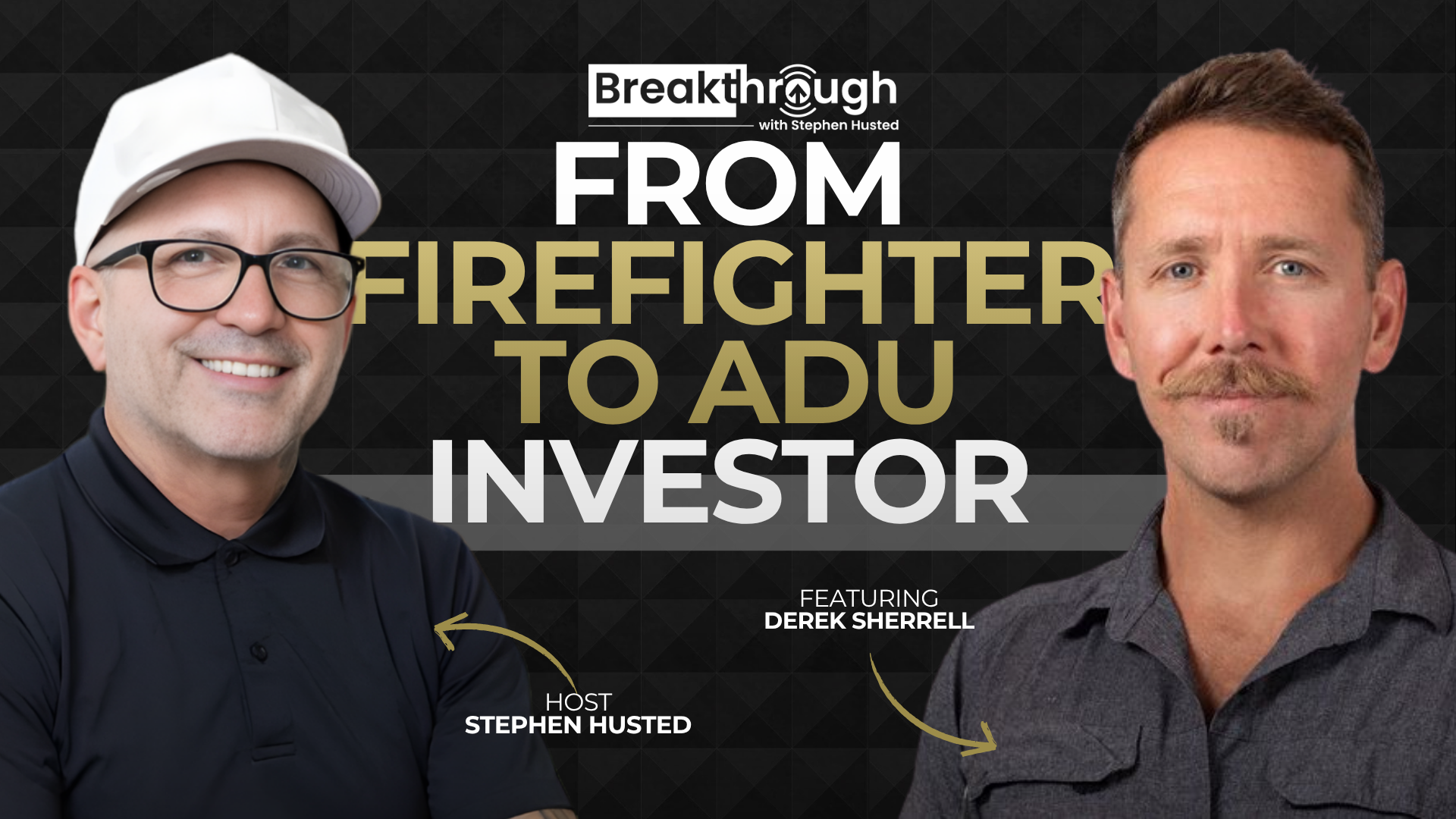
Today we are joined by a special guest, Derek Sherrell, also known as That ADU Guy. With over 30 years of experience in construction and real estate, Derek is an expert in Accessory Dwelling Units (ADUs). In this episode, we dive into the world of ADUs, exploring the potential for housing development, innovative strategies for infill, and the importance of community in real estate growth.
TAKEAWAY 1: The Power of Infill Housing Infill housing provides a unique opportunity to maximize property value and create needed housing in urban areas. By understanding local planning and zoning codes, investors can unlock hidden value and transform underutilized properties into thriving communities.
TAKEAWAY 2: Building Success with a Community Focus Real estate success is not just about profits; it's about creating homes and communities where people want to live. By focusing on long-term tenant satisfaction and community impact, investors can create lasting value and positive change.
TAKEAWAY 3: Embracing the Journey and Learning from Mistakes Derek shares his personal journey from a young carpenter to a successful real estate investor and mentor. Derek encourages aspiring investors to find mentors, develop skills, and add value to others as a path to growth and achievement.
Thank you for joining us on this insightful journey into the world of ADUs and real estate development. We hope you found inspiration in Derek's story and practical strategies for your real estate endeavors. If you enjoyed today's episode and want to stay updated on our latest insights, subscribe to The BreakThrough Podcast and share it with others who might benefit.
TRANSCRIPT
∎ Teaser / Highlighted Clip
[Derek Sherrell] (0:00 - 0:44)
Becoming an expert in your local planning and zoning code is where the money is made, and nobody does the work. I'm the only person that I've ever seen post a video about reading planning and zoning code, ever, because nobody talks about it. It's not sexy, it's not fun.
If I were to flip my computer around and show you my desk, it's like it's literally, I mean, literally just covered right now with files, with, I mean, with, I mean, plans, like all these different hoops we have to jump through. All the boring administrative work that no real estate investors talk about is where we make money. It's the rule book to how we make money in real estate, and nobody talks about it.
∎ Podcast Intro:
[Stephen Husted] (0:45 - 3:24)
Welcome to The Breakthrough with Stephen Huston, the show that takes you behind the scenes with successful entrepreneurs, real estate investors, and other movers and shakers in the business world. In each episode, we'll sit down with our guests to explore their personal and professional journeys, including the challenges they faced, the breakthrough moments that propelled them to success, and the strategies and the tactics they used to get there. Get inspired by new ideas and strategies, and get to know our guests on a deeper level.
Join us for candid conversations, powerful insights, and plenty of breakthrough moments. Please help us grow by subscribing and sharing the podcast, and welcome to the show.
∎ Guest Introduction:
All right, listeners, buckler for another incredible episode of The Breakthrough with Stephen Huston.
Today, we've got Derek Sherrill, also known as ThatADUGuy, who's here to share his amazing journey from starting in construction at just 14 to becoming a master of infill housing and ADU development. Derek's got some fascinating stories, like how he started by building an ADU without permits in high school, and eventually transitioned from being a firefighter to a full-time real estate expert. In this episode, we dive deep into the realities of the market, the importance of pivoting your strategy, and how to avoid common pitfalls in real estate.
Derek also opens up about the biggest challenges he faces, like dealing with neighborhood pushback when developing a new housing. Plus, he'll give you the lowdown of how to identify the best properties for ADU development and the critical role of understanding local zoning laws. This isn't just for the seasoned investors.
If you're new to real estate or just curious about the magic behind ADUs, Derek's insights are gold. His journey is a testament to resilience, adaptability, and the power of staying true to your values while navigating the ever-changing real estate landscape. So if you want to learn how to transform a simple property into a gold mine, or just need some real talk on how to build a sustainable real estate portfolio, this episode is for you.
Stay tuned and get ready to be inspired by Derek Sherrill, that ADU guy, right here on The Breakthrough.
∎ Podcast Proper:
We got past the technical difficulties.
[Derek Sherrell] (3:24 - 3:26)
Yeah, if this was easy, anybody would do it, right?
[Stephen Husted] (3:27 - 3:50)
Yeah, I was shooting, like once we jumped off and I just gave you some time to see what was going on, I got on and shot a video and said, yeah, yeah, I remember in the very beginning when I would start my podcast and there'd be one issue and I would freak out, like everybody would be, oh my God, and now it's like, yeah, whatever. He'll come back on, we'll figure it out.
[Derek Sherrell] (3:51 - 4:08)
Yeah, for sure. Yeah, quick reboot, you know, where it's like flashbacks to the early days of Zoom when everybody would jump on their, you know, first couple meetings and be talking for a minute before they realized they were on mute. Oh yeah.
Flashbacks of like early pandemic video conferencing, huh? Oh goodness.
[Stephen Husted] (4:10 - 4:28)
That Zoom's done, I don't know, recently, I try to use Riverside for all my meetings and podcasts, but I've been on a couple of Zoom meetings recently and I'm like, wow, their technology is getting better. Like the clarity is way more improved than it used to be.
[Derek Sherrell] (4:28 - 4:36)
So kind of interesting. Yeah, I've noticed that too. Yeah, they've got to up their game if they want to.
Yeah, they were losing market share, so they had to reboot, I think.
[Stephen Husted] (4:37 - 4:44)
Yeah, that makes sense. It's funny that you thought too, I just kept looking at the screen, my head, it's really nice now. So that's good, good for them.
[Derek Sherrell] (4:45 - 5:02)
So- Just a good reminder to our entrepreneur friends out there that if you don't pivot and you don't adjust, like you're going to get mowed over. I mean, a hundred years ago, everybody bought their stuff from Sears. Now Sears, you know, is maybe a thing of the past.
So just a good reminder there, huh?
[Stephen Husted] (5:05 - 5:12)
Yeah, when you think about that, what comes to mind right now for you in pivoting?
[Derek Sherrell] (5:14 - 5:48)
Just for me personally, I'm just changing how I'm structuring my deals with the cost of money. That's what's coming to mind for me. It's just changing a strategy that I've always had, that's always worked, that doesn't work as well anymore.
So, you know, being able to change with the times really, but whatever that pivot means in your business. For us as build to rent, as a build to rent business, we're looking at potentially for the first time ever selling some of our new builds to keep funding the machine. So that's personally what the pivot is looking like for us in our business right now.
[Stephen Husted] (5:49 - 6:37)
Yeah, I think if you don't look at the big picture, you kind of start going down fast in a lot of ways because what you were doing before is just not working. It's almost the same thing as we were buying single family homes out in Kansas City, you know, during like 2019, during COVID, and you could do no wrong. You know, interest rates were super low.
You find a property, you rehab it. You could even have to fire two contractors and still go and you would have appreciation. You would still burr out of it.
Everything was fine. It's like, no, now you have to readjust your expectations and your strategy of what you're trying to do. And that's a big part of investing.
And I think that's something that you learn, I think, over time. Would you agree?
[Derek Sherrell] (6:38 - 7:00)
Yeah, oh, for sure. You have to learn that. You have to be able to roll with the punches.
You know, it's common sense. Like if what you're doing isn't working anymore, don't hold on to the comfortable thing that you've always done. You're gonna have to change and adapt with the market, with the times, with the technology.
I mean, nobody likes change unless it's our own idea, but it's just a part of the business that we have to be open to.
[Stephen Husted] (7:01 - 7:26)
Yeah, absolutely. So let's kind of get the audience up to speed in what you really do. I know where I found you was on Instagram and you were building ADUs and giving out a ton of information there and just really informative.
When did you first start building? Because I know you have a pretty, you got a pretty cool story. Used to be a school teacher and worked in, were you a school teacher in woodshop?
[Derek Sherrell] (7:27 - 9:16)
No, no, but that's part of my story. So I started in construction, I would say semi-professionally when I was 14. I had a woodshop teacher in high school who handpicked a bunch of kids.
We thought we were special, but really we were just like a bunch of delinquents that he knew probably weren't gonna go to college and he wanted to teach a skill. So he created this construction technology class and we built an illegal ADU for another one of our teachers in 1995. And I was always good with my hands.
I really loved being on the job site and having that creative like artist spirit was really coming out of me and I knew that's what I wanted to do. So I started an apprenticeship, I worked for a master carpenter starting at 15 years old and ended up having my contractor's license at 19 and went right into the building industry as the muscle and the hammer for the investor and was building a lot of property and equity for other people. I mean, it never even crossed my mind for the first few years as a professional in the industry that I could actually own property and do that too.
So that's kind of my story. I got started in construction, I've never looked back. I mean, I'm going on my 30th year in some form of building.
I sidetracked in 06, 07, the wheels started to fall off the industry here. I went back to school, became a full-time professional fireman and I did those simultaneously for about 15 years until I retired from my real job a few years ago and now we just do real estate, new build to hold rental real estate full-time and then I teach other people how to do the same thing and I try to give away everything we do. There's no email list here, there's no course here, I don't have a mastermind, not that there's anything wrong with that stuff but we try to open source everything we're doing so we can reach more people.
[Stephen Husted] (9:18 - 9:49)
Yeah, it's really cool and your content's just insanely good. I mean, you just, I think we live in a day and age that if you really want to get in to learn how to build an ADU and you can gravitate to the right people, you're gonna have a leg up. Like you're gonna be 80% there and then you got to put in that effort, build that team.
How much are you shooting as far as like content on your properties and what you're doing? Are you shooting weekly or how does that work? And how many projects do you have going at a time?
[Derek Sherrell] (9:49 - 13:35)
That's a great, those are all great questions, man. I don't want to talk too much, I want to be as helpful as I can and get through as much information but starting right now, I usually do three projects at a time. We have one that we're building, usually two or three units at a time.
We have one in planning so we're waiting for plan review or lot division, stuff like that and then we have a project or two in the pipeline that we've been marketing to people that we know are going direct to seller. Right now, we have a little bit more. We have three projects really on the table but each of them are anywhere from two to four units.
So I mean, it would sound better if I said I had 12 projects going right now but really, we try to break it down into one active, one on deck and then kind of one in the whole and that's where we're comfortable. We've scaled up right now. I mean, these 10 or 12 units that we have to build this year is a lot and there's a diminishing return when we start to scale up and everybody talks about going to the moon and getting a Lambo and I want 1,000 units and how do we scale?
And that's not like, that's not reality, guys. There's very, very select few people that can pull that off but the more people you bring into the fold, the more problems you're gonna have. So I just encourage all of our listeners out here, if you can just do, I mean, for 15 years, I did one at a time.
I paid cash for them, slowly but surely and we did really, really well with that strategy. So you don't have to go to the moon. You can go slow and steady with, you know, high LTV or low LTV and high equity in your properties and you get good cashflow and you have all these little piggy banks everywhere.
So that's kind of how many projects we do at once and now for content, you know, honestly, I'm shooting something every day and I have no, I wanna preface this, what I'm about to say with I have no production experience, I have no camera experience, I don't like really like the way I look on camera, I don't like the way I sound, you know, I saw a piece of content you made a couple weeks ago and you were talking about how on some angles of how you're holding your phone, it shows that your bottom teeth are crooked. I've got crooked teeth, I've got wrinkles on my face, I think I sound like a goofball and you know what, why I'm successful on content is because I don't give a shit. It's not about me.
It's not about me. As soon as people out there can understand that it's just about adding value to others and it doesn't matter and nobody cares how you look and sound, they want you to solve their problem in like one minute and so with all that being said, I just started doing content December 19th, two and a half years ago. I woke up on my birthday at four in the morning and decided I'm going to do this, I'm gonna put my best foot forward, I took the Gary V approach where the first 400 videos don't matter, I'm just gonna do it.
If you're afraid to do it, do it. If you don't think you should post, post and I started doing that and what I found out is it took a lot of reps to get better at it and I look at some of my earlier stuff and I'm like oh my gosh, I like can't even watch it but the point is I took action and anybody else can. Like no experience, I definitely don't have a face for TV, I'm not good with sound or video, all of my content is shot with just a phone and it still helps people so the point I'm trying to make here folks is take action, add value to others and help people and it will change your life.
I mean the fact that I put out some content now and the opportunities I get and the rooms I get to go into and the people that call me, example perfect right here, you sign me on Instagram, now we're gonna be friends, we're helping each other out, it's so powerful and I spent, I mean I was 15 years late to this party, I spent the first 15 years thinking nobody cares, why would I ever make a video, like that's stupid and it was the biggest mistake I've ever made in my career was getting on social media late.
[Stephen Husted] (13:39 - 16:58)
That was a good one. I really appreciate you brought up all of that and it's because I think that sometimes people follow and they see you doing something they really wanna do and they start to like pick themselves apart in so many different avenues. I can't build an ADU, I'm not a contractor, I don't shoot content, all these, like there's all these steps and things that you gotta do and at the end of the day, what you just said is very similar to me.
When I first started shooting content, I sat in front of the camera during like COVID and I was like, what the hell am I gonna say? Like I just didn't know, and I kept trying and I kept screwing up and didn't know what to do and until I figured out, what I did know is all I wanted to do is create value, talk about my experiences in real estate, what I'm working on and just kind of just put it out there and once I kind of got my head around a few videos of just bringing value and I got a couple responses, it kind of got me to lean in more but yeah, my voice, didn't like my voice, I was like, holy shit, I'm 50, I'm not 30 anymore and the weird thing is when you start to do it later and you've been pretty, for me, antisocial for a long period of time and all of a sudden, I just jump out and start making content, put it on Instagram and Facebook, all these people are like, wait, what's going on?
And it's kind of a weird dynamic, however, when I was getting messages of thank you, help me out and it was sometimes and I had nothing to do with real estate, it could be anything, like they would catch on to something else and that's when I knew, it's really not about me, I know this now, it's just providing value, try and be myself, just be myself on here and I'm not gonna be the best expert or the best on camera, it's just not gonna happen, I'm just being me and this is where it's at so I really appreciate you bringing that up right now because when I started following you, I couldn't think of anything, all I just know is that you provide a ton of value. I picked up on one thing recently and one of the reasons why I reached out to you is, I'm an investor here in California but we invest out in the Midwest but we are starting to go into building ADUs and we never were able to sell them here in California, now that changed, I'm moving into the Seattle and surrounding areas market to build DADUs and so somehow I found you that way, tied to all the people that follow you and within four videos, you taught me so much, it's incredible what you can get out of a one minute video from somebody and it's just been very powerful so I like to know, how do you plan out when you're doing your builds, are you trying to get everybody from the, I noticed that you do it from the very beginning, you're bringing them through the journey of start to finish for the most part, correct?
[Derek Sherrell] (16:59 - 19:54)
Yeah, yeah, what we do, the point is here is to teach people how to A, understand finance and get lendable and control their DTI so they can actually get on the property ladder and then after that it would be, how do we identify properties because ADU play does not work everywhere, not even on the same street, there's a lot of things that are very, very important when it comes to driving high yields with this product and so we teach people how to identify those properties and that's, I'll give you my top three right now, like we want a flat lot, we want good access and we want newer infrastructure. So if I buy one house that's on a flat lot with good access and the sewer line has already been replaced because it's a 1940s house and there's a transformer right in the front yard and there's a storm drain right on the curb, that's gonna be, I mean that could save us 30, 40, $50,000 compared to the house next door that has a little bit of grade, that doesn't have good access or good parking, that needs a new sewer line and needs a panel upgrade.
So I teach people how to identify properties where this is gonna be way more affordable and then we give away our simple design, we build a couple of the same units over and over, we just change the colors and we built a YouTube channel where we can share that. So we have a playlist at that ADU guy on YouTube that says how to build an ADU with cost breakdown and there's 17 videos of exactly what we do from how we pull permits at the city with the planning and zoning department to how we cut the excavation pad to how I put in the sewer line, the water line, to how we build it, we raise the walls, I mean all the way down to like how we put in the tile, how I install the toilet. I give you all 200 steps of our build and then we also give away those plans.
So you can go to the website and download the plans for free. You might need to touch them up. If you're in California in a seismic area, you might need to get them engineered on the footings or whatnot and put in some hold downs.
But the bulk of it is there for free. So the goal is to teach people how to become eligible to buy a house, to teach them how to find properties to build ADUs and then how to build an ADU from the ground up and oh, by the way, here's the plans for free and we just share that openly as opposed to how do we get to 1,000 units? My goal and my values have always been like how do we get 1,000 people to one unit?
And that's kind of the process of what we're doing. And that's in long form video and then every day on the job site, I just pull out my camera and I take some goofy video of something that I think took me a long time to learn or I did it wrong for 15 years and now we know the best trim package to put in a house is pre-primed pine. Don't use MDF because over time, people mop the floor and it swells up.
So all these little things that took us a long time to learn, like I'm not an expert, I'm just really good at failing and I haven't given up. So that's kind of what we're trying to teach people.
[Stephen Husted] (19:55 - 20:52)
Yeah, I think there was one video you did and you were showing that where you spray paint the markings and you cover up like where your sewer line's gonna go and just little things like that. I was like, okay, this is clever. Like I'm catching onto this but you bring up a good point.
I've mentored a few people last year but I have a lady now that I'm mentoring and I was taking her through some steps. She bought two properties out in St. Louis and it dawned on me as she was buying these properties off market through a wholesaler, I was taking her through these steps and a lot of these steps were steps that I made mistakes on. And now she's getting my refined version of like, hey, I'm getting you away from the mistakes I had in a lot of different ways.
And I think that's the part that's really cool because you're kind of springboarding them a little bit more further. They can do their learning process and the issues they make and they can pass it forward too, hopefully.
[Derek Sherrell] (20:53 - 22:50)
Yeah, no, for sure. Like let's learn from each other's mistakes and get better. And it's really a team sport.
Something I wanna mention is our business is very unique where we give away our trade secrets. You could never like stroll into Amazon and be like, hey, show me how to write code or go to Apple and be like, help me design some cool new electronics, like you would be arrested. And in our business, we really want to see other people win.
And I've just never been around an industry where people are more willing to help one another, whether that's paid or free. Most people wanna give away their information. Even people that I know and that I follow that I'm friends with that have big followings and have big coursework and big high dollar masterminds, you pay to get into those rooms and they're just saying a longer version of what they share for free every day online anyways.
Like when people are really good and powerful at something, like they want to share it. You may have to pay for the relationship with them, but the information they're giving away. So you started the show talking about how much good information is out there.
Like there's amazing content, just be very picky of who you follow. Don't judge your insides based on other people's outsides. And everybody has a different style.
Some people like shiny houses and Lamborghinis, like follow people like that, if that's in line with your goals. But just don't compare your insides to other people's outsides and be careful who you follow because there's a lot of people out there that are trying to sell you a get rich quick plan. And that's not how real estate works.
It's a get rich slow play and it's hard and it's grinding and it will kick you in the shins every day. But if you don't give up and you don't die, I promise you will be successful. I just, I promise.
I don't know anybody that hasn't given up that hasn't won. I see a lot of people give up too soon because they're not getting rich and those are the people that fail. So if you can have a long term set of goggles and not give up and die, you'll do good.
[Stephen Husted] (22:50 - 23:28)
Well, also too, there's a lot of comparison going on where people are in their journey on social media. You're like, wait a minute, you're following this person. I know you think they had it figured out, but they've been in real estate 20 years.
If you were in some markets and you're investing for the last 20 years, you've done really well. The mark, the appreciation, you name it. So, and then you come in as somebody who's new, you really don't know where to start and you see them, you just kind of elevate towards that.
You gotta take steps and it takes a long time, but the get rich slow in real estate, do you know Ann Curry?
[Derek Sherrell] (23:29 - 23:30)
Yeah.
[Stephen Husted] (23:30 - 24:01)
Yeah, she says that a lot too and it's so true. This is a long, it's a long play. You gotta be in it for the right reasons too.
I don't know what, well, let's back this up. Building for you, what is it besides helping people, what is that satisfaction you get out of it? Is it from the finding the land and building and just the whole build out part of it?
What gets you really excited throughout the whole process of all these different scenarios?
[Derek Sherrell] (24:02 - 25:40)
I'm a deal junkie, I just really am. I love this, I'm a builder, I'm an artist, but the deep down superpower I think I have is, and I share this openly, folks, is I grew up poor. I grew up poor, we lived in apartments.
The kind of housing insecurity that we know as today was something that I experienced and I can make a difference. And when I say I can make a difference, it's not like we're just gonna buy old houses and make them nicer and gentrify the neighborhood. There's nothing wrong with that either, but we're actually wanting to create new, more affordable housing units by building new.
And so my deep-rooted fuel is I care about tenants because I was a tenant. I'm a developer that comes into the space with the mindset and the eyes and the heart of a tenant. So by building more needed infill housing and giving our tenants more choices and better units and giving them real hardwood floors and granite countertops and stainless steel appliances and yards and letting them have a dog, and yes, you can put holes in the wall and hang your pictures like that.
We want you to have a home here that you're gonna stay in forever. That's really my driver is let's create more housing and put downward pressure on rent so more people can have an affordable, nice place to live. And as long as my mind is there, I can work 16 hours a day, seven days a week.
It's a grind, but that's kind of my power and that's what keeps me going. And then I see the deals and I love analyzing deals. I love building.
I like solving complex problems of how do we get water and sewer and power to this build site across this road or canal or whatever it is. It's kind of that creative artist in me.
[Stephen Husted] (25:40 - 25:44)
The creative part is big. What did you do growing up creatively?
[Derek Sherrell] (25:45 - 25:56)
I've been a builder since I can remember taking my first steps. I mean, honestly, I would ride around town with no shirt on on my BMX bike. This is the 80s, guys.
[Stephen Husted] (25:56 - 25:56)
Yes.
[Derek Sherrell] (25:57 - 26:08)
We were building forts. I was always building some kind of fort. And the reason I'm drawn to these accessory dwelling units, I think, and I put lofts in all of my units with ladders up to the loft space.
[Stephen Husted] (26:08 - 26:09)
Cool.
[Derek Sherrell] (26:09 - 26:48)
You slide out, pull down ladders, which we teach people how to build as well for free. I could never afford to build a tree house. It was always just like scrap together what you could to build a fort in the Blackberries.
And so now I have all these loft designs that we do. And I think it's because I'm still just building forts. I mean, in my mind, what wealth and joy is to me is like riding around town with no shirt on building forts.
And that's still to this day, that's my happy place. I try to run, when the sun's out, I run 10 to 12 miles every day. And hopefully I don't have my shirt on and I'm just running by my forts or running between building forts.
It's still that spot in my heart where I'm happiest.
[Stephen Husted] (26:49 - 27:30)
Yeah, that's so cool. That's the greatest story of that. You kind of tapped into my childhood too because yes, I was a teenager in the 80s.
It was all about heavy metal and BMXing and freedom, forts, just being alone with friends in places. And all you had to do is get home by dark. Those lights go on on that street.
You just got to be home by then. But there was a lot of freedom back then in those days. And it's funny, a lot of those habits and traits that I learned as a kid, they kind of continued through to now.
It's kind of funny. You brought up, are you a trail runner? Or do you?
[Derek Sherrell] (27:31 - 27:36)
Yeah, I am. Yeah, I'm an ultra runner. That's kind of like one of my passions still.
[Stephen Husted] (27:39 - 28:17)
So I've been racing mountain bikes since 2014. And big endurance races like Leadville and Cape Epic and things like that, stage racing. But last year, end of last year, I really wanted to get, do an exercise that I could just go out my front door, go 20, 30 minutes, not have to get my kit on and go on a hour, two hour ride.
And I started taking it, I got onto running. And man, I wish I sort of started running earlier. It is like completely changed my life.
[Derek Sherrell] (28:17 - 28:33)
Yeah, yeah, running is an amazing, amazing thing to do. And I like it because it's free, it's easy. Like you said, you can just step out your front door and do it, pretty low barrier of entry if you have the body that allows it.
Some people can't, but yeah.
[Stephen Husted] (28:33 - 28:45)
True. Well, and I've seen a lot of people get into running that are kind of bigger and heavier and they all of a sudden transform. You never know, where do you live exactly?
I live in Ashland, Oregon.
[Derek Sherrell] (28:46 - 28:57)
I'm in Southern Oregon, Ashland, yeah, Ashland, Talent. I live in Talent right now. But yeah, we're just a few miles from Ashland.
That's a little more recognizable. Right on the California, Oregon border on I-5.
[Stephen Husted] (28:58 - 29:00)
Okay, cool, so you've got all kinds of trails.
[Derek Sherrell] (29:01 - 29:15)
Oh yeah, we have an amazing watershed here. We can run 5,000 feet from town to the top of the mountain and back. So we have amazing mountain biking.
I mean, if you ever come up to Southern Oregon, we'll get you a place to stay and we'll go ride bikes or something.
[Stephen Husted] (29:16 - 29:19)
Yeah, do you ride mountain bikes too? Yeah, I do. Okay.
[Derek Sherrell] (29:19 - 29:24)
Yeah, I'm not like an endurance racer, but I can hold my own.
[Stephen Husted] (29:24 - 29:38)
Yeah, definitely if you got the trail running behind you, you got the cardio there for sure. So what is the difference when people reach out to you and wanna get coached? You do coaching, correct?
[Derek Sherrell] (29:39 - 30:23)
Yeah, kind of. I have a consultation business where I work with people by the hour directly one-on-one. But most of those folks, when they reach out to me initially, I say, hey, go watch this playlist or go watch this on the YouTube channel.
Don't pay me unless you absolutely need one-on-one time with me. Go do all this stuff first. And if you still need direct one-on-one time with me, then you can book a call.
So I do consultations, but that's not my favorite thing to do. It's a high price and it's still trading time for money. So if I can help people for free, I always advise that first.
And some people just wanna pay for the relationship and I have folks that I do consultation with. But most people hire me for no more than an hour and we have a great game plan for them.
[Stephen Husted] (30:24 - 30:48)
And when they reach out to you, are you first trying to find out what their pain points are at the moment or do you guys just free-flowing it for an hour? Where are they coming and what are the, are they, they have pretty broad questions or are they all pretty certain? Are they same thing over and over that you're hearing, just they need to get some good advice on how to start or what are they saying?
[Derek Sherrell] (30:49 - 32:13)
No, no, most of it is more technical. So people call me and book time with me when they have an idea of where they wanna deploy the strategy or they already have a property and they already have conceptual drawings and they want me to look at them to make their plan more effective and more efficient in how to save money. So here's a good example.
I get somebody that books an hour with me and they say, hey, I just spent $10,000 for these plans and I want you to review my plans and see if we're doing anything wrong. And I'll look through a plan set and say they have an ADU that's 600 square feet, one bedroom, one bath and little things like the mini split may be on the wrong wall or when I see often is somebody will put a range, a stove on an interior wall and they can easily put that stove on an exterior wall and that would save them the chase work and the duct work to go up, over and out when they can just go straight out with their hood. So something like that might save them a couple thousand dollars and they just don't know because they've never had to pay the mechanical bill to run a free floating hood over two walls as opposed to just going straight out.
So little things like that, people call me with technical questions most of the time. The people that get down in the bottom of my funnel, if you will, they're already pretty well versed. Maybe they've built a few ADUs and they're just like, hey, how do I identify a property where I don't have to spend so much money on site work?
And we go into those details.
[Stephen Husted] (32:14 - 32:16)
And are they all over the United States?
[Derek Sherrell] (32:16 - 32:47)
Yep, yep, right now the hot spots are California, Oregon, Washington, Montana just passed amazing statewide code. So the four states with overarching statewide code that are California, Oregon, Washington, and Montana. And then there's, I get a lot of calls from Florida and Austin, Texas as well.
But California is probably the hotbed right now. We do a lot of work in California. And then I have people in my local market that see what I do and wanna do the same thing.
So I do some work here. But I'd say 75% is in California.
[Stephen Husted] (32:49 - 32:57)
Okay, yeah, California is, it's gonna be really big now coming up. I could, you know, with the AB 1033 passing.
[Derek Sherrell] (32:57 - 35:15)
Yeah, you know, there's some pros and cons to condoization of ADUs. I still like SB9 if I'm in California. I'm looking to split lots into legal lots of record.
We have a very similar law here with middle housing land division rules. But that's a whole different class. But I'll tell you this right now, folks, is it's not just about how do I build an ADU.
It's do not buy property that doesn't have room to infill. What we're doing is infill housing. We're buying places that have room to add more units, whether we're gonna keep them on the same tax lot, whether we're gonna condo them, whether we're gonna chop them up and sell them as tenants in common, whether we're going to do fee simple lot partitions.
That's where the money is made in real estate. I didn't get to talk about this yet, but becoming an expert. Yeah, let's go for this.
Becoming an expert in your local planning and zoning code is where the money is made. And nobody does the work. I'm the only person that I've ever seen post a video about reading planning and zoning code ever because nobody talks about it.
It's not sexy, it's not fun. If I were to flip my computer around and show you my desk, it's literally just covered right now with files, with plans, all these different hoops we have to go through. All the boring administrative work that no real estate investors talk about is where we make money.
It's the rule book to how we make money in real estate and nobody talks about it. So planning and zoning is super big. If you're not into planning and zoning and reading codes, just hire somebody on your team that is.
Just hire a professional land use planner. Or sometimes you can hire an architect to do a lot of that work. But if you hire a land use planner for hundreds of dollars an hour and you hire an architect for hundreds of dollars an hour, and then you have this extravagant design, you're gonna call me and I got this call this morning from somebody that says, hey, the house is 800,000 in Southern California, the ADU is gonna cost me 400,000, it doesn't pencil.
Well, it's because you paid a premium every step along the way. If you learn how to identify the house yourself, you learn how to do your own zoning, you get a copy and paste set of plans maybe from your city, and you don't overdesign and you don't overbuild, you can do that same play for half the price which is gonna drive your yield. So planning and zoning is huge.
[Stephen Husted] (35:16 - 35:27)
So how much work have you done? So you're in Oregon, but you know, you're pretty in depth with what's going on in California. So you've researched on that as well.
Are you doing projects out here too? Or are you just consulting?
[Derek Sherrell] (35:28 - 36:24)
No, no, everything that I build and hold is within like minus one place that house I have up in the mountains is within like five miles. So everything I'm doing is here. But yes, I stay abreast with local rules.
I read a lot of legislation and I've been involved in policymaking as a planning commissioner. I try to stay abreast of all the current state laws. And as you know, California is such a big market.
I'm well versed down there. I teach for the ADU Academy. We just did a academy in Los Angeles a few weeks ago.
So traveling around and teaching, I have to, you know, I can't say I'm an expert in every state or every city because there's some slight variations. But understanding the overarching state law is key to kind of my business and helping people. And it changes all the time.
Like just because you're an expert last year doesn't mean you're up to date this year.
[Stephen Husted] (36:24 - 36:34)
You're an expert this year? Yeah. Yeah, that goes right in line with the pivot part.
The minute you think you have it figured out, you don't.
[Derek Sherrell] (36:35 - 37:04)
Yeah, for sure. Yeah, we always are learning. You know, I go to a lot of conferences.
Some of them I get to speak at. People think I go just to speak and I don't. I happen to like talk about something, but I go to learn.
Like every, you know, once a quarter, twice a quarter, I'll go somewhere and I'm going to learn. I mean, we have to like always be learning. School is never out for a pro.
Like we always have to be evolving and learning. And like, there's no finish line here, folks. We have to just keep improving.
[Stephen Husted] (37:06 - 37:15)
You were just at a conference, weren't you? Was it, I think, because I saw a video with a buddy that I know out in Seattle, Justin.
[Derek Sherrell] (37:16 - 38:04)
Oh yeah, yeah, Justin's from Amazon. Yeah, Justin's a good buddy of mine. He's a great guy.
He's doing detached ADUs in Seattle right now. Yeah, I was at an event in Las Vegas, Nevada a couple weeks ago for Michael Zuber. He's a great resource, got an awesome YouTube channel.
One rental at a time is his channel. And he's a good dude. He's a friend of mine and he's a solid guy, heart of gold, you can trust him.
He did an event and I went out for that and gave kind of one of my ADU slide decks for the folks there. That event was based on helping W2 workers get closer to financial freedom. So speaking to a room of a couple hundred young investors, early investors that still have a real job that are trying to slowly but surely add a rental to their portfolio.
So it was right down my alley.
[Stephen Husted] (38:04 - 38:23)
Yeah, that's really cool. What would you give an aspiring new investor, like where would you give them their starting point if it was you? If you're starting over from scratch right now and you wanted to get into building or building ADU, like what would you do?
What would you tell somebody to kind of?
[Derek Sherrell] (38:24 - 39:44)
A few things. That's a great question, by the way, thank you. A few things, I would say hone your skills.
Like you need to have skills. You need to be really good at something and be able to generate income. Everybody talks about low and no money down.
Like you need some money or some skill to get into this game. You can't just like show up with other people's money and other people's time and get rich. Like not gonna happen.
So work on your skills. You need to find a mentor. I would highly suggest you find a mentor.
Find somebody in your market, not somebody with a Lambo across the country that's gonna charge you 10K. Find somebody in your market that you respect their character, they have integrity, and ask them if they would mentor you in exchange for some massive value you're gonna add. So if you have a skill, like maybe you're good at social media and there's a local investor that's building apartments in your area and you wanna learn how to build multifamily.
I would go to that person as a content creator and say, hey, listen, can I follow you around and I'm gonna make reels for you. We're gonna grow your social media following. And in turn, can I just like ride around with you for every Monday, something like that.
So develop skills where you can offer value to other people. Find a mentor in your market and then add massive value to them and then try to work for them. So you can be getting paid to learn the strategy that interests you in your market.
Like that's what I would do, period.
[Stephen Husted] (39:45 - 40:29)
Right, because you get going right away instead of, I don't know for you, but for me, when I got into investing out of state, I didn't have a mentor. It was just me. I was just learning the hard way.
I mean, I was connected with people through social media, but I didn't have a mentor. I just thought because I'm an agent out here in California that I could go figure it out and how to invest out of state because I'm an agent and I was brutally wrong on a lot of avenues. I learned, I was able to do things and I had a kind of an understanding, but I made a lot of mistakes.
And I think that that mentor can help voice a reason, insights, talking points.
[Derek Sherrell] (40:29 - 42:11)
We don't have to reinvent the wheel. Like there's so many amazing simple strategies out there that somebody's already done. And you can, you know, there's two ways to get a skill.
I mean, you can put in the time to learn it or you can purchase it. I'm not against like people paying for mentorship, but there's a lot of amazing free mentors out there. And they don't have to be in your backyard specializing in your strategy.
Like that's what I recommend. But I have some mentors that don't even know they're my mentors. Like there's, you know, there's people like Thach up in Seattle.
He's a great guy. He does amazing content. You know, I know him personally and I respect him.
He's somebody that I send people to when they say, hey, can you, you know, do you have a course? And I say, no, go check out his though. But his interview style of how he interviews people and talks about his properties, like that's how I started doing my content.
There's people that I see how they treat people on their team. And I'm like, that's a mentor of mine that teaches me how to build a team. And they don't even know it.
These are just people that I follow online. So the mentorship isn't like you have to, you know, go to a meetup and like go timidly talk to the, you know, biggest investor woman in the room and ask her if you can follow her around. You just have to pay attention, folks, pay attention.
Like if you just pick a strategy and you get really good at it, like you're gonna win. You know, my strategy happens to be infill housing with ADUs. You know, if you wanna be a wholesaler, go find a wholesaler in your market or in St. Louis. You know, you don't have to be next door, but you need to find somebody that's already doing what you wanna do and they're successful at it and then add value to them, either with your time or your skills or your money so they can teach you and get you up to speed way quicker than trying to reinvent the wheel yourself.
[Stephen Husted] (42:12 - 43:05)
Yeah, 100%. And stay focused on one strategy in the beginning. I've had so many people reach out to me and the lady that I'm mentoring right now, she's like, yeah, I wanna look into multi-units.
I wanna, you know, do that. And yes, I know we're in the middle of this flip and I got these two buy and holds. I'm like, hyper-focused, hyper-focused on one right now.
Like, I know it all sounds good. You know, next week you could, you know, wanna be doing storage units, you know? It's like, you kinda are doing Airbnbs.
You really gotta, you know, stay focused on something for a good period of time. And if you have to, you wanna pivot down the road, you know, so be it, you can. If you wanna change a strategy, go ahead.
Do you do anything besides building? Like, do you do any other real estate strategies or are you kind of in your pocket and that's just the zone you like to be in?
[Derek Sherrell] (43:06 - 44:01)
Yeah, no, I don't. This was boring 20 years ago and I knew I was nailing it and I just kept doing it. So slow and steady, rinse and repeat.
So we do these, you know, people know me as a house hacker but really we land hack. So we buy these houses with big lots that we can split into multiple lots and then we just build more houses and more ADUs on these big lots after we split them up. So it's the same thing over and over and over.
Build to rent, build and hold. I've never sold a single house and we just want to just keep getting better and better at what we do. And that's how we get efficiencies is like, you know, we've been, this unit that we build now that we just changed the color of are kind of our flagship unit.
We just try to build it over and over and get better at it. Slow and steady, doing the same thing. I've never went and looked at a mobile home park.
I'm not buying commercial. I have no intentions of like building a strip mall. I stay in my lane where I'm comfortable and where I'm successful and we just double down on that.
[Stephen Husted] (44:02 - 44:22)
Well, it's good too because to your point, you're also bringing all this value to other people that are in your audience and you're just staying in that pocket, which it's just, instead of always trying to pivot to different things, you're like, look, this is where you can come to me for, you can get all the information, go out there, do it yourself, because this is what I'm doing and I'm taking you on the journey in real time.
[Derek Sherrell] (44:22 - 45:47)
Yeah, yeah, and one thing I'd say too is that so many people are teaching and not that they don't have the whiskers to be teaching, but why I've had like a tiny bit of fellowship and like a tiny bit of trust from people that watch what I'm doing is because, I mean, I spent 28 years doing it before I even shared one thing, or 27 years doing it before I shared one thing. So when people saw what I was doing and they did a tiny bit of research on me, they're like, oh, okay, well, this guy's been doing the same thing for decades, like he probably knows what he's talking about. And not that we can't have these 20-year-old hotshots because there are some of them out there.
I mean, I've met, I know some of these folks personally and I'm like, damn, like you are special, you're cut from a different cloth, I wish I had half the ambition you have. But most of the time, people that are teaching or selling courses, they just don't have the experience to back it up. You cannot get 20 years of experience in multiple market cycles in real estate unless you've been in the game for 20 years, like tough shit, like there's no other way to get it.
So that's, before I started making content, not that I was perfect at what I was doing, but I had the experience to share. And if you're new to content and you're new to real estate, I'm not saying don't post, post everything, but just post that you're new and you're learning and you don't know shit because so many people are trying to sell a book of goods that they don't have and you wanna make sure that you're adding value to people.
[Stephen Husted] (45:48 - 46:38)
That's some good points right there. Yeah, I see that. And sometimes I get a little irritated online when I'll see somebody that's like, oh, I just got this one property, now I got a course and I got this.
And at the end of the day, I'm like, okay, good for you. I'm the one holding back thinking that I have limited beliefs on my own self that I can't do this yet, but I've been in the game a long time. I got my real estate license in 2008 when the market crashed.
So it's just interesting, but you bring up a good point there. Tell me something about a really bad scenario you've gone through on building and then tell me something that was just like a home run. Like I wanna know something about a big issue you've had that felt like a major, you probably solved it, but give me something that was pretty big.
[Derek Sherrell] (46:41 - 50:06)
Yeah, that's a good question. I don't wanna sound like we don't have failures because they're small ones that happen all the time, but what we've become really good at is doing due diligence to stay out of bad situations. And we pass on a lot of deals and a lot of people pay me to look at their deals and I kill their deals.
We are really good at not getting in bad situations, period. What I will say is that when we do a proper due diligence and we buy a property that we're gonna infill, one of the biggest things that comes up that wears on me the most is the impact it has on the neighbors. And the way that people look at you and treat you when you develop your own land next to them where they feel like there's an entitlement that you shouldn't do what you're allowed to do legally.
So the states have loosened up all these regulations. Single family zoning in many states is gone. And when you buy a big piece of land where everybody has a big huge backyard and you build a few houses in your backyard and all the neighbors look over the fence and cast negativity your way or write letters to the city council or attack you on social media, just because your building needed infill housing has been the hardest thing I've come up against.
So we don't have these huge problems. I've never had big losses. We don't lose money.
We're just too niche down to really miss, I think. But the people business is what's real. So when we buy properties and we do these infill developments and it's an upsetting thing to the neighborhood, to maybe the shared neighbors, that is the hardest part of the business.
And those are the losses that I feel because I'm a people person and we don't need to be people pleasers, but we wanna make people happy. When we're building housing, we want tenants to be happy. We want the neighbors to be happy.
We want the city to be happy. And you know what? When you're in this business and you're bold and you're making moves, you're not gonna make everybody happy.
And that was really hard. I still struggle with that. This isn't a self-limiting belief.
I'm like, man, I don't like it when people don't like me building houses on my land. It hurts. It's personal to me.
And I have to get past that, but that's probably the hardest part. And then that's probably the biggest loss. And then the biggest win, I would say, is we buy properties that, a lot of them are on the MLS, a lot of them are market rate or higher.
We buy properties that every investor and every realtor and every homeowner walk through and we come in and we pay more for them because we're an expert in the local planning and zoning code. And the upside is what we're gonna do with the land, not how it sits. So we have these, I don't have them out.
They're in my bag from traveling, but I've got a pair of goggles that I usually put on. And I say, these are my ADU goggles or my infill housing goggles. And I want everybody watching or listening to just picture my goofy mug with a big old set of science class goggles on.
And we look at properties different. And those are the biggest wins. I mean, they all feel like, you know, they're not all home runs, but buying property is where nobody else sees value.
And then we go in and we buy a house that nobody wants. We split the lot. We build two ADUs on the front lot.
We build a new house and two ADUs on the back lot. So we have this house nobody wanted. We build six units, five of them brand new on two different tax lots and force a half a million dollars of equity in less than a year.
Like, that's kind of our play.
[Stephen Husted] (50:08 - 50:15)
That's why you like the SB9. What's it called in Oregon? Is it, what's your version of SB9?
[Derek Sherrell] (50:15 - 50:57)
Well, a minor land partition is what we do. So it's fine. It's a little bit different than splitting up a lot that didn't used to meet the minimum lot requirement.
So for example, what we would do is if there's a zone where the minimum lot size is 5,000 square feet, we target lots that are 10,000 square feet or larger so we can legally split them. If we're looking at California SB9 law, it would be something similar to that, but there's no more minimum lot size. So we buy a 6,000 square foot lot and we cut it into two 3,000 footers.
Here we have the middle housing land division, which is our state law version of your SB9, which basically says you don't have to meet the minimum lot size anymore. You just have to meet lot coverage ratios and setbacks and you can split a lot if you can fit it, period.
[Stephen Husted] (50:59 - 53:44)
Yeah, there's a lot of pushback. I'll take that back. There's a lot of pushback.
There is definitely pushback. You know, when AB1033 passed, or SB9, even with agents, like local agents where I live in San Jose, which I'm in Willow Glen, and they were freaking out, really upset. You know, they think that everyone's gonna go out and just start building, and I don't think that's gonna be the case.
You know, you might get 20% of housing stock with ADUs, but, you know, it's something that's much needed. And, you know, the one reason that I wanted to get into it is I've had a lot of clients in the past, back in 2010, when it was somewhat affordable to buy in Silicon Valley, where, you know, two teachers could buy a house or, you know, a nurse, and that's just not the case anymore. You know, now we're building affordable housing and you gotta make, you know, 130,000 or less, which is crazy, you know, to live in here, and they're building affordable housing, and that's freaking out the neighborhood.
You want nurses, you want school teachers, you want people to live in these areas to, you know, they have jobs, and you're worried about a brand new construction in their backyard. So I understand what you're saying about that, because the content I've put out about AB1033, my brother used to be a general contractor. That's all he did was build ADUs.
My really good friend, that's all he does. He built 60 ADUs last year, and you definitely get some flack for it. And you're just like, wait a minute.
We're trying to solve this. We're trying to solve housing. The thing that most people complain about, you're trying to solve it, but I think it's, and I kind of think sometimes it's change.
You know, humans, we don't really like change in a lot of ways, you know? No matter how much your intentions are good, someone can find it to be bad. That's just the reality.
But you know what I mean? Yeah. Well, I'm really glad I found you online.
You came at the perfect time. That's the weirdest thing about Instagram and social media. About a couple months ago, I started following you, and then maybe a month ago, I decided, okay, I'm flying out to Seattle in about four days.
You know, I'm gonna start that journey of building ADUs. And you know, I wanna take that knowledge and bring it to California and build here, you know? So it was just cool to kind of, it's like Instagram's like listening to me.
Bringing me to Derek.
[Derek Sherrell] (53:44 - 53:48)
Yeah, it's nice when the algorithm works, huh? Right, yeah.
[Stephen Husted] (53:50 - 54:01)
So yeah. Can you give me, we can finish it here. Give me one of your biggest breakthrough moments.
Whatever, and it can be anything in life.
[Derek Sherrell] (54:04 - 56:08)
Yeah, my biggest breakthrough moment that's led to, everybody talks about mindset. And mindset is not easy to achieve. Positive mindset, abundance mindset is not easy to achieve until you have proof of concept.
Everybody wants to like put mindset before skillset. And I was able to break out of my shell when I knew I had a proven track record. I had a skillset that was building wealth while I was doing something that I enjoyed.
And this has been in the last five years where I was able to take my mindset and understand through my daily meditation and my affirmations that I can do anything that I want. And it's not about me. Nobody cares about Derek.
Nobody cares about really my path or my story. It's like I have a mindset as a teacher and if I can help people, I'm gonna have a gear that most other investors do not have. So I would say that the most empowering thing that's happened to me is shedding the self-limiting beliefs, trying to as much as I can dismantle my ego and just understand that I'm really good at what I do.
Like I don't think there's anybody better than me at what I do anywhere. And I say that like humbly. And it's only because I think I've been doing it longer and made more mistakes than anybody else.
But I realized that I'm really good at that and I realized I'm good at teaching it. And therefore my mindset has allowed me to just come out of my shell and not worry about how I look or my crooked teeth or people will think I'm stupid. It doesn't matter.
Like my mindset is I can't lose and I'm just gonna help as many people as I can. My goal is to influence one million housing units in my lifetime. And I know I've already influenced probably 10% of that in some way.
And that's what drives me today. So it's mindset backed by skillset and proven track record has made me feel almost unstoppable. I really do.
I feel like I can do anything that I wanna do.
[Stephen Husted] (56:10 - 57:04)
That was great. You know, I'm going through this episode going, I feel like he's talking to me today. I'm having this really weird moment of, you know, like we're having a conversation, you know, this is for the audience, but I'm hearing you say, you know, talking about the limiting beliefs, you know, I'm starting to mentor people and the limiting beliefs for me is like, you know, I'm not good enough.
You know, who am I to teach people? And, you know, am I a teacher? Do I know how to teach?
You know, but then somebody, I'll do things and I'll get this, I'll get a friend that's just like so grateful for everything I've taught them or how I switched their life, but I don't think of it that way. Like, because I'm looking at my own issues, my own limiting beliefs and my own weird thoughts that come in my brain, you know? So I appreciate your, that information you just passed.
That was really good.
[Derek Sherrell] (57:05 - 57:06)
Hmm. You're welcome, man. I mean that.
[Stephen Husted] (57:07 - 57:10)
Yeah, that was really awesome. Where can people find you?
[Derek Sherrell] (57:11 - 57:12)
I'm that ADU guy.
[Stephen Husted] (57:12 - 57:13)
I know where to find you.
[Derek Sherrell] (57:13 - 57:50)
Yeah, that ADU guy on all the spots. You know, I'm most active on Instagram and YouTube. Again, everything that we do, we give away for free on the YouTube channel.
So many people are like really interested in what we do and they wanna do it too, but they don't put in the time to like go watch the free content. So that ADU guy on YouTube, that ADU guy on Instagram. If you reach out to me, you get me.
I have no VAs. I have no auto chat bot getting back to you. Like if you send me a question, I will answer it same day, like period.
That's really where my passion is, is helping other people for free. So that's kind of where you can find me.
[Stephen Husted] (57:50 - 58:35)
I will vouch for that because I reached out to you and you immediately responded. I was so taken back by that. I think because I've reached out, you know, there's a lot of people I wanna get on the podcast that inspire me.
I see them online. I like their character. I like what they're doing and I wanna get them on the show and you know, I don't hear anything or you know, maybe it's an assistant.
It's all those different things and you reached right back out. I thought that said a lot and I've had a few that, you know, and those are the people that have done that, that have responded or called me, they're really great at teaching. Like they are the ones out there teaching the most, which I find to be very interesting.
So I appreciate that.
[Derek Sherrell] (58:35 - 59:28)
That's awesome to hear. If some of our listeners out there, if you have a skill or you're good at something and you wanna teach people, just go for it. I mean, the first podcast I was ever on was the BiggerPockets Real Estate Podcast, the biggest.
That was your first? The first one I ever went on. It's the biggest podcast in our network and now I go, I've said no to zero podcasts.
I go on every show that invites me. I don't care if you have one follower or millions of followers. If you have something to share, you know, again, it's not about us, it's about the people.
So don't give up. Like if you have something to share, reach out to the biggest podcasts out there and ask if you can help. When people call you like you called me or you DMed me, say yes.
The best way to get reps is by saying yes. And you know, my path just happened to start at one of the bigger ones. But for what it's worth, like, you know, just do it.
The worst thing that's gonna happen is you're gonna help some people.
[Stephen Husted] (59:29 - 59:42)
Yeah, absolutely. Well, this has been a great episode. I really appreciate all your insights and just, yeah, thank you.
I felt like you were speaking to me today. So that was, yeah, feels good. Feels good.
[Derek Sherrell] (59:43 - 59:44)
Perfect, thanks for having me.
∎ Podcast Outro:
[Stephen Husted] (59:45 - 1:00:13)
Thank you for tuning into our show where we hope you found inspiration and gained valuable insights. If you enjoyed this conversation and want to stay updated on our latest episodes, be sure to subscribe to our podcast and share it with others who might benefit from it. We appreciate your support and look forward to bringing you more candid conversations and breakthrough moments in the future.
Until next time, take care and keep exploring new ideas and strategies.