Episode 31 - Leaving Real Estate for Self Storage Business (GOOD IDEA?!)
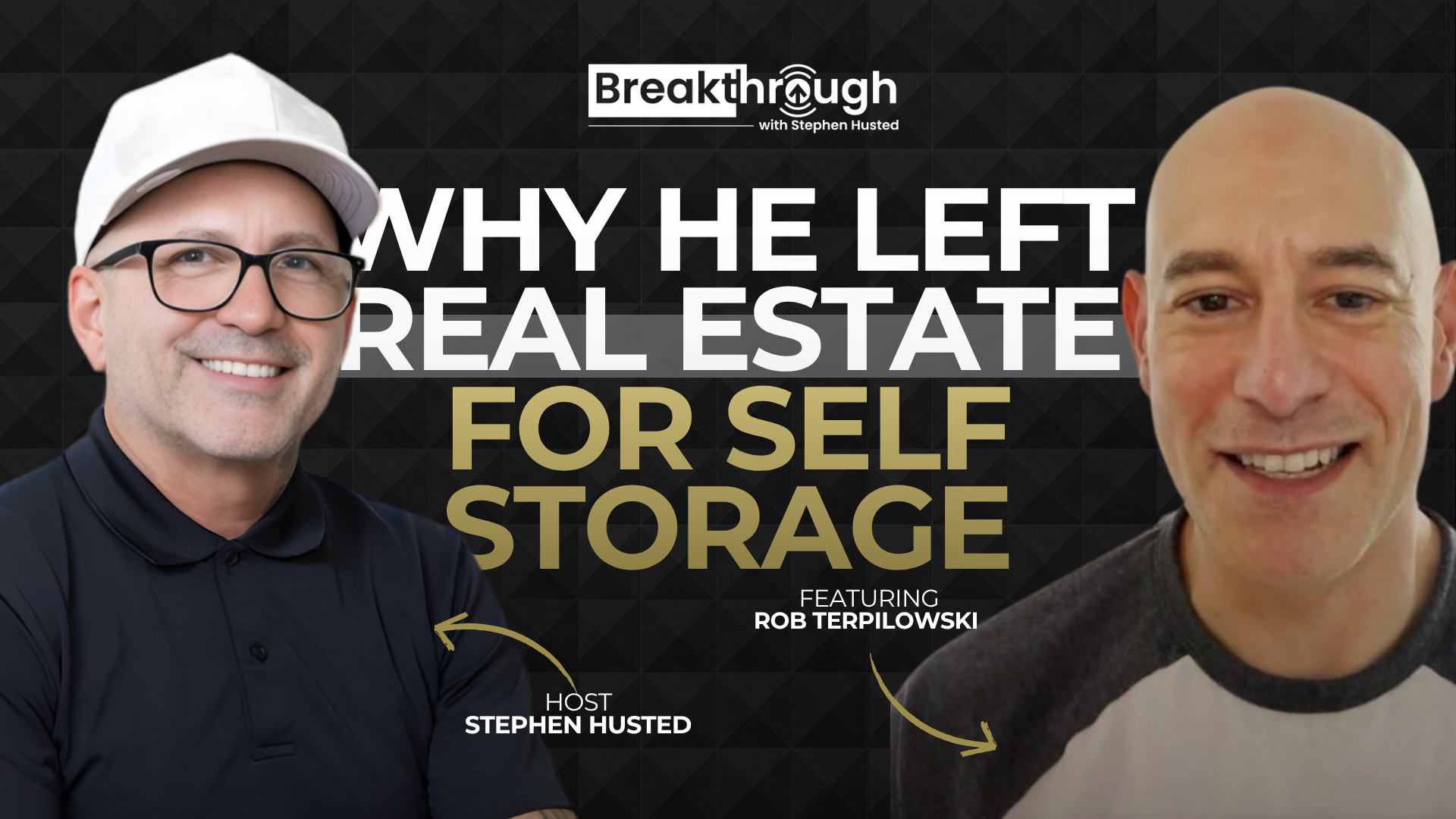
In this episode of The BreakThrough, we sit down with real estate investor Rob Terpilowski. Rob opens up about his journey through the unpredictable world of real estate, sharing the challenges, successes, and lessons he's learned along the way. Rob gives us an unfiltered look at the highs and lows of the industry. If you’ve ever wondered about the realities of real estate investing – beyond the polished social media posts – this episode is for you!
TAKEAWAY 1: Navigating Wholesale Challenges and Pre-Foreclosures: Wholesale deals can be unpredictable, especially when facing surprises like hidden pre-foreclosure statuses.
TAKEAWAY 2: Shifting from Residential to Self-Storage Investing: Rob discusses the realities of managing rental properties and why he pivoted to self-storage investments.
TAKEAWAY 3: The Unseen Costs and Rewards of Real Estate Investing: Rob sheds light on the often-overlooked expenses and risks involved in real estate, from dealing with squatters to facing unexpected legal battles.
Rob Terpilowski’s journey is a testament to the unpredictable yet rewarding nature of real estate investing. His experiences offer invaluable insights into the importance of adaptability, resilience, and the ability to pivot when needed.
TRANSCRIPT
∎ Teaser / Highlighted Clip
[Rob Terpilowski] (0:00 - 0:42)
So I started looking into mentorship programs and I discovered Jamil Damji and Astro Flipping. This was back in like 20, end of 2018, beginning in 2019. So it was, they had just started this program.
So I was within the first four months of them starting it. What they were kind of talking about kind of resonated with me as far as their approach and stuff like that. So I was like, okay, rather than spending another $5,000 on marketing and stuff and really not knowing what I'm doing, I'd rather pay to join somebody who's going to show me exactly what their recipe is and I'll stick with that.
∎ Podcast Intro:
[Stephen Husted] (0:43 - 2:06)
Brace yourself for a wild ride into the unexpected. This ain't your typical success show. I'm here talking to real folks who've been through it all, skipping the fancy business talk for authentic stories.
We're diving into childhood dreams, teenage escapades and everything in between. No scripts, just the stories that truly mold success. Each episode takes you on a journey through those breakthrough moments that paved their way.
No fluff, just genuine stories. So whether you're chasing dreams or just love a good story, buckle up for wisdom, laughs, and the unexpected. This is the Breakthrough Podcast, where success is a journey, not just some fancy destination.
Don't miss out. Hit the subscribe button now and join our Breakthrough crew. I got some incredible stories to share and you won't want to miss a single one.
∎ Guest Introduction:
Hey, everyone. Today's episode is going to be one for the books. I'm sitting down with Rob Terpolosky, a guy who's been through the ringer in real estate.
From wholesale deals blowing up to pre-foreclosures that no one saw coming, he's not afraid to share the ugly truth about this business. We dive into some wild stories about squatters trying to extort $150K. Yeah, you heard that right.
We also get into the pros and cons of self-storage and how he's transitioning from the headache of tenant dramas to finding gold in storage units. Let's get into it.
∎ Podcast Proper:
Rob, how's it going?
[Rob Terpilowski] (2:06 - 2:08)
Doing good. How are you doing, Stephen?
[Stephen Husted] (2:09 - 2:17)
Doing good for this Tuesday. Yeah. It looks like we solved our little bit of technical difficulty.
It wasn't that bad.
[Rob Terpilowski] (2:18 - 2:27)
Yeah. I think if only all of my problems were that easy to figure out, life would be just amazing.
[Stephen Husted] (2:27 - 2:33)
That's so true, right? That was like the easiest thing of the day. You could say that's an easy win, right?
[Rob Terpilowski] (2:33 - 3:09)
Yeah, exactly. Before I got on here, I'm dealing with a situation where I'm involved in a wholesale deal and it was supposed to close today. We finally got the seller's payoff and it's like $30K higher than he was expecting it to be.
It's showing that he's going to need to bring cash to close now in order to get this deal done. He obviously does not want to do that. We've been spending all morning trying to figure out if this deal is still going to work or not.
[Stephen Husted] (3:09 - 3:19)
Oh, wow. How did that come about? There was no seller net sheet midway through or in the beginning?
What went wrong?
[Rob Terpilowski] (3:20 - 4:34)
No. The other thing is that the seller didn't tell us he was in pre-foreclosure. That was the other thing.
That was a huge surprise to us. Much like the microphone this morning wasn't working. It was a surprise.
This was a major surprise this morning getting his text message and says, oh, the seller was like way more than he thought he had and he's in pre-foreclosure. How do we not know this the day before we get the payoff statement from the lender? So I don't know.
There is probably a number of things that we should have. I don't know why this didn't show up on the initial title report either. The other thing too is the seller moved out all the stuff last night out of the house.
That's the other crazy thing. So he's expecting to get paid today. He thought he was going to walk away with like $20k.
The settlement statement showing that he owes $13k on the sales. I was like, I don't know. The buyer is going to have to come up in price and nobody's going to have to make any money in order to get this deal to close unless the seller is willing to come down a little bit from what he wants.
[Stephen Husted] (4:35 - 4:43)
Do you think there's room for the investor? What is this going to be down the road for this investor? Is it a fix and flip?
Are they going to hold it?
[Rob Terpilowski] (4:44 - 6:26)
Yeah, it's a fix and flip. They're it's probably $425k. They're probably put like $50k or $60k into it.
So it's not going to be like a home run deal for them after transaction costs and hard money costs and all that stuff. But it'll be a nice, easy flip for them. So whether or not they're going to be able to come up with an additional $10k in order just to give us something and also for the seller to be able to walk away with something.
We'll see. So he's threatening, the seller's threatening, if he doesn't get his price now, he's going to just list the property and the bank told him it's worth $425k and so they're not willing to do a short sale on it. And I was like, okay, well, if the bank says it's worth $425k, you could see if they want to buy it from you for $425k.
But I don't think you're going to get that even if you put it on the market because of the condition it's in. So where's it located? This is located in Elma, Washington, which is probably about two hours outside of Seattle, kind of on the way to the Pacific coast.
So tiny, tiny little town in Grace Harbor County. We've got a small pool of investors that buy deals out that way when they come up, but it's not like a huge market out there. So we don't sell a ton of stuff out there, but every once in a while, we get something that there's enough room on there that the investors are interested in it.
[Stephen Husted] (6:28 - 6:42)
Yeah. So maybe to give the audience some color on what you do, what is your background? What are you into as far as investing is concerned?
Because I know you do, it seems like you do a few things. What's your bread and butter?
[Rob Terpilowski] (6:44 - 8:36)
So right now, my bread and butter is primarily wholesaling. I got into wholesaling though to find deals for myself, basically. Most people get into wholesaling the other way around.
They start with wholesaling as a means to build up capital and then buy flips and rentals and stuff like that. I got into real estate by buying properties at the auction. So I read Rich Dad, Poor Dad, pretty much 90% of all real estate investors, that's how their story starts.
And I hate that because it seems so cliche, but that's how I got interested in real estate as well. But then I didn't do anything for 10 years because I felt like I didn't know enough. I was like, I don't have enough money.
I got to save up 20% down payment and then I'm going to buy a house like here in Seattle. And then I'm going to make $200 a month, you know, net. And then I got to save up another 20% and buy, you know, this is going to take forever.
Like how is this even going to work? But then I discovered hard money and I was like, oh, I can buy a property and for fairly low down payment amount, that's in really bad shape. And I can get the renovation costs financed and then either sell it or refi it when I'm done.
So once I discovered that, I kind of just dove in head first and just started putting bids in at the foreclosure auction. And first week I got two properties and flipped both of them. I made money on one, lost money on the other.
I had like no idea what I was doing at all. No mentor, nobody like showing me what to do. All it was, it was like YouTube and I don't even know if BiggerPockets was around back then.
[Stephen Husted] (8:36 - 8:37)
What year is this?
[Rob Terpilowski] (8:38 - 8:39)
2011.
[Stephen Husted] (8:40 - 8:45)
Okay. Different time period too. No Instagram.
[Rob Terpilowski] (8:46 - 8:52)
Yeah. Well, Instagram may have been around, but not nearly in the same way as it is today.
[Stephen Husted] (8:52 - 8:54)
It was all photo. It was all photo back then. Yeah.
[Rob Terpilowski] (8:56 - 11:36)
So then bought another one at the auction, made a little bit of money off of that, but then discovered wholesalers after that. And so bought some deals from wholesalers. And that's when my interest in wholesaling kind of got peaked or at least finding off-market deals, because I saw what these wholesalers made on these deals.
On one, it was a duplex in Tacoma. The wholesaler got locked up at $75,000, which is just insane. And I bought it for $115,000, which was still a really good deal.
And then another one was a pair of duplexes, which I bought the pair for $340,000. The wholesaler had it under contract at $300,000. And it was still a great deal to me.
But I was like, if I found that deal at $300,000, that would just be an insane deal. So I was like, I need to learn how to find my own deals off-market. So I was like, okay, I'm going to do mailers.
I'm going to have sellers call me. I'll set up kind of my target, which was small multifamily at the time. And so I sent out a bunch of mailers.
I had my daughter at the time. She was seven. I had her writing the envelopes.
So it'd be handwritten, so they'd be more likely to be open. And I got some calls. I went out to talk to some very unmotivated sellers.
And I was working a day job at this time still. And I was like, damn, this is very, very time-consuming. Maybe these wholesalers are kind of earning their money after all.
So I kind of just went back to buying from wholesalers. But I still had this in the back of my mind that I wanted to find my own deals. So at some point, I shifted to looking for deals in the Midwest because stuff here in the Seattle area just doesn't cash flow very well.
And my goal was to acquire properties that would help me pay my bills. And it's just hard to do here in Seattle. So I was looking in Oklahoma and Indiana.
And that's kind of when I got back into like, okay, I'm going to start looking for my own deals. So I started running Facebook ads. I hired a cold caller.
And I was starting to get some deals in now at this point on my own. This is when I actually got deals where I didn't want to keep them myself. So I wholesaled them.
So the first wholesale deal I ended up doing, I probably spent like $4,000 or $5,000 over the course of I don't know how many months on Facebook ads and a marketing guy. And I got a deal that I ended up wholesaling and made like $1,500 on. So it wasn't a great ROI.
[Stephen Husted] (11:39 - 11:41)
You're doing a wholesale short sale.
[Rob Terpilowski] (11:44 - 12:52)
It's a whole short sale. So that's when I was like, okay, I need to get connected with somebody who is actually doing this like that can guide me and tell me what I'm doing wrong, you know, kind of give me a recipe. So I started looking into mentorship programs.
And I discovered Jamil Damji and Astro Flipping. This was back in like 20, end of 2018, beginning of 2019. So it was they had just started this program.
So I was within the first 4 months of them starting it, what they were kind of talking about kind of resonated with me as far as their approach and stuff like that. So I was like, okay, I'm gonna rather than spending another $5,000 on marketing and stuff and really not knowing what I'm doing, I'd rather pay to join, you know, somebody who's gonna show me exactly what their recipe is, and I'll stick with that.
[Stephen Husted] (12:52 - 13:01)
What was the difference, Rob? Like, did they have different kind of system in place? And what resonated with you?
[Rob Terpilowski] (13:01 - 14:21)
So the thing that resonated with me that kind of stuck out from the other, what some of the other mentorship programs were teaching was they were not going direct to seller on their deals. They were all about looking for deals on the MLS, doing outreach with agents, and building an army of agents that basically is going to be looking for deals for you and then also networking with a lot of other wholesalers and investors. And so really, it's more organic networking and sourcing deals from people within your network, rather than trying to find the sellers themselves.
Because they're like, if you are spending your time, if you dedicate your time talking to the people that are out there talking to the sellers, so you're not having to actually spend that money on marketing, and you do a deal with one of those agents or wholesalers, and that deal goes well, chances are that that person is going to want to do another deal with you. Whereas if you spend all this time and money finding a motivated seller, and you do a deal with them, unless they're a landlord and have a portfolio, you're probably not going to do another deal with that person again, right?
[Stephen Husted] (14:22 - 14:22)
Yeah
[Rob Terpilowski] (14:22 - 15:18)
And, and, and the fact that I was looking for properties for myself first, and then wholesaling anything that kind of didn't fit my buying criteria, I felt that kind of gave me a unique advantage to with talking with these agents and other wholesalers, right? Because a lot of them are getting bombarded by people that just want to wholesale, right? They just want to sell everything that they come across.
Whereas me, I'm like, okay, I go into every deal looking at it as okay, if I'm buying this deal for myself, where does it need to be as far as price and condition and rehab, you know, estimate and all that stuff. And then if it doesn't work for my criteria, then I have a network of buyers that I could pitch this deal to. And so that agent or wholesaler investor could still get paid, even though I might not be the one that's going to be buying that deal.
[Stephen Husted] (15:20 - 15:42)
How'd you put your team together? When it came to that? Did you start like, were you at this point, looking for the deals in Oklahoma, Indiana, and then said, okay, let me just try to figure out some of the top players in both, both avenues, and then just start reaching out.
And then did you stay in front of them, you know, month after month, and just until you finally got a couple deals, and then that relationship was there?
[Rob Terpilowski] (15:43 - 17:35)
Yeah, absolutely. So I started out a lot of online networking, Facebook groups, you know, the local real estate groups. But then I also I spent quite a bit of time actually in Oklahoma City and Indianapolis.
So I was probably going down to Oklahoma City every two or three months before the pandemic, just building my network meeting with contractors, agents, property managers, other wholesalers. And so I have some really good friends down there. And the thing is, like, people want to do deals with people they're friends with, right?
Yeah. So, so, absolutely true. Yeah.
So it's all about being likable and being easy to work with and low drama, you know, doing what you say you're gonna do. And so I've met some really great, great people down in Oklahoma City that I've done many deals with down there. So yeah, I ended up acquiring a bunch of properties down there.
And that's kind of where I cut my teeth wholesaling. And then I ended up shifting back to Washington as far as wholesaling goes a few years ago, because Oklahoma changed their wholesaling laws. That's right.
I heard that. Yeah. So you have to be licensed in order to market off market deals down there now.
And I just felt like it wasn't the wholesale fees weren't worth it in that market to justify me spending the time to get the license. So I felt like I could probably be working just as hard up here, but in Seattle, but making more money because the price points are higher, thus you can have higher assignment fees. You know, it's hard to mark up a $60,000 property by very much, but a $600,000 property can mark up, you know, a bit more than that.
[Stephen Husted] (17:36 - 17:42)
Are you still buying out in Oklahoma City and Indianapolis? Are you still in those markets?
[Rob Terpilowski] (17:43 - 18:00)
So I kind of shifted my strategy a bit a few years ago from residential real estate to self-storage now at this point. And what I found is real estate is not passive income.
[Stephen Husted] (18:02 - 18:03)
Yes.
[Rob Terpilowski] (18:06 - 18:16)
I don't know who came up with this term, but you are basically running a business. If you own rentals, you own a business. You know, this is not passive.
There's nothing passive about it.
[Stephen Husted] (18:16 - 18:18)
It's a day-to-day operation.
[Rob Terpilowski] (18:18 - 18:24)
Yes, exactly. Even if you have property managers, you're still having to do stuff day-to-day, right?
[Stephen Husted] (18:25 - 18:49)
Yeah. It's funny now I look back and some of the guests that I've had on my podcast, we all touch on a lot of the same topics because it's always those hot button points to the business, you know, property management, contractors, you know, underwriting, you know, it's like these big three keys that are, it's not a set it and forget it type business.
[Rob Terpilowski] (18:49 - 18:50)
Yeah.
[Stephen Husted] (18:50 - 19:01)
Especially if you have a portfolio of properties, then it's definitely not a set it and forget it, you know? Yeah, absolutely. When it rains, it pours too.
[Rob Terpilowski] (19:02 - 21:29)
Yes. Yeah. There's no doubt about that.
And the thing too is like some of these properties I like had acquired, you know, sub two, so they had an underlying mortgage. And so there's another, a whole nother can of worms. They don't really talk about what's up to that you have to be careful with as far as like insurance.
And it's just like such a pain in the ass. Some of these things that you have to deal with that, you know, I don't know if necessarily people that are going into like the sub two group, for example, know what they're getting into. Yeah.
It's an awesome way. I bought three properties in Oklahoma with like 10 K out of pocket and they cash flowed greats. And like, so that part of sub two was amazing.
Like the fact that I only had to spend 10 K out of my own pocket and I was able to control, you know, half a of assets and cashflow, you know, I don't know, $1,500 a month or so. And then not only that, there was the, the principal pay down and then the appreciation. So there are all these great things about sub two, right?
But then there's the flip side where you got to deal with stuff that you're not having to deal with. If you just flat out own the house and have a mortgage in your own name. So some of the, some of the things that I ran into with that, there were a lot of headaches.
And so I was like, I had about 15 doors at the time. And I'm like, you know what? I would rather just own one big property and not all these little one to, you know, four unit properties.
So I heard some, I mean, I, the thing that attracted me to self-storage was the fact that like, okay, you're not, you don't have the same landlord tenant laws that you do with residential real estate. And coming out of COVID at one point in time, like 40% of my tenants had stopped paying, you know, and then I was dealing with trying to get them out. And the ones I did get out, then like, you know, there was $15,000 in damage on some of those units, right?
So it was just kind of mind boggling what people were able to get away with during that time. And even now, actually in Seattle, I just did a reel about this wholesale deal we're working on where a squatter.
[Stephen Husted] (21:29 - 21:30)
Oh, I want to hear about this.
[Rob Terpilowski] (21:32 - 21:36)
It is stupid. Like I cannot believe this is legal.
[Stephen Husted] (21:36 - 22:21)
I don't get this. You know, it was funny. I was driving, I was driving her to the, my meeting room and I was thinking about that, that video that you posted.
And I just don't, I, I don't understand. Well, I don't understand the word tenant rights. I don't even know how the tenant, you know, squatter rights has it, why it's in the same sentence together.
It's insane. And I just don't understand the dynamics behind why you can just produce a fake lease, you know, and, and be able to just occupy somebody's property. And that's that, you know, just because it looks legit, you know, it just, it's strange, but you're, let's, let's hear about your story.
Cause I know it's crazy.
[Rob Terpilowski] (22:21 - 25:08)
Yeah. Yeah. And I'm right there with you.
I just, I don't get like in what realm of what, what reality is this like, okay. You know, for somebody, but it, but basically on this deal, this is another, it was a wholesale deal that another agent was involved and he reached out because he's like, Hey, I got this house in Puyallup, which is a bit South of Seattle. It's really nice house.
D.R. Horton, like not very old and just literally needs carpet and paint can go on the market. And so they were, they were wholesaling it. They had a tenant in there.
And so it was agreed that the house was going to be vacant at close tenants moved out the they got their security deposit back. And that was about two weeks before closing sometime between the tenants moving out and the deal closing the tenants mother moves into the property and she's not on the lease anywhere. I don't know how she got access to the property.
If the tenants just gave it to her, that part of the story is a bit shady. I feel like, but she's demanding from the seller in order for the seller to be able to close this deal right now. Cause the buyer's like, well, there's somebody in there.
So I'm not closing on it. Obviously this squatter wants $150,000 payment in order for this seller to be a, be able to close this deal. And she's not moving out unless she gets this 150 K.
And so there's a few other crazy stories going on in Seattle right now that I've heard where this one guy has been in a property in Bellevue for 18 months. And this poor homeowner has been having to pay this mortgage the entire time and property taxes and all that stuff. So I just don't understand.
So anyway, this deal is at risk of blowing up. So I found, I looked at it for myself at first and then I was like, cause the price is actually, it's pretty good, but I'm like, I don't think I want to get involved in this situation here. I do not know how long it's going to take to get this person out.
So I found somebody else though, who has probably, uh, uh, an iron threshold for risk. Yeah. And so he's willing to do it, but man, like I, I just don't understand how is this even legal?
Like why can you do this with the house? Why is this legally okay to extort somebody $150,000 for a house. But like, let's say you were to steal somebody's piece of equipment, right?
You, you take their excavator and you hold it hostage, steal their car or you steal their car and you say, I want X amount of money to give it back to you. Right. And then you can have it back.
Like that person would get arrested. Right.
[Stephen Husted] (25:09 - 25:33)
So why do you think it stems from Rob? Because Washington's pretty crazy, right? With their, their, it's not a landlord friendly state and it's so what came about that we ended up where we are now.
Like why do squatters have this much, this many rights now? And why is it different in every state? Why is that?
[Rob Terpilowski] (25:33 - 26:11)
Well, the reason I think it's different in every state is because you just have, it's a, I feel like it's a, like a liberal versus conservative argument. Right. And and very in states that are probably more pro-business are going to have laws that tend to favor landlords or property owners more than states that are, you know, pro-labor for example.
But what I don't understand is so that you got the squatter rights and you got the tenant rights, right? So I don't understand in any state why squatters have as much rights as they do. Right.
They have no legal claim on the property at all. Tenant rights. Okay.
That's a little more.
[Stephen Husted] (26:12 - 26:13)
That's a different, that's different.
[Rob Terpilowski] (26:13 - 26:52)
That's different. I still don't agree with a lot of the stuff that's going on here in Washington where it's like, like it's, it's getting a little out of control on that side too. Like max late fees of $10, you know, if they're late on rents, like, okay, what's that going to, how's that going to incentivize somebody to pay their rent on time?
Some of the other things are some landlords report to the credit agencies, right? Their tenant's payment history. Well, they're trying to pass a law or maybe it has passed at this point where you can only report the on-time payments.
You can't report the late payments to the credit agency. So there's like, in like six months, having six months.
[Stephen Husted] (26:52 - 26:55)
But this happens with your credit card where you don't pay, but that's okay.
[Rob Terpilowski] (26:56 - 27:59)
Why, why, why, how's this any different than a credit card? Why are they not protecting people that are paying late on their credit card? You know?
So I don't know. This is a, I think what you're asking is a very good question. If we were to go back and take a step back and, and ask ourselves like, what is, what is driving or even who is driving this agenda for really giving the tenants so many more rights to a property that they do not own, right?
And they had no risk. There's no risk for them in acquiring this property. All the risk is on the property owner, right?
For maintaining it, for paying the taxes and making sure it's in good livable condition. So why is it that those property owners aren't being rewarded for taking that risk, you know, and providing housing to somebody that doesn't have enough money for a down payment to actually pay for this house themselves?
[Stephen Husted] (27:59 - 28:06)
Yeah, it's, it's pretty insane. So what happened? What happened with this lady moving in?
Is this ongoing right now?
[Rob Terpilowski] (28:06 - 28:24)
Yeah. So this is in process right now. We're currently working with the seller and I'm hoping that we're going to be able just to close on this deal in a couple of weeks.
And then the buyer is going to be, you know, taking on the squatter, taking on the squatter. Yeah.
[Stephen Husted] (28:25 - 28:34)
But so she takes it over. She did. So did she produce a lease or she just, just an active squatter?
[Rob Terpilowski] (28:34 - 28:47)
She's just an active squatter. I don't think she's produced a lease. So that's the other thing I don't understand is why can't the police just go in there and get some sort of verification that, okay, this person doesn't have a legal claim.
[Stephen Husted] (28:47 - 28:58)
And it hasn't been 30 days. Right. Well, I don't, I know that some places it's not over 30 days.
And then they, and then they just say, well, this is a civil matter.
[Rob Terpilowski] (28:59 - 28:59)
Yeah.
[Stephen Husted] (28:59 - 29:15)
Yeah. And it just, and they just leave it up to the courts. And I think some of these, it seems like the opportunity came from the tenants.
It's almost like they were in cahoots with each other. You know what I mean? Like, well, because the tenants, right.
It's the tenant's mom.
[Rob Terpilowski] (29:17 - 29:22)
Oh yeah. Yeah. On this, on this case, I was like, the tenants have to be involved in this.
Of course.
[Stephen Husted] (29:22 - 29:24)
And they're going to split that money up too.
[Rob Terpilowski] (29:24 - 29:24)
Yeah.
[Stephen Husted] (29:25 - 30:50)
Yeah, exactly. Oh, it's crazy. Yeah.
Yeah. I'm going through it right now. I got to, I got to, I went through three squatters on my very first property I bought in the Midwest.
And, you know, it's been one after another. And then what happens is you, this, this last, this current squatter who we were able to get her on a month to month lease. So now we're in, we're evicting her.
And the problem is you, then they move out at a certain point, but now the house has been a target. So it's like, well, she moves out. We don't know.
And then 24 hours go by and then another person moves in. And I'm just like, I'm so done with it. And honestly, it's, it's kind of made me think about it on, on all my properties everywhere, because it's just something that's been coming up a lot lately.
There's more news on squatters and just, especially the smart ones that know what they're doing. It's a big problem and it can happen to anybody. And I think that's one thing that's, I think something that people don't really realize is you could take off from anywhere you're in the United States and go on a vacation for a few weeks and then show up and somebody's living in your house.
You could be the one that's, you know, pro this and pro this and everybody needs rights, but then it happens to you. And that's a big problem.
[Rob Terpilowski] (30:50 - 31:00)
Yeah. I was thinking the same thing. I was like, why, why couldn't this happen to somebody that's just on vacation for a few weeks and come back in their house?
Yeah.
[Stephen Husted] (31:00 - 31:06)
Yeah, it has. It has. So that makes, so make storage lockers.
[Rob Terpilowski] (31:08 - 31:08)
Yes.
[Stephen Husted] (31:09 - 31:10)
A lot more doable.
[Rob Terpilowski] (31:10 - 33:24)
Yeah. So here's the thing I love about storage so far. You know, they're five days late on their rent.
I just lock them out of their unit. Like you don't need to get a court order. You just throw a lock on there and they can't get their stuff out until they pay.
Right. But also nobody's going to care if like grandma's dresser gets auctioned off, you know, or whatever crap they got in their, in their locker that just has been sitting in there for months and months and months. So, so that part was, has been really, really nice.
And the other thing too, is, you know, I think self-storage is treated more by its users, like a utility. Right. So like a hundred dollar bill, you know, coming in a hundred dollar invoice every month from self-storage isn't like, you know, somebody is dedicating a huge amount of their income towards a rent payment.
Right. So I don't think it's ever going to be looked at in a similar way as a tenant, tenant rights, you know, for eviction purposes and stuff like that. So and then everything is super automated with the self-storage facility, like the late notices, the overlock notices, like all this stuff goes out automatically if they're not submitting their, their payments.
So most of the time we're not having to chase these people down unless they're really falling behind on their payments. So, so that's the other thing I really like about it is kind of the level of automation that a lot of this management software provides you. So, so basically I ended up selling a couple of my duplexes here in Tacoma and I complained about the cashflow here in the Seattle area, but the amazing thing in this market is like the appreciation though is crazy.
Right. So I own those things for five years. I was able to basically 1031 out of them and buy this facility and not have to bring any additional capital in.
And it's cash flowing way, way, way more than the duplexes here ever were. So.
[Stephen Husted] (33:25 - 33:28)
And where, where is this? Where is the storage?
[Rob Terpilowski] (33:29 - 33:31)
Storage facility is in Maine.
[Stephen Husted] (33:32 - 33:43)
In Maine. And what, what, what did you do to pick a market to invest in? And what was that research like before you ended up buying in Maine?
[Rob Terpilowski] (33:44 - 35:10)
So with storage, it was more, it was less about the location, more about just the numbers on the deal. So if I came across a deal, I would analyze it as far as you know, the local market that it was in, but I was kind of agnostic as to where in the country I would end up when I was looking for these. So basically what I had is I had my VA go out there and get on every wholesalers mailing lists for self-storage, any face join a Facebook groups comment on every single deal.
We set up a special email address. And so basically I was just getting all these deals sent to me and kind of going through each one of them and seeing, you know, okay, this one, as far as the numbers go, look good. Let's do a deeper dive into the local market there and kind of see what's going on as far as other facilities in the area, what they're renting for, what their occupancy is and, and that sort of stuff.
So it was just kind of by chance that I came across one in Maine. And the thing that I really liked about this deal was that I was able to get seller financing for the balance that I didn't have from the 1031 exchange. So that helped juice the cashflow a bit more on it than something that I would need a commercial loan, would have needed a commercial loan to buy.
[Stephen Husted] (35:11 - 35:12)
What was the terms on that?
[Rob Terpilowski] (35:13 - 36:22)
It's a 6% interest only with a five-year balloon. And so the cool thing was that the previous owner or the guy that I was buying it from got its seller financed from the person he bought it from. And that note was assumable, which was cool.
And then the seller gave me a second position on top of that to make up for the difference from the 1031 exchange. So yeah, so this thing, yeah, so this thing's cash flowing like crazy. Just did one rent run around of rent increases.
And the thing that is just mind boggling to me is like, okay, there's a hundred units. I just raised the, the unit rents by $10 a month, right? Nobody, I was really worried that people were going to start complaining and screaming at me and nobody said anything.
And my income just went up a thousand dollars a month on this, right? And, and it's still, the rents are still under market. So I'll do the same thing again next year on it.
[Stephen Husted] (36:22 - 36:50)
And people tend not to want to move out of self-storage too, you know, it's a hassle, you know, so $10 here, $20 here, it's not going to break the bank, so to speak, but, you know, and they just don't want to move the stuff. So it's kind of a, a good scenario. How did you go about underwriting the deal and what's the difference between underwriting a storage facility compared to a duplex?
[Rob Terpilowski] (36:51 - 39:00)
Yeah. So storage facility, you know, it's all, the valuation is all about the income, right? So you're, you're looking at it from a completely different perspective as one, like I'm evaluating a small residential deal there.
It's, it's, the valuation is kind of, it's mostly based on comps in the area. And then you kind of have to do, you do have, still have to take a look at the actual, you know, income and cashflow numbers, obviously, when you're buying a deal like that, but a lender is primarily going to be looking at the comps, not the income, right? Whereas with commercial, it's all about what, what the numbers look like.
And so as I was underwriting that deal, you know, I'm basically looking at, okay, what are the numbers as they are today that the current owner is getting as far as income? And then what are they spending their money on? I want to make sure that, and this is the thing too, when I'm looking at wholesaling some of these rental deals, I can now easily tell when a seller is BS-ing me.
Like I, I, I look at their profit and loss statement and they say that their expense ratio is 20%, you know, on a duplex or on a fourplex. And I was like, there's no way that they're bragging about how low their expense ratio is. There's no way you can have an expense ratio of 20% on a residential property.
That's just not possible. So obviously you're either, you're either fudging your numbers or you're deferring a ton of maintenance, or you're doing something to keep that number lower than it needs to be or lower than it should be. So, so, but basically taking a look through their numbers and trying to figure out, okay, are they, it's somewhere in the realm of possibility of where numbers should be, you know, with the self-storage facility, you're probably looking at between like a 30 and 40% expense ratio.
And as long as you're in there, then you kind of break it down further and see where, okay, where are they spending their money? You know, are they deferring any maintenance and stuff like that?
[Stephen Husted] (39:00 - 39:20)
And then- Are you looking for a value add type scenario in the, in the equation as well? Like, okay, look, you know, it's a tired landlord and, you know, the, the facility is a little rundown. They're not doing good with marketing.
Like, is there, are you adding that element in there too of where you're going to basically increase value and, and income?
[Rob Terpilowski] (39:21 - 39:30)
Yeah, absolutely. I, I hate buying things for full retail price. Like, I- Like where do we go from here?
[Stephen Husted] (39:34 - 39:37)
He already set it up. I don't know if it's going to do good.
[Rob Terpilowski] (39:39 - 41:19)
I, I, I love deals where there's opportunity to add value. And there's multiple ways you can add value. And the thing that I really liked about this, so I've done like deals where it was like, you know, a duplex that was like a 250K rehab all the way down to the studs, basically, you know, rebuilding it and condoizing the two units and selling them off separately.
But the thing I really like about this, the, the value add aspect of the self-storage deals, these units were just built within the last 10 years. So there are in great shape, but the owner really hasn't done much in the way of keeping the rents up with the market. And this is the awesome thing about income properties and value add is that you can buy something that is in great shape, but it's a value add property because it's the income that it's generating is below where it should be or where it could be at least.
So you can push the value of that asset up by bringing its income up and you don't even have to do anything in the way of capital expenses to the property. And so that's the thing I really, really liked about this particular deal was like, he hasn't raised the rents in a few years. And so he's about 25% below market.
So I can bring the value of this property up by another 25% over time. If I can push those rents up to the market rate, and I don't even know you do anything as far as adding anything additional to the facility as far as capital expenses go. So, but yes, I am always, always, always looking for value add.
[Stephen Husted] (41:20 - 41:36)
What do you, why do you think that he didn't have it at that point? Do you think they just get, they could just get comfortable with the type of clients they have there and they don't, and they feel they're going to lose people. So they just keep them steady to keep, you know, keep the units filled, so to speak?
[Rob Terpilowski] (41:36 - 43:24)
Yeah, I think so. And I feel like they kind of put too much, I mean, every businesses are relationship based, right? But self-storage is kind of a commodity, right?
Like somebody is not necessarily going to store your stuff in your place because they're your friends with them, right? They're going to go wherever, you know, they feel the best value is. And I think these guys were very, very reluctant to raise rents because they're afraid that they're going to upset people and that people are going to start leaving.
And so I think that's one aspect of it. The other aspect too, is they owned another business, right? And so I don't know if the self-storage was more of a, kind of like a side business for them and not their main focus.
And so maybe if they aren't making, you know, they're not really maximizing their profit on this particular facility, it's not like a huge loss to them because their primary income source is this other business that they're running. So that's, I think the other angle is why they might not have been really kind of keeping the rents up to where they should be. And the other thing too, I think they were worried about is there was a new facility a few miles away that opened up and putting possibly price pressure on rates in the area.
But I haven't seen that yet. So we raised the rents was one thing that we did recently. And the other thing that we did was we started mandating insurance and we're offering insurance now through the management software has a partnership with an insurance carrier.
So we're basically getting 50% of all the insurance premiums that get collected.
[Stephen Husted] (43:25 - 43:26)
So that's a value add play.
[Rob Terpilowski] (43:26 - 43:27)
Yeah. Yeah.
[Stephen Husted] (43:27 - 43:30)
Okay. Really cool. Exactly.
And they weren't doing that.
[Rob Terpilowski] (43:30 - 43:32)
They weren't doing that either now.
[Stephen Husted] (43:33 - 43:49)
Yeah. And so when you, when you went into the underwriting process on this deal, so are you, you're pulling comparables from how far out are you just finding all the facilities and looking at the condition and, and then are you going to their website and checking out pricing? Is that kind of how you're?
[Rob Terpilowski] (43:49 - 45:19)
Yeah, absolutely. Yeah. It was a little easier in this market because it's a bit more of a rural location.
So this was the other thing I liked is there were not a ton of facilities around this one. So there was maybe two or three other competitors within about 10 miles of there. But yeah, it involves going to their, their website, seeing what units they have available, how much they're charging for them, what sort of specials they're advertising.
And then, you know, then I go on Google, I kind of take a look at the reviews and see what people are saying about them, you know, and try to make yours better. Yeah, exactly. See what the major complaints are there, see what they're doing good.
And then taking a look at the pictures of the facility, like on, you know, the Google business pages and, and street view and stuff like that to kind of see, you know, like, okay, is this, is it an unmanned facility? Is it something that has an office there and truck rentals and stuff like that? So, but yeah, so basically, though, it's just basically going online and getting all the pricing information from those facilities in the area, and then kind of tabulating those and figuring out, okay, I don't want to be at the very top end of that, because I don't want to price myself above where everybody else is.
But if I can be up close to there, you know, I'll use that as a, as my assumption for what I can get the income up to get the sweet spot. Yeah, yeah.
[Stephen Husted] (45:20 - 45:25)
So are you thinking of getting more facilities down the road? This is you only do you only have one?
[Rob Terpilowski] (45:25 - 45:27)
Yeah, I just have this one right now.
[Stephen Husted] (45:27 - 45:29)
When do you when do you close on it?
[Rob Terpilowski] (45:29 - 45:30)
This was in December.
[Stephen Husted] (45:31 - 45:35)
Okay. All right. So you're this is new.
You're new at the at the strategy.
[Rob Terpilowski] (45:35 - 45:36)
Yeah, yeah.
[Stephen Husted] (45:36 - 45:39)
Do you think that do you want to get another one? Like what?
[Rob Terpilowski] (45:39 - 47:39)
Yeah, yeah, absolutely. I saw I'm actually work finishing up a renovation project just outside of Atlanta on a fourplex. And this thing's been going on for a while, but I've decided that okay, I actually I don't think I want to keep this one.
As a residential rental, I'm just gonna go ahead and I think sell this one off and, and look for my next self storage deal. So I've got a number of people here in Seattle who are very interested in this strategy as well, especially from what they're seeing with just all these horror stories about the tenants and squatters, and they're very intrigued by the idea of the self storage, but they want just more of a passive role. So I'm still on the hunt for the next deal.
And my my basic, I either want to be able to just pay for something all cash, you know, basically funded by these investors or find something that could be seller financed, and the rates are low enough that make the cash flow viable. I think it's very tough right now to buy something with commercial financing, unless you're buying it at like a 10 cap or 11 cap or something like that, or putting 50% down on it, you know, in order for the to be there. So I just don't think it's very, very hard right now, I think to buy a cash flowing property, commercial with commercial financing, and have the have that income be decent enough for it to make sense.
So that that's kind of been the challenge now is finding those seller financed deals, where the the terms make sense. But that's kind of what I'm on the lookout for, as I've been sifting through these deals that have been coming in.
[Stephen Husted] (47:40 - 48:18)
Yeah, sometimes you just have to be patient. Yeah, like that's a, that's a skill. Yeah, in itself.
Yeah, because I think when you're becoming when you get into investing, you know, you know, it's sort of an addiction, you know, like, it's a rush, and you just want to keep momentum going. But then sometimes, you know, when the market is not in your favor, and, you know, where rates are at, you kind of have to, you know, step back and reevaluate and just be patient and wait for that next opportunity that really does pencil out that is a somewhat of a no brainer. And those still come around, you just have to you got to wait it out.
[Rob Terpilowski] (48:19 - 49:24)
Yeah, absolutely. And that's the thing, too, I think, with with real estate, probably any real job, like it takes a lot of consistency, even when you're not finding stuff that works, like I, yes, wholesaling is the same way. It's like looking through so many, just shitty deals, like I don't know how many deals I've looked through probably 500 deals I've run numbers on so far this year, right?
And we've sold like a dozen deals. So looking through 500 deals to sell a dozen, you know, how many people are willing to just every day, look at deals, look at deals. Okay, here's another one.
No numbers don't work. Numbers don't work like lots of failures, lots of failures. It takes a lot of consistency to find stuff where the numbers make sense.
Right. And I'm sure you know this with like having to find, you know, deals like because it sounds like you're looking for deals kind of all over the country to if you own stuff in the in the Midwest and sort of I'm starting to get to that point.
[Stephen Husted] (49:24 - 49:39)
You know, I'm trying to condense my strategies down. And, you know, I'm more focused in Seattle now, which just came about by having a few people on my podcast.
[Rob Terpilowski] (49:40 - 49:42)
Okay. Was one of them Justin?
[Stephen Husted] (49:43 - 50:22)
Yeah, so I well, you know what, it all started with Justin, actually, because I was at the, yeah, I was at the BiggerPockets conference and I met him and then came back home. And that was right around the same time that I started the podcast. And so, you know, I invited him on as a guest.
And then I just started, you know, following other people, you know, we started following each other on Instagram. And then all of a sudden, we're just all connected in one way or another. And then I had Ann Curry on the podcast.
And yeah, and yeah, Ian Love and it's off for the races. And we just got into contract on our first property in Seattle last Saturday.
[Rob Terpilowski] (50:22 - 50:25)
Oh, awesome. What kind of deal is it?
[Stephen Husted] (50:26 - 51:10)
So we bought a two bedroom, one bath, single family basement on a 12,000 square foot lot. So we're going to develop the main house into two units, going to do the dadu play. Oh, awesome.
Possibly do two dadu plays. And, you know, something we've brought it to the architect and she's like, I haven't even worked on a lot. That's 12,500.
She's like, I'm so excited. I don't know what to do here. She's like, I think I'm going to put one of the dadu's in the front of the house and maybe one in the back and maybe a driveway to the left.
I'm like, wait, the driveway to the right of the house. She's like, you got room on, but you got a hundred, it's a hundred feet wide.
[Rob Terpilowski] (51:10 - 51:12)
Yeah. That's huge for Seattle.
[Stephen Husted] (51:13 - 51:20)
Yeah. Yeah. Picked it up for $750 with a $10,000 seller credit.
[Rob Terpilowski] (51:20 - 51:23)
Wow. Did you find that on the MLS?
[Stephen Husted] (51:23 - 51:29)
Yeah. We locked it up. We locked it up in like less than 24 hours.
[Rob Terpilowski] (51:30 - 51:33)
Wow. So how'd you do your feasibility that quickly though?
[Stephen Husted] (51:33 - 52:06)
Well, we, we got most people out there in like three days. Went through all that. Talked to the architect.
Yeah. We've been barreling through surveys lined up and it was just such a big lot. It's flat, you know, not that many trees.
There's trees, but they're more on the out, you know, the outskirts of the, of the lot, just a very straightforward lot. And, you know, got the contractor out there and they're just like, dude, you got, you got a goldmine here. This is amazing.
[Rob Terpilowski] (52:07 - 52:09)
What part of Seattle is it in?
[Stephen Husted] (52:10 - 52:12)
Up past Ballard.
[Rob Terpilowski] (52:12 - 52:25)
Oh, wow. So you are like in a really good area then. Like dad dues up there will probably sell for like, I don't know, 800 K maybe a piece thousand square feet.
[Stephen Husted] (52:25 - 53:42)
750 I'm thinking, but you know, here, but the, the play on this, the only downside to this property is it's closer to the freeway. But there's a barrier wall and then there's trees that block it off. And so it's not that bad, but we're just going to utilize, hopefully take full advantage of these daddy plays where we can have, you know, turn the garage down the, down the road after the permitting process, gain more of that square footage.
We have so much room that we could have, you know, a 3000 square foot lot per dad do. And the front house still has, you know, a decent backyard. So there's all these different plays, but my contractor said, Hey, I would, I would keep the main house.
It's like, don't sell it. Like, let's just fix it up. Let's put the other unit, you know, make this a rental cashflow.
I'm like, but then I'm, you know, I've heard so many horror stories about Washington as, you know, just, it's not a landlord friendly Stanley. Am I going to start going through the same stuff I don't want to go through? Like, is it worth it?
You know what I mean? I really have to take a hard look on where I want to put my effort in. You know, I'm just, I'm nervous.
It's like California. I don't want to go through that. Yeah.
[Rob Terpilowski] (53:43 - 54:12)
I mean, I guess the question is, can you take that equity and put it into some other cash flowing asset where you're not, you don't have the same risk and potentially you're getting a higher, you know, cash on cash return. Cause I mean, it is tempting to leave it in there. Cause especially if it's going to cashflow and the appreciation is going to be crazy here too, like over the next 10 years, that's like the other thing.
So it's kind of a puzzle, man.
[Stephen Husted] (54:12 - 55:44)
I don't know. It's a puzzle, but you know, I'm, it's funny how it all came about to starting for investing out in Seattle, but it made sense. And a lot of it, how it made sense was having the right team, you know, just meeting the right people.
Then I flew out there, you know, got on the ground, checked out neighborhoods, met Ian, met contract, made everybody. And that just gave me a little bit more peace of mind. Plus, you know, because I live in California, it's closer, easier to get on a plane and fly out there.
It's only two hours away. And I see where these developments of daddoos are a really good play. And it's, I think what happened, you know, what we've learned over building portfolios is we were doing burrs and keeping them and getting our cash out.
You know, we're doing them at scale, using hard money and all that good stuff. But we're getting to that point where we're running out of cash in one way or another. And it's like, now this is a good way to like, you know, do a few projects per year where we actually make cash.
And then, you know, what I was thinking of doing is moving some of that cash to the Midwest back to like Indianapolis, Indiana, where it's more landlord friendly and put it somewhere where I can have a little bit better peace of mind and control with any type of tenants and squatter type things. And it's really based on that. That's why I would choose that area is because they favor a landlord more.
So that's the vision as of now, but you know how that goes.
[Rob Terpilowski] (55:45 - 55:50)
Once you get into it, you'll figure it out as you go.
[Stephen Husted] (55:50 - 55:53)
Yeah. And isn't that the beauty of real estate?
[Rob Terpilowski] (55:54 - 55:54)
Yes.
[Stephen Husted] (55:55 - 55:56)
You're always figuring it out.
[Rob Terpilowski] (55:56 - 56:01)
It's never the same. Everybody is always figuring it out as they go.
[Stephen Husted] (56:01 - 56:05)
Yeah. So how's it been in Seattle for you as far as wholesaling is concerned?
[Rob Terpilowski] (56:06 - 59:00)
Last year was rough for sure. When the interest rates went up towards the end of the year, like business completely dried up. We were doing about five deals a month and then interest rates spiked and we didn't sell anything that August at all.
And then it was kind of slow to come back. This year has been a bit better. Got a lot more investors buying stuff.
And now the bottleneck has been the deals, getting deals where the numbers actually make sense. So it's kind of amazing how quickly it flips from a seller's market to a buyer's market and then back to a seller's market here. So I think- Based on inventory, right?
Based on inventory and fear was like another big component of that, right? Because investors just stopped buying because we were selling things for about 60% of after repair value typically. And then the interest rates spiked, prices started dropping, and that discount to ARV that investors wanted got larger.
But the seller's prices didn't come down to follow that, right? Because the investors are like, this property might be worth 10% less when I go sell it in four to six months. So I got to bake that into my rehab numbers that, okay, maybe the ARV right now is 500.
But when I go sell this thing, it's going to be 450 because who knows when the prices are going to stop dropping. So there was a pretty big adjustment there. The sellers finally started getting a little bit more realistic about their prices, even though their neighbor just sold their place for 800.
It was like 2000 square feet bigger and fully remodeled, but that doesn't- They don't care. Yeah, they don't care. So things kind of returned back to normal.
Sellers are a bit more realistic now about what their place is worth. But now we got a ton more buyers that weren't around about a year ago. So now my biggest challenge is trying to source deals.
And so that's why I'm taking a look at like 500 deals so far this year, running numbers on 500 deals to find like a dozen that we've sold. So yeah, I'm in the process of trying to come up with some creative ways to source some more inventory for all these people that want to buy a property to either flip or burr or put a dadu on or whatever.
[Stephen Husted] (59:01 - 59:07)
Yeah. What do you like to do on your free time? What keeps you sane?
[Rob Terpilowski] (59:08 - 59:13)
Yeah. I play ice hockey a couple of times a week.
[Stephen Husted] (59:13 - 59:14)
Oh, cool.
[Rob Terpilowski] (59:14 - 59:42)
And Justin actually does too. It was a while ago, but we got up early, went to the rink like at 6 a.m. or something like that. And they had open ice.
So we just played there for an hour before we started our day. But he plays in a league around here and I play in a league around here, although we've never played each other. Where do you live?
I live in Snoqualmie, which is about 25 miles outside of Seattle.
[Stephen Husted] (59:43 - 59:45)
I heard that market's kind of crazy too.
[Rob Terpilowski] (59:46 - 59:46)
Yeah.
[Stephen Husted] (59:46 - 59:47)
We're getting there.
[Rob Terpilowski] (59:47 - 1:00:14)
Yeah. It's getting there because it's close. It's not too long of a drive to get to Issaquah and Bellevue, which there's a lot of companies based out of there.
Costco's based out of Issaquah and then got a lot of companies now headquartered in Bellevue. And then Redmond is not too far away where Microsoft is. So the prices in Snoqualmie have been going up quite a bit over the last couple of years.
[Stephen Husted] (1:00:16 - 1:00:17)
I've heard that.
[Rob Terpilowski] (1:00:17 - 1:00:56)
Yeah. But they just put an ice rink out there like two years ago, which is amazing. It's like literally three minutes from my house.
I can be done with the game and just be home in less than five minutes. And I never thought they would put an ice rink out there because it's kind of a ways out. There's one down in Renton, there's one up in North Seattle.
But at the time that they bought the land, it was cheap out there. So they ended up building a couple of rinks and there's an office park out there that they built. Yeah.
[Stephen Husted] (1:00:57 - 1:01:03)
Good. That's good. Well, I'll be coming out to Seattle in a few weeks.
We should get together.
[Rob Terpilowski] (1:01:03 - 1:01:10)
Yeah, for sure. What's the dates that you're coming out? Because I'm heading out of town for a couple of weeks.
[Stephen Husted] (1:01:11 - 1:01:19)
Good question. Well, we close on the 21st of this month.
[Rob Terpilowski] (1:01:20 - 1:01:20)
Okay.
[Stephen Husted] (1:01:20 - 1:01:25)
And so I'm probably going to come out sometime after the 26th of this month, I think.
[Rob Terpilowski] (1:01:25 - 1:01:30)
Okay. I'm going to be out the 22nd through July 5th.
[Stephen Husted] (1:01:30 - 1:01:45)
5th? Cool. All right.
Well, I'll reach out if we're in that same... I think it's going to be around that time period, I would say. It probably will be after July 4th.
Yeah. We'll see if we can make it work.
[Rob Terpilowski] (1:01:45 - 1:01:46)
Okay. All right. Cool.
[Stephen Husted] (1:01:46 - 1:01:50)
Yeah. That'd be cool. So where can people find you online?
[Rob Terpilowski] (1:01:51 - 1:02:19)
So Facebook, it's interesting. I got a pretty big local following on Facebook, much more so than Instagram. So Facebook's a great place to start.
So if you go to facebook.com slash robbob, R-O-B-B-O-B, and then Instagram is rterpilowski. So that's R-T-E-R-P-I-L-O-W-S-K-I. Very short, easy to say.
Well, add it to the show notes, too.
[Stephen Husted] (1:02:19 - 1:02:41)
Yeah. Well, you know, it's funny. I was stalking some video a while back, and this is how you came on my radar.
You had wholesaled something to somebody. I don't know if it was one of Thatch's students or it was somebody. And they kind of commented your name.
And then I started following you. I'm like, I'm going to get him on the podcast.
[Rob Terpilowski] (1:02:43 - 1:03:08)
Yeah. And I've actually worked with a number of Thatch's students, helping them if they get something under contract, I'll help them find a buyer for it. Yeah, that's kind of been a great resource for me is networking with his students because they can't always, that group is getting so big now, they can't always get one-on-one help necessarily when they actually get a deal locked up.
So I've helped a number of his students.
[Stephen Husted] (1:03:09 - 1:03:23)
That's cool. You guys got a lot of good things going on in Seattle. A lot of good investors, a lot of cool people.
I like the area a lot. I could move there. I don't know if I can deal with the weather, but when it's nice and sunny, it's just amazing.
[Rob Terpilowski] (1:03:24 - 1:03:32)
Yeah, I agree. Winters are a struggle, but the summertime weather is, you can't beat it here.
[Stephen Husted] (1:03:32 - 1:03:57)
Yeah, no, I got a little glimpse of that. I'm like, okay, this place is amazing. So, yeah, well, I appreciate you jumping on today.
Glad that we got to have a conversation. Definitely, we'll chat with you later. And hopefully, if our timeline's up, maybe we can get together when I get into town.
Well, honestly, I'm going to be flying out all the time anyways. So it's a long project.
[Rob Terpilowski] (1:03:57 - 1:04:01)
Yeah, I'll be here. All right, Steve.
[Stephen Husted] (1:04:01 - 1:04:04)
Great, Rob. Thanks a lot for your time. All right.
[Rob Terpilowski] (1:04:04 - 1:04:05)
Thank you.