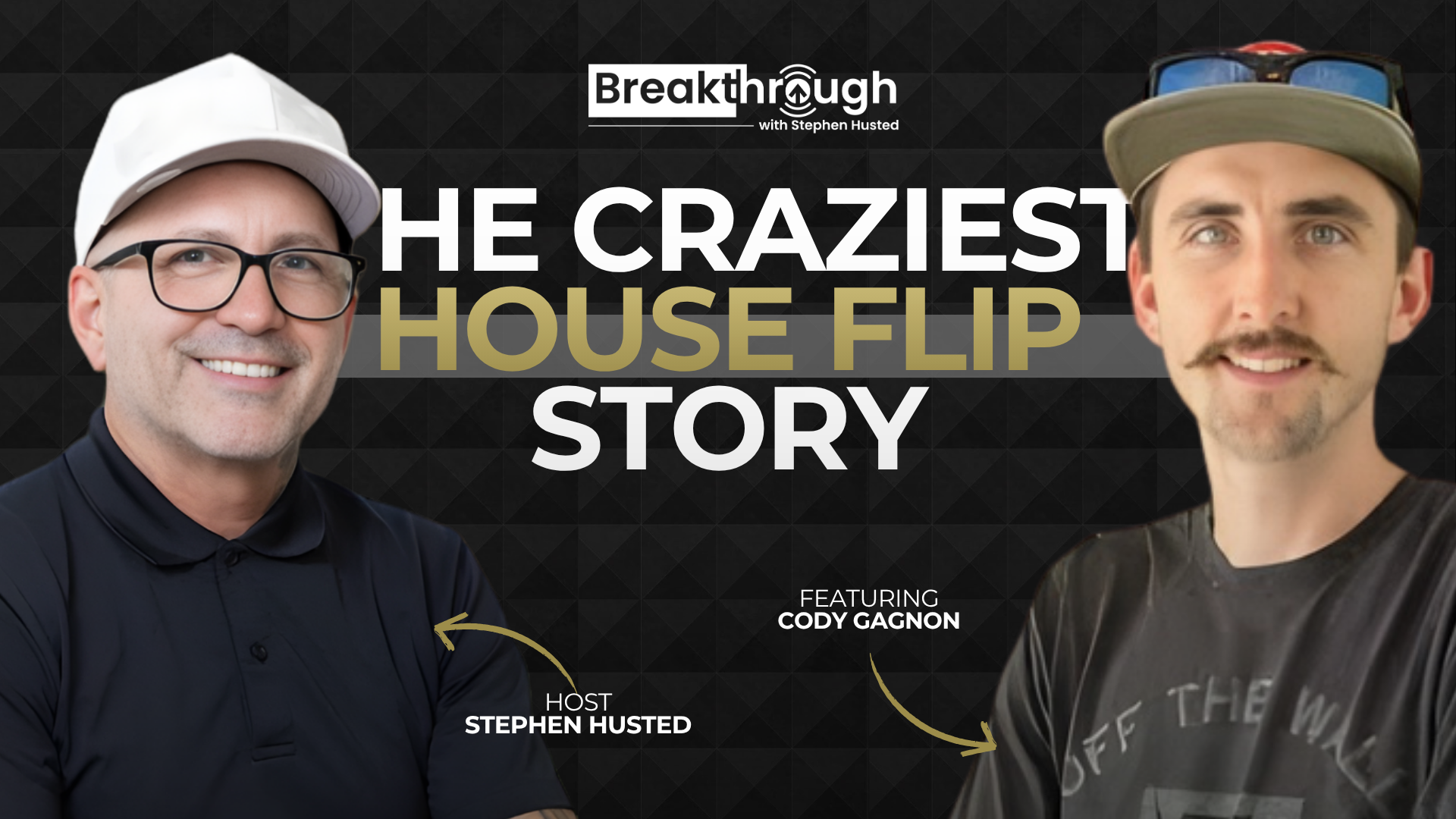
Episode 33 - The Craziest House Flipping Story with Cody Gagnon
This episode is for you if:
• You’re interested in the intersection between endurance sports and entrepreneurial mindset.
• You want to hear insights on real estate investing and scaling without compromising freedom.
• You’re curious about trail running, ultra-endurance sports, and balancing multiple ventures.
In this episode, Stephen sits down with Cody Gagnon, a real estate investor, endurance athlete, and multi-business owner who has an incredible perspective on managing multiple passions. Cody shares how his journey from cycling to trail running has influenced his approach to business and personal growth. With a background in flipping properties and a handyman business, Cody has built a lifestyle that supports his endurance goals and entrepreneurial ambitions. Listen in to hear how Cody balances training for ultramarathons, investing in real estate, and designing a flexible life that lets him pursue his passions on his terms.
Stephen and Cody talked about:
00:00 The Big Project: A Turning Point
02:11 The Duplex Deal: From Lead to Acquisition
08:52 Navigating the Chattanooga Market
10:55 Managing Properties and Tenants
17:52 Getting Started in Real Estate
20:34 Creative Deal Structures and Networking
26:45 Identifying and Structuring Deals
28:34 Advanced Real Estate Seminars
31:55 Adventure Racing: A New Passion
38:30 Endurance Training and Trail Running
49:16 Future Goals in Real Estate and Personal Life
52:42 Final Thoughts
TRANSCRIPT
∎ Teaser / Highlighted Clip
[Cody Gagnon] (0:00 - 0:18)
I've been really focusing on just like creative deal structure, not trying to present a certain strategy to a seller because I'm more about like just listening to what the seller has to say. I'm wasting so much time if I'm trying to do my own maintenance and all that stuff because I can just pay someone to do that for less than what I would charge to do it.
[Stephen Husted] (0:19 - 0:26)
One thing I tell people they're like, how do you get started? How do you do this? And like, how did you figure this out?
And I say, ask for help.
[Cody Gagnon] (0:26 - 0:35)
The best dealers come from solving weird, complicated problems that people have that may cause them to have to sell a piece of real estate.
[Stephen Husted] (0:35 - 0:38)
I think endurance sports definitely translates into our businesses.
[Cody Gagnon] (0:39 - 0:39)
Yeah.
[Stephen Husted] (0:40 - 2:37)
Just the mindset and powering through things. There's a big correlation with endurance sports and being an entrepreneur or a real estate investor. I think they have a lot of similarities.
∎ Podcast Intro:
Brace yourself for a wild ride into the unexpected. This ain't your typical success show. I'm here talking to real folks who've been through it all, skipping the fancy business talk for authentic stories.
We're diving into childhood dreams, teenage escapades, and everything in between. No scripts, just the stories that truly mold success. Each episode takes you on a journey through those breakthrough moments that paved their way.
No fluff, just genuine stories. So whether you're chasing dreams or just love a good story, buckle up for wisdom, laughs, and the unexpected. This is The Breakthrough Podcast, where success is a journey, not just some fancy destination.
Don't miss out. Hit the subscribe button now and join our Breakthrough crew. I got some incredible stories to share, and you won't want to miss a single one.
∎ Guest Introduction:
Hey, everyone. Welcome back to The Breakthrough with Stephen Husted. Today, I've got a really awesome guest for you.
I'm sitting down with my buddy, Cody Gagnon. He's a real estate investor, endurance athlete, all-around hustler. We actually met at the BiggerPockets conference a couple of years ago, and he's been on some insane adventures since then.
In this episode, Cody's going to break down how he found one of his best deals through, get this, his landscaper. Plus, we dive into his strategy for splitting lots, building duplexes, and how he's navigating today's crazy market. Oh, and if you're into endurance sports, you won't want to miss his wild story about racing across the state of Florida, paddling, biking, trekking for 72 hours straight.
Yeah, you got that right. This conversation is full of insights, laughs, some hard-earned lessons from real estate grind. You don't want to miss it. Let's dive in.
∎ Podcast Proper:
All right, buddy.
Cool, man.
[Cody Gagnon] (2:38 - 2:46)
How you been? Good, man. I'm glad I was able to get you on.
Yeah, it's been a little while. Probably a lot's happened since then. That was a couple years ago.
[Stephen Husted] (2:47 - 2:50)
Yeah, was it two years ago from that BiggerPockets conference?
[Cody Gagnon] (2:50 - 2:52)
Yeah, 2022 in San Diego.
[Stephen Husted] (2:53 - 3:01)
Interesting enough, I was just thinking about this when I was driving over here. I think I've had everybody who I personally met at that conference on the podcast.
[Cody Gagnon] (3:01 - 3:03)
Oh, awesome. Yeah, man.
[Stephen Husted] (3:03 - 3:20)
I think you're the last one. I think it was very random. I think I saw you post something on Instagram.
Then I sent the post over to my assistant. I said, hey, let's reach out to Cody. Let's get him on the podcast.
I go, he's doing cool stuff, and I want to follow up.
[Cody Gagnon] (3:20 - 3:37)
Yeah, for sure. You're probably one of the few people that I've followed since that meetup. Those seminars are just so big that you meet so many people surface level, but we had some similarities in going out and just riding stupid miles on bikes and stuff like that.
Oh, yeah. Kept keeping up with your story. It's been good.
[Stephen Husted] (3:38 - 3:51)
Yeah, and that's a cool thing too, right? You start to connect with somebody. It's not just about real estate.
It's the biking part, the aspect of it. Or, oh, Cody's got another project. All right, let's see where he's going to take this one.
[Cody Gagnon] (3:51 - 4:32)
Yeah. The one we just started a month ago, that's probably the biggest project that I've done up to this point. We can get into that.
That one was a turning point for me because it was one of the biggest ones I've taken on. It was one of the best deals that I've gotten. It was one of my first true motivated sellers.
I might make a deal or whatever, but this guy, that was my first real motivated seller experience. It was like an aha moment for me because I was like, okay, I know exactly what I'm looking for now. When I'm out door knocking or cold calling, if I'm not hearing those types of words or feeling those types of feelings, then yeah, they might be interested in selling, but there's no real motivation there.
[Stephen Husted] (4:33 - 4:39)
Yeah. You got that over time and experience and more defining your buy box, so to speak.
[Cody Gagnon] (4:40 - 4:40)
Yep.
[Stephen Husted] (4:40 - 4:43)
Yeah. Tell me how you found this one. Tell me the whole...
[Cody Gagnon] (4:44 - 4:45)
Yeah, yeah.
[Stephen Husted] (4:45 - 4:45)
Give me it all.
[Cody Gagnon] (4:45 - 8:30)
Yeah, for sure. Well, this is the last deal I did. I had two going, but one of them didn't close, but this one, I actually own a duplex right up the street from this house.
I've been doing a lot of cold calling and door knocking, more door knocking than cold calling, but in this particular case, it was actually my landscaper that brought me the deal. He had been cutting the yard to this house for like 10 years and I have a duplex right up the street from there. He'd go from there to that house and then leave.
He had just finished that house up and the owner showed up as usual to hand him a check. He was just venting to him, I think. He was like, I just had some family move out of this house.
They've been living there for several years and he didn't realize how they were living in there and really what the real conditions of the house were. And he was just over it. He was like, I have to get rid of this house.
I don't ever want to come back to East Ridge again. I just need to get rid of it. And then Danny, who's my landscaper, he just thought of me because we're always talking.
He cuts all my properties too, so he just knows that I'm in the business. So he called me to tell me. He said, hey man, you won't believe this guy just saying he needs to get rid of this house.
Here's his info. And then yeah, I had to meet with that seller maybe three or four times, but we eventually made a deal. And this one's a single family.
Usually I don't really try to hold houses. If it's single family, I'll usually just try to flip it and take the cash and dump it into some multifamily or some type of bindhold. So at the time it was a four bed, one and a half bath on a 1.6 acre lot. And it's on a corner lot too. So it has road access on both sides. And we just got lucky enough that the house sits to the backside of it.
So we had the house. I'm splitting the lot, the survey and all that stuff still in the works, but we're getting two lots out of the bottom of it where we plan on putting a couple of duplexes actually. So yeah, it just turned into a big deal.
And he, as far as price goes and stuff, I met up with him three or four times before we actually made a deal because he said that he was going to offer it up to a couple of family members first and stuff like that. And I was like, sir, what do you think the house is worth? And he says, I always had to have a hundred thousand for it.
And I was trying to hide my, you know, I was like, oh, okay. You know, just trying to, in my head, I knew that the house when it was done was worth 300,000, just the house itself, not even including the lot split and all that stuff. So we get inside, it's nasty.
They had a bunch of pets. There was literally like cockroaches coming out of the toaster, all kinds of crazy stuff. And we're getting like one of the worst rooms at a house.
And I'm like, so I was like, what do you really mean for this house? He started at a hundred thousand. I was like, we'll see what he says.
And he was like, okay, so I mean, I'd probably really need a hundred thousand. And long story short, that's what I got it for. But yeah, the ARV is about 300 to 320 because we turn into a four bed, two bath, it's 1,700 square feet.
And then the lots themselves, those will be free and clear. But those just by themselves are about 30,000 a piece. They're like 10,000 square foot lots.
But across the street, like I said, I have that duplex, it's all duplexes over there. So we're going to split them and then try to get them rezoned as R2, put two duplexes there. And those will be holds.
And when I say we, I brought a partner in on this one. He does a lot of flips, like five or six flips at a time. And he just has a lot more experience with some bigger construction projects.
So I brought him in for one, just because I knew that was going to be the biggest project that I had. But two, he also had the private money connection at this point. So I brought the deal, he brought the funding and some of his, we kind of put our contractors together, but he just brought some of the experience behind it.
And yeah, it just worked out really good, man. Because up to this point, I've been bootstrapping everything, hard money, loans, and stuff like that. So I can usually only handle a few deals at once because all those monthly payments are just like, it gets crazy.
But with the private money, it's been like, we got all the money at Furzy and we don't owe any of it until we close again when we sell it. So it's been way more stress free. We just get stuff done.
We pay people when they're done and we just move on with our lives. It's been awesome.
[Stephen Husted] (8:31 - 8:44)
Yeah, that's cool. So you're surveying the lot, right? So first and foremost, and then you're going to build two duplexes on there.
Do you know how much you're going to be spending on building those out? And then what's the ARV on those?
[Cody Gagnon] (8:45 - 9:45)
Yeah, roughly between $125 and $150 a square foot on the build. Just depends on who we end up using, but that's on average what we could get it done for. It'd be like, well, two bedroom, one bath, each side duplexes.
And the ARV in that area for that type of duplex that we're targeting is going to be between $280 and $300,000. The one that I had up on the street there, I had that one for a while. I actually ended up selling that duplex, but like that sold for $280, but there's a couple that are sold for low threes that were just a bit more updated than the one that I had up there.
So that's good. It'll be pretty good. And then even worst case, like a house, even if we couldn't get the R2 zoning, it'd probably cost us, and we're in a different market obviously, so the price is a lot different, but we could probably get a nice little 1200 square foot house built for like $125K, $125K to $150K and the ARV is probably about the same.
For a smaller house like that, probably $260, $280.
[Stephen Husted] (9:46 - 10:00)
Yeah. So there's lots of different options that you have on it, which is great because you got that lot and the timing was perfect too, because he was done. He finally went over there and walked that house and he's like, no, I'm not renovating this place.
[Cody Gagnon] (10:00 - 10:45)
Yeah, she was about 20 minutes away. And I guess that was kind of like a family house that had been passed down. He was the last one to get it, but he was out of Eastridge.
These are all suburbs of Chattanooga, Tennessee, but he's like, I just don't ever want to be in Eastridge again. I don't live here. I don't want to drive down here anymore.
So yeah, he was ready. And that one, there was no, it wasn't a creative deal or anything. We just, we paid him cash and moved on.
But I've been really focusing on just like creative deal structure, not trying to present a certain strategy to a seller. Cause I'm more about like just listening to what the seller has to say. And then out of whatever problem they're solving, I'll just offer them whatever strategy works to get the deal done.
But because people have different unique problems, like I've been really interested in pushing like more creative type deals.
[Stephen Husted] (10:45 - 10:56)
Yeah. Because it's not a one size fits all type scenario when it's cool that you had your landscaper in the mix there. Did you give him a finder's fee?
Yeah, man.
[Cody Gagnon] (10:56 - 11:20)
And yeah, I paid him a thousand dollars for that. And I told him, I said, any house you bring me, I'll pay you a thousand dollars. If you're out there, if you bring me a small multifamily property that is distressed for some reason or another, if I close on it, I'll pay you 2,500.
So, man, I've put that out to a bunch of people. A thousand dollars for a house, 2,500 for two units or more. I'd pay that all day long if people were going to bring me deals like that.
Oh yeah.
[Stephen Husted] (11:20 - 11:26)
Yeah. You could have a couple of deals a month and be like, okay, now I got to pick which ones I want to do.
[Cody Gagnon] (11:26 - 11:27)
So yeah.
[Stephen Husted] (11:28 - 11:37)
How is the Chattanooga market? How is it health wise right now from everything that's been going on with the interest rates? Is it still doing pretty good?
[Cody Gagnon] (11:37 - 12:44)
Yeah. Probably like the whole Chattanooga metro area is probably maybe 400 ish thousand people. So it's not a huge, but it's a small little like metro.
The thing about it is markets like Nashville, even in Atlanta, San Diego, LA out that way, these bigger cities, they were seeing a lot more, a lot more hits, steep price cuts. I wouldn't say necessarily a crash. Things slowed down.
And then we did see some price cuts there for a while. In Chattanooga, it's still such like an affordable market that we didn't really see price dips. Things did slow down a little bit.
Like the days on market, we're seeing a lot of 40, 50, 60 days on market, depending on the price point. But price has never really like dipped. We just slowed down a little bit, but it's still very steady.
Like I would say in Chattanooga, if you're still like under 400,000 price point, then it's moving pretty quick. Anything that's like 500 and up, then those are sitting long because the monthly payment is just affected so much greater. So it's still pretty healthy.
For an area that is pretty affordable, the rents are still like really good. So it makes it easier, especially if you're buying multi-family.
[Stephen Husted] (12:44 - 12:48)
Yeah. Are they been going up too? Or are they been staying steady?
[Cody Gagnon] (12:48 - 13:15)
Very steady. Yeah. I noticed right when all that happened and things were sitting on the market longer and rentals are sitting on the market longer.
For whatever reason, people just were like, we're not moving. I had a couple vacancies last year and one this year, which that one didn't take too long because it was a smaller, more affordable unit. But at first it was like, I mean, within a week or two, you're filling units.
And I had a couple that sat for like about 30 days or so. So not terrible, but it slowed down. Yeah.
[Stephen Husted] (13:16 - 13:21)
Yeah. And it's hard when you get that 30 days because it feels like it's three months. It does.
[Cody Gagnon] (13:21 - 13:21)
Yeah.
[Stephen Husted] (13:21 - 13:36)
Because you're so used to a certain way of like, oh, Ted, it's moving out. I'm going to go clean it up a little bit, get it back on the real market, get Ted in there. And you're like, wait, that's not happening.
But you're holding mostly multi, the duplexes. Is that right? Or do you have single families too?
[Cody Gagnon] (13:37 - 14:47)
I have two single families, but the rest is small multi. I'm sure in most markets, but even in a market here, Chandler is a relatively good cashflow market. But even in a cashflow market, the single families, I mean, yeah, you might, especially with rates out there, you might cashflow like 200 to 300 bucks a month if you bought a decent deal.
But if I get a duplex at a good price, since a duplex almost sells for the same cost as an entry level house in Chattanooga, but I'm getting two double the rents. So both of my duplexes, I did buy them maybe a couple of years ago, but they all cashflow like a thousand dollars a month. And I wasn't buying market value and all that kind of stuff.
But even if I get a house at a good deal, it's still hard to really cashflow that much because again, there's only one rent. If I can rent a three bed, two bath for 2000 bucks, then with current rates, I need to be at least all in 200,000. If it's less than 1%, you're not really in cashflow at a six and a half, 7% interest rate.
I don't do them for like a point and a quarter or a point and a half rule instead of a 1% rule. That number is working a lot better right now just with the way rates are.
[Stephen Husted] (14:47 - 14:53)
Yeah, that's good. So are you still the handyman for your properties?
[Cody Gagnon] (14:55 - 15:43)
No, I still own the handyman business, but it's funny because I actually have them like fully separate. Like when I buy a deal, so with the real estate business and the handyman business, when I buy a deal, a lot of people are like, oh yeah, of course you would do real estate. You know how to do all the work.
You'll just do the work yourself. And I'm like, well, I actually keep it separate because I'm wasting so much time if I'm trying to do my own maintenance and all that stuff, because I can just pay someone to do that for less than what I would charge to do it. So basically if I have my guys getting jobs done in the handyman business, and when I buy a deal, I'm running the numbers to pay someone to do the remodel, the rehab, and all that stuff.
Then you're making money in both areas versus if I'm doing all the repairs and doing all the work, you're making less money. So I actually hire all that stuff out. Good.
[Stephen Husted] (15:43 - 15:44)
But you did in the beginning, right?
[Cody Gagnon] (15:45 - 16:05)
Yeah. In the beginning, I was managing my own properties and I didn't have a lot. I think I managed up to like four doors.
And then I had one incident that I was just like, yeah, this isn't for me. I enjoy finding the property and managing the construction part of it. And then as soon as it's done, I just pass it to my property manager and just move on and start looking for the next one.
[Stephen Husted] (16:05 - 16:06)
Yeah.
[Cody Gagnon] (16:06 - 16:07)
In the beginning I was, yeah.
[Stephen Husted] (16:08 - 16:20)
But it's all a process, right? In the beginning. And you realize, wait a minute, I don't want to be time sucked if I have all these doors.
Next, you know, I'm spending six hours a day on property management stuff. It takes away from the cool stuff.
[Cody Gagnon] (16:21 - 18:14)
Oh yeah, for sure. And it's harder to make, it really is harder to make good business decisions too when you're managing. And the incident that had me decide to just start using a property manager was I had bought a property and I was trying to give them that 30-day notice because they had been on month-to-month rent leases for a few years at that point with the old owner.
Anyways, I was trying to give them a notice to get out of there so I could renovate and get the rents up because we were way under market. And, you know, I got this whole like, he got angry and I got his whole life story on how he can't move and this and that. And I was like, this is really preventing me from like making a good business decision.
Obviously, I didn't want to just put him out on the street, but at the same time, it's like, now there's a mortgage on this place. Like, things just need to be done. This property, it only makes sense for me to even own this thing if I do what I need to do.
So, from that point forward, I moved on and that's actually a funny story in itself and I can make it quick. But essentially, that tenant in particular, the one I'm talking about, this was the first duplex I ever bought. And he really didn't want to move, it just comes to find out.
So, we actually worked a deal out with him because his kids go to school right there and everything. So, we worked a deal out with him. I said, hey, if you can give me 30 days to fix this unit up for you guys and give you a nicer place to live, I'll let you stay.
There'll be a slight increase, but because I don't have to look for a tenant, I'll give you a deal still on the rent. So, I kept it like one or 200 bucks under market rate. And he thought about it for a little while and they accepted it.
So, they signed a lease with me starting a month in the future so I can secure myself. And then I had him move out. They put all their stuff in a pods thing, pods storage container.
They stayed with some local family for a month and we turned the unit and moved them back in at an increased rate. I didn't have to look for a new tenant. So, he's still there today.
They're in there today. They're still there. I've had that place for like three years now.
[Stephen Husted] (18:14 - 18:36)
There's something to be said that you get a tenant that just doesn't give you any issues and is hassle-free and they've been staying. Those little slight rent increases are just not even worth it. They just really aren't.
It's better to keep them in because the minute you move them out, then you got to do the turnover. You're going to spend money there and then you don't know who the heck you're getting next. It could be your worst nightmare.
[Cody Gagnon] (18:36 - 18:37)
Yeah, absolutely.
[Stephen Husted] (18:37 - 18:38)
Coming down the pipeline.
[Cody Gagnon] (18:39 - 19:01)
Yeah, and at a minimum, I don't think I've ever had a unit that didn't at least just need to be painted and cleaned. And so, just the cost to get things done now, I mean, you can barely get a unit painted for under $2,000 and you're going to be $1,500 to $2,000 depending on the size of the unit. And depending on how good of a deal you have, that could be like a whole year of cash flow just getting the place painted, you know?
[Stephen Husted] (19:02 - 19:04)
100%. Yeah. 100%.
[Cody Gagnon] (19:04 - 19:32)
I've tried to get better about that and all the time, my property manager will email me and say, hey, what's your feelings on this one? Their lease is coming up. Do you want to increase it or not?
If I'm already close to market, at least somewhere in the ballpark, I'll leave it. Leave it. There was a legacy tenant that I inherited.
If we're already way under, then I'd rather just take the risk and get them out of there anyways, so that way we can jump. But sometimes it's five, six, 700 bucks. That's how low they are.
So, there's a lot of missed opportunity.
[Stephen Husted] (19:33 - 19:34)
Yeah. It's like a puzzle.
[Cody Gagnon] (19:35 - 19:35)
Yeah.
[Stephen Husted] (19:35 - 19:54)
And then you have those ones that are really low, but then your property taxes have gone up and there's all these other little things that have gone up, but you're still below and you have to make that decision for the business as a whole that you have to kind of move it in a direction. But everything is somewhat at points, a case by case.
[Cody Gagnon] (19:54 - 19:54)
Yep.
[Stephen Husted] (19:55 - 20:10)
Like we have one tenant in a duplex and we haven't raised her rent in a couple years now, I would say. And she just chills and we just leave her alone. There's no reason to go.
And we would probably gain another $100.
[Cody Gagnon] (20:11 - 20:11)
Yeah.
[Stephen Husted] (20:11 - 20:14)
It's like, that's not changing it for us.
[Cody Gagnon] (20:14 - 20:14)
Yep.
[Stephen Husted] (20:15 - 20:19)
But then how many properties do you own now? How many doors do you have right now?
[Cody Gagnon] (20:19 - 20:20)
Seven doors.
[Stephen Husted] (20:21 - 20:21)
Okay.
[Cody Gagnon] (20:21 - 21:47)
Yeah. Yeah. Nothing crazy, but that's it.
And so, yeah, seven doors. I started really buying properties. It was like 2021.
So, like a year before I met you. I bought my first property in 2019, but it was like my own house. I had just gotten out of the Navy.
I had some money saved up. I bought my house and ended up kind of just flipping that one while I lived there. And that's what really got it going for me because I think I bought that house for $104,000 and then I put $20,000 into it while I lived there and I sold it for $180,000.
And then $190,000 about like a year and a half later. And I was like, man, that was kind of crazy. Yeah.
And then I just started diving in. So, I probably sold it in like 2020 sometime. And then I just started getting addicted to just learning about it, man.
I just started listening to podcasts. Of course, all the bigger pocket stuff that really got me going and then diving into more specific books on certain things I was missing and trying to learn about. And then really the biggest thing though, aside from any of that was when I moved here, just networking and getting in front of people and having just a network base to tap into every time.
Hey, what lender are you using? Or hey, do you know a good attorney? If anything comes up, you can just text a couple of people and you'll probably have an answer.
[Stephen Husted] (21:48 - 22:29)
Yeah. And I think that's a big point because I think that one thing I tell people, they're like, how do you get started? How do you do this?
And how did you figure this out? And I say, I asked for help. I just asked for help.
I don't consider myself some super smart person that's it all figured out. Most of the time when I'm going in a new direction, I don't have a clue what I'm doing. I'm just like, I'll do some initial research.
I start to figure out who can help me do this, who needs to be on my team. And then I just go after those experts. And then I just get them on board and start to learn whatever that strategy is I'm trying to pull off.
But you just got to do it. You never start off and you're never going to figure it all out in real estate. That's the thing about it.
[Cody Gagnon] (22:30 - 23:15)
That's what I love about it. There's so much going on that you're just always learning because even once you get the traditional pathway learned of buying a property, okay, how does funding work? What's earnest money?
You learn all this stuff on just how to buy a property and then you might do a couple of those. And then there's this whole other world, wraps and owner finance and options and all this creative stuff that then you start learning that stuff and it's like, okay, now we're doing deals with other people's money or we're doing deals with no money down, stuff that you can't even comprehend that until you just know the basic stuff. That's what I've been diving into now and it all stemmed from the seminar I went to in February, which was the best thing I ever did.
Oh, really?
[Stephen Husted] (23:15 - 23:16)
Tell me about it.
[Cody Gagnon] (23:16 - 27:24)
Yeah, it was so good. It's not bashing on bigger pockets or anything like that, but bigger pockets is really good surface level info, just get you motivated, realize how the asset of real estate is beneficial and all that stuff. And it's been good.
I went to their seminars. There's thousands of people there and you meet a few people, but I went on this cruise in February. It was a cruise slash real estate conference and it was called Generations of Wealth and I was referred to it by a local guy here in Chattanooga named Mike Cakes.
He goes every year and he invited me to go and it's just a bunch of like old gray hair dudes that run it, but they've been in the business for 30 years or whatever. And they're all doing mainly like creative deals, creative deal structure. And man, it was just awesome because one, it was an eight day cruise.
So I was kind of just like on the ship with all these guys and the people attending the seminar for eight days. That's a long time. Yeah, it was great.
So the seminar was only four out of the eight days. Okay. So it was a good mix between kind of like a vacation and the seminar, but how they would do it was we'd have, so like the first day of the seminar, we'd have the two speakers for the day.
And then so you listen to them speak and then we get lunch, but we're on a cruise ship. So like, we all kind of like, you know, you'll start getting lunch with everybody and then you go back to the seminar. And then even after the seminar is over, like if you go to big pockets, for instance, the speakers talk and then when they're done, they go backstage.
You'd never see him again. Right there. They just go sit in the crowd with everybody else.
And there's only 20 or 30 of us there. And then after the day's over, they don't even hold it all day. It'll be, it's over by like one 32 o'clock, hang out on the ship for the rest of the day.
And then we all meet up for dinner. We all have dinner together and then they have these, they called them these town hall sessions. But every night, even if it was a day that they weren't having speakers every night in the same room, we'd meet up at 7 PM.
And like, we, you know, we'd bring drinks in, everybody would stop at the bar and grab a drink on the way in. And we would just sit in a big circle and be like, Hey, we talked about this today. Like, do any of you guys have deeper questions into that topic or how this works?
And so we're just having this like big mastermind with all the same people, just not on like a plan structure. It's just kind of like a Q and A. It was awesome.
And anyways, I met this guy named Bill Kirk, which you may or may not heard of. A lot of people that listen to your podcast may have heard of, but Bill Kirk is one of those guys, man, old, old guy, gray hair. He doesn't have a ton of hair anymore, but he was, he was super smart.
And he's from Cartersville, Georgia and him and his wife Kim, they live in Florida and Georgia at the moment. They're kind of bouncing around. They're kind of in that like ender phase where they're pretty much retired, but he's like the option guy.
Like I learned what options were and how options work. And also he finds all of his deals from door knocking. And that was like a new concept for me.
And man, it's just been good. Cause I feel like it really it's not the most scalable strategy, but it's definitely probably the most effective strategy just because people are getting blasted all day by cold callers, especially if you're high equity or you're pretty foreclosure or this or that. Those people's phones are getting blown up.
They are not going to answer or as soon as they find out what you're calling about, they hang up on you. And then everybody's mailboxes are stuffed full with mailers. We buy houses, cash, all that stuff.
So when you show up to someone's house and you knock on their door, they're way less likely to just shut the door on your face or tell you to go away. But the biggest thing, honestly, that I learned this year was how he talks to people. Like he doesn't want to show up and say, Hey, I was going to the Hamilton County eviction list.
And I saw that you're going through an eviction. I'm here today because I was interested in buying your house. He will say something more like, Hey, I'm talking to landlords today that are, that are going through evictions.
What can you tell me about it? And like, he'll just, he'll ask them 10 questions before he will propose anything to them. He'll just keep asking them questions.
Then he learns the whole thing. If he finds that they're like, Oh, it's just another day in the business. Yeah.
I had an eviction, but like we're turning the unit. They can tell that it's not distressed. And he's like, okay, I understand.
He moves on. He's looking for that. He's looking for someone to give him enough information that he's okay.
There's a problem there that I can solve. And then he goes in. So basically just asking questions, which one leads to a way more natural conversation and finding a sale.
[Stephen Husted] (27:24 - 27:24)
Yeah.
[Cody Gagnon] (27:24 - 27:38)
And finding trying to put the deal together. Yeah. And he tells people, he even tells me, I'm not here to sell you anything.
I'm here to help you. If I can, let me ask you a couple of questions. And then you just find out if there's a problem or not.
And if there is, you capitalize on trying to help them out.
[Stephen Husted] (27:38 - 27:43)
Did you use that knowledge on the property you just closed on?
[Cody Gagnon] (27:44 - 28:21)
Yes. In a way that one was just a true, like he wanted out. So in that case, the big hammer works cash offer.
He just wanted cash. He wanted to walk away. He didn't want to be attached to the property at all.
So owner financing is out. If it had a mortgage on it, sub two is out, all that kind of stuff. So that one, we didn't have to get into the weeds as much on it.
We just gave him the number he wanted and that was it. But the other deal that I got under contract shortly after that was a lot of just asking questions and not doing a lot of talking like I'm doing now. Just listening and coming up with a solution.
So tell me the structure.
[Stephen Husted] (28:22 - 28:27)
So you said options, wraps. Let's give a version of what that really means.
[Cody Gagnon] (28:27 - 29:20)
Yeah. So like I kind of touched on it in the beginning, but one of the most important things I learned from Bill Cook is stop going out and looking for a house to buy. Start going out and you don't know if you're there.
Are you there to buy a house? Are you there to rent a house? Are you there to maybe there's nothing that you can offer them?
Start going out and looking for problems that you might be able to solve. And so with that, that's a problem with wholesalers and other people like, oh, I really want to go get a sub two deal. I want to get a sub two deal.
If you reduce yourself to sub two only, there's way less opportunity to get a deal. So why not go out and look for problems? And out of all the strategies that there are to buy real estate, offer that to solve their problem and you're way more likely to get the deal.
And now you're open to just more available deals in general. If you're going out only getting cash offers, sometimes cash is not going to solve their problem why they want to get rid of the house in the first place.
[Stephen Husted] (29:20 - 29:26)
Yeah. It's identifying their problem, trying to figure it out first and foremost, and seeing what you can do, then structuring it out.
[Cody Gagnon] (29:26 - 30:45)
Yeah. So I always find a problem, then structure the deal to exactly what they're asking for. And as far as what you're asking, Adam, those tools in your toolbox as like, back to Bill Cook, and I'm actually going to another one of his seminars in September in Florida.
But there's cash, there's owner finance. If maybe it's an older landlord that's looking to exit the business and trying to spread out his tax liability. Maybe it's sub two, if they're underwater, but they're locked into a super good rate because they bought five or six years ago.
Maybe it's an option. Maybe they don't want to sell now, but they're tired of dealing with the property. So maybe you master lease the house from them with an option to buy in the next five years when they are ready to sell.
So now they get the cash flow they're used to, but you'll take care of getting the property rented out and take care of the maintenance. And you'll secure an option on the property so you can buy it in five years from now at a predetermined price now. Those would be like some of your main ones, but just let them talk to you and then pick one of those.
And the option thing, man, that kind of blew my mind. That's like one of my favorite strategies now. I haven't actually executed an options agreement yet, but there's a lot more that goes into it.
And so I'm still learning and looking for those opportunities, but again, not forcing it. Not like, oh, these options sound cool. Let me just go try to lock up a bunch of options on properties.
It's just, they only work in really specific situations.
[Stephen Husted] (30:45 - 31:09)
Well, I think more so is the fact that you went on the cruise, you went in these groups, and then now you just, you're aware of it. So it's going to be in the back of your head for that moment when you meet up with that owner and it makes sense and you know it right away. And I think that's the biggest key to it all.
It's just, you just got the knowledge. It's in your back pocket. It's like part of your toolbox, so to speak.
[Cody Gagnon] (31:09 - 32:00)
Yeah, for sure. And it was like just the right timing too, because they advertise that seminar as an advanced real estate seminar. But if you were just starting, if you would have went to that seminar, it would have just been like a fire hydrant.
You went to collect the real gold that was there. That's why BiggerPockets is good for just collecting this base level knowledge, right? And then when you go to the more advanced stuff, now you're just filling some empty holes that you had.
Versus if you would have been a beginner to that one, it would have been a bunch of info dumped on you and you wouldn't have really walked away with some value there. Your brain would have hurt really bad. So I was able to actually go home and implement it, like you said, because it was like, okay, I already have all this base knowledge.
I've already done several deals. So I just filled all these other little holes in my brain of missing pieces of info. And now it's like this open world of so many other different ways to do things.
So it's pretty cool.
[Stephen Husted] (32:01 - 32:02)
Yeah. How much was this?
[Cody Gagnon] (32:02 - 32:51)
Oh, man. And it's like half the price of BiggerPockets too. So that generation's a wealth.
The seminar ticket is like $700. And then you also have to buy the cruise ticket because it's on a cruise ship, which can be anywhere from like 1200 bucks to like 2500 bucks. It depends on what room you want and all that kind of thing.
But you'll get a little bit of a deal because you're using their travel agent. They're getting like some special pricing for the event. But like Bill Kirk's, so he has a, he calls it Whatbox.
It's called the Whatbox Seminar. And it's in Florida. So Whatbox question mark.
When people think, say like, think outside the box, they'll say like, Whatbox. So anyways, Whatbox Seminar, that seminar is like $600. And you just have to get to Tampa, Florida.
That's it. It's two days at a hotel down there. Yeah.
[Stephen Husted] (32:52 - 32:55)
And the main focus is more creative financing.
[Cody Gagnon] (32:55 - 33:50)
That's creative de-restructuring. So not necessarily creative finance might be part of the deal structure, but it's more on creative deal structure. And what he means by that is kind of what I'm explaining to you.
The best dealers come from solving weird, complicated problems that people have that may cause them to have to sell a piece of real estate. And so that's what was on my mind. And you don't hear a lot of people talking about it like that.
And once I changed that mindset, how I started hearing them talk about it, it was like, wow, you really could have a way higher closing rate. If you were going at deals like that, then just going like, how low can I get this seller on the price and give him a cash offer? Because what if someone was like, yeah, I want to sell my house, but I need 250,000.
And it's like, well, I'm paying you cash. I can only pay 175. It's 175 or I can't do the deal.
And I'm like, okay, well, I'm not selling you my house then because I need- Right.
[Stephen Husted] (33:50 - 33:54)
You just missed that opportunity of trying to figure out how to structure it.
[Cody Gagnon] (33:54 - 34:23)
Well, what if they're willing to hold a note and what if they own it free and clear, or maybe they would only have 80,000 of debt on it. And you take the 80,000 subject to and you own or finance the rest of the equity and you get them to give you all your payments to them are principal pay down. So you can pay the 250,000 as long as they give you at least a 10 year note, because by the time you get to refinance, you'll have paid off so much principal balance that you'll have no problem refinancing them or whatever.
So now you can pay 250,000, right?
[Stephen Husted] (34:23 - 34:24)
Yeah.
[Cody Gagnon] (34:24 - 34:27)
So once I can look at stuff like that, I was like, man, this is a game changer.
[Stephen Husted] (34:28 - 34:30)
That's cool. That's so great.
[Cody Gagnon] (34:30 - 34:30)
Yeah.
[Stephen Husted] (34:31 - 34:37)
So what else have you been up to recently? You've been riding? I know you did a big race.
Where was that? Was that big race in Florida?
[Cody Gagnon] (34:37 - 35:39)
Yeah, man, it was. Yeah. Aside from real estate, I've been in my high school years, I was really into more endurance style, like cross country racing.
And then throughout the Navy and just more of my adult life, I've been really into just more aggressive, like enduro riding berms and jumps and how big can I go and all that stuff. But I've been going back into the pain cave a little bit and starting to enjoy just going out for hours and seeing how hard I can push myself. So yeah, I did a race in Florida across the state of Florida in February.
That was actually right before that cruise that I was telling you about. And it was awesome, man. 72 hours, like 360 miles.
It was a 72 hour cutoff. That one was a mixture between cycling, paddling, and trekking. So trekking would be just whether you're hiking or running, you just have to get there.
So that one was not a traditional just bike event. They actually call it adventure racing. I don't know if- That's cool.
I don't know if you've heard of adventure racing.
[Stephen Husted] (35:39 - 35:44)
No, man. I've never heard of that. I was like, wait, you had to get on, you had to paddle on a boat.
Is that what you just said?
[Cody Gagnon] (35:44 - 36:20)
Yeah, it was a cruise boat. So an adventure race, it's those three disciplines. It's mountain biking, paddling, and trekking is what they call it.
And this one was a 72 hour, so they call that an expedition race. So it's a regular adventure race or an expedition is anything more than like 20. An expedition, I think, is 72 hours or more.
And usually 72 hours to five days is like a normal expedition race. But in that, there was probably a total of 200 something miles of cycling, about 60 miles of paddling, and about 60 miles of trekking.
[Stephen Husted] (36:21 - 36:22)
60 miles of paddling.
[Cody Gagnon] (36:22 - 37:51)
Yeah. So there was two paddle sections. How it works also is the other caveat to it is it's not a marked course.
There's a finish line and they drop you off at the start, which was on the other side of Florida. It was like a three hour bus ride. And there's no marked course.
It's a self-oriented race. So they provide you the maps with checkpoints on them. And you orient your way across the state as long as you're hitting those checkpoints.
And so everybody's going a different way, whatever you feel is the fastest. So you have to know how to read maps, use a compass. You know, do we want to go this way or is it going to be faster to stick on the road?
Or should we kind of just cut through the woods right here? So you're making your own way across the course and then they have transition areas. So it might be, for instance, like we started out with a paddle.
It was like a six hour paddle. Obviously, we didn't know exactly how long it was going to take us in the beginning, but we started, we went from coastline to coastline. So we started like in this bay and we could see where we need to finish.
And we were like, it's roughly this many miles that we measured it out. So it's probably going to take us X amount of time. That one took us about six hours.
And then it was right into a bike. It was like an 80 mile bike, which was a mix between like gravel roads, paved roads. We were on the Florida trail for a little bit, which was a single track.
So I think total out of that whole adventure anyways, there was like three or four cycling sections. There was two paddles and there was two trekking sections. And the second paddle, it took us eight hours.
We were in a canoe for eight hours. I was on a four man team. Yeah.
[Stephen Husted] (37:51 - 37:53)
Oh, so you're on a team. Okay. All right.
[Cody Gagnon] (37:53 - 38:37)
You can go from a solo up to a four man team and then all male, all female or co-ed. And so I was on a four man, all male team, but you all have to finish the race together. If you don't all finish, then you get disqualified.
And how you win is finishing the entire course before the cutoff and who collects the most checkpoints. So you don't even have to collect all the checkpoints, but that's how you win. Most checkpoints collected and finished before the cutoff.
Are you in the Everglades? It was crazy, man. No, this one, we were actually up north in Florida.
It was from St. Myers to St. Augustine, which is up by the panhandle. And then we went all the way across to St. Augustine.
[Stephen Husted] (38:37 - 38:38)
No, no Gators.
[Cody Gagnon] (38:38 - 40:36)
No, no, but quite a bit. Yeah, quite a bit of wildlife actually. So that race is called the C2C.
And that was a brand new course, but they actually do normally hold it further south where there's, so this was the first year they held it up where they had it. So it was a new course. It actually ended up being way harder than they thought it was going to be.
And out of a hundred and I think it was like somewhere around 150 teams, only 10 teams actually finished the entire original planned course. And we were the 10th one. Really?
Yeah. We were the 10th one. That was my first adventure.
Yeah. So the last paddle, the last paddle was a few hours in a river inland and it dumped us out into the ocean because the last paddle was pretty close to the end. At the end of that paddle, it was one bike to the finish.
Anyways, it dumped you out into the ocean and there was this big Bay cross. There was this big Bay that we had to cross. And it was like one in the morning by the time we got dumped into that Bay.
And we were actually like the third or fourth team to get there. And the storms were rolling through and the Bay was really big. And so the water got really rough and the first place team dumped their canoe in the middle of the Bay at one in the morning.
And so they had to get all their stuff to shore. Actually, they ended up having to send somebody out to help them. We have these trappers on us and you don't have phones or anything because it's self-orienteered.
They don't want you to cheat. So they actually had to come help them out. And so if you were already going, they were letting us go, right?
But because the weather wasn't getting any better, they redirected the course and anybody who hadn't got to the Bay yet, once they got to the Bay, they were having them cut that section short for safety reasons. So yeah. So we were like one of the only, one of the 10 teams that actually completed the entire course.
The rest of the teams had to do an alternate route, which means they also missed some of the checkpoints. Yeah.
[Stephen Husted] (40:37 - 40:37)
Oh, wow.
[Cody Gagnon] (40:38 - 40:58)
Yeah. Dude, this sounds crazy. It was wild, man.
It was really good. So I'm doing another adventure race next month, but this one's only a 10 hour. So they call them speed races, but it'll be the same three disciplines, but within 10 hours, I think it's 30 to 40 miles of cycling, like 10 to 12 miles of trekking and 10 to 12 miles of paddling.
[Stephen Husted] (40:59 - 41:03)
So weren't you doing some running as well? Did you do some running?
[Cody Gagnon] (41:03 - 44:13)
Yeah. I thought I saw that. Yeah.
Like I said, I've just been going down the rabbit hole of endurance stuff lately. Because how I started was I was training for that 72 hour race. So, oh, and by the way, in between the segments, the turn doesn't stop, right?
You have to finish in 72 hours. So like if you sleep, it's up to you. You have to strategize when you're going to sleep.
Are we still going to have enough time to finish? Yada, yada, yada. So you, cause you're going through the night from a paddle right into a bike, right into a 30 mile hike, right into, you're just going, going, going, we might stop and hey, let's get like a quick little two hours.
Cause like we can't even read the map anymore. We started, I was, we were paddling that one at midnight and we kept thinking we saw the shoreline, but we'd get there and it wasn't there. So there was, out of the 72 hours, we did it on four hours of sleep.
Cause you got to sleep, right? But you just can't do it. So to answer your question, that was in, I was training for that race.
And because of the trucking and just the amount of time on your feet and stuff, I picked up trail running. So to this point in my whole life, I've only ever raced mountain bikes, rode a lot of road bikes for cross training. You know what I mean?
And, but I was like, man, I got to start probably trail running too. I kind of trained for this race. So I started trail running and Megan, my girlfriend's already like a pretty avid trail runner.
She's run 50 miles, a hundred milers. Really? Yeah.
We'll be out in Phoenix again in October for the Javelina 100. That'll be her second year doing that. She got, she ran a hundred miler in 19 hours last year.
And her goal this year is a 17 hours. So, so she's on the crazy trail running stuff. And so I was like, well, I'm just going to start like picking her rain.
I'm just going to start running to train for this race. And yeah, I just went down a different rabbit hole with that and was running a lot. And so even after the adventure race, I was like, you know, like probably the best shape that I've been in my life endurance wise.
And I was like, the trail running thing's kind of cool. That's a horror level. Like you go ride a hundred miles on your bike, like your butt hurts, your legs are a little sore, but you're good.
You go run 30 miles and you feel like your life's about to fall apart. Like things stop moving, your stomach hurts, your hamstrings are so tight. You can barely walk.
So, so after I was like, you know, I want to go run. Megan was, she had a 50 K coming up, which is 30 miles. And I was like, okay, I want to go do that.
So I did it. I just kept the training going and I did it. And man, it was miserable.
Like I said, I kind of just fell apart. I made it up to 20 miles pretty good. The last 10 miles, I was having a really hard time.
So I'm going to run for 60 seconds, walk for 60 seconds, run for 60 seconds, walk. And then it went to, I'm going to run for 30 seconds, walk for 60 seconds. And then it went to like, I'm just going to walk until I feel like I can run again.
And so I still did pretty good. So I finished a 30 mile, I finished a 50 K in six hours and 30 minutes. And Megan finished her 50 K in four hours and 45 minutes.
And she whipped my butt. But so yeah, that's just kind of snowballed. So now I'm doing, I'm trying to redeem myself on the 50 K.
So I'm doing another, which is 30 miles. So I'm doing another 30 mile in November in which I plan on being able to run the entire thing without stopping. So that's my goal.
And meanwhile, later that month, she'll be running a hundred miles. So.
[Stephen Husted] (44:13 - 44:36)
Yeah, that's cool. You know, it's funny back in November around Thanksgiving, I started getting into running. I just wanted to have another fitness discipline.
That was something that I could just go out the front door, go 30 minutes, you know, get that workout out instead of having to plan a route and be out, you know what I mean? Go out there for two, three hours.
[Cody Gagnon] (44:37 - 44:37)
Yeah.
[Stephen Husted] (44:37 - 45:57)
Just that's something that get up and go. And, and then all of a sudden I started, you know, I got 30 minutes in and I was like, holy shit, I feel so good. Like I got runners high.
Like it was the dopamine hit. I'm like, dude, I'm doing this. Did a 5K race on Thanksgiving day.
And then of course, then I'm like, oh, all right. So I want to do a half marathon by New Year's day. So then New Year's day.
So then I started going from three miles to five to seven to 10. And then New Year's day, I'm like, all right, I'm going for it about 11 miles in. And all of a sudden I, my legs just, no, no, you're stopping.
And I'm like, no, I'm going to push through this. I can push through it on the bike. And it, then I learned really quick.
That's not how it works with running. Shit falls apart, man. It falls apart.
I had to call my wife. I just, I called her. I said, Hey, I can't walk.
You got to come pick me up. And I was pissed off because, you know, from doing endurance, especially for cycling, like big races and just big miles doing a 20 to 30 mile run to me seems easy mentally. Like, oh, I can do this because I've done longer and I can go out there for four hours, but it's not, it's the impact.
And there's just other things that have played into it.
[Cody Gagnon] (45:57 - 45:57)
Yep.
[Stephen Husted] (45:57 - 46:08)
So now I've reverted all the way back down. I don't do anything more than six miles right now, but I do want to start trail running the brain that I got here. I want to like, Oh, I want to go do Cocoa Donut.
[Cody Gagnon] (46:08 - 46:08)
Yeah.
[Stephen Husted] (46:08 - 46:09)
Yeah. I want to do Cocoa.
[Cody Gagnon] (46:09 - 46:40)
I think I was like, no, because I was, I had, I think I had just wrapped up that, that Florida race. And like, man, even like that 30 mile hike, like I'd rather run 30 miles than hike 30 miles because run 30 miles, maybe on your hour on your feet for four to six hours, depending on how fast you are high 30 miles, you're not, that's eight to 12 hours on your feet. It was just like terrible, but yeah, you should do Cocoa Donut, man.
[Stephen Husted] (46:40 - 47:38)
Well, it's funny when I saw the race, I'm like, all right, that's cool. It's far. You're not really running the whole thing.
You're hiking. And then I was hearing everybody talk about like, Oh, the sleep deprivation and seeing things. And then of course, in my head, I'm going, well, I've been sleep deprived in the past and it was a whole different ball game.
So I don't know, maybe it's going to be okay. Being out in nature, going through that. And so that kind of like started intriguing me, but I'm like, maybe I'll start with some smaller scenarios.
Like I said, I haven't even started trail running yet. It's been either at the gym or on the roads, but it's how, let me ask you this. Here's another little mental thing I noticed about running.
I'm so used to going faster on the bike compared to running. Do you get that? Like, how do you feel when you're out on the trails?
Does it feel like, because you like ripping trails and doing jumps and all of a sudden now you're running, you're going slower. Is it just a completely different discipline, different vibe? And you're just like, yeah, this is just different.
[Cody Gagnon] (47:39 - 49:25)
Yeah, it is, man. Like really the only thing I get out of, I still prefer riding bikes. You know, for me, bike ride is fun.
Like I just want to be out on my bike. But anyways, when I get out of trail running is just the same thing as being an endurance athlete. Like as you know, it's okay.
Like that seems hard. Let me do it. Like this starting to suck.
Let me see how far I can push myself. But yeah, when I first started trail running, it was like, okay, if I'm going to go run a 5k, I can push myself as hard as I can and I'll make it through the full three miles, right? Like we'll be done in 20 minutes.
I just had the last 20 minutes. I'll run as hard as I can. But then we go do something where, okay, I'm going to go run, even if I'm going to run 12 miles, okay, I'm going to be outside.
I'm going to be out here for like an hour and a half. So I'm going to have to let me run a little slower. But you're looking, okay, I'm running it.
I'm running a 10 minute pace. I'm running a 10 minute 30 pace. And if you're slow, but I guess once you break that barrier a couple of times and you realize I have to stay at this pace to be able to try to last as long as I'm going to last.
But yeah, that's pretty painful because it's not fun. It was like trying through the woods. But what I do enjoy about it goes back to what you said earlier is I still rather be on my bike.
But some days it's nice to just grab my running vest, grab my trail shoes, and I'm out the door. I'm not planning. I don't have to learn anything.
I've checked tire pressure. I don't need a helmet, none of that kind of stuff. And then the other part that I like about it is this, it kind of sounds weird, but like something about trail running just feels like super primal.
Like you're just out there in the woods running the single track trail. Let's even if you're doing like just a 12 mile run or whatever, you're out there for an hour and a half, just like thumping through the woods, you know? And it's a different feeling going through so fast on a bike that you don't even really see what's around.
Yeah. When you're running, you're kind of like enjoying everything. You hear stuff in the trees.
It's a whole other experience for sure.
[Stephen Husted] (49:25 - 49:26)
Yeah, that's cool, man.
[Cody Gagnon] (49:27 - 50:41)
Another thing you should consider because you're having issues with it, and I was too, when I tried my first 50K and I blew up after 20 miles, and the last 10 miles was really bad. Like you said, it's higher impact. There's way more muscles that you're using.
And I was developed as a cyclist. So I was lacking in a lot of places that you need to be strong as a runner. And so after that, I was like, man, I want to run a 50K.
I want to start being able to do this way stronger and not having to walk. So I started going to, there's a gym here called Crux, and it's a conditioning gym. And they only work with, well, they'll work with anybody, but a lot of their clientele is cyclists, runners, and like climbers, basically.
And it's all like core programming. So they program your workouts, but it's all based on like the type of conditioning and strengthening that you need to do for like those types of sports. And yeah, because I would hit, after I'd hit an hour and a half running, my hamstring would get so tight that like the side of my knee would start hurting because my hamstring was pushing on my IT band and stuff like that.
And now I've been going there for a couple, and even just a couple months, man, with just what they've had me doing. I think I'm like two hour and a half runs deep now without any knee pain. So it's been making a big difference for sure.
[Stephen Husted] (50:42 - 51:06)
Yeah, that's awesome. And I think endurance sports definitely translates into our businesses. Just the mindset and powering through things, and there's the dark times, it's difficult.
I really do think there's a big correlation with endurance sports and being an entrepreneur or a real estate investor. I think they have a lot of similarities, honestly.
[Cody Gagnon] (51:06 - 51:49)
And just like in general too, when you go through something that's like that hard to where like at first you're like, this is cool, I'm in the woods. And then you start really going into the pain cave and you're like, I hate being outside, I want to be done now. Then just in your normal life when something comes up like, yeah, it's not really a big deal if we can solve that pretty easily.
Like the tasks or things that are really daunting to normal people just start to become like small, less, what's the right word? Just less of a big deal because like you got bigger fish to fry, whether it's because you've done some, gone through some crazy stuff in the endurance world, or you're just solving way bigger problems in the kind of business that we're in. I've noticed that for sure.
[Stephen Husted] (51:50 - 52:00)
Yeah, that's true. That's good. You got any other goals that you got your eyes on in the next year or so that you're trying to focus on?
[Cody Gagnon] (52:04 - 55:16)
In the business side of things, I've been doing this since I started, which I haven't been doing this very long, a little over three years. But one of the things I've done just naturally since I've started was like do a flip or two, use that cash plus money from my business to buy a rental, a duplex or a triplex or whatever. Then just do a couple flips, buy a property, do a couple flips, buy a property, save some money, buy a property.
And so one of the next things I really want to do is just buy some like midsize apartment. The duplexes and the triplexes here, they're pretty profitable, but if I were into like one solid 12 unit, that's like way more life-changing than another $500 or $600 a month added. If I can add maybe a few grand extra a month to my cash flow, it would be awesome.
And since I'm just getting way more versed in some more creative ways to do things and more unique situations to look for to be able to find actual deals, I feel like I could probably find one that makes sense. That's kind of one of my next goals because if you're just looking at apartment, like if you're just looking at midsize apartments on Crexie or just actual MLS listed properties, they don't want to sell, but they're going to sell for some other motive. They want a 1031 or they want to, there's no real motivation for apartments, particularly all these apartments that have bought the last three to five years and all those loans are coming new right now.
And they're going from a 4% interest rate to a 7.5% interest rate. They're not profitable anymore, so they're either going to have to be offloading these things, or maybe they refinance because they're going to, I'm just going to try to make it work. But now they're not performing on their loans because the property just doesn't make enough money because they bought too high or whatever.
I feel like there's going to be a lot of apartment opportunity in general. I am for going as big as you can, but I'm not going to be like, oh, the next attainable thing in my brain is somewhere between like 10, 12 units, or maybe even 10 to 20 units. But because my property manager could handle that, me and someone in my network, I would be able to put that type of deal together.
So that's kind of my next goal as far as real estate stuff is. And then the handyman business, really I just use that for extra income with the cashflow. It's tempting to try to scale that business, but I really don't want employees.
And part of the reason why I'm doing all this is because I'm flexible. If I want to take off somewhere for a week, I just don't schedule anything. And so the money's tempting, but I don't want to do that.
And then on the personal side, like I said, right now, I'm just really enjoying kind of like the endurance events. So just trying to do a couple of like good sized runs or rides a year or like actual events. I'm training every several days a week, but during a couple more like cool long distance things, I'd really like to do some type of gravel bike, like bike packing thing, like a multi-day biking event would be sick.
And then other than that, as far as personal, just continue with the real estate stuff, just being able to be flexible and present and go do what I want, you know, go ride, design my business so I can just go ride my bike and go visit my parents, be present with my friends and stuff here that while we're actually out doing stuff and being able to enjoy it.
[Stephen Husted] (55:16 - 55:17)
It's awesome.
[Cody Gagnon] (55:17 - 55:31)
Where can everybody find you? On Instagram, it's at GagnonREI. My last name's G-A-G-N-O-N-R-E-I.
So that's Instagram. And then Facebook is just Cody Gagnon. G-A-G-N-O-N.
Yep.
[Stephen Husted] (55:32 - 55:52)
That's good. Well, I'm glad I was able to get you on. And I knew when I was driving here, I was like, okay, this is gonna be cool because I know we have a lot of similarities with the biking and just everything and just meeting at the BiggerPockets conference.
We latched on for that last day. So it was good to get you on, and hopefully someday maybe we can do a really cool trail.
[Cody Gagnon] (55:52 - 56:11)
Yeah. You know, we're a ways away, but a lot of the cool like trail run type stuff is there's a lot out here, but a lot of the iconic stuff is kind of out west. And we're always out there once or twice a year.
So if you ever get into a cool 50K or 50 miler or something out there. Yeah, maybe I can get out there and we can do it at the same time.
[Stephen Husted] (56:12 - 56:18)
Let's do it. Well, I appreciate you jumping on today, man. I hope you have a good rest of your week and we'll definitely talk soon.
[Cody Gagnon] (56:18 - 56:23)
Yeah, man. I appreciate you inviting me. I'm excited that we got to do it.
And hopefully there's some more to come with that.
[Stephen Husted] (56:23 - 56:57)
Yeah. Let's do a race. Let's do it.
All right. All right. Talk to you soon.
See you, man. Thanks. All right. Bye.
∎ Podcast Outro:
Thank you for tuning into our show, where we hope you found inspiration and gained valuable insights. If you enjoyed this conversation and want to stay updated on our latest episodes, be sure to subscribe to our podcast and share it with others who might benefit from it.
We appreciate your support and look forward to bringing you more candid conversations and breakthrough moments in the future. Until next time, take care and keep exploring new ideas and strategies.