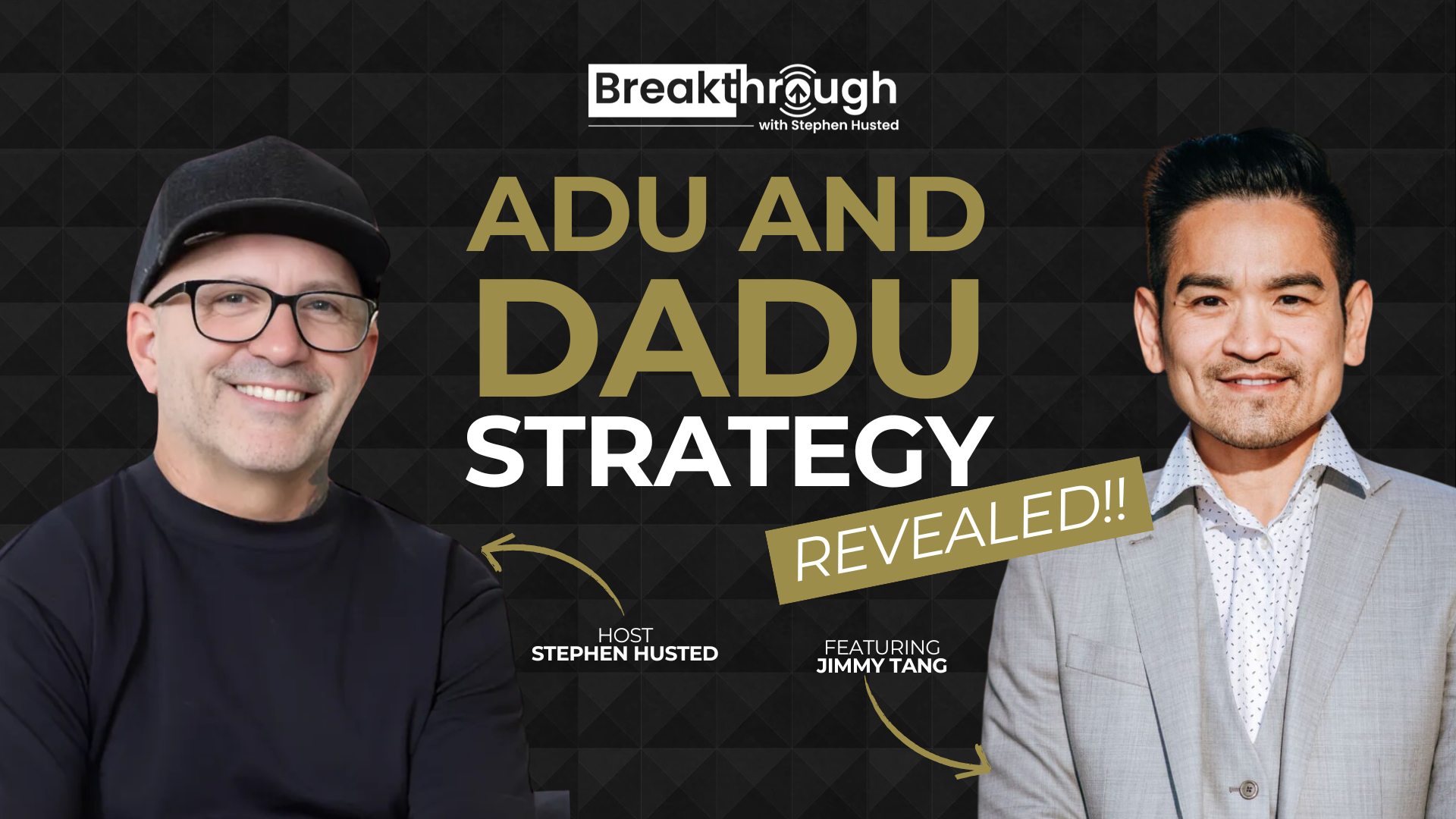
Episode 36 - What You Need to Know About ADUs & DADUs with Jimmy Tang
What would you do if you discovered your $870k offer beat out a $1 million bid—and the seller still chose you?
In this episode, Stephen sits down with Jimmy Tang, a Seattle-based real estate developer and YouTuber who’s taking the city by storm with his innovative approach to housing density. With years of experience in development, fix-and-flip projects, and strategic use of ADUs and DADUs, Jimmy is no stranger to the challenges of navigating Seattle’s housing market. Get ready for an insightful, laugh-out-loud conversation packed with actionable advice and candid real estate tales.
Stephen and Jimmy talked about:
00:00 – Discovering Jimmy's Content
02:45 – Challenges of Out-of-State Investing
04:03 – The Power of YouTube and Online Learning
06:14 – Dealing with Public Criticism
08:15 – Networking and Building a Team in Seattle
09:19 – Jimmy's Background and Early Investments
13:12 – Scaling Up and Learning from Experience
15:55 – Current Projects and Strategies
17:13 – Navigating Permitting and Construction Challenges
19:24 – Daily Operations and Team Management
23:12 – Design and Development Insights
32:37 – Handling Neighborhood Relations
36:26 – Rehab and Expansion Plans
39:02 – Balancing Stress and Fitness
48:56 – Advice for New Investors
54:34 – Navigating Zoning and Permits
59:38 – Connecting and Collaborating
TRANSCRIPT
∎ Teaser / Highlighted Clip
[Jimmy Tang] (0:00 - 0:34)
Stress is something that you better learn how to deal with if you want to be an entrepreneur. If you're not able to make thousands of decisions a day and they're just coming at you, entrepreneurship is probably not for you because, you know, and then the other fact, then that's one thing is you're a solo entrepreneur, but when you have eight other employees, depending on you and the success of your company and, you know, everything to work out right and then you finally, and the other thing is, you know, our income is when we sell a house, right? And so weathering those storms is critical.
∎ Podcast Intro:
[Stephen Husted] (0:34 - 2:12)
Brace yourself for a wild ride into the unexpected. This ain't your typical success show. I'm here talking to real folks who've been through it all, skipping the fancy business talk for authentic stories.
We're diving into childhood dreams, teenage escapades, and everything in between. No scripts, just the stories that truly mold success. Each episode takes you on a journey through those breakthrough moments that paved their way.
No fluff, just genuine stories. So whether you're chasing dreams or just love a good story, buckle up for wisdom, laughs, and the unexpected. This is the Breakthrough Podcast, where success is a journey, not just some fancy destination.
Don't miss out. Hit the subscribe button now and join our Breakthrough crew. I got some incredible stories to share and you won't want to miss a single one.
∎ Guest Introduction:
All right, folks, today I got a real treat for you. I'm sitting down with Jimmy Tang, a guy who's absolutely crushing it in the real estate game. Jimmy's not just a developer, he's a problem solver, a creative thinker, and honestly, someone who's redefining what's possible in housing development, especially in Seattle.
From ADUs to DADUs to single-family flips to the new middle housing laws, Jimmy's got the kind of insight that'll make you rethink what's possible with your property. And if you've seen his YouTube or Instagram, you know he's not just about the numbers. He's breaking it down in a way that is approachable and entertaining.
So whether you're a newbie to real estate or a seasoned investor, this episode is packed with practical advice, strategies, and a whole lot of laughs. Let's get into it.
∎ Podcast Proper:
[Jimmy Tang] (2:13 - 2:20)
Thanks for joining. Absolutely. I'm excited to be here, so thanks for having me.
[Stephen Husted] (2:21 - 5:40)
Yeah, I think I might as well just start leading into this conversation of how I even got you in front of you. We closed on two of our first properties out in Seattle, and I'm sitting at the airport on YouTube, and I'm like, okay, it's time to start binging even more content on DADUs. And there you were.
Started watching a couple videos. Then I just, of course, how YouTube works is just like, give me everything, Jimmy. So I'm just watching one after another, and then had Wi-Fi on the plane, so I'm watching more.
But what was crazy is I was learning all this information, which was great, but then I was actually getting really stressed out. I'm like, shit, Jimmy's on the ground, and he's driving around to all these projects. I'm an out-of-state investor.
Oh my God, my team's got to be so tight. I had to work through that part of it because when you've got a bunch of projects going, you're managing a lot of things, and being on the ground and being able to walk it, solve problems is huge. Yeah, so I got a little stressed out, but I got a good team, hopefully, and I'm going to go out there once every month, maybe every other month, and try to just build a system out of how I'm going to do this.
So binged all your content. I'm still doing that, by the way. There's a lot of it, so I'm still doing that.
But I hired a videographer to come out to the two projects and to film. In one of your videos, you asked him a question, and Michael talked, and his voice is very distinctive. So he shows up at the house, and he starts talking, and I go, do you know Jimmy?
He's all, yeah. I'm like, okay, you got to hook me up with him. I want to get him on the podcast.
I'm binging all his content right now. He started laughing. He's like, no way.
He's like, yeah, for sure, I'll connect you guys. He's like, yeah, you guys, you should fly out and do some content. Him come to your projects, and then you going out to his.
I'm like, great. You didn't know that he was my videographer? Well, at the point, no, not in the very beginning.
But as I started going through it, then there was something, I think I looked at a comment, and he was in it. And I was like, okay. But I literally binged your content for three, four days straight.
And that's kind of what I do when I get into something new, whatever strategy it is. I'm usually on a binge. And it's usually only a few people that I just like, trust.
They're giving good information out. And what's wild about this, and I had this conversation with Vayna a couple of days ago on my podcast. We live in this era now that I can buy a couple of properties, and I know I want to do this strategy, and I can watch 10, 20-minute videos and binge it, and put me ahead well over a year of knowledge.
You know what I mean? And I think you could probably agree with this, 10 years ago, it was a lot different.
[Jimmy Tang] (5:40 - 5:41)
Absolutely.
[Stephen Husted] (5:41 - 5:43)
Right? When you first got into it.
[Jimmy Tang] (5:43 - 6:20)
Yeah, you had to go find mentors or find someone that's doing what you want to do to actually even ask for their time. And setting up appointments to actually meet with them. And maybe they will share some things or some tips or even their strategy.
But that was difficult back then. But nowadays, YouTube is your university. And so, yeah, YouTube and online is just, honestly, if whatever you want to do, you would just Google search or YouTube it.
And man, I really don't know you really need to go to a real university.
[Stephen Husted] (6:21 - 6:56)
I know. It goes down to anything. I think it's funny, and I brought this up to Vaina.
I'm like, do you find it wild when you're putting out this like one-minute piece of information that's, to some people, it's pretty valuable. But then you get a bunch of bad comments and hate comments on this one little thing. And I'm scratching my head going, wait a minute, if you're getting into real estate or you're trying to move in a direction, this is going to help you move forward.
And I just find it interesting how some can really take advantage of it. And some look at it as a negative.
[Jimmy Tang] (6:57 - 7:59)
Yeah. Well, you just got to know that going into when you put yourself out in the public, you're going to get 50-50 or even 75% haters or just people who don't really know what is the day-to-day grind of doing what we do. Being an entrepreneur, it takes a lot of work and nobody needs to put themselves out there.
But when we do it, we definitely, yeah, we're trying to give back, but also expand our business as well. And so we just take, I guess, the public humiliation or the bad comments. But again, you better build a thick skin as an entrepreneur because you let comments get in your way.
God, you're going to block yourself from all the opportunities and all the open doors that are opening for you. So don't focus on those comments. Focus on the supportive comments or the people reaching out to you after they watch your video and they're like, I want to learn more or I want to partner up with you.
It's definitely got to focus on the positive side of social media.
[Stephen Husted] (8:01 - 9:46)
Yes. And it's sometimes, I try my best. Sometimes I get dragged down the rabbit hole and I'm going, why are the people thinking this way?
And I'm like, wait a minute, the word that Vayner and I had on Tuesday, which was such a great word, was stay locked in. Locked in what you're doing, whether it's real estate or you name it, whatever you're trying to get into, locking into it and blocking out the noise is such a huge part of it. I'm really at that point right now with this whole, what's going on in Seattle.
And it was interesting, even how I ended up out there. I met a couple of people at the BiggerPockets conference and then brought them on my podcast and little people were telling little information. And then I was listening to a podcast for midterm rentals and Ann Curry was on it.
And I'm like, oh, I really like this lady's messaging. So I DM'd her, she came on the podcast. Then she connected me to somebody else.
And next you know, it was like, wait a minute, I have a whole team out in Seattle. Why am I not investing out there? You know, it's close to California.
They're a little ahead of the game when it comes to this whole ADU, DADU and just basically thinking out of the box when it comes to development. Price points seemed good, a little better than California. And it just made sense where I was at.
And it's now I'm leaving my portfolios of other properties in the Midwest. They're just on idle. It's everything in Seattle.
So I'd like to hear a little bit about your backstory. I know some of it, but I'd like the audience to hear as well. If you can just give us a little breakdown of how you ended up in Seattle or Tacoma, right?
[Jimmy Tang] (9:47 - 13:05)
No, not Tacoma. I mean, I bought my first two properties in Tacoma. Yeah, in Tacoma.
But no, I immigrated from Vietnam when I was five years old. We left the country after the war and I came here with my grandmother and my dad's side of the family. But I was raised by my grandmother because I lost my dad when I was like four months.
And my mom made the decision to not come to America with us. So I think it's a blessing, even though sometimes I wonder why she made that decision. So I came here with my older brother, older sister, and just lived with my grandma, grandpa, and my uncle, like probably six of us in a small two-bedroom apartment.
And just growing up in a low-income housing, you see other kids in school having better stuff, better clothes. And you're just trying to figure out how do I make more money? So I did newspaper routes and got my first job as a bag boy at a grocery store when I was like 15 and a half, 16.
And just started working after school, weekends, then put myself through college. I pretty much went through college and it came out pretty, didn't have a lot of debt. I mean, we had grants and I worked and I paid that off too.
So then it was around, I think my senior year in college that I ran into some people or even a professor actually was talking about rentals and duplex. And then I came across Rich Dad, Poor Dad. And of course, that taught you about passive income.
And so I started looking for laundromats or rentals. And then I found my first two duplexes in Tacoma, Washington for about $175,000 each. I bought one with no money down because they gave you a hundred percent financing for primary residence.
And then the second one, they were like side-by-side to each other. So second one, we bought it with like 10% down. And this was actually on a, I believe was a five-year arm.
And that was in, I think 2004, 2005. And then of course, around 2007, 2008, the whole real estate market came off. But the funny thing is the loan that I had on that, it actually made the interest rate go down even more.
I mean, it was pretty far down. Like I think it was around 2% or 3%. So I don't know what terms I got on that loan, but it was amazing.
It got to a point where the bank was like, no, you got to add some principal on top of your interest payment because it was so low. So I had that almost until 2014 is when I sold the duplexes. But I mean, that kicked off my rental real estate investing.
And then at the same time, I was still had my corporate IT job that lasted all the way up till like September 5th of 2014. So yeah, just dabbling in real estate on the side while I was working the nine to five to build up the capital to do more real estate. Yeah.
I mean, that's really the story.
[Stephen Husted] (13:05 - 13:24)
Did you think you were going to end up here then? So you got the two duplexes, it seemed like you're being an entrepreneur. Did you really think you were going to end up doing some big scale, large development like you're doing right now?
Or was it a natural progression that kind of went up and down?
[Jimmy Tang] (13:26 - 14:27)
You know, my dream is always to build a skyscraper, right? Because I was watching Donald Trump and Apprentice and just reading his book as I was growing up. And I was like, oh man, I'd love to be Donald Trump of the West Coast.
But I mean, that was my, I looked up to him, right? During that time. And so I had that dream.
But of course, a skyscraper, man, now I even think about it, just the moving parts that is needed just to get that kind of project off the ground. It's crazy because I see the project that we do now and all the people that- The mechanics of it. Yeah.
It's just the time. Just for example, our 12-unit live-work-eat project in Georgetown, that took us probably three years just to get the permit. And that's probably about the same amount of time it takes to do like a one, two, 300-unit apartment in Seattle.
So if I were to spend that same amount of time again, I'd probably just go and do the two, 300-unit apartment.
[Stephen Husted] (14:28 - 14:30)
At least path of resistance type thing. Yeah.
[Jimmy Tang] (14:30 - 14:40)
Well, might as well get the bang for your buck. You're going to have to waste three to five years of your life. Well, might as well do the 300-unit versus the 12-unit, right?
[Stephen Husted] (14:41 - 14:52)
Right. What have you learned from that project? Because that one you got during COVID, right?
And you had some issues and then there's some issues on what you could build from. I think I remember one of your videos.
[Jimmy Tang] (14:53 - 15:59)
We're still building it now. We're about to be done probably by the end of the year, but definitely it's just the time it took, the holding costs and everything. I mean, we're still going to make some money, but probably not as much as we performed when we first started the project.
But because we bought it at such a low cost base that we'll make it out okay. But again, like I said, is that if I knew that it was going to take that long of a time, I would invest it in either shorter projects that it took shorter time so that I can turn the money around quicker or do something just way bigger, like a hundred X bigger. Because it just takes the same amount of mind and it involves the same people, all the architect, the city people, it's just the same people.
But it's just the other part would be raising capital, right? A lot more for down payment and all that. But at that time I was probably thinking small and didn't believe that I could do it.
But now after going through what I went through and the number of projects and the size of the projects, definitely worked up my mindset to do something bigger.
[Stephen Husted] (16:02 - 16:06)
Can you tell the audience what you are doing as far as project-wise out in Seattle?
[Jimmy Tang] (16:08 - 16:52)
Yeah. So currently we do majority of our projects. We do a lot of single family, ADUs and DADUs on one single family's lot.
But a lot of our projects, we get double lots. So we do like six of them at a time. And then we're probably building, right now we're building around 35 doors in active construction.
And when I say doors, that just means like the 12 live work unit is 12 doors. And then a three-pack SFR, ADU, that's three doors. So we probably around six to eight active construction sites right now.
And we have some more down in the pipeline in permitting right now. So that's what a majority of our projects is our own spec projects.
[Stephen Husted] (16:54 - 17:05)
And what do you look for in a project? When you're out there, something pops up, maybe it's off market, maybe it's on the MLS. What are you looking out for?
What do you shine away from?
[Jimmy Tang] (17:07 - 19:10)
Right now, I guess, if you're talking about where we are in the economy and I guess the unstable of how people feel right now about real estate, just because of the interest rates and all that, you definitely don't want to do too many and take on too many. And then you also want to look at financing. It's like, can you buy a project that they will close on permits?
But definitely that's what we are doing because one, holding costs is just a lot higher because of the interest rates, right? And if you can't rent that out while you're working on permits, that's going to eat into your profit. And then two, it's just the permitting hasn't gotten better in the permitting time, but it seems to be dragging out longer and longer.
And again, you got to factor that into your holding costs because I feel like there's a lot of turnovers in the planning department of our jurisdictions that we want to do. And so the new people that come on, they're learning. You might even know more than the guys that they hire at the planning department.
And so that's frustrating because then they want to nitpick every little thing on your plans that just cause you to have a lot more corrections. And so that's frustrating. And then we are talking about, this is just the simple project of a three-pack or even just a daddy, right?
And I feel like they're treating this like an apartment project or a 12-unit townhouse project that is just, I think it's just difficult. And hopefully things turn around as far as the timeline, because there are a few laws that passed a year ago that include also the state wanting the city to keep track of the permitting timeline. And I think it's that if the city cuts back on their permitting timeline, there's an incentive that the state gives to the city if they can improve that timeline.
So yeah, hopefully that kickstarts some improvement in the permitting process.
[Stephen Husted] (19:12 - 19:21)
Is it more just a staffing scenario? Like they're just short on staff? Because that's what it is somewhat in where I live in San Jose.
It's just short on staff.
[Jimmy Tang] (19:22 - 19:37)
I think before it was short on staff, but they ramped up it. But again, you're talking about these guys are learning. These guys, I think some of them are straight out of college, and so they're just learning city codes and all this.
So it's a learning curve as well.
[Stephen Husted] (19:37 - 20:41)
So walk me through your operation. What is your role? Who's on your team?
Because I know it takes an army, so to speak. There's a lot of people. There's a lot of moving parts.
I mean, I literally have had five meetings since noon. One was with my designer. I had one with Ian Love.
I had another one with my contractor. And my head's spinning at that point. I'm going, wait, I got to get an infiltration report.
That needs to get ordered. I got one on this one. We're going to build the datu, but there's an existing detached garage.
Is that foundation okay? Can we tie in the datu to that foundation? Can we do a site plan for where the second datu can come in 2025?
How are we laying that part out? You know what I mean? My head's spinning.
Wait, what? I got to do what? And I'm just trying to absorb it all.
So I know at your level, you got a lot of projects. So tell me, what do you do on a daily basis within the business?
[Jimmy Tang] (20:42 - 21:58)
You know, just show up and be the face of the company with Michael. No, it's not that easy. So day to day, I would just make sure everything is still flowing with all the projects we have going on.
And then people always send us deals that I have to analyze real quick to see if I want it or even on the, just quick glancing at it doesn't even make sense. Is it profitable? I look up at the address on my phone and I look at, are there a bunch of trees or is it on a busy street or where does the house sit on the lot if I'm not going to try to save the house.
So I look at that over my phone and I'll look at the purchase price. And if I know the area real well or the neighborhood real well, then I'll know the comps in my head because we've done projects there. So I would be able to do the comps real quick.
And then I'll say yes or no, if I like the project and we'll get it under contract and then kick off. Usually after I get it under contract, I kick off the survey right away, right? Because I know that they're usually two to four weeks out.
So by the time we close, maybe I'll have my survey. You taught me that, by the way, you taught me that. You taught me that.
I think you probably like three to 5,000 in mortgage payment right there.
[Stephen Husted] (21:58 - 21:59)
Absolutely. Absolutely.
[Jimmy Tang] (22:01 - 24:06)
So, and then analyzing deals, meeting with investors who are interested in lending us money or JVing with us on projects. So I sometimes show them and meet them on site and show them our projects. And then also overseeing, looking at our numbers.
So we're making sure we're within budget and getting new bids. So looking over the bids from the contractors and deciding who to go with on our future projects or even the projects that we have now that we haven't gotten bids for like landscaping and all that, the stuff that towards the end. I rarely pick out my designs anymore.
I let my designer do that. But when I first started, like you, I did all that picking, right? I even went to the Home Depot to pick out all that.
And when you see 50 shades of white, it's like, heck no, I'm done with that. So I'm glad that we passed that off because for me, it takes a lot of, that kind of decision is not something I want to spend time on. Takes a lot of brain power.
When you give somebody too many options, that causes even more like overwhelming and delay. And because you're just like, I don't want to make this decision because it might be wrong, even though it's just 50 shades of white. I mean, you know, there's people who actually can see the difference in the 50 shades of white.
So yes, that's why they're designers and you stick to what you do best. Then of course, the other things I do is, so when we make a decision on a project, then we find the architect that we think works best for this project, or we try to maybe reuse the plans that we have on another site. If it actually is a perfect site of like 50 by a hundred or very similar in dimensions, then we can try to reuse the plans.
But rarely, hardly I ever reuse my plans because it seems to be every site is different because a lot of dimensions are different, or there's trees that are in different locations that we have to save. So it changes your design. And save the trees.
Yeah, yeah, yeah. So.
[Stephen Husted] (24:07 - 24:25)
For anyone who's listening, you got to save, you got to be careful. One big thing that Jimmy can, that we'll put out there, and I can tell you this firsthand on one of my two projects, is trees can change dynamics when it comes to building. And your performance.
[Jimmy Tang] (24:25 - 25:53)
Yes, yeah, yeah, yeah, yeah. So then I work with the architect, go back and forth with the layout of what I like. And that's the part that I enjoy the most is when I used to do the flipping, I enjoy recreating the space instead of designing the open kitchen or adding a bedroom here or there, or just making it be a better flow.
And that's what I enjoyed the most out of from this whole real estate investment thing is just designing the house, the layout. That's my favorite part too, by the way. Yeah, yeah, yeah.
Like for us now, before when we designed the SFR and ADU, we will have a shared wall because that's the easiest and that doesn't take up more space on your lot, in your lot coverage. So we make it simple. But the thing is, it doesn't sell as well as if you try to separate the ADU and the single family, either by like a closet or for us, we did stairwell or another project we did, we split it up by a powder bathroom on the second floor.
And then you were able to walk underneath that. It's just like a walkway. So that one, the ADU actually sold first out of all the three units.
So that obviously shows that it's more marketable and people love that more, that the more separate you can make them feel from your neighbors, the quicker it would sell. Your projects are so cool.
[Stephen Husted] (25:54 - 26:28)
I love it. It's like so cool. I saw one video when you were talking about it was SFR, two-story, had the ADU attached and I think it was attached to the stairwell.
I caught that. I was like, oh, that's intriguing. And then you had the dadu.
Then I think the SFR had a deck too, rooftop deck. And it was just so cool. And just so well appointed on the lot.
And people would think it's a lot of density, but it feels great. And you've got the trees around it. It just makes sense.
[Jimmy Tang] (26:29 - 26:29)
I don't know.
[Stephen Husted] (26:29 - 27:28)
I just, I love the way they look. That part too, when I saw that video, I'm like, oh, that, oh, so funny enough, I saw that video. My designer on one of my projects here in San Jose, she reached out to me.
I was like, hey, I want to get coffee. I want to pick your brain. Got a couple of meetings.
You really want to get in investing. And I just, I told her, look, this is what I'm doing. I'm in Seattle.
I'm developing. This is where all my focus is at. If you want to join along, we can, but I'm not going to be investing in other markets, different strategies.
It's only this. So if you want to, and she's a designer, so, and she's a phenomenal one. So going back to the white colors, when we were doing our project, she came with the book and it was like 10 whites.
And this one's got this undertone. This is, I'm like, okay. All right.
Yeah. We got seven whites in one 1700 square foot house.
[Jimmy Tang] (27:28 - 27:30)
Seven whites. Oh my goodness.
[Stephen Husted] (27:30 - 28:15)
Different in like ceilings and the baseboards and the trim and the bathroom or not the bathrooms or one of the bathrooms and the exterior. But anyways, so I sent her your video with the one that had the ADU attached by the stair. I'm like, this is what we're building first.
Just watch this video. And she's coming back. She's like, oh, okay.
And then she's already designing like, oh, like, should we like figure out local places for like countertops to fixtures, flooring, instead of going the lulls of the whole depot way. I'm like, girl, yes. If we want to take these onto a different level, you're the designer.
You keep me in the loop. We can collaborate. Great.
[Jimmy Tang] (28:15 - 28:35)
So just make sure you give her a budget because these designers love to spend. The tiles they pick out is always $10 a tile and not like $3.99. It's going to be better for the resale, right? Know your market, know your neighborhood.
[Stephen Husted] (28:38 - 29:00)
It's so true. What was the progression from, so you did the duplexes, then you were getting to Flippy and I saw some of those houses that they were super nice. And then you probably just started hearing the news and started figuring out the whole ADU, first ADU play.
And did that like, was that the light bulb moment to kind of go in on this whole direction?
[Jimmy Tang] (29:01 - 32:49)
It actually wasn't even on the news because nobody knew about it back in 2019. But I think I mentioned before is that I was doing some comps and I came across this listing that sold and I was like, how did this guy sold for this much? And it had this like pound sign B on it, on the address.
And I'm like, and the lot size is smaller than the minimum lot size. And I was just like, then I dug into further and like found out who the builder was. And then, so I reached out to them and they told me about, oh, we were able to do it because we condoed it.
And this was before the state or the city passed or Seattle passed the law for you to be able to do two and condo it and sell it separately, but they did it. And then, so I was working on plans for my next project that it didn't get approved until 2020, but that's when the city passed that law. And then nobody really knew about it or not a lot of people, if you're not inside of the builders group or builders community or the investing community of like building, right?
Flippers don't even know about it or flippers didn't even care about those things. They just wanted to buy a house that they can flip. But within the building community, I think that was a pretty, something that they didn't talk about because they wanted to keep it under wraps and stuff.
But once the city did pass that law, then a lot of people started seeing it on comps. Then they started seeing it around being sold. And of course you had to educate some agents to how do you sell this and how do you explain this to the buyers and what that all meant.
But it was around that time. And before that we did some luxury single families. I mean, we're selling those homes for 1.5 to $2.5 million. And for me, I'm not sure if I did it consciously or subconsciously, but I knew for me, it always like when you do a big project like that, all your money's tied up and you have to sell that one project to get your capital back to keep going. Whereas this type of strategy with the three path is you need to only actually sell the SFR and you'll get majority of your money back. And with the two ADU and DADU should be, if not a lot of your profit in there.
So if you sell the SFR, your mortgage would go down drastically and you can just wait it out to sell the other two units. Or you sell the other two units and wait it out to sell the SFR. So for me, that was like, I guess a hedge or less risk.
So that's why, I mean, we just started doing majority of our projects on the three pack. And we haven't done a single family custom like luxury built for a while, but we're going to get back into that again, because for me, I enjoy, it's more simple, less utility work because everything is, when you do a one for one meeting, you take one old house down and you build up one, one brand new house. It's just more simple.
Don't have to do a lot of coordination because when you do three on a single lot and it's a tight lot, you're talking about all the coordination that usually we get the DADU done first and it's all the way in the back of the lot. And then we're trying to build the SFR and ADU in the front of the lot. And you're trying to get the drywall guys back there and the painters back into the DADU while the framers and the plumber, HVAC guys are working in the front.
And it's just like, then you get five, eight cars parking in the front. The neighbors hate you. And that's what I'm saying is like, gosh, you better get along with your neighbors and treat them well and try not to get paint on their cars.
[Stephen Husted] (32:50 - 33:10)
Yeah. How do you handle all that? I mean, I know some people are pretty okay with the whole density part in Seattle, and then there's some that probably not fans of it.
How do you handle neighbors and how do you come up with solutions for the neighbors? Is it, do you have a point of contact within your team that handles issues? Or is it you?
[Jimmy Tang] (33:11 - 34:16)
No, usually I let my superintendent handle it. If they get to a point where my super can't do it, then he'll tell me about it and we'll try to figure it out. But for us, we try to communicate as much as possible to the neighbors.
And of course, you're always going to have somebody who don't like the change, don't like the architect, the type of project we're putting up, or the fact that it's three stories now and it's blocking their sun and stuff like that. But again, I'm sorry, you don't like change, but it's just, that's what's needed in the city, right? I mean, there's neighbors that love it, neighbors that hate it.
And that goes back to the same as there's people who love your content and people who don't. So, but whatever we can do to alleviate all this construction and stuff during this time, let us know and we'll try to make it as easy as possible for you and all that. And sometimes we give them new fence or new landscaping or whatever it is, a new retaining wall.
So, we definitely try to leave the place better than when we got there, so.
[Stephen Husted] (34:18 - 36:23)
That's what I'm trying to, I'm talking to my partner on that. And one of these projects is a corner lot and the seller didn't really want to sell it to any developers. And we had wrote the offer in our own names.
And so, they sold it to us. I already told this story with Veena on the last podcast, but we got really lucky on this property because the highest offer was a builder at like a million 15. And she declined the offer and went with ours at 870 because they just saw two guys on the contract, didn't want to send it.
They think we're going to develop it. So, we get it and we close and we got the survey going. We didn't get the survey done when we were in escrow, which because I didn't see Jimmy's content, I'll add to that, but that's what you learn.
You've got to learn, you learn the hard way and you just got to move through it and make your adjustments as time goes on projects, kind of what I'm going through. But we got the survey out there and the was like, wait, what's going on? The past owner said that there wasn't going to be any development and my contractor's out there because we're rehabbing the main house.
So, he's having these conversations, but the sticking point of this whole thing was this one tree that's 80% on my lot, 20% on hers. There is no fence line. So, to her, she could probably think that's her tree or maybe she doesn't even know.
Maybe she thinks it's the neighbor's tree. I don't even know, but she's making this and was bringing up something about the trees. And I'm like, well, it's 80%.
We're going to remove it. We're going to be putting a fence up to get privacy. Let's have a conversation with her.
Like, hey, we're going to remove this tree. It's on our lot. And we'd like to get your suggestion on a few trees that we can plant because we're going to be putting a fence out.
What can we do to enhance your yard? What we're doing in our yard to kind of blend it all together. I don't want to feel like I'm just doing what I want to do.
I want to bring them in there. I might be completely wrong when I put this out there like this, but that's what I'm thinking.
[Jimmy Tang] (36:25 - 36:40)
That's absolutely it. That's the right way of doing it, just trying to work with them. Because the fact that once we sell it, but they have to live there for however more long that they're going to live there.
And so, you want to make sure that they're still going to be happy after you sell that property.
[Stephen Husted] (36:40 - 37:25)
Well, we ended up doing, so I just got off the phone this morning. We're leaving the tree and we're just going the least path of resistance. And I'm also using Ian's design on his daddy from what he just built.
And so, we just literally used his, she got it on the lot. She says, hey, this fits great. It's going to look good in the neighborhood and it fits the main house a lot too.
It's a two, two big living space on the first floor. And we're like, fine, we're going with that rehab in the main house, adding a bedroom and a bathroom in the basement, turning the house from a four, two to five, three, adding a curb cut parking on the left side of the house, moving on. That's what we're doing.
[Jimmy Tang] (37:26 - 37:31)
For the first couple of projects you do, try to keep it simple and not overcomplicated.
[Stephen Husted] (37:33 - 38:08)
Yeah, that's what I was thinking. I was like, well, I can get the tree out and we can do a three bedroom and do the garage. And I'm like, we'll do good just on this one.
The other one that I had met Michael at, that's where we were talking about for you to see because we got this one property, it's on a 12,000 square foot lot. We're a single family on a basement. And so we are rehabbing the main house, building out the basement, and then we're going to build one daddoo and then plan for the second one for next summer.
[Jimmy Tang] (38:08 - 38:09)
Yeah.
[Stephen Husted] (38:09 - 38:22)
And go that route. But I'm like, this is a perfect chimney light. You would have just went crazy on it.
Yeah. Are you sure you can't get two lots out of it? Yeah.
It's a hundred feet wide. Yeah.
[Jimmy Tang] (38:23 - 38:26)
I mean, I don't know what the zoning is, but are you sure you can't get two lots?
[Stephen Husted] (38:31 - 40:07)
Well, I'll have to talk to Jacqueline about that and see what she's going to be actually meeting our contractor and Ian out there to kind of walk it and get some... I'm like, look, I just want to... What's the highest and best use on this property, on this lot?
I mean, let's do whatever we possibly can to build it out since we got such a big... And that one went on the market on a Friday. We wrote an offer, gave him 24 hours to respond.
It didn't even make it to an open house. The listing agent didn't want to... Or she didn't go, oh, I got an offer.
Let's do an open house. Let's work some momentum on this property. Signed it.
Done. 740, called it a day. So yeah.
Tell me, what does your day-to-day look like? I'm trying to get better at doing this online too. And I want people to understand investing sometimes is not really sexy.
There's a lot of stress points to it. I try to make that very clear. I do some videos on my experience in East Detroit, where I first started investing a while back and all the things I went through.
And everybody can talk about cashflow, cashflow, and you can make... On paper, you got this cashflow, but you don't factor in that you're going to have three break-ins, three squatters, a couple of evictions. But if you could just sit on the chair in my office and listen to all these crazy interactions I have on a daily basis, do you find that you're pretty stressed out in your business?
Or are you good at managing your stress and just when things are going rotten in the business?
[Jimmy Tang] (40:08 - 41:58)
I think I've managed to do better now the past year and a half because I started working out. And so I work out six days a week, change my eating habit a little bit. And so I feel definitely mentally and physically, I feel a lot better.
And so when you feel a lot better mentally and physically, then you are able to handle the stress a little bit better. And I'm starting to try to do more meditation and self-improvement and all that. So stress is something that you better learn how to deal with if you want to be an entrepreneur.
If you're not able to make thousands of decisions a day and just coming at you, then entrepreneurship is probably not for you. And then the other fact, then that's one thing is you're a solo entrepreneur, but when you have eight other employees, depending on you and the success of your company and everything to work out right, and the other thing is my business is like, our income is when we sell a house, right? And weathering those storms is critical.
And just, I think I'm able to handle the stress more lately is just because of all the working out, just being able to have all the help that I do have with my employees for me to be able to have a flexible schedule to spend time with the kids and the family. And so that's important to me too, because I don't try to work crazy hours or too much on the weekends or anything like that. And I do really try to balance and spend the time with the kids and take them to practice and all that.
So that alone makes me feel like I can leave work and focus on them. Cause you know, spending too much time focusing on work drives me crazy too. So that's a mental stress, right?
[Stephen Husted] (41:58 - 42:12)
At the end of the day, you're just like, oh my gosh, what did I just do? Where'd the day go to? Yeah.
The working out part is good.
[Jimmy Tang] (42:12 - 42:40)
Yeah. It's absolutely a must. I mean, I don't know why I hated working out for the first 42 years of my life, but I'm glad I found it and I'm glad I stuck to it.
And I'm glad I'm actually enjoying it. And actually, if I missed a day, I feel weird and I feel like I'm missing something. Like even on my day offs, I feel like I want to work out all seven days just because I know how it feels after I'm done working out.
It just makes me have more energy.
[Stephen Husted] (42:41 - 42:52)
Mental clarity. Yeah. Yeah.
So when you say working out, what are you doing? Are you going to the gym? And weightlifting?
Are you doing cardio? What are you into?
[Jimmy Tang] (42:53 - 43:38)
So I have a coach. He's remote. Shout out to Chris.
If you guys need an awesome coach. So he just sends me a program on an app and it just shows me different routines every day. One day it'd be cardio.
Another day it'd be legs. Another day it'd be triceps and biceps. And next day it'd another cardio, but different types of cardio type workout.
So we just go through that every week. And then I just upload my videos to him when I'm working out and he'll critique it and what I need to change. And then that's it.
And really just watching what I eat and trying to get enough proteins in and supplements as well. So they're all just working together to just hopefully make me a healthier person.
[Stephen Husted] (43:38 - 46:42)
Yeah. It's kind of a journey. It's just, it's the same kind of journey as what you're going through as an entrepreneur, starting off in a W2 to find your first part.
Like you're constantly doing this little bit of working on yourself, bettering yourself, reading, knowledge, fitness. It's just like a little bit of time just gets added on. I totally get it.
I have really bad anxiety. I thought I had ADHD for 50 years of my life. And then randomly my wife works at Apple.
I'm like, Oh, I'm going to go to an ADHD doctor and get diagnosed. So I go through it and tells me, he's like, yeah, you don't have this. You don't have that.
But he's like, but I don't think you have ADHD. I'm like, okay. He's like, yeah, I think you have severe anxiety.
And I'm like, he's like, how do you feel? I'm like, I don't know what to say. He's like, well, they both are very similar.
Maybe started from some type of childhood trauma where your brain hits fight or flight. And then your brain thinks, okay, this is how it's going to be. So I've always been just, I might look calm, but I'm so wound up in my head, everything.
And this is so crazy. And that's why like fitness, cycling, mountain biking, endurance sports has been a really, just a rate, really great outlet for me. Calm to my brain.
I can think clearly. But when I found, when I started running just randomly, because I wanted to find another exercise to kind of incorporate in my day, cause I was getting so busy. I wanted something I could do in 30 and 40 minutes.
So I started, I was like, Oh, this is the game changer. Like I've never had something where I go in the morning. It's almost sometimes makes me too calm.
Like I'm like, just relax. I'm like, I don't know. I need a little bit of a little bit more edge, but it definitely makes me focus more.
And I started getting in the habit of doing it before I get on a podcast. Because one thing I went through when I first started my podcast, I enjoy talking to people. And so I wanted to get, start a podcast and just connect with people.
I really liked that, but I've gone 50 years of my life. You and I could have a conversation. Like we were together and we're just having this conversation.
I've had such a hard time focusing on what somebody's saying. And it almost created a really, like it would really mess with my head. Like it gave me, like, I just, I felt bad.
Like, Oh, I didn't really focus on exactly what this person's saying. So then I fast forward to now I start this podcast and for one hour, I have to have this conversation with this guest and focus. And so it forced me into it.
But then the running came, made me calm down and I can sit back and actually enjoy a conversation and listen to what somebody's going to say and not walk away kind of bummed out. But yeah, fitness is, I think fitness is such a game changer and you don't even have to be the best at it. You don't need to be the fastest.
If you just do it, you're going to feel, it just sets you up for success and all on all avenues in my eyes. So yeah, I'm glad you kind of brought that in.
[Jimmy Tang] (46:42 - 47:10)
Yeah. It's going to teach you some characteristics about yourself and test you to see if you really, who you are, who you say you are, you know, showing up is the hardest part, right? Showing up like every day.
I don't care if you don't do the max or push to failure. Right. But at least you do four reps or something.
Right. And just showing up and just doing something, you don't have to do the whole routine, but doing something that will just make you feel better. That you stuck to your word.
Yeah.
[Stephen Husted] (47:13 - 48:58)
I saw this video. I was telling Vayner about it as well. Just, this is funny.
These things are all just happening last week, but it was on Instagram and it was a woman on a treadmaster. She's heavy. And it said that, and it starts off with like the date.
I don't even know what year it was. I want to say 2019 and she's on it and she's heavy. And then it starts showing this and she recorded out, which was so great.
Then it showed this progression of, she's getting a little bit. She's getting a little bit. Now she's running a little bit faster.
She's doing this. And it shows her like doing some type of like, maybe it's a 5k race. Then she see her strength, but then you can see like her gears getting better, her outfit.
She's got tack on. I think she's got a garment on and she's losing weight and she's losing weight. And she like de-aged herself by like 20 years.
It was insane. Lost all this weight and now she's doing like half marathons and it was just wild. But she started off, she was barely running, like one step at a time.
She was heavy. And it was just, you know, I went straight to the comments because I'm like, I want to see how people got inspired. And this was one of the only posts I've seen in a very long time that there wasn't a hater in the mix.
Like I think everybody was on page like, this is pretty damn incredible. You look great. So something to take away for the audience, anybody who wants to become an entrepreneur, how you take care of not only your mind, but your physical health are huge.
I think they go hand in hand. If you're going to be an entrepreneur, whether you like it or not, you better find something that's going to be a fitness related. Yeah.
Just to help on all avenues.
[Jimmy Tang] (48:59 - 49:08)
Yeah. You definitely don't want to get burnt out and quit right before you hit the peak of success. So you definitely want to try to balance as much as possible.
[Stephen Husted] (49:09 - 49:21)
What kind of advice would you give a new investor? Call any type of strategy because you've kind of had a long journey and that's kind of how it starts. It always starts somewhere, but what kind of advice would you give a new investor?
[Jimmy Tang] (49:23 - 51:58)
I said, take it slow, take it easy. Don't try to do so many projects at the beginning because you're just so excited about it. Right.
But because you want to learn and you want to learn the process, you want to learn the mistakes and all that. And once the project is done, you want to look back on it and try to see what you can do. You should improve the second one because the other thing is once you get on to do too many and if you have three projects and you're all stuck at the same phase, you're like, you don't know what to do.
And you have holding costs, you have whatever other situation that could arise from any obstacles that can come up that's going to cause you more delays and all that. So I say, take it slow and reach out to people that have done it around locally that you can ask for help or tips, advice, and definitely have some cash reserves just for anything that come up so that even if you have construction draws and all that, but still have some cash on the side to whether it's some storm or even when you're done with the project and it doesn't sell as quickly as you thought, then those mortgages is going to, those mortgage payments going to catch up. So just be conservative on your first few projects so that you get more comfortable. And then once you are comfortable, go ahead and scale all the way up as quickly as you want to start raising capital or whatever you want.
But then again, raising capital, you're talking about taking care of people's nest eggs or you better treat that money more important than your own money. So yes, that's a huge one. Yeah, yeah.
So don't think like, oh shit, I just got, I just did three or five projects and I'm a pro now and start raising capital and from using other people's money. So yeah, just be careful, take your time because the opportunity for next year is going to be pretty, I think it's like a once in a lifetime opportunity in Seattle or in Washington at least. And so I don't know, maybe the whole country will eventually, maybe, I don't know, but at least in this state, I feel like you're going to have a lot of opportunities come around next summer and it's good that you do the projects now that you can learn.
And by that time, when summer rolls around, that you're ready for what you can identify in other jurisdictions of opportunities of land, how you're experiencing how to identify the land that you'd want to buy, the type of land you want to buy, what things on the land that you want to avoid and all things like that. So I think just get your experience in now and just be ready for next summer.
[Stephen Husted] (52:00 - 55:10)
Yeah, I think not taking on too much is a big thing, especially with, I have a lot of new investors reach out to me and they want to pick my brain or partner up or shadow. And I kind of try to give some advice, but they'll text me and it's like one week it's, I want to do short-term rentals. Once I want to do fix and flip, next thing I want to like, you got to just pick one thing, focus on one thing.
You're going to see so many different success stories and shiny objects that you can sometimes, it will make you so that you don't even take any action. So you just need to find something and get into it and learn from there. And then it turns into a natural progression.
If you stay with it and it's really something that you're really passionate about, you're going to go down that, you're going to start seeing all those things fall in place where it's how to raise capital. That raising capital could be something as simple in the beginning as you're talking about your projects to somebody and tell us money. And they're like, they want to invest too.
And they don't maybe have the time. Maybe they work a nine to five and they just want to be the equity partner and you're going to be the day-to-day or find the deal. And that's a very organic way to start in raising capital because they're seeing what you're doing and they want to be a part of it.
So I think starting off slow, learning, staying locked into it is such a big thing in investing. And if you got time, you got a lot of time, there's going to be a lot of different things going on. So it's never not going to be boring.
That's for sure. I'm hearing you tell me some things right now, like when you're saying like, don't scale up too fast. And funny enough, when we bought that first property, we knew it had a big lot.
We knew we were going to build out the basement. We're going to do the one daddo. And then now we know we possibly could build a second one.
I'm like, okay, cool. Then this other property popped up and I'm like, let's just write an offer. I think it's going to go for more.
So as I'm thinking, writing it for 870, I'm like, let's stay in the game. And then being calls back, he's like, dude, this story is kind of crazy. But there was another offer at a million 15 and a seller doesn't want to take it because they wanted to build.
So they're going to take yours. They're not even going to counter you at 870. I'm like, oh, wait, what?
Oh, wait. Now I have two rehabs, three daddos, two basement. I'm like, wait a minute.
Whoa. Okay. And I've been doing development and fixing flips, but I'm still feeling a little like overwhelmed by it too.
Like, okay, there's going to be a lot. Yeah. Even in my assistant saying the same thing right now, I'm a little kind of, there's just a learning curve.
You're not going to know it until I can watch as many videos of yours and learn as much as I possibly can. I'm not going to learn all of this until I'm going through one, two, three point A to B. That's just the way it is.
I mean, even brought up one good point about building out the SFR, the ADU and the daddo. You start in the back of, you start with the daddo and work forward so that it just makes it easier to. So when you say that, how you're getting the permits, you're not doing anything with the front SFR.
You're not building it at all. Like you're not even framing.
[Jimmy Tang] (55:11 - 55:51)
Oh no, no. We get the permit for all three units at the same time. But once we start construction, we usually start with the unit in the back of the lot because it's just logistically, it'd be harder for you to bring out all the materials.
If you like did the SFR and ADU first it for you to drive back the big trucks and everything to do the daddo last, it's kind of difficult. Again, that's majority of the sites because it's, you know, usually the daddo is in the back. But we do frame it.
We do poor foundation for all three units at the same time. When we start framing. Yeah.
But when we start framing, it's like we start framing the daddo first.
[Stephen Husted] (55:52 - 56:27)
So for the audience that just should probably said this at the very beginning, what a daddo is or what's an ADU. SFR is single family residence. ADU is an attached accessory, wait, attached dwelling unit.
And then a daddo is a detached, attached accessory dwelling unit. Yeah. Detached accessory dwelling unit.
Detached. Yeah. So just so, and it's a little different.
The nuance is a little different in Seattle than it is in California. In California, a daddo is basically an ADU. That's what they call it.
[Jimmy Tang] (56:27 - 56:32)
Yeah. Okay. Got it.
And then I think you guys call it something like jadu, J-A-D-U.
[Stephen Husted] (56:32 - 56:35)
Yeah. That's the attached one.
[Jimmy Tang] (56:37 - 57:16)
I keep getting that confused. I mean, one of the, one of the things we didn't touch on is that one of the other laws that passed was HB 1110, right? That you can put four to six units on your lot.
So that's for middle housing that we're trying to get more middle housing, basically. And so even your 12,000 square foot lot, I mean, you're like, man, I can put another a second ADU. No, no, no, no.
If you're going to wait till next summer anyways, you wait until you know what you can do. I think you can probably put like four, at least four. And then six, if you're like a quarter mile from the mass transit stop.
[Stephen Husted] (57:17 - 57:28)
So quarter mile. So we are on that 12,000 square foot lot. We are.
I may have to talk to you offline.
[Jimmy Tang] (57:29 - 57:30)
I don't know. Yeah. Yeah.
[Stephen Husted] (57:30 - 57:32)
I'm going to talk to my designer on this.
[Jimmy Tang] (57:32 - 58:35)
Yeah. I mean, some of the projects we're putting on hold until we figure out what the city is allowing us to do with the new law. So like the ones that we have a pretty big lot that we'll wait on.
But yeah, I mean, it's like when I say next year is going to be crazy for us around here in real estate, it's going to be like the wild, wild West. And even the planners and the planners don't even know what that all means. So we're all going to be like working together to figure out what design is actually going forward.
What's going to, what does a four, four unit mean? Does it mean four D test unit or is it a big box? And it's just for two units at the bottom, two units on top or so nobody know what that means yet, but it's going to be fun times because you as consumers going to actually be working with the city to sort of like help them and guide them and make the rules of what design is acceptable.
So that's going to be pretty cool. I mean, you're talking about, yeah, I'm not talking just Seattle, but majority of the big cities in Washington.
[Stephen Husted] (58:35 - 59:57)
So there's a lot of, and it makes a lot of sense. I've said this a lot on the podcast. I've just said this to people in person.
I talked to Ian about this. Even my designer, California is a little different. The layouts of the houses are just different.
These neighborhoods, we don't have alley access. They're just different. Yes, there's corner lots, but even like the corner lots, the house sits like right in the middle of the lot.
So you've got all this like frontage, right? That you can't do anything with. And then like the corner, the back part of the lot, you'd park an RV.
That's it. So there's not a lot of the density that Seattle's doing. Like when I'm driving around, I'm like, what the, how the heck did they do that?
It's like a 4,000 square foot lot. It's like five units in there. They're like right up.
It's crazy, but it's needed. It's needed. The housing's needed and they know they don't have enough room.
So they got to figure out density at the end of the day. That's where the creative part of this new bill is going to, they're trying to solve that too. Let's kind of think out of the box even more from what it sounds like.
Cool. Well, we could talk about that another time. So where can the audience find you?
I can tell you right now, you can find them on YouTube.
[Jimmy Tang] (59:57 - 59:59)
Go down the rabbit hole.
[Stephen Husted] (59:59 - 1:00:00)
He's right on YouTube.
[Jimmy Tang] (1:00:01 - 1:00:22)
Yeah, please do. I'd love to get more subscribers and stuff, but yeah, YouTube just search Jimmy Tang and Instagram is Gosh Tang It and Facebook Jimmy Tang. So pretty easy to find, I think.
If not, I'll just sort of pop up on your real speed and go down the rabbit hole, I guess.
[Stephen Husted] (1:00:23 - 1:01:23)
Yeah, absolutely. Well, you know, I'd love to kind of collaborate with you down the road, just on like some Instagram lives, just quick little things on lives. I think that that's such a cool little place to throw information.
Yeah. I appreciate your time and I'm glad I found you. I just think it's, I think the story is hilarious too, just the fact that I'm sitting in the damn airport ready to binge because I know what I have in front of me and then how it just leads to, you know, okay, cool.
Like I got Jimmy, I got this information and yeah, and it's helped me out a lot. I mean, even today, just now, like now I'm rethinking that first project that we're going like, oh gosh, I need to talk to, should we hold off? Like what are we, because one thing I brought up to her was I want to do the highest and best use of that lot.
It's 12,000 square feet and that's massive when it comes to Seattle. Yeah. That's like a, she said she's never even worked on a lot that big.
That's funny. Yeah. You know, she's like, oh my gosh, you got something to do.
So yeah, we'll do that for another time.
[Jimmy Tang] (1:01:23 - 1:01:30)
Yeah. Well, you let me know next time you're up in Seattle. I'd love to meet up and we can do Instagram live and visit the projects.
[Stephen Husted] (1:01:31 - 1:02:17)
Yeah, let's do it. Sounds like a plan. Cool, man.
Well, appreciate your time. You have a good rest of your day and yeah, we'll definitely be in touch. Thanks again.
Go drink that water. Yeah, I made it through. See ya.
∎ Podcast Outro:
Thank you for tuning into our show where we hope you found inspiration and gain valuable insights. If you enjoyed this conversation and want to stay updated on our latest episodes, be sure to subscribe to our podcast and share it with others who might benefit from it. We appreciate your support and look forward to bringing you more candid conversations and breakthrough moments in the future.
Until next time, take care and keep exploring new ideas and strategies.