Episode 64 - The Real Estate Path Nobody Explains: Rentals → Development → Freedom? | David Rosenbeck
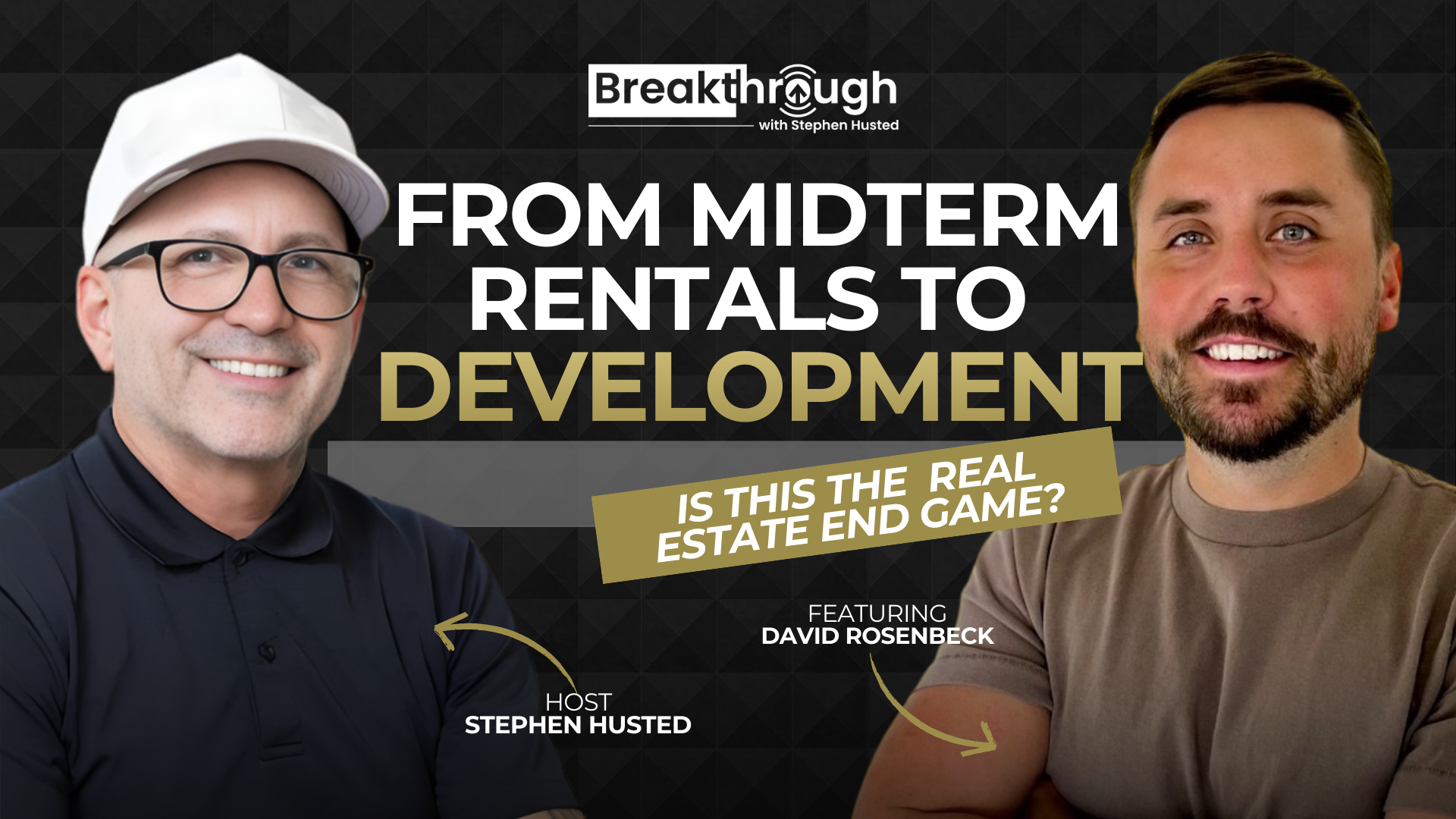
What happens when you stop chasing properties and start building assets on purpose? In this episode, Stephen sits down with David, a former nurse practitioner whose investing journey started during the pandemic while working in high-pressure hospital environments like the ER, ICU, and oncology. While caring for patients, David noticed a growing issue that most investors were missing. Traveling nurses had money, but they didn’t have comfortable, reliable places to stay. That insight became the foundation of his real estate strategy. David shares how that simple observation led him into midterm rentals, why he chose to scale intentionally instead of chasing doors, and how that mindset eventually pushed him toward ground-up development and residential assisted living. What makes David’s story compelling isn’t just the asset classes he chose, but how methodical and patient his approach has been at every stage.
Stephen and David talked about:
00:00 Introducing: David Rosenbeck
04:08 David's Background and Midterm Rentals
05:08 Transition to Real Estate Development
21:16 Financing and Private Capital
31:57 Exploring the Future of Short-Term Rentals
32:22 Unique and Affordable Rental Ideas
33:55 High-End Luxury Rentals
35:41 Social Media and Project Updates
36:06 Bunky Life: A Unique Cabin Concept
38:39 Midterm Rentals in Fort Wayne
42:11 Residential Assisted Living Investments
55:09 Challenges and Skills in Real Estate Development
58:07 Concluding Thoughts and Future Plans
TRANSCRIPT
∎ Teaser / Highlighted Clip
[DAVID ROSENBECK] (0:00 - 0:58)
I was actually at a conference and I was talking to somebody that was a developer and she said, why the fuck are you giving away all of your equity? And I was like, what do you mean? And she's like, why are you trying to give away your equity?
And I was like, I don't think I'm trying to give away my equity. I just thought that's what you had to do. She's like, David, there are so many people out there that are sitting on money that would be happy to put it into something and get a nice, stable, flat return on it.
She was like, you would be so surprised. It starts surging around. And then whenever I learned the avenue of the 401k to a self-directed IRA, that was a complete game changer for me.
So for people listening, the 401k to self-directed IRA route is what I did for all of my private money that I raised. And basically it's thinking about people in your network of, Oh, so-and-so worked as an engineer for 20 years. And then they pivoted and went over to this other company, or they've basically at least 10 years, make sure that they've worked there and just start thinking through your network.
And basically then they've built up a pretty good 401k if they've been contributing to it. And then it needs to be an old 401k. And that's the most important part.
[Stephen Husted] (0:59 - 3:02)
There's multiple things you can start to tap into as well. And then down the road, when you have a lucrative business, let's say you want to get out, there's another investor that'll buy it from you. They'll just buy that business from you, everything there.
And you put a price tag on it and then you move on. So it's just getting that vision together, like you're saying, like going somewhere where you see that there's a market for it and then going all in. I think it's super smart.
∎ Podcast Intro:
I'm Stephen Husted, and you're listening to The Breakthrough Podcast, a space designed for clarity, curiosity, and the stories that move us. Here, we step away from the noise and into the moments that define us, the early influences, the hidden struggles, and the breakthroughs that reshape our lives. From personal reinvention to building a life through real estate and entrepreneurship, these conversations remind us that success isn't a straight line.
It's a series of honest decisions, brave actions, and small shifts that change everything. This is where those stories live. Let's begin.
∎ Guest Introduction:
What happens when a nurse practitioner asks one question during the pandemic and turns it into a life-changing real estate strategy? David Rosenbeck noticed traveling nurses had money but nowhere comfortable to stay during COVID. That observation led him into midterm rentals, where he scaled multiple properties in Fort Wayne by solving one specific problem.
He walks us through how that became his foundation, why he skipped chasing dozens of properties, and how it pushed him toward ground-up development in Sedona. We discuss Sedona's unique STR market, the reality of permitting, and why patients pay. David also breaks down raising private capital without giving equity, why development offers multiple exits, and a shift toward residential assisted living for serious cash flow and impact.
Honest, tactical, and eye-opening, especially if you're torn between speed and sustainability. Let's get into it.
∎ Podcast Proper:
David, how's it going?
[DAVID ROSENBECK] (3:03 - 3:05)
It's going good. How are you doing? Thanks for having me on.
[Stephen Husted] (3:05 - 3:53)
Thank you for accepting our email to join. I appreciate that. We're kind of pivoting on how we're finding guests now.
Because first, it was me going through Instagram. It was people that I follow, and I like their story, and whatever they're doing. So then I DM them, and they get on the podcast.
And I'm like, okay, now I'm running out of people. So I was like, why don't we reach out to the guests that were on The Bigger Pockets? And so now my team is reaching out to people.
So sometimes when I show up in the morning, I'm driving here, and my assistant's like, I'm like, okay, who's our guest today? And she's giving me a summary. And then I get into the office, and then I have a whole summary list that I can kind of go through.
And then I go to their social media and see where they're at. But it makes it kind of cool, because I'm like, okay, who are we talking to today? Exactly.
[DAVID ROSENBECK] (3:54 - 3:58)
Yeah, you're like, all right, what am I going to learn today? Interesting. All right, new face, new person, let's go.
[Stephen Husted] (3:58 - 4:06)
Totally. And it was so cool, because Jackie said, oh, David, he does midterm rentals. I'm like, fantastic, we're already on the right page now today.
We got a lot to talk about.
[DAVID ROSENBECK] (4:07 - 4:08)
Absolutely, absolutely.
[Stephen Husted] (4:09 - 4:12)
Yeah, yeah. So how's everything been going for your 2025?
[DAVID ROSENBECK] (4:14 - 7:37)
Oh, slow and painful. That's kind of been the 2025 motto so far. So I've got my midterm rental portfolio.
So just a quick little background on me. I'm a nurse practitioner, worked in the oncology space for a little over three years prior to that, worked ER, ICU. And then, yeah, whenever the COVID pandemic hit, there was nothing but traveling nurses in the hospital.
And I was like, where are all you guys staying at? Like, oh, yeah, we're staying at this sketchy motel next to the hospital. It's next to the truck stop.
But I'm like, holy crap. And so I was like, if I would have an apartment that I could rent out to you guys that was furnished, would you be interested in that? And they're like, oh, my gosh, yeah, that'd be fantastic.
And then lo and behold, I figured out that there's a place called Furnish Finder. And then you can do 30-day minimums on Airbnb. And so I just kind of went all in on that.
And I think it took me, it was like 24 months. I got up to eight doors here in Fort Wayne, Indiana, which is where my wife and I originally were born and raised. And then now we've been traveling around quite a bit.
And then after I kind of got through the midterm rental thing, you know, us entrepreneurs, we get shiny object syndrome. And I was like, well, if I go to conferences, who's usually the guy walking around or gal walking around with the nicest watch, the most well-dressed and what's going on? And they seem like they really have their stuff together.
And it's usually people in development. And so my friend and I, we were actually, we did a podcast together for quite a while. He wanted to get into developments.
I wanted to get into developments. And we're like, okay, well, if that's the eventual route that it seems like people go, it seems like kind of the trajectory or the baby steps of real estate investors. Usually, oh, I buy my first long-term rental, or maybe I do my first flip.
And then, okay, maybe I'll dabble in midterm rentals. Then, okay, maybe I'll get into short-term rentals, higher cashflow. And then, okay, eventually 20 years down the road, they get into developments.
That's when they start making crazy, crazy money. And we're like, well, if that's the route that we're eventually going to go in, like, let's just walk towards that right now. Don't sprint because then you'll fall and you'll hurt yourself.
And then let's just walk there. And so he started a ground-up development down in Gatlinburg, Tennessee. He built a double A-frame out there.
His name's Yonatan Waxman. Go look him up. He's building an awesome place.
Well, actually, it's already built down there. It's phenomenal. He's doing really well with it.
I think he told me he had like a $20,000 a month down there in Gatlinburg, which is doing pretty good with how much competition they have. And now he's building more properties on that same parcel of land. And then I decided I must've been a glutton for punishment because I chose Sedona, Arizona.
And I was doing a lot of research around the country, trying to find out where I wanted to try to develop. And Arizona, I liked for one, because they have a grandfather clause for short-term rentals specifically. I think this came in like 2018, 2019, something like that, and so it was pre-COVID.
And essentially stating that no HOA or state law or city law can infringe on you running a short-term rental if you had it licensed and up and running up until that point. So my thought process as just like some extra protection for short-term rentals, let's go to a state where it seems like they're protecting their people instead of states like that, California or something like that, to where they could just come in with any sort of law that they wanted to, and all of a sudden your business could go belly up overnight. But I didn't take into account how long it would take to deal with small city government in Sedona, Arizona.
So we've owned the lot for I think 14 months now, and we have still yet to submit for building permits because we're just going back and forth with the city on the plans. We want to make sure that they're really teed up, ready to go to try and avoid the amount of red lining as much as possible. But man, dealing with city, dealing with draftsmen, dealing with engineers, it's a whole different animal.
[Stephen Husted] (7:38 - 7:50)
Well, we got a lot to talk about today. I love it how you're just talking. You literally just told everything that I've done.
That was all of it right there. Long-term rentals.
[DAVID ROSENBECK] (7:50 - 7:51)
You should have just asked me. I would have told you.
[Stephen Husted] (7:51 - 8:31)
Short-term rentals, mid-term rentals, into development. That was my exact timeline. I was cracking up.
Why do you think that is? Do you think that it... Because I know a lot of investors too that I had a gentleman on who was also on the bigger pockets, does the same process when he's really good at what he does.
And he's like, I don't need to go chase other things. He's like, this is working just fine. And I'm being successful at it.
There's no reason to pivot. Why do you think that you go from a long-term to a short-term to a mid-term to development? Do you think it's more money or is it you're just intrigued and you want to do something creative and something bigger?
[DAVID ROSENBECK] (8:32 - 12:19)
I think it's mostly because people, they're afraid to take bigger swings and they've seen other people take that route. So then they just decide that they're going to go that route. And also I think a huge, huge part of it is that entrepreneurs are very, especially younger entrepreneurs in the social media age and instant gratification.
They want something now. And I have a lot of friends that they're like, oh, you've been waiting two years just to... Between me, we actually moved out to Sedona.
We were looking at lots. This has been over a two-year process and we haven't even submitted for building permits yet. And so it'll probably be three plus years before I even see this project being done.
And so a lot of people, they say, oh, well, in that three-year timeframe, I could have probably purchased four short-term rentals in that timeframe if I really put my nose to the grindstone, raised some money, did X, Y, Z, whatever. And then I could be moving even more quickly. But in my opinion, that's just, it's a lot more stress.
It's a lot more moving people, I think, mistake a lot of movement for progress. Even if they're not really moving super far ahead, they're just maybe running in circles. And for me, the thought process was if I could just build one behemoth and it takes me a long time and I just have to basically chip away 1% per day, making sure I'm following up with my draftsman, make sure I'm following up with my civil engineer.
And then eventually getting into the city, then I have to manage my contractor, et cetera. But this thing will be a purpose-built, made for Sedona, short-term rental, instead of trying to buy a house in Sedona, adding on a bunch of bedrooms, the layout's still a little bit choppy and a little bit weird because like Sedona, you can make really, really good money out there, but there's a lot of properties that are in like that four, maybe five bedroom range. And they are kind of like chopped up.
And it was somebody's retirement home that eventually had to go to the market because they didn't want it anymore. They weren't using it anymore. Kids sold it.
And for me, the idea of just being able to slowly chip away at something and then have it exactly the way I want it to be. This was probably a little bit of like a trauma response to my properties in Fort Wayne, because all of them are like 90 to a hundred years old. And there's CapEx that pops up, things that you don't expect.
They're drafty. It was negative four yesterday here in Fort Wayne with the wind chills. So it's like, you're always worrying about stuff.
And I'm like, man, if I could just have something brand spanking new and I'm a younger guy. So I want something that I'm like willing to hold onto for 10, 15, 20 years, a hundred year old house. I don't know if I really want to hold onto it for 10, 15, 20 years.
And so I think if people had a little bit more patience, then they can have a huge payoff because a lot of people they'll into these smaller short-term rentals in like a different market that can maybe move a little bit more quickly, but okay. They're making 5,000 a month in cashflow, 6,000, something like that off of these properties. And maybe they don't have a ton of equity in the property.
So then they're hanging onto them. Don't really have much of an opportunity to pivot otherwise. But with this, I mean, if we're digging into numbers, my hopeful plan here with the Sedona property, bought the land for 240, which was a year ago.
My realtor's telling me it's already gone up in value. I could probably sell the same lot for 300. And then the build out all together, all money in, including interest for the construction loan, interest to private money lenders should be in at like one three, one four, but it'll be a six bed, seven bath home.
Every bedroom will have its own en suite. Every bedroom has Florida ceiling windows facing the red rocks. And this thing should grow somewhere in the neighborhood of like 400,000 a year should net probably 12 to $14,000 a month in cashflow and should be worth at bare minimum, about two, 2.2. And more likely my realtor said like, by the time you're done with this, if you put it on the market, if the interest rates come down a little bit, could probably even fetch like two eight. So I'm looking at a little over a million dollars in equity on a property. And it's like, if you're willing to just be a little bit more patient and chip away at something, you could really have just one humongous pie that you weren't running around chasing a bunch of other people during that process.
[Stephen Husted] (12:20 - 12:59)
Yeah. And it's centralized to one project. So you really can focus on one thing and one thing only, which there's a lot to be said about that when you're investing to just have your big focus on one big picture.
That is super smart. And what you just said, the value has gone up on the land, basically is covering all your permit process and your plans. Really thinking it that way, you know what I mean?
So now you got that covered and now you're into the building part too. You can, I would imagine from whatever lot you picked, you probably picked it in a way that the views and the way you position the house is going to give certain kinds of views. Am I right on that?
Absolutely.
[DAVID ROSENBECK] (13:00 - 13:57)
Yeah. That's one of the big things out there. My good friend, John Bianchi, he owns STR Search, I think is the company now.
Basically they help people find shorter rentals. He's the Airbnb data guy on Instagram. He's been up on stages a bunch of times.
He was basically saying, because I had him check Sedona and he was like, Sedona is such a weird market, man. He was like, you can have this big, gorgeous house, but if it doesn't have views, it just doesn't book as much. He's like, the views are really the big thing here.
And square footage isn't really as necessary because people are spending all their time outside. That's why they're in Sedona. The weather's gorgeous year round.
So they're going to be outside. So he's like, don't worry too much about the house. Worry more about finding a lot that has really good views.
Thunder Mountain is one of the main mountains in Sedona, Arizona. And we've got full on Thunder Mountain views sitting right in front of our face whenever you're standing on the lot. And it should be, we'll have a rooftop patio.
We're hoping that we'll probably put a barrel sauna up there with a little fish eyeball facing towards it. And I mean, it'll be an epic place. I think it'll probably be a top 15 property in Sedona once it's all said and done.
[Stephen Husted] (13:57 - 14:15)
I just went to Sedona last March. It was amazing. It was my first time.
And we stayed at an Airbnb. It was just like a little track home, but it had really good view from the living room. And I literally just left right from the house and ran the trails.
It was just amazing. I went up to that really cool church.
[DAVID ROSENBECK] (14:16 - 14:16)
Yeah. Chapel.
[Stephen Husted] (14:17 - 14:40)
Yeah. So that place is amazing. And it's got a great food scene.
It's got a cool art scene in it. And what was really special about Sedona on top of the beauty was you can be there and take off for the day and go to Flagstaff or you can go to Jerome for the day. Like you could just pop around to these little towns and get completely different vibes.
We really liked it. We were there five days, I think, which was perfect. Yeah.
[DAVID ROSENBECK] (14:40 - 14:56)
We spent 14 months in Sedona while we were thinking we were going to be spending that time overseeing the build. And instead, we just enjoyed the time that we were there. So we spent 14 months there and we're already missing it.
We're back here in Fort Wayne now for a little while, but we're like, man, that's Sedona sunshine. The vibes there. It's a very, very cool place.
[Stephen Husted] (14:57 - 15:06)
Yeah, that's cool. So walk me through. So you found the lot and you pulled the trigger, you bought it.
And then when you went into planning, walk me through how you chose your architect.
[DAVID ROSENBECK] (15:07 - 18:07)
So actually my builder. So I found my builder first. There was another guy that I knew.
Actually, we recorded him on our podcast and I got ahold of him. I was like, hey, you're a builder. You're in the Phoenix area.
Do you know of any good builders or are you willing to go up to Sedona? And he said, I'm way too busy and I can't make the trip up to Sedona. We've got too many projects in the pipeline, but I can give you a handful of people that I'd recommend.
And so I think I got five, maybe even seven contractors now. I can't remember off the top of my head, but maybe he gave me seven and I actually talked to five, like interviewed five of them and then ended up choosing my current builder that I have right now. And he's been fantastic throughout this process.
Cause every once in a while I'll call him and I'll just be like, Hey, are you still okay? Like everything's still good on your end. Cause I'm like thinking that this whole thing blows up.
If he decides that he doesn't want to do this project anymore. Once I finally get building permits for it. But once I talked to him, I said, Hey, who do you like?
Do you know of anybody in the Sedona market? Cause the city is so finicky and touchy about like maintaining the vibe of Sedona, making sure that the house is conformed to this style that they want to have there. There's very strict height restrictions, the color of your house, how reflective the glass is on your house, like all sorts of different things that just the general run of the mill architect would not know about or know that they need to put in there.
And he said, I've got a guy, he actually just did a project for another guy in Fort Wayne. I think his project was like seven bedrooms and like 5,500 square feet. So even bigger than mine.
And he got it all the way to the finish line and got him to permitting. So I was like, okay, that's my guy. And that's, that's been my architect thus far.
And then we needed civil engineering and structural engineering. And I asked my realtor if he knew of any good people, cause he lives out there in Sedona. And he said, yep, I've got, he's like, I've got one guy who's fast and he's a little bit more expensive, but he doesn't have as much experience in Sedona.
Then I've got another guy who's slow and expensive, but he is the lead engineer consultant for the entire city of Sedona. Whenever the city does projects and I'm like, I'll take the slow guy. I'll take him if it's more expensive, but he knows exactly what we need to do.
I'll go that route. And he has certainly been slow, but every Friday he has a meeting with the city just for his own company and his own projects and the city's projects. And so he knows everybody by name there.
And so if he needs to get ahold of so-and-so and we're in the middle of a meeting, he'll just pick up the phone and call them on their cell phone. And if you went with somebody that, you know, wasn't very familiar with the city, then I think they'd look at everything with much more scrutiny than if, you know, somebody that they know, because Sedona is a weird market. It's there's only 8,000 permanent residents that live in Sedona.
And so that those people make up the people who are on the city council board, the people that work within the city government. And there's over 3 million or 2.4 million people per year that visit Sedona. And so you've got millions of people coming through.
There's only 8,000 people that run all of it and they get a billion dollars worth of revenue from tourism that comes through the city. So they got a lot of money and there's a small amount of people. And those small people, they basically try to bite the hand that feeds them because they all hate short-term rentals, but short-term rentals are paying all the bills for the city
So they try to make sure.
[Stephen Husted] (18:07 - 18:08)
They need them there, right?
[DAVID ROSENBECK] (18:08 - 18:09)
Exactly right. Yeah.
[Stephen Husted] (18:09 - 18:14)
I mean, there's not a, there's a few hotels, right? But yeah, there's not a ton, right?
[DAVID ROSENBECK] (18:14 - 18:49)
Yeah. There's but it's mostly short-term rentals. Yeah.
And so they know that they need it. And we have some friends who have a co-hosting company out there and I think they're up to like 80 properties. Now, Sedona premier, they're phenomenal.
They said that they've gone to some of these meetings where they're talking about potentially like putting a cap on short-term rentals or how to throttle down the growth that Sedona has been seeing since COVID. And basically after the meeting, they would talk to some people kind of informally off to the side and they're like, nothing's ever going to happen. Like we can't shut off the faucet of all this money coming in.
Basically they're doing it to appease all the people that are mad that there's short-term rentals in their neighborhood, but they're like, we can't shut the faucet off. Like that would just be a B a bad business move.
[Stephen Husted] (18:50 - 19:10)
That's crazy. We have a cabin out in the Smokies and it's one of those markets where it's pretty protected. It's been, they've been having these cabins out there and people have been vacationing out there and they're not going to touch it.
Like it's very pro. And that's a big thing when doing these short-term rentals, you really have to pick a market that has longevity. That's a big part of it.
[DAVID ROSENBECK] (19:11 - 20:08)
Yeah. The idea of somebody like being a cowboy and going into their own market and deciding they're going to do short-term rentals. We had some friends up in Michigan that they kind of found their niche of small lakes and then buying old cabins on small lakes, turning them into short-term rentals.
And then they made a pretty good portfolio. We're making really good cashflow. And then all of a sudden Michigan just went wild.
Cause I think they were potentially going to introduce a bill somewhat similar to Arizona's to where things would be grandfathered in. So then once all these small city governments, HOAs, et cetera, caught wind of that, then everybody panicked and the pendulum swung the other way to be like, Hey, we need to make sure we put some rules in place here before everybody, or before everything gets changed, we can't do anything about it. And like, I think three of their properties got shut down overnight, which was a huge chunk of their portfolio.
And so going into markets where there's not a very established short-term rental activity there can be a good thing, but also can be a little bit of a scary thing. You know, it's sometimes better to just go to a place where you know what the rules are going to be.
[Stephen Husted] (20:08 - 21:02)
Yeah, definitely. We have a midterm rental in Kansas city and in the beginning it was pretty pro short-term rentals. You just had to do a couple of different things.
And then all of a sudden they started changing the rules and everything and regulating the heck out of it. And we just had to pivot into midterm, which was totally fine. We're right next to a hospital, like walking distance.
So we knew that would be okay, but not everybody has that opportunity, especially if you're in somewhere where you're in like the mounds or I have a client that bought in Southlake and it was a short-term rental, no issues. And then all of a sudden the community voted and they banned short-term rentals in this one section. So he had to sell that property and then he bought in another location just to be able to do a short term, but he also has money.
So he was able to pivot and hold it for a while and let it sit vacant. A lot of people don't have those kinds of luxuries. So you definitely have to pick your market correctly.
[DAVID ROSENBECK] (21:03 - 21:15)
Yeah, a hundred percent. You're getting your cabin down in Tennessee. You're not going to be able to midterm that thing for whatever you're renting out a short term.
So yeah, you got to make sure that you either have some exit plans or you're pretty solid that you're going to be able to short term it for the longterm.
[Stephen Husted] (21:16 - 21:20)
Oh yeah, absolutely. How are you going about the financing part on the new development?
[DAVID ROSENBECK] (21:21 - 24:37)
Yeah. So, I mean, I basically had very little of my own capital and I was like, well, I mean, I bought Matt Faircloth's book, Raising Private Capital, Bigger Pockets produced it. Phenomenal book for anybody that actually just texted to one of my friends this morning because she said that she's got a project out in Colorado that she's looking to raise money on.
And I didn't realize how many different avenues there were for raising private capital to put into deals. And I always thought that I was going to have to give away equity to bring in somebody with money. And that's just not the case at all.
I was actually at a conference and I was talking to somebody that was a developer and she said, why the fuck are you giving away all of your equity? And I was like, what do you mean? And she's like, why are you trying to give away your equity?
And I was like, I don't think I'm trying to give away my equity. I just thought that's what you had to do. She's like, David, there are so many people out there that are sitting on money that would be happy to put it into something and get a nice, stable, flat return on it
She was like, you would be so surprised. Let's start surging around. And then whenever I learned the avenue of the 401k to a self-directed IRA, that was a complete game changer for me.
So for people listening, the 401k to self-directed IRA route is what I did for all of my private money that I raised. And basically it's thinking about people in your network of, oh, so-and-so worked as an engineer for 20 years, and then they pivoted and went over to this other company or they've basically at least 10 years, make sure that they've worked there and just start thinking through your network. And basically then they've built up a pretty good 401k if they've been contributing to it.
And then it needs to be an old 401k. That's the most important part. And so whenever they start their new job, if they didn't roll over their old 401k, that thing's just kind of sitting there floating at the mercy of the market.
But they can take that and via a custodian company. So I used Equity Trust. It's a company out of Ohio.
It was recommended to me by a friend. That custodian company put together a promissory note. Your lawyer can do that for very little money.
They put together a nice promissory note for you. You spell out the terms. Mine was 12% interest on a 24-month note, which now looking back, I would have probably done a little bit of a longer note, like 36-month note just to give myself a little bit of extra wiggle room.
And then they take the 401k funds. They put it basically into an escrow account for their company at Equity Trust. And then they transfer it out to you via the terms of your promissory note.
And then you get to use the money for whatever you want to use it for. And one of the big things that whenever I was talking to one of my friends about private money lending that I never caught on was that he said, you never want to tie your, how did he say this? Basically like avoiding SEC issues.
So he said, never like basically be promising a return against a certain project because then you might be getting into like securities and like guarantees. So he said, basically take on that money to your business as a private loan that you can use for anything you need to use it for within your business. You just happen to be using it for this development project.
And if you do it that way, there's no guarantees, there's no securities issues or anything like that. So that's the route that I went. And I ran it through my lawyer.
Everything was peachy. Run it through your own lawyers. Don't trust some guy on a podcast.
But that was the way that I went through it and it worked out beautifully. So I use that to purchase the lot. And then I'm also using private capital to then float the construction loan whenever it comes through.
And yeah, that's hopefully the game plan, but we'll see once I actually break ground and get things rolling. Beautiful. That was so great.
[Stephen Husted] (24:37 - 24:58)
And it's funny, I started doing exactly that as well. Like trying to figure out when I get these developments in my hands, that how do I utilize this deal? Because I can't take them all on.
But there's also, there's a lot of people, like you said, money on the sidelines, they want to get a return on it. And it's the perfect way to pull it off. So that's super smart on your end.
[DAVID ROSENBECK] (24:58 - 26:28)
Absolutely. I mean, I was talking to that friend this morning about it and I figured it up. And so my promissory note, the reason I said I should have extended it a little bit longer, for one, I had no idea that it was going to take this long for me to do the development.
I probably should have, but I'm always a glass half full, pie in the sky. I'll have this deal in 18 months, no problem. Yeah.
So I put, my lawyer actually recommended this. He put a clause in the promissory note to where at the end of the promissory note, if the principal plus interest cannot be returned, then the person signing, the lender agrees that the note will then shift into a higher interest rate for until the remaining principal plus interest is returned. So then it pops into 15%.
So that's expensive money, but it helps the other person on the other end. Because a lot of these people, if you're going to somebody that's a doctor, engineer, et cetera, they're probably not a super savvy investor. And so they may be thinking, because if you go to somebody that does this for a living, private money lending, they usually like 10%, 500 grand for like a three-year note or something like that.
And they don't think anything of it, but other people they're thinking, okay, like 10%, I could get that statistically in the market. If I just put it in there, do I really want to go this route? It's a little more risky, et cetera, et cetera.
But if you go just a little bit richer on the interest rate, and then you're giving it like a personal guarantee that, Hey, I'm going to pay you this amount. This is how it's going to go. And then if you need to have the extra time, you can have that little bit of extra buffer on the backend and then they make even more money on it
So just kind of sweetens the pot and lets them know like, Hey, if shit hits the fan and I can't pay you back because this is taking longer than anticipated, it's actually better for you because you're making even more money off of it.
[Stephen Husted] (26:29 - 27:13)
Yeah. That's super smart. And this allows you, if something else pops up and you got some momentum going, right?
Because there's something to be said. Yes. You brought up a lot of people like instant gratification.
You're spending 24, 36 months, whatever. Let's just call it that. Right.
But this is your first one. So you're going to put in, this is actually, this is your learning curve, right? And then the second one, you're going to be a little bit faster.
Your team's going to be a little bit tighter, right? You're going to know what went right, what went wrong, right? And then you'll go from there.
And then that's when you start to get the scale because you've learned so much now. And there's something to be said about that. And it's such a skill.
You're going to development college for 36 months right now.
[DAVID ROSENBECK] (27:14 - 29:16)
Exactly right. I was talking to my old man about this and I was like, dude, I said, basically, I just want to survive this. That's the only goal with this entire process is I want to survive.
I don't want to go bankrupt. If I can, at the very end of this, and that's kind of the beauty about development as well, is that you do have multiple exit strategies because you could just go to where, because this permitting process, I mean, it's been taking me over 12 months just to try and get this thing to permitting. And so if I wanted to, I could, the cost of my land has gone up and then that long process and the instant gratification that nobody else wants to go through that long process.
If I wanted to, I could probably turn around. Once I get my building permits and everything is approved, wrap that up and put it on the open market and say, Hey, we've got this law and we've got approved plans that you can start building tomorrow with. All you have to do is purchase it.
That's extremely valuable to another developer out there. They're like, holy crap, this guy did all this legwork. I'll pay extra for that.
So I don't have to waste two years of time. And then, so that's one exit strategy. Next exit strategy is what I'm planning to do, which is do a cash out refi, which will pay out all of my private money lenders.
And then I'll be able to just hang onto it as a short-term rental and then just run it from there. And then third exit strategy, I've got so much equity baked into this thing, which whenever you're developing in expensive markets, you usually bake in a ton of equity with these deals because you're building something. And the cost for building in a really hard market to build is not going to be as a two by four, still a two by four, but the process to get it there is what makes it really valuable.
And the completed project is what's really valuable. So that's I'll be all in around 1.4, but could potentially sell it for 2.8 because somebody's looking for, once again, quick instant gratification. I want to buy that house right now so I can start making money with it, run it as a short-term rental.
Let's go. So three different exit strategies within the development world. And I really liked that idea that I had a little bit of maneuverability because if you're just buying short-term rentals, that's it.
You buy a place, you put 20% down on it, you spend 80 grand on furniture. And then, I mean, you're in the hole. If you wanted to turn around and sell that thing in 12 months between your closing costs, realtor fees, everything else, you're going to be in the hole on that thing.
So your only exit strategy is to hang on to it and hope that you make money.
[Stephen Husted] (29:18 - 30:09)
100%. I'm in that issue. We're in that issue right now with the cabin and the Smokies.
We bought at peak and rates went up. And then that market, 2023, the market started shifting down. And this started, I've told it before, it was just crazy.
When we bought it, this older gentleman owned three on this street. And they had terrible furniture, terrible photos. He set the same price all year round.
He just wanted it booked. That was it. He didn't do anything.
He didn't fix anything. So we pick it up and we have experience. We know, okay, we're going to get new furniture.
We're going to take better photos. We're going to get a hot tub. We're going to run it better.
We're going to use software. We're going to do all these different things. And funny enough, we did get the pricing up higher, but then the market shifted down.
Now we're back to where this guy was and he didn't do anything with it. You're like, crap.
[DAVID ROSENBECK] (30:10 - 30:11)
Maybe he was doing something right.
[Stephen Husted] (30:11 - 31:16)
Yeah. But the crazy part is he probably hardly had a mortgage on it. If he even did, I don't even remember if he had a mortgage, but here we are carrying high mortgage and we have no exit strategy on it.
And you brought up a very good point because after that, I had a BiggerPockets conference on my podcast and they were talking about developing out in Seattle and that got me intrigued and ended up going out there. And now we're full force out in Seattle. And it's true.
We can buy a house. We can build out the basement. We can lot split.
We can build new construction. But the thing is, if the market shifts, like let's say it goes down in the main house that we need to sell off, the pricing has gone down. Well, we could take the new development that we paid 450 to build and then we sell for 770.
We can actually go and pay down the principal amounts on the main house if we had to kind of that quote unquote an exit strategy. So I think it's very important to have several ways that you could, if shit hit the fan, that you can kind of tap into. And that's really smart.
So why don't you bring it up like that? I'm like, yeah. And I think that's this real estate journey, dude.
[DAVID ROSENBECK] (31:16 - 31:40)
Yeah. It sounds painfully familiar. Yeah.
But I mean, yeah, I think I got lucky though, because I got into, I was the midterm guy for a long time. And then I got into a group of friends that were all short term rental people. And so I was learning from their mistakes from the get go.
And then whenever I decided I was going to try to do developments and I kind of started working through everything, it was talking through, you know, fleshing out the idea with them. They're like, yeah, that sounds like a way better deal to go for that. Absolutely.
[Stephen Husted] (31:41 - 32:00)
Yeah. And, but some of it too is probably your gut was you were kind of processing information and trying to understand like, okay, is this the right when you're going but then at some point you, your gut tells you let's do this, right? There's a point where you have to like pull the trigger, which is a lot of people don't do like, yeah.
[DAVID ROSENBECK] (32:00 - 34:45)
And really like Sedona with it being the type of market it is like, it's one of those places that people will always go to no matter what. And then I think that the future of short-term rentals, in my opinion, with my very limited experience of short-term rentals, so take it with a grain of salt. But in my opinion, from talking to people and figuring just brainstorming on it, I think the only two routes that I want to go in, in the short-term rental space is either super cheap, super small, super unique to where it's like, Hey, I'm building a like Christie Wolf.
She's a friend of mine. She did the firewatch towers. And I think they're in Idaho and something like that.
And you could build one of those. Like I actually found plans online on some forum for building your own firewatch tower. And it's just a bunch of lumber.
And then my wife and I were thinking about potentially moving out to New Hampshire after this, we really liked the new England area. And there's just not anything in regards to like super unique stays out there. There's a lot of like nicer stays, but I was like, and you could buy land for dirt cheap up like close to ski resorts and like anywhere in the new England area.
I think new England is actually pretty untapped. Everybody says it's way too expensive, but if you get out of like the major cities, I think new England is pretty untapped. And so I was looking around, I could buy like a 30 acre piece of land in upstate new Hampshire.
That was, I think like 30 minutes from a ski resort for, I think it was like 30 acres, like 200 grand or something like that. And it had a river running through the middle of it. You could see mountains.
I mean, it was gorgeous. And I was like, if you would throw three of those fire towers out there, let's just say it costs a hundred grand to build each one of them, which I don't think it would. Cause you'd get some cowboy builder out there in the middle of nowhere, New Hampshire or upstate Maine, wherever you're looking at.
And he'd be like, oh hell I can build that thing. No problem. And he'd have it built in three months.
The city wouldn't care because the city, it's a smaller city government that doesn't have a big chip on their shoulder like Sedona. And he'd be like, yeah, I want to build these fire towers so people can stay in them. And like, here's how everything's safe.
I got structural engineers that they made sure everything was kosher and you could rent those things out for $500 a night. And you got a hundred grand into them, rent it out for 500 a night. You're going to make your money back in no time on that.
So I think small, cheap, unique is one route. And then the other route is super high end luxury, top of the top, because those people, whatever happens with the economy, whatever happens with AI, the 1% is going to continue to be the 1%. They're going to keep making money and they're going to keep wanting to go on vacations.
A place like Sedona is highly attractive for very high net worth people. They love to go there and reset and chill out. Actually, one of the people that I know out there, they just had, I think it was a couple of years ago now, but they had LeBron James for Thanksgiving at one of their properties out there.
So it's like people go out to these types of markets to like reset, chill out. And so if I've got one of the nicest properties in the area, I can charge an arm and a leg for it because that pool of people is out there that are looking for it. So the chasm in between that, like the 1%ers and then like the 5% of the super small, super unique, the whatever that comes out to the other 94% in between that, I have no interest in.
Yeah.
[Stephen Husted] (34:45 - 35:44)
I think you nailed it all really on point, David, to be really honest. I'm like listening and going, oh yeah. And we have even talked about a couple other things that I'm sure you've already thought about on this Sedona property, because it's going to be a bigger one.
You could host masterminds there. I mean, I don't know where the land is, but you could possibly do a wedding. I mean, that's the thing about the unique ones, like you said, on the acres, there's multiple things you could start to tap into as well.
And then down the road, when you have a lucrative business, let's say you want to get out, there's another investor that'll buy it from you. We'll just buy that business from you. Everything there and you put a price tag on it and then you move on.
So it's just getting that vision together. Like you're saying, like going somewhere where you see that there's a market for it and then going all in. I think it's, I think it's super smart.
I can't wait to hear about this. Can you post this on social media?
[DAVID ROSENBECK] (35:45 - 37:32)
Oh, for sure. Yeah. I mean, people probably think the Sedona project is like non-existent because I haven't been posting anything about it, but it's like, man, nothing's been happening.
It's like, well, still waiting on the city again. I don't know if that's not entertaining for people, but speaking, touching on unique stuff again, if something that I've been wanting to do, but haven't gotten able or haven't been able to do. So if anybody listening wants to try this, you're more than willing to steal my idea.
We interviewed a guy and I have no affiliation with them. I just love their product. It's called Bunky Life.
If you just do bunkylife.com or bunkylife, something like that. It's basically these small cabins that they send to you that you can like two guys can assemble it in like eight hours, but it's like a 300, 350 square foot, like small cabin. Everything is CNC cut.
You basically just Legos, put it all together and they sell them shipped to your door. You can buy it with a credit card for like 27 grand. And so once again, same idea.
If you would find like a cool piece of land, that's a little bit tucked away, but still within like an hour and a half of any sort of major city like Seattle or anywhere else. And you find a small chunk of land, you throw three of those little bunkies out there. You're all in for 75 grand plus the cost of whatever your dirt is.
And then you put a little bit of infrastructure in there. But if people are living in a little tiny cabin, they might be used to roughing it a little bit. So you could have incinerating toilet in there.
So you don't have to worry about having septic and plumbing. You can then have just a water tank in there that you refill. I know Christie does that for one of her, the Hobbit house.
She just has somebody come in once a week. I think it's the local, what are they like a concrete company or something that has a water truck. And she just has like a handshake deal that they come out there.
And once a week they fill up the water tanks because they have those big water tanker trucks. And so you can be relatively off the grid. If you would just make that thing really good pictures, good furnishings, and make it just an interesting place to go to.
You're all in at $27,000. If you're making a couple of hundred bucks a night on that thing and you maintain any sort of occupancy, you're making good money. And then once you have it paid off, there's no mortgage, there's nothing, you're making great cashflow.
[Stephen Husted] (37:33 - 37:38)
Damn it, David, stop giving, you're doing the shiny objects with me right now.
[DAVID ROSENBECK] (37:38 - 37:42)
Dude, I'm telling you, once you look them up, you're going to be like, I want one of those in my backyard.
[Stephen Husted] (37:42 - 37:43)
They're awesome.
[DAVID ROSENBECK] (37:44 - 38:32)
What state are they in? I think it's a Canadian company, technically, because bunkies apparently must be a big thing up in Canada. But then they started, I think they have a sister company down in the States.
You don't have to worry about shipping from Canada and paying the extra for it. I think it's somewhere up north, maybe Idaho or hell, it might even be Kentucky actually. Because he was maybe located, I don't know, I can't remember.
It was a while ago. But either way, Bunky Life, yeah, they deliver it straight to your door, man. And I told my wife, I was like, if we were living in an apartment right now, but I was like, eventually, whenever we buy a place that's got a backyard and everything, I'm building one of those out back just for an office.
I mean, for 25 grand to have an entirely enclosed space that you're built out and it's three, 400 square feet, you can turn it into a gym. You can turn it into a sauna at one of your properties or something like that if you wanted to. It's just an awesome little product that I haven't got to use yet.
[Stephen Husted] (38:32 - 38:40)
Yeah, that's great. It's so cool. I love it.
So what other properties, tell me what else you have going on. You have some midterms as well?
[DAVID ROSENBECK] (38:40 - 41:33)
Yeah. So midterms here in Fort Wayne, we're up to eight doors and now we've trimmed it down to five doors. We've got a arbitrage that we run.
We've got a co-host property that we run. And then we've got a small, tiny little house. I call it my misfit houses.
I really liked those whenever it was going early, early days in the pandemic. Because like in Fort Wayne, Indiana, you can buy a less than 1,000 square foot house, maybe a one bed, one bath, two bed, one bath. It's a house that nobody wants.
No investor wants it because he can't cashflow enough because you can't rent it for enough. No family wants to buy it because they're going to outgrow at no time. So it's kind of sits there and nobody wants it.
And so they're usually extremely cheap, especially in Midwest markets like Fort Wayne. And so we picked up one of these, I think it was in 2021. So it was still early on low interest rates.
Prices weren't going quite too crazy yet. We picked it up for 65 grand and we put, I think, 10,000 into it with renovation costs. And then as soon as we put it on the market, our mortgage was like $483.
We were renting it out for $2,000 a month to traveling nurses coming through. So we're cashflowed a thousand bucks a month on a $65,000 property. And so we got that.
And then we bought a house that we purchased as a primary that had a carriage house out back. And so we now midterm both of those. And then we have a town home that we bought also as a primary.
I call it puddle jumping our portfolio. So you have to have a very understanding wife or partner to be able to do this. But pretty much every year for the three years, whenever we first started doing this, we moved primaries and then we bought a primary with the goal of this is going to be an investment property.
At some point, you have to live in it for 12 months because that's the rules with the bank. You have to make sure that everything's kosher there. But after you live in it for 12 months, you can buy a new primary residence.
You can turn the old one into a rental. You don't have to ask the bank's permission. And we put 5% down on each one of those.
And actually the town home that we bought, it was just outside of city limits. So technically it was in a USDA zone. And so we put 3% down with the developer because it was a brand new build.
And it was like, I got 70% of the way done whenever we first looked at it. And I just called up the owner of the building company. I was like, Hey, I see these townhomes over there.
What's the stories that you want to look through? I was like, yeah, sure. So went and walked through it with him.
And he said, we require 3% down to hold this until whenever it's done and ready to go. And so then we get to doing the final paperwork with the bank. And my banker was like, this is in the USDA zone.
You only have to put 0% down for this if you want to. And I was like, well, I already put 3% down. She's like, well, we'll just give you that money back at the closing table.
And I'm like, oh, okay. So we went to the closing table and I got paid to buy that townhome. It's just preposterous.
So that thing's, it's actually one of our best performers that we've gotten. That was like a, I think it was 227, three bed, three bath, like 1800 square foot townhome. And we rented out for anywhere from 2,400 to 2,700 a month.
And we cashed like 800 bucks a month on it. And it's a brand new property. And after we got that one and I realized what it was like owning a brand new property versus an 80, 90 hundred year old one.
I was like, that's the direction I want to go. And I think that was kind of an impetus as well, or pushing me towards doing developments.
[Stephen Husted] (41:34 - 42:01)
Yeah. Yeah. That's a really good point.
We have a big portfolio out in Kansas city, but they're older, a hundred year old homes. And even if you rehab them, they're just things that pop up left and right. And now that we're out in Seattle and doing ground up, it's much more predictable.
I mean, you still have little issues here and there, but it's just, it's a brand new home. And there's something to be said to set and forget it on that aspect so that you can kind of focus on the bigger picture. Yes.
[DAVID ROSENBECK] (42:02 - 43:56)
And whenever you're dealing with like new builds, at least hopefully you should be working with professionals. And that was somebody that's going to be a business partner of mine. We're actually now shiny object continues.
I'm getting into residential assisted living. And so one of my business partners, cause Sonona is taking too long. And so I was like, well, I want to get into something else.
And this actually, it's been kind of on my radar for a while now. And I went to the RAL bootcamp. It's RAL Academy is the company.
They put on a bootcamp out in Phoenix and I was living in Sedona at the time. And I just looked it up and the bootcamp was like the next weekend. I was like, well, that's gotta be a sign.
So down there and yeah. Then a position that I used to work with his wife, she does a lot of commercial stuff and show, she has, I think a strip mall and then she's doing a land flip, like a subdivision development in Idaho. And then they had just moved to Phoenix like three weeks before that.
And me and her had always tried to do something together. Nothing ever panned out. We were looking at places in Florida for short-term rentals and just kind of a little bit of everything.
And then I said, Hey, are you interested in RALs by chance? Like there's a bootcamp coming up and I can bring somebody along as a guest. And she was like, I've been looking at this for like a year and I've been wanting to get into it.
Let's do it. So now we're looking hot and heavy into that. And I think that's honestly the path that I'm most excited about of anything that I've seen in real estate, even though I just talked about building seven figures of equity in a short-term rental in Sedona.
I'm more excited about the RAL asset class because I think it's got legs for decades after this short-term rentals. They're already getting a pretty bad name. As soon as you mention it to somebody, it's either a gut reaction of, Oh gosh, short-term rentals, hate those.
Or it's somebody that's at least stayed in something. They're like, okay, I don't really care that much. Literally nobody says, Oh God, I can't believe you're building something for, to house old people and let them rest in a nice place and live out the rest of the years of their life.
Nobody says that. And so, and whenever I heard about the money you can make on those things, it is wild. Have you dabbled in that at all?
I've heard about them.
[Stephen Husted] (43:56 - 43:58)
Let's hear like what you've learned so far.
[DAVID ROSENBECK] (43:59 - 46:23)
Yeah. So whenever I went there, I was talking with one of the coaches. He's a couple of years younger than I am.
He's also a nurse and he lived up in Minneapolis, but he's immigrant from, I think Puerto Rico. If it's not Puerto Rico, he's going to be mad at me if he hears this, but, but he's immigrant that was living in Queens. And then he got his nursing license.
He grew up very, very rough with his mother and he just didn't have any money growing up. And then he went into nursing school and then he found out about the RAL asset class around COVID time. And he was like, well, that's interesting.
Bought the bootcamp, got through the process. And then he was working as a travel nurse up in Minneapolis at the time. And so he's like, all right, I'm going to get into this.
And then he ended up buying his first property. You buy them with an SBA loan instead of buying them with traditional real estate. So that's cool.
SBA has a bad rap for some people because they say it's pain in the butt, but from the way it made it sound, whenever I was talking to everybody there at the academy, they said, no, SBA loves this asset class because it's more of a business than what it is real estate. Real estate, like short-term rentals, it's still just a house at the end of the day. It's going to be appraised as a house.
It's not going to be appraised as a business. And so with RALs, it's different. They take the cashflow, they take the EBITDA, whatever you're like the multiple of the EBITDA that's coming in for the project, everything like that, take into account the value of the actual project itself, not just the real estate.
And so his first project that he bought, it cashflowed $17,000 a month, took him six months to get it up and running and turned around. And then he bought a second one 12 months later, an existing business, renovated it, turned around, got new residents in there that were paying a higher amount, put them in and did memory care. Memory care, you can charge a little bit more for, and with him having a medical background, it helped a little bit.
That one's $27,000 a month that's cash flowing. And then the next one that he's looking at now, I wasn't even looking to buy anything else. I was sitting pretty good.
He's making over 40,000 a month in cashflow off of two properties. But he said this deal came through, he moved back to Queens and he was very excited about that because he's coming back into town and now making really good baller money. But there's this property that popped up in New Jersey and he was like, I underwrote it and I couldn't believe it.
And I sent it to everybody that I knew. And they all agreed with the underwriting. He said, if he turns this around, it's only a 19 bed facility in New Jersey.
So it's not like it's anything crazy. He said that this thing, if he converts it over to memory care, should cashflow $60,000 a month for one facility, one transaction, one deal. It's like, holy smokes.
People will put together a thousand house portfolio somewhere in the Midwest that may not cashflow that much. Exactly.
[Stephen Husted] (46:24 - 46:41)
So walk me through, do you know the numbers on that? How much was the purchase price? And then what are the upfront costs to get the whole thing going?
I'm sure you got licensing and some structuring of the property itself to get people in there correctly, but what does it look like? What are the costs associated?
[DAVID ROSENBECK] (46:42 - 49:21)
The only details that I got from him on that specific project, I'll talk about what we're working on, but I think the only thing I got out of him was, it was a $4.2 million purchase price. But since he has experience in the space, he owns two RALs. They also take into account that he's a healthcare professional.
He's a nurse. So then they also, with the SBA underwriters, take that into account. He said that he may be able to put as low as 5% down on this deal.
So you go for any short-term rental investor, they have to put at least 20% down or maybe 25, if they're going for a DSCR, he can put down 5% with an SBA loan. And some people may say, oh, well, that's way too over leveraged. What happens if XYZ happens?
He's got 60,000 a month in cashflow to fall back on. That's a pretty good buffer. But a guy that's here in Indiana, actually, I got ahold of him because that's where we're looking to do our RAL business is here in Fort Wayne, because it's a that I know where all the pockets of the old money are.
And it's basically like a healthcare community. There's five hospitals here in town. That's the main driver of the economy for Fort Wayne.
And then me just being in the healthcare space, I know a bunch of people, I can poach a bunch of people from the hospitals that I used to work for to come work for me. And so it just made sense for us. But this guy, he bought or built his first one.
So he did ground up development for both of his properties, which that perked my ears up right away anyways, because that's just the route that I want to go down. And his first project, he built it for 1.8. He has 16 residents in there. And then his second project, he turned around, I think 12 months later, or maybe it was 24 months later.
I think it was 2022 and then 2024. So he just finished up his other one last year. And that one, I think he said was like 2.1 or 2.2 altogether for building it. But with the SBA loan, you can bundle everything together, including your holding costs and reserves. So whenever you go through, it's wild. Whenever I was at this bootcamp, I was like, why in the hell am I doing anything other than this?
Because it just seems like there's so many pros to this approach because they were saying, you can buy the land, you can pay for the construction loan. And that guy that I was talking about that did his place in Minneapolis, they gave him $50,000 just as reserves to sit on the side so that it can help with his holding costs. And they factor in your holding costs for the total loan amount.
And then it all just gets bundled into, I think usually SBA's 25-year loan. So a 25-year loan, not too far off from a conventional 30. And the interest rates aren't that much more crazy, like maybe 8%, 7%, something like that.
And so you're not that far out of the normal residential range and you're putting 5% down, 10% down on this thing. And they're still getting that kind of cashflow, even though they're very highly levered. But he was telling me that his properties in Indiana, he's, I think like two or three hours away from me.
He said that he averages 30,000 a month in cashflow on both of those properties. And it's just like, holy smokes.
[Stephen Husted] (49:21 - 49:29)
And SBA's underwriting it too. You know what I mean? They're underwriting the business.
So you're going to, you kind of have two partners in a way.
[DAVID ROSENBECK] (49:30 - 50:00)
100%. Yeah. No bank's going to really understand STRs.
You're trying to beat them over the head and say, no, this is a good deal. I should be doing this. It's going to make money.
But the bank doesn't really know how to underwrite that. But an SBA loan, they know they have to have a PNL. They have to have market research.
They have to know what the comps are in the neighborhood or the area of what they're charging per month. You have to have basically a whole business plan put together. But once you submit that to them and they underwrite everything, they're like, yeah, this is going to make money.
So then you feel even better about moving forward with the project because you got the blessing of the underwriters, like you said.
[Stephen Husted] (50:01 - 50:06)
Yeah. That's fantastic. Best of luck on that.
That sounds great. Go for it. And it's right in your wheelhouse too.
[DAVID ROSENBECK] (50:07 - 50:07)
You know what I mean?
[Stephen Husted] (50:07 - 50:08)
Yeah.
[DAVID ROSENBECK] (50:08 - 50:39)
That's so great. I know. It ticked too many boxes because whenever I told my wife about it, I was like, I think I want to get into RAL.
She's like, what are you talking about? She's like, we're in the middle of a development that we haven't even started yet. And you're doing midterm rentals.
But I was just like, no. Because now I've even kicked around the idea of with how much equity I have in the Sedona project, I think I may just hang onto it for 12 months, get out of the short-term capital gains range, and then just sell that puppy, plow seven figures into two or three RALs, work on developments. If I get three of those things up and running, I'm done.
I'm on a beach somewhere forever after that.
[Stephen Husted] (50:40 - 50:56)
You don't need a thousand properties. There's something to be said about that, to be really honest. If you can have a very small, tight portfolio that spits out cashflow, the better you're going to be.
The less headaches, easier for everything to do with your life.
[DAVID ROSENBECK] (50:57 - 52:51)
And with the RALs too, legally you have to have a manager. That's part of the state licensing and stuff like that. So you have to hire somebody that is the manager for that business.
So as long as you know how to hire well, and you get somebody in there that you can trust that's going to do a good job, their job is to take care of the staffing. Their job is to take care of the advertising. Their job is to make sure that the intake for the new patient coming in goes well.
That is their job that you're paying them for. And you're paying them well for it. They make $60,000 to $100,000 a year doing this, but that's all written in and that's baked into your underwriting.
And you can decide how much cashflow you're going to get from that and if it's worth it or not. And then your only job, air quotes, hopefully, is just managing that manager then afterwards. And so some of the people I was talking to, one of the coaches, his wife, she is a nurse as well.
She's kind of in charge of managing the manager. He was a flipper before they got into this realm. And so he does more of the next project.
And then she kind of takes care of managing what they have. And I think they're at three RALs and then they're going to pick up two more in the next six months now. But she said, now that with all the systems, processes, AI, tech, everything that is coming into this space now, because it is kind of like an emerging asset class, even though it's been around forever, but the idea of like these smaller boutique places, like under 20 beds instead of 150 bed facility where there's one nurse for every 30 patients.
And it's just, everybody has a story of somebody that's been in a nursing home that just got pitiful care. And so with these RALs, they're much smaller, they're more boutique, they're more tailored to the people that people are willing to pay more to make sure that their person is well taken care of basically. And she said she spends maybe five hours a week managing their three RAL portfolio that they currently have.
And those are in three different states. I think two of them are in Arkansas, one of them is in Tennessee. And then I think they're picking up two more in like a separate state somewhere else.
So they're managing them remotely. They live in an RV. So you don't even have to be around for these things.
They actually coach you and teach you how to be an absent investor basically.
[Stephen Husted] (52:52 - 53:01)
What's the timeline from like identifying a property to going through the SBA process? Like what's that timeline to getting it up and running? What do you think?
Give or take.
[DAVID ROSENBECK] (53:02 - 53:42)
So if I were to buy an existing business, they said bare minimum six months before you get your first person in there because you got to do renovations. But the nice thing about buying an existing business, they're probably already licensed with the state. They probably already have fire suppression, all the things that you need in there.
They also teach how to like buy an existing home, do a renovation on it to turn it into an RAL. But then you've got to add in fire suppression. You got to get licensed with the state, all that other stuff.
So buying an existing business, bare minimum six months, probably 12 months. If you're going to try to turn over a property, same kind of timeline. And then if I'm going to be developing something, I'm hoping it'll be less than two years, but I'm banking on probably about a two-year timeline on if I'm going to build something out here.
[Stephen Husted] (53:42 - 53:44)
Okay. All right. That's worth it.
[DAVID ROSENBECK] (53:44 - 53:46)
So basically got to just deal with patience.
[Stephen Husted] (53:46 - 54:00)
Patience, right? That's the name of the game. You brought it up.
You got two. You got a big development in Sedona and you got this on your mind and they both kind of require the same kind of output in a way. And patience is one of them.
Yeah. That's good.
[DAVID ROSENBECK] (54:01 - 55:08)
My wife and I, we keep trying to figure out like, what do we want our life to look like? That's something that I think a lot of entrepreneurs don't really, really sit down and like think about a lot. And it's like, I basically, once this first property, once Sedona gets done and I'm like out from under the gun, because this one's like a it's got to work out.
If it doesn't, things can really go haywire, but I don't foresee myself ever not having some sort of project that I'm working on and development kind of like lended itself well to that because it's like, Oh, it's something that I'm not spending 10 hours a day, cold calling, trying to wholesale or something like that. It's no, I have to, instead of being a machine gun approach, trying to hit everybody for wholesaling, I'm just sniper approach. I've got 10 minutes that I needed to devote to this because there's one thing that needs to happen today so that I can move on to whatever that one thing is that I need to do tomorrow.
And then you get to kind of see the progress and the projects move along. And I just think that seems like a very sustainable thing for the longterm after this. Like, I don't want to be super busy running around doing all sorts of crazy stuff.
I'm just not one of those kinds of guys. I would much rather it be, I've got a slow and steady pace and something that like mathematically will be an inevitability once at the end of the day, instead of just running around trying to grab anything that I can get ahold of.
[Stephen Husted] (55:09 - 55:13)
Yeah, that's brilliant. What do you think the biggest skill is for somebody that wants to get into development?
[DAVID ROSENBECK] (55:14 - 56:06)
Patience for sure. But we already hit that. So patience.
And then really something that I am finding out that I'm not very good at, and I think it's the Midwest guy in me, is I'm not very good at like getting on people's ass. And you need to be able to do that because every single one of these contractors that you're bringing into the situation, whether it's your builder, your draftsman, your architect, your civil engineer, any of these people, you're one of probably 15 people that they're working with that day or that week on different projects. And so if you're not the squeaky wheel, you may not get the grease.
You need to be able to like make sure that you're staying top of mind and getting on these people. And like the Midwest nice guy in me is like, oh, well, I don't want to step on any toes. Don't want to do this.
Don't want to do that. But now I'm getting to the point after talking to my buddy who developed his place down in Tennessee, he grew up in Cleveland. So he's kind of similar.
He's like, dude, by the end of it, I was like, you need to get your ass over there right now. What do you do? He was like, it'll come.
[Stephen Husted] (56:07 - 56:09)
Well, yeah, they're working in your business. Essentially.
[DAVID ROSENBECK] (56:09 - 56:25)
Exactly. That's what he told me. He was like, you are paying them.
Yeah. You are paying them to do a service. Make sure they're doing the service in the timeline that you want them to be doing it.
So that's really been one of the big things, like making sure, having the wisdom to be patient whenever you're supposed to be patient, but then having the wisdom to push whenever you need to push.
[Stephen Husted] (56:26 - 56:56)
Yeah, absolutely. Fully agree with that. And I'm the same way.
I'm pretty nice. And I always hire, I hire them for their skill, but I also hire them knowing that if I'm going to spend six months, a year talking to them, that I got to like them. And I just want to build that relationship.
Like, I don't want to worry about the project. I want them to take care of that part. I want to take care of the bigger picture.
And, but you know, I've had times in the past where I just, I got burned because I'm just, yeah, too nice. You're right. It's a big part of it.
You got to get thick skin, but you have to get burned a couple of times too.
[DAVID ROSENBECK] (56:56 - 57:26)
Yes. Well, I mean, I had this moment of realization not too long ago to where it was, I basically waited two weeks for one email exchange between the draftsman and the civil engineer. Cause I was waiting.
I sent a text message here, text message there, send an email here, email there. Never really was getting a response. Finally, I called both of them, got them on the phone call together, merged the calls together, and it was figured out.
It was solved in two minutes. I was like, we burned up two weeks of nothing happening because I was on the back burner until I put myself on the front burner.
[Stephen Husted] (57:26 - 58:00)
Yes. Yeah. I've gone through that same thing.
Matter of fact, I had that whole conversation with my architect out in Seattle on a project and I did it on the trails in Sedona. Yeah. Very nice.
Full circle. Which was the funniest part. I'm like, I don't know if I want to be doing this right now on my vacation.
And it was interesting. Things had just fallen to the wayside and it was because I put all the trust in her and she was kind of a little rough around the edges. I'm like, Oh, she's good at what she's doing.
I'm going to leave her alone. That was a bad decision. That was a bad decision.
And at the end of the day, it's my business.
[DAVID ROSENBECK] (58:00 - 58:07)
Yeah. I got to take the responsibility to stay on them and have the uncomfortable conversations here and there to kind of nudge people a little bit.
[Stephen Husted] (58:07 - 58:39)
Absolutely. Well, David, this has been a great conversation. I think our new strategy of going after people on different podcasts and bringing them on.
And so I can show up in the morning going, okay, who do we got today? I think it's been working out really good. I've been excited to take on new guests and your story has been amazing.
You gave me a little bit of shiny object syndrome. I'm going to have to taper that down by the time we get done. When we get off this, I have to like go, all right, calm down.
That's David's path. That's his leave it alone.
[DAVID ROSENBECK] (58:39 - 58:42)
Yeah. I'll follow up in a month from now. He'd be like, dude, I'm looking at these RLs.
They're crazy.
[Stephen Husted] (58:45 - 58:54)
That's so true. Well, I appreciate you jumping on today. Best of luck on all your projects.
Hopefully we can have you on again down the road and kind of see where you're at.
[DAVID ROSENBECK] (58:55 - 59:01)
For sure. Yeah. Thank you so much for having me on.
I'll be happy to come back on and hopefully I actually have some progress to talk about the next time I'm on.
[Stephen Husted] (59:01 - 59:34)
Definitely. All right, David, have a great day. Talk to you soon.
Thanks.
∎ Podcast Outro:
Thank you for tuning into our show, where we hope you found inspiration and gain valuable insights. If you enjoyed this conversation and want to stay updated on our latest episodes, be sure to subscribe to our podcast and share it with others who might benefit from it.
We appreciate your support and look forward to bringing you more candid conversations and breakthrough moments in the future. Until next time, take care and keep exploring new ideas and strategies.