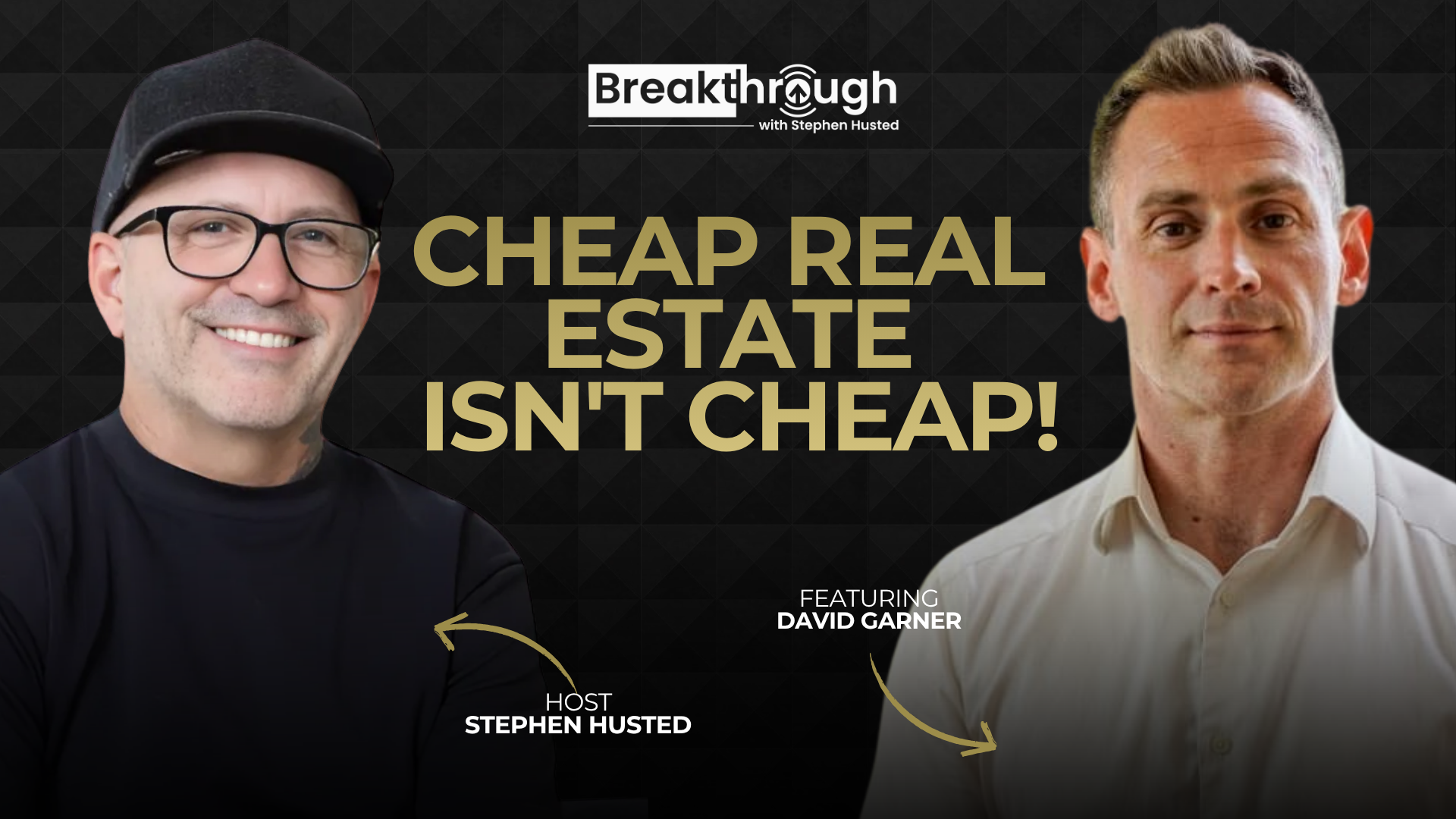
What happens when a real estate portfolio grows faster than the systems behind it? David Garner experienced it firsthand. After getting into US real estate investing in 2016, David scaled from his first rental property to 124 houses in just a few years. On paper, everything looked like it was working. But eventually, vacancies, maintenance, property management problems, contractors, and poor buying decisions all caught up with the business. What followed was a major financial collapse that forced David to completely rethink how he invested. In this conversation, David opens up about what went wrong, what he learned from rebuilding, and why his approach to real estate today looks very different. We talk about cheap rental properties, the reality of passive income, property management, cash reserves, remote investing, and why spending more upfront can sometimes prevent much bigger problems later.
Stephen and David talked about:
00:00 David Garner and the Gen X Uniform
07:30 How David Got Into US Real Estate
10:43 Scaling From 4 Houses to 124
12:42 How 124 Properties Nearly Bankrupted Him
15:08 Why David Changed His Investment Strategy
24:16 The Reality of Remote Property Management
31:22 How to Reduce Risk in Real Estate
40:44 Why Cheap Renovations Become Expensive
47:24 The Problem With $250/Month Cash Flow
54:45 Why Cheap Real Estate Can Be the Most Expensive
TRANSCRIPT
∎ Teaser / Highlighted Clip
00:00 David Garner: There are so many podcasts and people saying, you know, this is how you deal with property management. You've got to stick to the process and be firm. And now you've got to give people, you know, all of the leeway in the world. The truth is it's different for everybody, but it's a skill set and it's an art form. And that's why you get amazing property managers and you get really not so amazing property managers. It comes down to how good they are with people. This is the biggest thing. Real estate is a people game. It's not property game. It's a people game.
00:26 Stephen Husted: This was during COVID. And we hooked up to this agent, investor-friendly agent, and she was pushing us east of Troost and over the highway. And she's like, hey, this is a little bit more, it's a long-term play, but it's a good deal, good price point. And I brought it up to my partner at the time. And the way we structured this partnership was, hey, the first three deals he's going to do, bring the capital. I'll be the operator. And we'll see how we work together. And if we get past three, then I'll meet you 50-50 and we'll go from there. We just went through the craziest issues. Break-ins, people are stealing the appliance. Every time we put appliances, they get stolen. So then we had to put the appliances in the day the tenant moves in. And it was just one thing after another. So the point where we just sold out of them. Like there was just too many losses. And it was just so constant that it just didn't make financial sense.
∎ Podcast Intro:
01:26 Stephen Husted: I'm Stephen Husted, and you're listening to The Breakthrough Podcast, a space designed for clarity, curiosity, and the stories that move us. Here, we step away from the noise and into the moments that define us. the early influences, the hidden struggles, and the breakthroughs that reshape our lives. From personal reinvention to building a life through real estate and entrepreneurship, these conversations remind us that success isn't a straight line. It's a series of honest decisions, brave actions, and small shifts that change everything. This is where those stories live. Let's begin.
∎ Guest Introduction:
02:04 Stephen Husted: I'm excited to introduce David Garner, a real estate investor who went from building a portfolio of 124 properties to completely rethinking his approach to investing. David started investing in US real estate in 2016 and scaled rapidly, but eventually learned that bigger wasn't always better. By 2023, vacancies, maintenance, property managers, contractors, and poor property selection caught up with the portfolio. forcing him to rebuild from the ground up. Today, David focuses on quality over quantity, investing in better properties, creating low maintenance assets, and building long-term wealth rather than simply chasing more doors. Let's hear what David learned from scaling too quickly and starting over.
∎ Podcast Proper:
02:54 Stephen Husted: David, thanks for joining today.
02:57 David Garner: Absolute pleasure. Nice to be here. Thanks for inviting me.
03:00 Stephen Husted: Yeah, I'm glad you got the memo and wore the black shirt too so we can match.
03:04 David Garner: Yeah, we got the Gen X uniform. We're all good.
03:09 Stephen Husted: It is. It's funny. A lot of the guys that do come on, they'll show up in a black t-shirt and like, dude, I noticed that you wear black shirts for every podcast. So I came on with a black shirt. I'm like,
03:18 David Garner: that's good. Yeah, look, I mean, it's functional for me because I live in Brazil and it's like 30 degrees in new money. I don't know what that is in sort of shotguns and eagles or whatever you guys measure it in. I sweat a lot. I'm a gringo. I'm the whitest man you'll meet out here. And black works for those purposes, right? So a couple of t-shirts a day and I'm good.
03:39 Stephen Husted: Yeah. Yeah. I don't really deviate from black t-shirts. I mean, I just, one of those things, I don't even know how this all came about, but I think the more I created businesses and got busy, the last thing I want to do in the morning is trying to figure out an outfit.
03:53 David Garner: Yeah. I just
03:54 Stephen Husted: stick to the same thing.
03:57 David Garner: in my 20s i would want people to look at me right i would want to look like i was successful so it was flashy clothes and watches and stuff like that but as you progress on you realize how unimportant that stuff is and it actually detracts from the time and the focus that you can spend on actually trying to generate some real success for yourself so you kind of drop all of that as you get a little bit older and wiser i think certainly i did not that i'm much wiser but i'm definitely older
04:24 Stephen Husted: Well, you're getting wiser as time goes on. That's how you start catching those things.
04:28 David Garner: Yeah. One would hope.
04:32 Stephen Husted: Yeah. I'm in my fifties.
04:33 David Garner: I'm 46.
04:34 Stephen Husted: 46. Yeah. Yeah. Now that I look back on things, going back to like the t-shirts, you're right. Not having to use my brain on things like that in the morning is very important. It's something that I even tell my team and I'll give you an example. Yesterday. We were getting internet installed on one of our investment properties that we just built. And it had the wrong address. And so the technician was calling me. He's like, hey, wrong address. Hey, you need to do this. Hey, you need to do that. Then I was talking to my contractor earlier in the day. Once that was all said and done and it actually didn't get finished, I immediately called my assistant and said, why do they have my number? Why isn't it the general business number? Right. Why aren't you taking on the whole thing? And even if there's an issue, those are the things that you should be taking on. And I have to paint that picture. That was distracting me by about 30 minutes of my day, which is a lot.
05:37 David Garner: And I think as you get older, you appreciate time so much more like the distraction. But we live in a world now where it's full of distractions. It's almost like the objective is to keep you as distracted as possible. I got ADHD. I got diagnosed with that in 2021, which explained a bunch of stuff from the previous 40 years. But it's so prevalent and so common now because we just have no attention span. Everything's three seconds, right? You've got to drag someone's attention out of them in three seconds time. Otherwise you lose them and it's exhausting. So finding the time or finding the mental strength, I guess, just to focus on one thing for long enough to actually take value from it is it's a skill people are losing my wife was saying yesterday she heard some noise i think was a study that something like two percent of kids now can read a chapter of a book without getting completely distracted or distressed with it which is crazy to me i'd come from a generation where there were no phones right i got my first phone when i was 18 years old so i had all of that time up to that point without a phone so we had to entertain ourselves with the real world and engage with the real world and i think that's changing and not necessarily to everybody's benefit yeah
06:56 Stephen Husted: that's definitely true and just trying to break away from all the distractions or trying to lock into something you know it's interesting too for example like yesterday i locked into doing something and i spent like three to four hours working on it And then I almost felt guilty that I did too much in that time period. Because I'm so used to another way of moving through things like, oh, I accomplished X, Y, and Z. Instead of like, hey, how about just deep diving this one thing and trying to move that needle? It's weird. But just the brain reframe from technology is, it happens to the best of us.
07:33 David Garner: It's hard not to because information is so readily available, especially now in the last couple of years with AI, right? You can rabbit hole something to death and you can get yourself into kind of this doom loop of information that's really not useful. You don't come out of those three, four hour sort of rabbit hole sessions with anything more than if you'd have focused a little bit and maybe done it in a different way. I don't know. There are pluses and minuses to pros and cons to where the world's going with regard to the readiness of information and how much information is out there and how correct that information might be. So, yeah, I think we've all got to be a little bit careful about where we source our information and how easy it is just to get lost in this overload of data.
08:17 Stephen Husted: Yeah. And you've seen it firsthand. You've gone through it just like me. Yeah. Like how hard it used to be. Like there was a point where getting information took a lot of skill and research to get to that point. And now we get to the point where we can just go into AI, click some buttons, ask them, put a prompt in. And now it's almost like I told my team this where like we have information overload. Yeah. We have too much information now. Like, okay, now it's almost like you have to have a team member. to go through information if you want like let's say do content or build out stuff it's you need somebody that just can just go through everything okay what are we really doing with all this at this point yeah
08:56 David Garner: look i get that when i write for my blog i use ai to help me research stuff and you can end up getting into something that should have taken an hour to write Ends up taking three hours to research because you keep falling down new rabbit holes of information and it leads you to places that were nowhere near the sort of the core of what you wanted to write about in the first place. So, yeah, it's pretty easy to get lost. But it's a meme now, right? We're a meme. There's the picture of the kid looking up information in an encyclopedia. Like this was our AI. You had to pick up a book or pick up a phone, which was attached to the wall to speak to a human being to get information. But now it's just so readily available. It's a good and a bad thing.
09:34 Stephen Husted: Yeah. When you're doing researching for your blog, you know, when you maybe you get inspired by a topic and you start to, you go, I'm going to research this. I'm going to write about it. And you know about the topic. You're probably 80% in there. But then all of a sudden you start using AI for it. It pulls up stuff. You're like, wait a minute. I didn't know anything about this. Wait, should I have this in there? Is this actually correct? Yeah.
09:54 David Garner: And 100% you've got to double check AI because it will tell you with such confidence that A is A and B is B. And then you're like. I'm not sure about that. I've been doing this for 20 years. I'm not quite sure about that. And you get it to double check its work. It's like, yeah, no, I was completely wrong. Here's the actual answer. So it's not perfect by any stretch of the imagination, but who knows where it's going to go? It's almost like nobody's seen Terminator 2. It worries me a little bit. The evidence of where it could go wrong is already out there.
10:24 Stephen Husted: So, yeah, I want to hear a little bit about your backstory. So I was reading some of your bio and that you're. investing from abroad and you're investing in the midwest
10:35 David Garner: so rewind to 2016 i was living in spain at the time and i was working for some guys that they it was around 2010 i was working with some guys we rewind a little bit further from new york that had bought a tape of non-performing mortgages as we know 2008 to 2010 there was tons of this stuff about banks were desperate to get it off their books So they bought like a $10 million non-performing loan book from, I think it was GMAC Bank. And they bought it for like a million bucks. And what they wanted to do was package off the loans and sell them to smaller investors. And that was my job. So effectively, I was a sales guy. So I was packaging these small loans, selling to investors. But that was my introduction to the US real estate market. So it came in from the debt side, which for me, I feel it was a better introduction to US real estate because you understand it a lot. better or at least i did coming in from the debt angle and understanding the debt piece and how it all works because it's way different from everywhere else in the world the way the u.s mortgage market works so i did that for a little bit and then around 2016 i had a little bit of money from the work i'd done so i thought you know what i'm gonna go buy a property in the u.s i kind of understand it i can see other people doing well with it i'd made some good connections with some decent people so i thought yeah, I'll give this a go. And at the time of 2016, we bought a house in Jackson, Mississippi, South Jackson, Mississippi, which if you want a baptism of fire, I suggest go there, buy a rental property and wait because you're going to have some fun times. But we bought it. I think we paid like 30 grand for it. We did a light rehab. We put a tenant in there. We got a property manager. We did all of that. then we got an appraisal and it appraised up at like 90 i think something like that so we could we figured we could we kind of fell across the buy renovate rent refinance repeat strategy because it just kind of made sense to us at the time so we did that we refinanced it pulled the money out i'm gonna go buy another one right so we did that and then So we'd done, I think, four houses and they're all kind of the same, like 1,000 square foot, three bed, two bath, nothing special, just bog standard stuff. They rented really well. They were renting at the time for like $700 to $900, thereabouts, 2016. So it was kind of bottom of the market. You're picking up houses for 30 grand in these neighbourhoods and all of the challenges that come with those kind of neighbourhoods, which we didn't find out about. until a little bit later on until we'd own this stuff a while because you don't right you don't have problems on day one you have problems in year three and it all hits you at once but i'll get on to that and along the way we met some people that saw what we were doing i say we me at that point and saw we were pretty good at it so they started throwing some money at us which was just like throwing gasoline on the fire because i'd systemized them everything so i knew how to find a house i knew how to get a contractor in there and what to do to it. I knew how to put a tenant in there. We had a decent property manager, or so we thought at the time. And that, it was just like throwing gasoline on the fire. And between 2016 and 2021, 22, we got to 124 houses, which is hyper fast scaling. And I do not recommend anybody do that because I was a spreadsheet investor. I was like, the bigger the rent and the lower the purchase price, the better the deal, right? With taking no account of the neighborhood, the street, the tenants, the general mess that you find yourself in when you own those kind of houses and you don't know what you're doing. But that stuff doesn't hit you until a little bit later on until you've owned this stuff a while. And we thought everything was going great because our maintenance costs were pretty good. We were doing the really good deals, and that was the bit that I was excited about, so I was focused on that. But come 2023, long story short, all of the problems you have with that C-stroke D-class real estate hit us all at once, right? Vacancies, turnovers, capex, maintenance, property managers being... property managers contractors doing what they do when people bite the hand that feeds them so we built good teams and we were throwing money at people to do jobs and what we didn't realize from our ivory tower was that we were getting less value for money day by day from contractors from property managers our property manager was if somebody had first month's rent and a deposit they put them in the house that's it Like no screening, no nothing. And we know how that ends. So we went from around $60,000 per month positive cash flow on our spreadsheet to about $90,000 negative in the space of three to six months. Like everything hit us all at once. And it'd be pretty much... and bankrupted us. And this was 2023. So we had foreclosures, we had short sales. We were lucky enough that some of the notes that we had were with private lenders and they were pretty keen to get out of them. So some of those guys took a hit and it was devastating because we thought we were the beeswax. We'd scaled super quick. We'd done everything right. We'd done what all of the podcasts say you're supposed to do. We'd got to over a hundred doors. We could brag about that in the bar. But what we had was 124 crappy properties in crappy neighborhoods with crappy tenants. That's what we owned. And it all came to our head. And it was a really tough time and a real ego check at that moment to figure out we hadn't built anything but a mess, right? Which we now had to dig ourselves out of. And a bunch of other stuff happened for us at that time as well. My wife's father died. We lost a baby. We had like a few rounds of IVF and then we lost a baby. We got sued by one of our lenders in federal court, which is not fun. I do not recommend anybody get involved in that business. So all this stuff was happening at the same time. I mean, I look back on it now and I'm thankful because it built the strength of mind and resilience to be able to face those things as they happen. But it was very difficult. We looked at what had gone wrong in our portfolio. We analyzed or tried to analyze why, where the problems laid. And we had a bunch of problems. Like we had contractors that were ripping us off. We had property managers that were doing a really bad job and all of that stuff as well, because we're remote, right? We're doing it from another country. So we had that, but we also made really bad decisions in terms of what to buy. And we did not understand how... management intensive that kind of real estate is and how you're dealing with people who are living in these homes who are one car crash away from not being able to pay their rent they're one medical bill away from bankruptcy right so as long as everything's running smooth rent turns up on time but one little hiccup in their life and the other side of it some folk in that segment don't necessarily live well so there were issues with the properties as well but we looked at what went wrong and we decided to give it another go but we rebuilt our investment strategy around the few properties that we owned that actually worked for us and those were bigger houses on nicer streets at least two bathrooms but more importantly than that properly renovated like no more lvp floors and a lick of paint Like not fresh paint on a hundred year old sewer line, no more of that. We took the properties that we had, we threw what little money we had left into those. And then we started buying more, but on the basis of they were from the sewer line to the roof, everything brand new, everything brand new, high quality finishes, much nicer streets, still in kind of C-class neighborhoods, but the nicer streets where there's more renovated houses, where the tenants that have options, the good tenants, they want to live. right so there's still affordable housing but they want to live in a nice house they don't want high utility bills they don't want the property manager contracts are coming out every two three weeks for a broken furnace they don't want the roof leaking they don't want a house flooding all the time so they'll leave if that's the kind of house you're putting them in the good tenants will leave if you're not doing your job as a landlord and creating a sustainable low maintenance asset and we weren't right we were being cheapskates we thought spending as little as possible was the lever that we could pull to make more money. And it's the complete opposite. We were stepping over $100 bills to pick up pennies. So we rebuilt around that. And we've managed over the last three years to build up to 30 houses. We have 100% occupancy. Nobody's, I say nobody, rarely do we get even late rents, nevermind unpaid rents. We haven't had a turnover in three years. My capex has been zero between 2023 and now because we took it all. We did everything before we put a tenant in there. New roof, new electrics, new plumbing, new systems, everything brand new. And while you still have repairs and maintenance and stuff like that, generally speaking, you're going to have a much easier ride as a landlord if you focus on quality over quantity. And that's our goal now over the next five years. Every single penny we earn from our properties goes back into the properties. People talk about what's your capex reserve and what's your maintenance reserve. Mine's 100%. Whatever comes out goes into that reserve account because I've been bitten so hard before that I just want a big mountain of cash that I can pull out of when something does go wrong. And it inevitably will at some point. So my reserve is 100% and anything above my reserve at the end of the year goes down to pay down my DSCR loans. And I want to ultimately, we probably want between five and 10 properties debt free to retire with. I don't need 30, I don't need 50, I don't need 100 with a bunch of debt. My end goal is I'll sell a bunch, I'll pay off the mortgages on the rest and we'll keep those, the best houses with the best tenants and ride that out. But yeah, getting to the point where we realize that you're not investing for a $250 check, you're investing for the 10-year hold and the 200 grand of equity you build, right? From your pay down and appreciation, whatever. And that's why we started the part of the business that we have now, which is helping other foreigners buy U.S. real estate, of which there are a lot. And they generally all get missold a very specific product, which is kind of what we were buying to start with. Cheap houses in bad neighborhoods, mostly Section 8. It's been kind of packaged up and sold to Latin Americans and Europeans as this guaranteed passive income vehicle. And if there's one thing I would tell anyone looking at US real estate, an $80,000 house, it's not passive income in any way, shape or form. So that's kind of the genesis of where we got to where we are right now.
21:49 Stephen Husted: This is good. Really good. I don't even know how to unpack all this because this hits so many things that I've gone through over the years as well. By far, everything, I didn't go through it at your level of scale, but I already went through everything you went through for the most part. And yes, in the beginning, the numbers, they look real good. And even your team will make those numbers look good. Your agent, your property management. And when you're in certain types of neighborhoods, You just have more to deal with. Just like you said, if they have one issue, they're not going to be able to make rent. Or there's just a lot of scenarios that pop up. And to the point of not taking care of the big mechanicals, that's a massive one. And there was a lot of points, I would say, bigger pockets. That's a perfect example. Oh, you can go buy this house in Detroit. You can put 20 grand into it. But you're fixing up this and this. It's like you left out the roof, the plumbing, the furnace, the sewer line. You left out all those big things. All those big things. So you're going to burr out of it. And you're going to move on to the next,
23:09 David Garner: which can
23:10 Stephen Husted: work. And it can work for three to five years. But then what happens, just like you said, you get to scale. And then when you have more than five properties, 10 properties in that range, you start to notice that your repairs and your issues all happen at one odd reason. All at one time. All comes to a head. And next you know, you're like, oh, am I prepared for this and this? And then things, what happens is these problems come to light, but then things move slow. Because now you're trying to get the teams to address those issues. And that takes time. And then that contractor falls behind or that tenant falls behind on rent or they're going to get evicted. And then it just, then you've got a squatter. Then you've got, it all compiles. So what you brought up, I love that it was just straight to the point. That is, it's good. And then, but the thing to it is at the end of all that, you realize really what you wanted. And you shifted gears. So you pivoted. And we've gone to that point too. I have a couple of properties in the Detroit area. And I've sold some of them because I had issues. And I just couldn't address them. And I was doing bad. I didn't have a good team. I didn't have a good contractor. Nothing was good. And found somebody that would take it on who this is what their expertise was. Take it on houses that had squatters and all these issues. They love that. That was their business. They understood it. Cool. They had great people on the ground. Great. You can have it. I focused over to Kansas city. We
24:49 David Garner: got out of the whole Kansas city,
24:51 Stephen Husted: C minus neighborhoods, more in the C plus B minus neighborhoods where a little bit more stable, did the rehabs, got everything completed. Roof, plumbing, electrical, you know, got all those windows.
25:04 David Garner: Are you East or West of Troost?
25:07 Stephen Husted: I'm not East. that was a little you're you're testing me right there
25:15 David Garner: well look hey i think there is some opportunity east of truce but like on truce like it's spreading a little bit but it is it's it's a brave 10 to 20 year hold with no guarantees on the east well
25:32 Stephen Husted: let me just tell you this so I have a lot of clients that work in tech and their company goes public or they got RSUs and they reach out to me and they want to buy investment properties. Right. They see what I'm doing. Very similar to like you started doing your thing and then you had people coming to you. Well, that happened with me. And this was during COVID. And we hooked up to this agent, investor friendly agent, and she was pushing us east of truth. over the highway and it was she's like hey this is a little bit more it's a long-term play but it's a good deal good price point and i brought it up to my partner at the time and the way we structured this this partnership was hey the first three deals he's going to do bring the capital i'll be the operator and we'll see how we work together and if we get past three then i'll meet you 50 50 and we'll go from there we just went through the craziest issues just Break-ins, people are stealing the appliance. Every time we put appliances in, they get stolen. So then we had to put the appliances in the day the tenant moves in. And it was just one thing after another. So the point where we just sold out of them. Like there was just too many losses. And it was just so constant that it just didn't make financial sense. And it goes back to what you said. I think if you're an operator. and you have investment properties and they're in the more questionable neighborhoods but you're local and you got a really strong local team you're almost like property managing some of them too
27:09 David Garner: like that is your business you need to be able to doorknock physically yeah like with kind of real estate what i learned and most of my stuff was up in pennsylvania when it all kind of fell in on itself but you've got to have someone Or be local enough or have someone that can go knock on the door because it's 50-50 whether you're getting rent on time. 50-50, right? And there's always going to be issues. And the one thing I learned with that kind of real estate is that silence is not golden. And this is the big risk I see with people buying Section 8 properties because the check turns up and they never hear a peep from the tenant. But then they go and do a walk around after two years of living there and they realize why they never got a phone call, right? And the place is just... trashed it's management intensive these are people with problematic lives you know like i said they're one paycheck away from having real problems which is a terrible thing but you need to account for that if you're going to be a housing provider for a family like that or people like that you've got to take into account the fact that they are not going to be able to meet those commitments some of the time and you've got to have some flex on that and you've got to know how to deal with that and you've got to be able to speak to people and converse with people who live in those kind of neighborhoods on a level and have them have some kind of respect for you. Because if not, you're just the evil landlord. You know, you're the thief, the robber baron. And that's just going to end in tears. which it did for me many times especially being so far away and you know imagine calling someone up with this accent and you know i'm calling somebody south jackson mississippi with this accent saying pay your rent that's not it doesn't work out for you i'll tell you what yeah yeah honestly i have people hang up on me because i self-managed for a little while when we had a there was a few tenants that we had that were really cool and this is the other thing in those markets you can have the best tenant in the world some There's real golden people in some of those neighborhoods, but they are the exception to the rule. And I'm not saying they're bad people at all. What I am saying is that they're financially stressed. And you have to take account of that if you're the housing provider because you're relying on them. And this is the thing with that real estate. You know, people look at it as an investment and say it's a house and it's going to go up in value and it's going to be the income. Now, to make all that work, strip all that away, there's a person that's got to write you a check. every month how capable are they writing that check right that's what it really strip everything else away that's what it boils down to if you want to own a house for 10 years and it'd be relatively unproblematic the person living here has got to be able to write you that check and when they can't write you that check you've got to be able to negotiate with them a way to make that work for you and for them and that's an art form There are so many podcasts and people saying, you know, this is how you deal with property management. You've got to stick to the process and be firm. And now you've got to give people, you know, all of the leeway in the world. The truth is it's different for everybody, but it's a skill set and it's an art form. And that's why you get amazing property managers and you get really not so amazing property managers. It comes down to how good they are with people. This is the biggest thing. Real estate is a people game. It's not a property game. It's a people game.
30:20 Stephen Husted: You're absolutely right. You're absolutely right. All the big disgruntled tenants that I've had, it was over property management doing things that like they had an issue, like COVID especially. And they were getting charged late fees over and over. And they're like, look, I'm not working right now. I'm trying to get this. And you're just tacking that on. And then I find out after the fact, and believe me, the ways that I found out during COVID in that market. like, straight savagery of, like, cousins calling me that were basically saying that I'm going to, I'll just burn your fucking house down. Straight up. Like, those were the phone calls.
30:58 David Garner: I was like, whoa.
30:59 Stephen Husted: And then I'd find out, I'd go, are you really charging them late fees during this time period? She just lost her job. They're like, yeah. I'm like,
31:07 David Garner: stop.
31:08 Stephen Husted: Stop doing that. Like, talk to her. Let's figure out a game plan. Like, I want people in there. She wasn't a bad tenant prior. She was paying on time. So what are we doing here?
31:19 David Garner: This has always been my issue with property managers. The business model of property management doesn't align with the interests of a landlord a lot of the time. They make more money on a turnover than they do collecting 10% of your $2,000 a month rent check or whatever it is you're charging for rent. They're like, well, we might take 50% of the late fee, so charge the late fee all the time because they've got offices and staff and insurance and all that to pay for. It's not a profitable business. It's a thin margin business. And therefore, sometimes I find they lack the flexibility or just the common sense. Because for you as a landlord, I'm pretty sure you'd miss a rent check to save a $10,000 turnover. 100%. Right? Three months of vacancy and a 10 grand turnover, or let's hammer this person for the extra $100 they can't make that month. And again, property management, that's just as much of an art form as it is a science as well. And these are the things that you pick up along the way. And this is why it's very difficult for the people that I deal with now, the overseas buyers, because they have no idea what they're getting into, especially if they're getting into that kind of Section 8 C-class real estate. They have no idea. And especially my clients from Latin America, they have this kind of rose-tinted view of the USA. There are no ghettos. Everyone eats McDonald's for breakfast and everyone lives in a McMansion. I'm like, no, the hood is real. It exists, right? And there are people of all... shapes sizes and colors in the u.s and of all socioeconomic levels and if you don't know how to deal with those people service providers tenants everybody you are going to come unstuck because as a remote investor from thousands of miles away you are reliant on somebody else for everything and the second somebody gets a whiff that you're even out of state never mind out of country and i'm sure you've experienced this the price goes up and the quality goes down i see that all the time All the time. We had a client in Cleveland. They got like, it's a reasonable little rent. It's like $150,000 house. It's on a decent street. It's got fairly well rehabbed. It's got a decent tenant in there. Tenant left and the property manager was going to charge him like $9,000 for a turnover. That house had been rehabbed. That tenant had only been in there three months and they straight up for a fiction straight away. So the property manager was not so good. are placing the right kind of tenant in the first place. But then they wanted to charge them nine grand after they'd only turned it over three months ago. And it's like, well, they're kind of holding them hostage. What are they going to do? I see that all the time. It's sad that this is, I think, more of the value that we give. It's less about finding people properties. It's more about kind of making sure that they don't lose their shirt by dealing with people that are just going to take advantage.
34:04 Stephen Husted: So with all this, I know we went into a pretty deep. These are some things that probably. What we just said would probably scare a new investor to want to invest.
34:14 David Garner: It should. Yeah. It should.
34:16 Stephen Husted: What are the things you've learned to put into place that would help minimize? Because nothing gets alleviated. Let's just say that.
34:24 David Garner: Yeah, you can't eliminate problems. You can plan for them. You can have a pace plan, right? You can have a primary plan, an alternative plan, a contingency plan, and an emergency plan for everything. like an old project management thing, old school pace plant. So number one, that's one of the biggest issues is people getting into it on the basis of being sold real estate as some kind of passive thing. It's not. So set your expectations accordingly would be number one. Number two is surround yourself with the right people. And my experience of that, we had a lot of people problems in our real estate business. But they didn't all start out as bad relationships. People did a really good job to start with. But then I know I have to take accountability. I dropped the ball and just let people run. People did a good job for us and we just let them run, like contractors, for example. And I stopped micromanaging people to the extent that I stopped managing them, essentially, and just trusted people. And unfortunately, some of those people bit the hand that was feeding them, which was my hand, and I lost a few fingers. surround yourself with good people, learn as much as possible and have a contingency plan as best as you can for everything. And also, as long as you are sensible about stuff and you have the right expectations, whatever goes wrong, just bear in mind that this too shall pass. Nothing's going to kill you unless you bet your house on something stupid. Nothing is worth losing sleep over at the end of the day. Don't kill yourself with stress. My hairline lost like three inches in 2023.
36:04 Stephen Husted: 2023 was tough. That was a tough year. It's interesting that your timeline kind of lined up with my type. We're like identical. I started investing in 2015.
36:14 David Garner: All right. Well, there you go. Yeah. It's a very similar time. Yeah. 2023, like I said, for me, was just awful. My wife. lost her father we before living here in brazil i lived in argentina for four years and we moved from the uk to argentina to look after my wife's father because he had alzheimer's dementia like she didn't really have a relationship with him she got a call one day saying we've just found this man on the street with a head injury and he says he's your tad and he'd had a psychotic break so we had to up sticks move ourselves and at the time we had six dogs from the uk to argentina to look after to him and he passed away in 2023 we had like numerous ivf rounds fail and then we lost a baby and then we got sued and the business collapsed and it's just like everything all at once it was the worst it sucked But now looking back, like whatever happens today, I know I'm going to be all right because I went through 2023 and I'm still here.
37:18 Stephen Husted: Yeah, you have that perspective now.
37:20 David Garner: Yeah, yeah, absolutely. And it is its perspective. Like the first time you get a broken boiler, like a furnace, as you guys would say, you think the world's going to end. But then you've owned real estate. If you can get through the first five years of things go and roll and you don't lose your shirt. then everything gets a lot easier because you've got that perspective. And a boiler breaks or a furnace breaks down. You know you can get that fixed. You know you can get that replaced. It's not going to be too much of a problem. Yeah, some people might be a bit pissed or whatever in the process, but that's fine. That's just people being people. You get through it. Nothing's insurmountable, but it takes a while to get through that. And as with any business or anything in life, the first time something goes wrong, you think the world's ending. And it's not. It's just a thing that you deal with. But it takes some time and some experience to have that perspective that this too shall pass. Nothing's going to kill you.
38:14 Stephen Husted: Yeah. And you definitely have to have thick skin and have some grit and some endurance. If you can't have some of these characteristics, real estate might not be for you.
38:24 David Garner: 100%. I
38:25 Stephen Husted: mean, I had to say it that way, but having investment properties reveals a lot of things about yourself as well. Oh, yeah.
38:31 David Garner: Yeah, yeah.
38:32 Stephen Husted: 100%. It definitely does.
38:33 David Garner: I tell you one thing that I learned about myself is I do not like conflict. To my detriment, sweet something under the carpet or agree to things I shouldn't be agreeing to because I don't want that conflict. And I've had to train myself to be okay with conflict and not have it scare me or frighten me or whatever to be able to sit with somebody who's angry at me because they've got a problem. And instead of just giving in and giving people what they want. learning that actually you have a problem it's my problem also so let's sit on the same side of the table looking at the problem rather than opposite side of the table fighting over it
39:10 Stephen Husted: right or taking it too personal too when it's directed and there's a some there's yeah it really exposes the good and the bad and your personality yeah and it's weird to say that when it's like investment properties but the reason why is you're dealing with people Because it all stems down to there. So there's all these different personalities. And one thing that I would say that one of my character flaws when I first started was I always wanted everybody to like me. And I wanted to like them. And I wanted to have these relationships with my contractor. And I wanted to talk to them all the time on the phone. Yeah, that's all fine. It's cool to like who you're talking to on the other side, especially when you're dealing with them on a weekly, monthly basis. But shit's going to hit the fan and you're going to have problems. And that trust sometimes has to get built over time. It can't just happen in day one. And I've done this over and over like, oh, I get a lender. I don't want to. OK, I'm not going to use any other lenders. He's my guy. Because I got it solved. Well, that's not how everything works. You have to have backups and contingencies. You better foster more than just one relationship. You better have at least three of each individual that you need on your team. You better have those.
40:27 David Garner: So much. I was talking to one of my clients about this yesterday. We got him a rental in Kansas City. It's on East 83rd Terrace. So it's literally. I know where it's at. Just west of. Truce, right? Just West. Great property. Like the one two doors down sold in 2023 for like $250. And this one just appraised for $309 and we picked it up for $255. So it's a great deal for him. It's rented at like $2,200, I think. So it's really nice house. It was renovated last year, everything brand new. But it's got a property manager managing the tenant right now. And I'm like, I'm going to give you the contact for two of the property managers, ring them up, speak to them, tell them what you own. get them interested in having your business because the property manager that runs it is the kind of property manager I prefer, right? They're a small mom and pop enterprise. He goes out, fixes the toilet. She deals with the tenants. They know the neighborhoods. They know the tenants. They've been doing it a long time and they own their own rentals. And I feel, in my experiences, I get a better level of service from those kind of people and those kind of businesses in those kind of sea markets than the big corporate property managers who've just got Maureen on the phone who's just pressuring a tenant to pay rent that they don't have and everything goes wrong. However, that kind of business is fragile. What if they tomorrow have an accident or one of them gets sick or they decide not to be property managers anymore? They're selling up. We say, we're off, deal with it yourself. You need a backup. You need to be able to ring someone up and say, hey, remember I told you about that rental I got? Well, look, I've just lost my property manager. Can you go knock on the door, just reassure the tenant and let them know everything's, there's some continuity and you're going to be looking after it from now on. You need that in place. And if you've got it in place and it's in your, you've got, that number to call and that existing relationship, there's no panic. You're not going, oh my God, what am I going to do? The tenant's not going to pay their rent. I can't collect. Well, no, you just call the guy that you spoke to a few months ago and said, hey, I've got this rental. Might be interested in using your services at some point. So just have your backups.
42:28 Stephen Husted: Definitely. You got to have a pretty robust vendor list. And that list takes time to build out.
42:34 David Garner: Yeah. You have to realize that every initial phone call you have with a vendor is going to be great. They're going to be the best level of service ever and they're going to be the cheapest price ever. But until you've worked with someone a little bit, you don't understand whether they're actually going to deliver on that because every call is a sales call. They want your business. So yeah, you've got to have backups for absolutely everything.
42:55 Stephen Husted: I want to pivot to something you brought up earlier because when you first went deep on your story, It was just hitting so many points and I was in my head going, oh, I have to like bring up this and we got to talk about all these different things because there was so much there. But did you, when you started really scaling, what were you doing to these houses in the very beginning?
43:16 David Garner: Not enough is the answer. So walk me
43:18 Stephen Husted: through, what were you doing to get them? Because I think this is a very important. part were you buying these properties were you doing inspections did you understand all the mechanicals or were you just like hey we're going to dress this up get it rented start cash flowing and figure out the capex the big mechanicals down the road what was that plan like
43:38 David Garner: it's an interesting question because for me it was probably a little different to your average u.s citizen because everything works differently in america to everywhere else in the world the houses are different they're built different they have different systems To me, a furnace is a boiler. I always now think of American houses by and large as like Lego houses because everything's replaceable, interchangeable. They're made of sticks and everything's interchangeable. I come from a place where everything was made in the Victorian times or earlier at a brick and it's still standing and it's a solid lump. Whereas the US is very different. A house in the US is a much more living, breathing organism than some of the other places. Like my clients in Europe, everything's concrete. just a concrete box super low maintenance whereas the us is a little different so the answer is i did not know anything or it certainly didn't know as much as i should and my goal my misplaced goal was to look at that spreadsheet and go as little money out as possible as much money in as possible successful business Whereas actually the opposite is true. The more you spend up front, the less problems and headaches and losses you're going to have later on down the line. But if you go, oh, okay, it's got a 10-year-old furnace in there. That's fine. It still works. Cool. Yeah, but a 10-year-old furnace, if it's not been well-maintained, it's going to cost you probably two grams worth of repairs every winter because it's going to keep breaking. And then it's going to cost you the five grand or whatever it costs in your market to replace it. So it's just a fool's errand to not replace that stuff early on. The roof, well, it's 15 years old and it's leaking a little bit. Okay, well, we can patch that up and deal with it later. Sure, you can patch it up and deal with it later. But then you've got the cost of getting a contract, right? You've got the inconvenience for a tenant. You've got a risk that something could go really wrong and you have a massive water damage. And think about your tenant. You want your tenant, the mecca for you and I is to have a tenant that stays in the house for 20 years, always pays the rent and looks after the house. That's the goal. How long is that tenant going to stay if the roof is constantly leaking, the utility bills are through the roof because it's old systems and crappy windows and doors. Then they're going to move to somewhere else. Tenants, in my experience, don't move because the rent goes up. Because they're going to have to pay that higher rent somewhere else. They move because they're having a bad experience either with the house or the neighborhood. So number one, don't buy something in a terrible neighborhood. I rent this place here in Brazil. And I've rented this place not because it's an amazing house. I rented it because it's not in the neighborhood that's probably three blocks that way, which I can't walk down at night. This is Brazil. It's a little bit different. I chose the neighborhood before the house. And I think most people do that. They want to live in an area. And then they'll look for a house in that area. And even within an area, the street by street, in these C-class and B-class markets, it's street by street. You can have a really lovely street two blocks over. You can have somewhere you do not want to be at night. And people, I had one client that was convinced he didn't want a particular zip code. Want to buy a particular zip code because the crime stats were off. And I'm like, well, yeah, that's right. But that zip code covers a really nice area. And a really dodgy area is too broad a statistic. That's like saying I want to invest in Cleveland because Cleveland's a good real estate market. Cleveland's 2 million properties. I think it's 2 million. It's a million or 2 million. It's a lot of houses, right? And it's the same as Kansas City. You can throw a rock and hit a good neighborhood and you can throw a rock in the other direction and hit a bad neighborhood. You've got to learn it street by street. But going back to your question, I don't want to get too far off point, which is something I do, so I apologize. But I didn't know enough. So we were patching up old furnaces. We weren't replacing sewer lines. We were keeping old roofs. We were painting kitchen cabinets. We were doing everything that a certain segment of the gurus and whatever said to do. Spend as little as possible. It's just a rental. Just put cheap flooring out. It's just a rental. Worst advice ever. Worst advice ever. You're stepping over $100 bills to pick up pennies is what you're doing. And then you think your spreadsheet, 250 bucks a month, is going to show up in your bank account. It's not. Your bank account is going to be negative every month. And you're not going to attract a good tenant. And the tenants you do attract are going to struggle to pay rent. They're not going to look after the house. It's going to need constant repair. Your turnover is going to cost way more every time because you've used the cheapest possible kit every time. And then your maintenance bill, don't even start on that because that 15-year-old furnace that is living on a... winging a prayer it's constantly breaking in winter it's a terrible tenant experience it's expensive for you your turnover rates through the roof and it's just terrible advice yeah
48:24 Stephen Husted: you really nailed it i'm and you learn these you learn this from going through it yeah you learn these things going through the issues and then you figure out the direction that you really go like what you said you get to that point where you have to like revisit the business. What am I trying to do here? Okay, this isn't working. So let's go build it out this way. And you're totally right.
48:50 David Garner: We do
48:51 Stephen Husted: developments out in Seattle now. And so we're going in and everything's getting done. And then I realized after that, I was like, oh, there's so much more peace of mind. I would rather have a repair thing where it's like a door handle or something in the closet came loose. These things that are just trivial, little small things. than dealing with the big things because i know that the roof's done i know the plumbing has been updated and electrical it's got new windows yeah and all those things give you a good length of peace of mind which is goes a long way in my eyes it
49:24 David Garner: does it's a weird one because if you don't go through that and experience it everything runs smooth let's say you you decide to do everything right just because you're that kind of guy and you're going to replace everything brand new right from the start you've never experienced the problems But having experienced it, it makes you appreciate so much more. There's a right way to do this and a very risky way to do it. And I've seen people that have got away with it. They buy cheap houses, they give them a lick of paint. And for whatever reason, these people just do okay. But you're right. I think one thing really resonates that you just said for me is that originally I started this out because I wanted income. I thought real estate gives you income. The reality is owning real estate, if you maintain it properly, and I mean properly, not just repair it when it breaks, but maintain it properly, it's going to suck up any rent, all of it, really, until you've owned it for long enough that then it starts to pay out a little bit. But if you get involved and a huge amount of the clients I deal with, I can't do business with. just because they're coming to me, like speaking to a lovely lady from Ecuador. She's like, I've got this money. I want to buy a house in America because I want the income to live on. I'm not selling you that on that basis because you're investing for a $250 check. What happens when a $5,000 furnace goes or an AC unit gets stolen or the electrical panel needs doing or the roof needs repatching or replacing or the sewer lines got cracked or got roots in it. Where are you going to find that money? And you're doing that for a $250 check. You're taking on debt and buying a $150,000, $200,000 asset for $250. That's crazy. All of my income, as I said to you now, goes into my reserve. All of it. So I never have to worry. I never have to have a problem. Five roofs could blow off tomorrow and I could replace them with cash straight away. I don't have a problem. But the original perspective we had was every property adds 250 bucks or 300 bucks or whatever to my bottom line. And that was a massive mistake because I spent it and then it wasn't there when I needed it. And in 2023, I really needed it. So that was a lesson learned. Now I'm building wealth and building wealth is a way different strategy to buying properties for the income. You can own properties for the income, but it takes a while to get there, in my opinion and experience.
51:58 Stephen Husted: Yeah, a lot of the old timers that I've talked to that have been in the game for like 20, 30 years, all had very similar stories about how they built their wealth. And a lot of it was those first five years were the toughest and they learned all the good and the bad during that time period. They built better systems. And then they also understood markets when markets were hot and when markets were cooling down. Some markets, they would buy more. Some, they would just be building their business and not buying anything. And it wasn't a constant, like the gas was on. But they all said the very similar thing. If you can invest for the long term, that's where the payoff happens. Yes, you're getting repairs and you got those for your tax write-offs and deductions and that's good. But you're getting a couple different things happening at one time. You're getting the principal pay down by the tenant if you've got that property rented. And then you're building out a little appreciation. Sometimes you're not having any appreciation because of where the market is. Like we're kind of in that market right now where things are kind of flatlined in certain areas. And that really depends on where you are in the United States. There's markets that are still doing really good. Some are flat, some are going down. It's all cynical. It all moves differently. But if you stay in it long enough, you look back and then you see what you had built within there. And I think that's the key.
53:27 David Garner: 100%. Look, the historical 30-year appreciation rate, according to the Case-Shiller Index, is like 4.2%. But some years there's a loss and some years there's a gain. And like you said, national level housing statistics are just talking points for the media. It's absolutely pointless. What's happening in San Diego is not what's happening in Cleveland, Ohio. It's not what's happening in Kansas City or Detroit, Michigan. Even what's happening in Detroit, Michigan isn't what's happening in Detroit, Michigan because it's street by street. That's true. Real estate is super hyper local to the point where one street can be good and the next street can be bad. But I get a lot of clients come to me. Because they've been marketed it saying, I want to buy a house in Ohio because Ohio is a good investment. Like Ohio is bigger than the UK, I think. Like it's got good bits, sure. It's got pretty awful bits as well that probably need 20 years of investment to become reasonable, nice areas. But I do think a lot of my clients don't appreciate the size and diversity of the United States. We just talked about Kansas City. They're it. That road, Troost or Paseo or the 71, all those three roads that are there, west of it, pretty nice. East of it, not so good. Still probably some opportunities there if you've got the stomach for it. Be sure you need to have the stomach for it in those markets like we talked about. And it's about what you're prepared to take on. How much risk and how much time and effort and potential for losses and horizon do you have? That should really dictate. what you buy and where i think just the right expectations yeah
55:09 Stephen Husted: setting your expectations it's interesting that you brought up about the wow that beginning investor saying i want that extra 250 to like live off or what have you and have much these properties and i would remember hearing a lot of people online talk about oh i retired i bought 10 properties and i'm like how it's different for me where i'm at I don't say it's impossible, but it's going to take me a little longer. I live in a very expensive area of Silicon Valley and the cashflow goes right back to the business. I don't really, I don't think I've ever really said, oh, wow, I made this amount of money this month. It just sits in the business.
55:45 David Garner: Yeah. Just stay in that real estate ecosystem, like, because you'll need it. You will need it either to capitalize on an opportunity or to cover a problem, but you'll need it. Yes. Simple as. That's been my experience. I've never owned a property that I haven't had to spend money on. I don't think that exists.
56:05 Stephen Husted: I think you could pull it off. So I have one of our cleaners that cleans our midterm rental. She wants to get into real estate. And I tell her, you're a great market to do it. She's in Kansas City. I'm like, you can be on the ground. You have these skills, you can go to your assets, you can find houses that look like they need to be rehabbed. Like you've got a good scenario going here and the cost of living. So yes, you could build probably a business out where, yeah, it probably could cover your mortgage on a house. Like you could probably live off that. Wouldn't work where I'm at. For me, it's cash. I live in a very expensive market.
56:41 David Garner: Yeah, you're Seattle way, right?
56:43 Stephen Husted: I'm in San Jose, California.
56:45 David Garner: Right. Yeah. Money-wise, same difference. You said you were building it. Yeah. Just expensive. Just expensive. Yeah. And this is why I think you get a lot of, there's a lot of these turnkey companies now. I've noticed in the last couple of weeks, they're all now pushing St. Louis, Missouri, and what was the other place they're pushing? I think there's some in Oklahoma City. They're now pushing these markets where you can buy a rental for 150 grand because it's a low entry point for someone who's got like an 80% DSCR loan. They may be putting 20, 30 grand in. It's accessible for a lot of people. But $150,000 house to somebody who lives in San Jose, California, it's like, that's my garden shed. It almost blows people's minds that's available. But cheap is not good. Cheap is the most expensive price you can pay in real estate for anything. Like pay cheap, pay twice. That's a great statement. That's a great statement. The most expensive price you pay because the cheaper the house is cheap for a reason. It's not just cheap because you're really lucky to have found a cheap house. It's cheap because they're all cheap and they're cheap because nobody wants to live in them. And nobody wants to live in them typically because they're in a bad neighborhood, let's say, or a rougher neighborhood. The people that live in those neighborhoods are living there not through choice, but through necessity. It's their primary housing option. But that comes with a bunch of stuff that you have to deal with as a landlord, which both you and I have experience. And it's a rude awakening to own those kinds of houses. And it really is, this is the primary reason we set up the part of our business that helps other foreigners buy in the U S because the only thing they're marketed are section eight houses. Like some of them are marketed like these 30, 40 grand houses as turnkey, believe it or not, but they don't know any better. You have an Argentinian businessman and somebody says, hey, you can buy this house in America for a hundred grand. They think that's a stunning deal. I'm like, no, a hundred grand house is not an asset. That's a liability. That's just a bill you haven't opened yet. That's all that is.
58:49 Stephen Husted: So how do you navigate that for them? So with that being said, you gave an example that you have that one client that bought. recently and has the local property management company, the husband and wife. So how are you navigating that? What are you setting expectation-wise with these new investors?
59:11 David Garner: It's a really good question. And I took the decision very early on when we started doing this, that I was not interested in doing business with anyone who thought they knew better than me because they've been shown a spreadsheet. I just won't do business with them. So the initial call that we have, let's say typically we're dealing with a couple of guys from Columbia right now. They're both successful entrepreneurs. They've got their own businesses. They've done really well. They've got a little cash pile that they want to invest. And they've done their research. And they came to me on the initial call. They said their exact words were, I want to buy a cheap house in America and rent it to Section 8. I'm like, you don't. You think you do because you've got this outcome in mind. And you think that this is the vehicle that's going to take you to that outcome. It's not. And here's why. And I tell them my experience. But a lot of these folk have been so heavily sold, this $100,000 duplex in wherever, that they believe the spreadsheet. They believe they're going to make $1,200 a month out of that house. And I'm like, that's not how that's going to play out. It's not. And if you're set on that, I'm not the person to help you. Because I'm going to show you something with half the returns and I'm going to recommend that you don't touch a penny of it for five years. That's what I'm going to tell you. I can tell you straight up front. So if that's not going to work for you, then good luck. I wish you well. And you go do that because I'm not getting involved in it. I'm not putting my name and my reputation on that because I know what those phone calls are going to look like in six months, 12 months time. But this is what they're sold. And the reason they're sold it is because the people typically selling that kind of investment products have such huge margins because they're basically wholesaling they're buying something for 30 spending 10 on it and even if they do spend some of them sell it raw with the promise that they'll renovate it after the person's bought it that's a really typical business model so they're like give us a hundred grand and we will and we'll sell you the house and then we'll take some of that hundred grand and then we'll renovate it and then we'll put a tenant in it like are you mad That's crazy. You've got no quality control. You have no scope of work. You've had no inspection. You've had no appraisal. You don't know anything about the market. You don't know anything about the street. You've been told that fair market rents are what you're going to get for rents, and it's definitely not. And what is their incentive once they've got that 100 grand in their bank account? Is it to spend 60 of it on the renovation like you're going to need? No. It's to spend 10 grand painting kitchen cabinets. And that's what happens. And these people think it, because like you said, for the first year, it worked out great because their money turns up, Section 8 pays them, their bank account's going up, they never get a maintenance call. It's great. I'm like, yeah, you've not got a maintenance call because the tenants don't want the property manager visiting that house because there's hardly anything left of it. And this is typically what happens. Like a year later. This is what happens in a lot of cases, right? It's what I experienced. I thought I had the best tenants in the world until I didn't. So we figured out, we got to the point of, right, okay, now the rent's stopped, the private tenants, the rent's stopped, and we find the house abandoned. And I can, oh, the stories I can tell you. The one in Mississippi that sticks out in my mind that I tell a lot of people about when they're talking about these kind of cheap houses is to say, look, here's one of my first experiences of a Section 8 house. It was one of the ones we had in Mississippi. Same kind, just a ranch 3-2 standard 1,000 square foot house that we had. And I think it was rented for $850 a month. And I asked the property manager, after owning it for a year, I asked the property manager, we never had a maintenance call, to go do a walkthrough for me. And I think he charged me like $150 to do this walkthrough. And I didn't want to pay it, to be honest. I was like, well, nothing's going wrong. This house is great. It's performing. When they went there, what they'd found, aside from the fact that the place was a mess, like trashed, like everything, dogs eaten doors, holes in dry, the usual stuff. What happened is this tenant, and it's a single guy, it's a disabled guy, I think, a very large fella, let's say. His toilet had broken, and it must have broken like two, three months into the lease. And instead of calling that repair in, he decided to use the bathtub as his toilet when the property manager got there he sent me a photo the bathtub had about this much space left in the top of it it was full of human feces and i'm like that was the first i can't imagine i can almost taste it like when i tell the story it's just horrendous but that is not a standalone story and these are i'm not saying that makes those kind of cheap houses in those neighborhoods are bad investment but you've just got to have the right expectations stuff like that can happen so yeah look if i'm speaking to somebody and they've got their heart set on that i just let them run with it like i don't have a product to sell them for that and i don't want it i don't want to get involved some
01:04:23 Stephen Husted: good points you've laid out a lot of information today in this podcast a lot i appreciate you
01:04:30 David Garner: I talk too much. You ask my wife, she will confirm. I talk too much.
01:04:37 Stephen Husted: It's good, but this was a good, this was a good episode because one, you really tapped into kind of my journey. I'm glad I didn't scale as bad as much as you did, but you know, I did go through that same, those same pain points for sure. Yeah. And, but you know, now that I look back, those pain points were supposed to be there. to get me where I am today. And same with you. You went through this to get to where you are, to understand exactly what you want to do and how you want to do it. There's something to be said about that.
01:05:11 David Garner: There is. And I think the journey, what I realized with the journey, you don't so much learn what to do as you go along as much as you learn what not to do as you go along because you get it wrong. you fix it, and there is nothing like a bit of pain to teach you a good lesson. Like losing a bit of money or having a bit of stress, you think, I'm not going to do that again. Because you can read it all in the books. It's like you can't read a book about playing golf and then go play in the PGA Tour, can you? You've got to be in the trenches and experience it. And yeah, so for me, it was 2023 when the world fell in on itself. But we had just about enough resilience left. We scraped enough. sort of mental fortitude to give it another go, but based on just not doing the stuff that got us into that in the first place. And that's what's got us to the point now where we don't have a reasonable life, live in Brazil, like a block from the beach. I've got eight dogs to keep me company and a relatively happy wife. And I don't have the problems and the stress that I had when I had 124 properties and I thought I'd made it. My ego was... way out of control in retrospect because i was like yeah i've got 124 doors and i've done it in the space of five or six years didn't have any money like it wasn't doing well i just built a house of cards and eventually it fell down just because we were focused on the wrong thing i
01:06:37 Stephen Husted: appreciate being honest on your story it's been really good to hear i appreciate it i think a lot of people would appreciate what you've gone through and just putting it out there. I think it was something to be said. It just really good. I appreciate it. Thanks for coming on today,
01:06:51 David Garner: David. Yeah, no, I've enjoyed it. It's been great. Thank you. Thank you for having me.
01:06:55 Stephen Husted: Yeah. You had a little bit of technical difficulty. It doesn't matter.
01:06:58 David Garner: Yeah. We got plenty out here for
01:07:00 Stephen Husted: this one. And yeah, I would love to stay in touch with you as well.
01:07:04 David Garner: Yeah, absolutely. I'm not going anywhere. This is the five. I've been Argentina, Australia, Spain, the UK. And now here, and I think this is the place we want to stay. Brazil's amazing. I'd recommend it if you've not been.
01:07:15 Stephen Husted: That's great. Well, thanks again for joining the podcast today. I hope you have a good rest of your day.
01:07:21 David Garner: Good stuff. Take care. All the best.
∎ Podcast Outro:
01:07:23 Stephen Husted: Thank you for tuning into our show, where we hope you found inspiration and gained valuable insights. If you enjoyed this conversation and want to stay updated on our latest episodes, be sure to subscribe to our podcast and share it with others who might benefit from it. We appreciate your support and look forward to bringing you more candid conversations and breakthrough moments in the future. Until next time, take care and keep exploring new ideas and strategies.