Episode 13 - Investor's Guide to Property Management: An Interview with James Jones
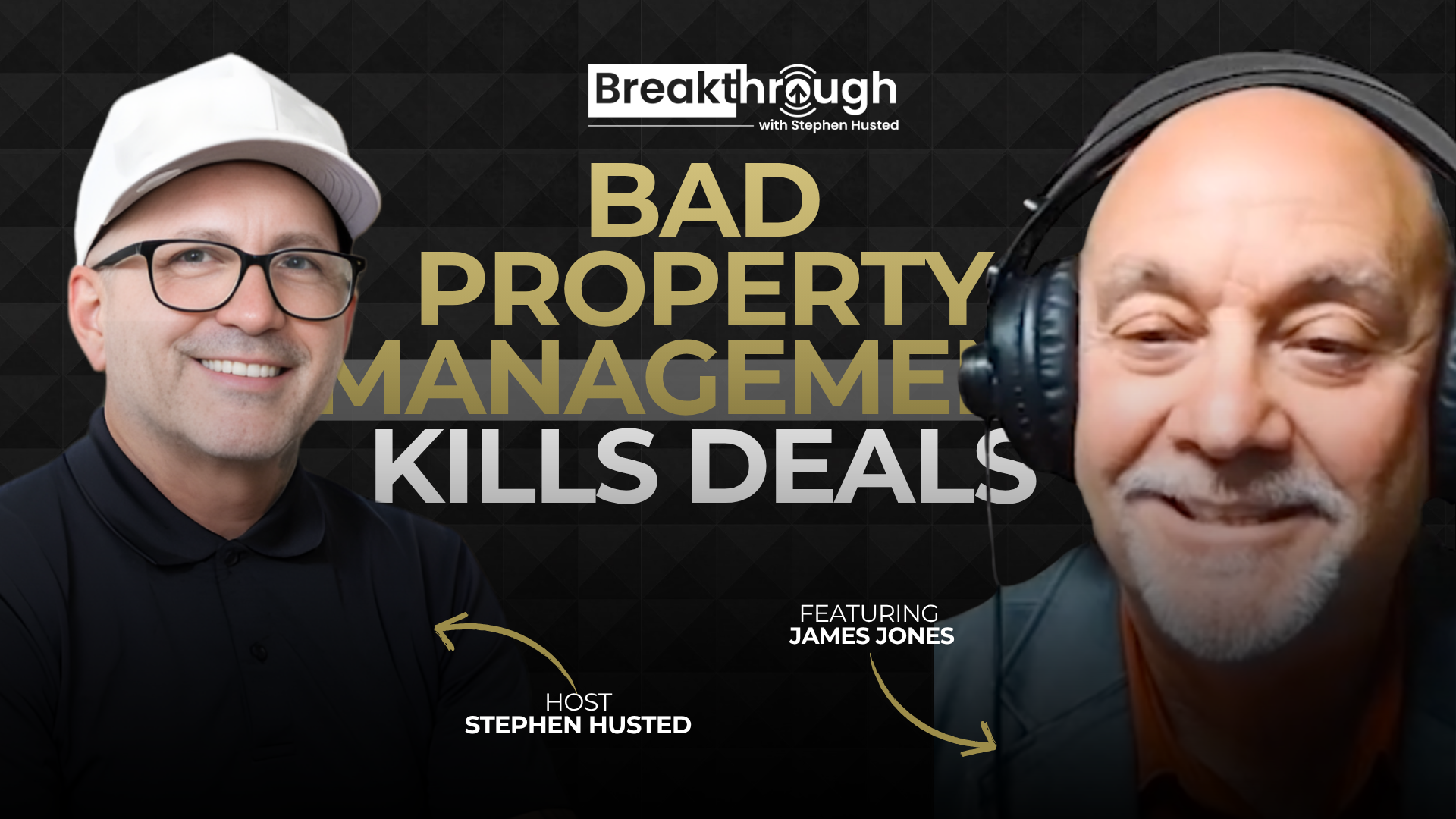
Welcome back to The Breakthrough Podcast! I'm your host, Stephen Husted. Today, we have an insightful discussion lined up as we dive into the world of property management with the seasoned property manager, James Jones. In this episode, we unravel the complexities of managing multiple properties and gain valuable insights from Jones's experiences as a successful property owner who entrusts his investments to our property management services.
Takeaway 1: Efficient Scaling and System Building: Scaling a property management business comes with its challenges. We explore the potential pitfalls of hasty scaling, discussing how inefficient systems and processes can lead to service inadequacies for property owners.
Takeaway 2: The Foundation of Successful Property Management Honesty, ethics, and effective communication are the pillars of successful property management.
Takeaway 3: Choosing the Right Property Management Company: For new investors entering the real estate arena, selecting the right property management company is crucial.
TRANSCRIPT
∎ Teaser / Highlighted Clip
[James Jones] (0:00 - 0:56)
I don't know how many times I've heard from owners who've come over to us that, you know, they haven't received any money in forever. I have one horror story of a company, or not a company, but about 10 owners, I believe it was, that came over to us about 15 years ago, and they were being told by a very small property manager who wasn't even licensed in the state. So she was doing it illegally, but she was telling all of these owners that their properties were vacant, and that's why they hadn't received any money for four or five months.
The properties were vacant. One of the owners happened to come out to view what was going on, and in fact, they were not vacant. They were occupied, and the owner had, or the property manager owner, had walked away with, I think it was nearly 100 grand in cash.
∎ Podcast Intro:
[Stephen Husted] (0:57 - 1:48)
Welcome to The Breakthrough with Stephen Husted, the show that takes you behind the scenes with successful entrepreneurs, real estate investors, and other movers and shakers in the business world. In each episode, we'll sit down with our guests to explore their personal and professional journeys, including the challenges they faced, the breakthrough moments that propelled them to success, and the strategies and the tactics they used to get there. Get inspired by new ideas and strategies, and get to know our guests on a deeper level.
Join us for candid conversations, powerful insights, and plenty of breakthrough moments. Please help us grow by subscribing and sharing the podcast, and welcome to the show.
∎ Podcast Proper:
All right, Jim.
Thank you for joining. I really appreciate it.
[James Jones] (1:48 - 1:50)
Thank you. I appreciate it myself.
[Stephen Husted] (1:50 - 2:52)
Yeah, I, um, I don't know, it was a couple weeks ago. I was talking to my assistant and one of my partners and I was, I was telling them how much of a relief I've had in dealing with my property management out in Kansas City from what I was going through for the years prior. And it just dawned on me that, you know, before I felt like I was the property manager and I was just micromanaging them and always trying to understand, you know, the owner's statement or the communication with the tenants, just all these different things.
And all it was, was on my brain. And, you know, fast forward to now, I think you guys have been managing our properties probably about a year, maybe a year and a half. I think so.
Yeah. I think, I think about a year. And you took, you took us over from another property management company that grew too fast and had some issues there from what I remember.
Is that true?
[James Jones] (2:52 - 2:56)
I believe so. Yeah. And I've actually been down that road myself.
[Stephen Husted] (2:56 - 3:14)
Really? Is that, so why don't we just go into it from there? What happens with property managers that they scale too big?
And is it, is it a problem that they have, they don't have systems and processes in place to take on all the new clients?
[James Jones] (3:15 - 7:48)
Yes. That's the biggest part of it. Short answer is yes.
That, that's the problem. And, you know, I've, I have, have experienced probably every problem that you can imagine and our system continues to evolve every day. We've never got it figured out.
We don't take the approach that we've ever got it figured out. But what happens with management companies and speaking personally that happened to us over 20 years ago was you get to a point when you're trying to build your management business that you want to scale, you need to scale in order, if you're going to be in the business, you need to scale in order to provide customers. And, and by the way, we have two sets of customers, the way we look at it, tenants and the owners.
So we're right in the middle, a bad spot to be in sometimes, but the fact that you have two sets of customers that the owners and the tenants. So you need to scale in order to provide each of those customers the type of service that each of them deserve. And they all have different needs.
The tenants obviously have different needs than the owners. So the problem is, is you're trying to run as fast as you can to scale that business and be able to provide the types of, of personnel resources, the technological resources that are needed in order to provide you those services. And you have to have enough business to be able to pay all that, to pay for the assistance.
I mean, I have the luxury right now is I have divisional managers in each of our divisions that are high-end managers that are in charge of the entire system. Under them, they have a layer of managers that help them. I have an assistant myself that helps me.
So I have that luxury now versus 20 years ago. I didn't. It was just me and my wife and I was a paramedic by trade.
So that was my full-time job and I did that for 20 years from the time I was 21 years old. So I was trying to grow this business. My wife and I, she would work on it during the day.
I would work on it on my days off. And it was literally a seven-day-a-week job in order to provide the level of service that we, we needed to provide. And we, we stumbled a lot along the way to be perfectly honest about it.
It just, it just happened and, and luckily we grew through it. We had a lot of dedicated owners that stuck with us. I think they realized we had the ethics and morals of what we were trying to do.
And that's a large part of the property management business itself is being ethical and, and having that, that type of business sense to, to provide the owners what they want. Ethical in what way? Just being honest about what you're doing.
Number one, handling their money ethically and honestly. Yes. I don't know how many times I've heard from owners who've come over to us that, you know, they, they haven't received any money in forever.
I have one horror story of a company, or not a company, but about 10 owners, I believe it was, that came over to us about 15 years ago. And they were being told by a very small property manager who wasn't even licensed in the state. So she was doing it illegally.
But she was telling all of these owners that their properties were vacant. And that's why they hadn't received any money for four or five months. The properties were vacant.
One of the owners happened to come out to view what was going on. And in fact, they were not vacant. They were occupied.
And the owner had, or the property manager owner, had walked away with, I think it was nearly a hundred grand in cash. It was a bad situation. And I hear it all the time.
Not to that degree. I don't hear it. But I do hear it all the time to where they just either can't reach a manager.
Nobody will return a call. Nobody will return an email. And, and that's, so that's what I'm referring to is, I mean, I work for you.
And we take that very, very seriously. Customer service is very important to us. And that's not to say that we're perfect.
I mean, we stumble along the way and.
[Stephen Husted] (7:49 - 9:57)
Sure. But there's a, there's a big, there's a big difference. I told you, and I've told, you know, everybody on your team that I communicate with, like Sierra, I go, we went from non-communication to you guys over communicating on a daily basis.
And it's great. And it's, it's just the follow-up too, is, is just you, everything is lined up correctly, you know, there's something going on with the property. I know about it.
And if I'm doing something on that property with my, let's say my handyman or my contractor, you guys are also following up as well. So it's always this like double layer of communication, which makes things move a lot smoother. It's easy to get you guys on the phone, you know, send an email.
We're going to get on the phone within 24 hours, usually. And that just, I can't explain how much more that's made me more relaxed on dealing with my portfolio out there, out in Kansas city is just that level. And that, that's pretty, that's pretty much the reason why I wanted to bring you on because it's just been a nine day different experience.
And I think a lot of people have to understand this, especially new investors that are buying properties out of state is their property management company can make or break them. And that is like just property management and their contractor are the two that could really take them down really quick. And, and so I think a big part of what I've learned now is when you start to see issues with a property manager or a contractor is you need to cut that tie quick and, and you can't really sit around and give them, you know, more tries at making it right.
You just have to move on and try to find another one until you find that correct a company that works well and, and you feel is communicating correctly. And not taking you for a ride that is not going in the right direction. I mean, that's just the truth of it for me, at least.
[James Jones] (9:58 - 11:46)
I agree. And you know, my wife, Christy, and like I said, we started this business in 87 and we talk about this all the time. We're both very intimately still involved in this company.
Every, every one of our owners I talk to personally when they onboard, I don't turf them to anybody else. I want to talk to them myself so that I can try to get an idea of what they're trying to accomplish. We have some owners who are very, very actively involved with their properties.
I have others that are pretty passive. They sit back and just let us, let us run. That's a good feeling.
Cause I feel like they trust us, but at the same time, I always encourage them to, Hey, you need to kind of stay engaged a little bit because we are human. We can make mistakes with accounting or whatever, you know, you enter a bill in wrong or something. So I always encourage owners to please take a look at those statements and, and be engaged in it.
Cause again, we're human and we can make mistakes and I would hate for something like that to happen. But the one thing I wanted to point out is, you know, I know for a fact what I want to accomplish for you as an owner. I know what's in my heart.
I know what's in my head and what I want to do, but I'm only as good as the 50 or 60 people that we got working here. And that's why I tell every owner, you have my cell number, you got my email. I will return those calls.
And I generally return my calls the same day, if not within 24 hours, most definitely, but usually the same day because I need to know what's going on. If we have a team member who is slacking for some reason, then I need to know so that we can, you know, get, get things back on track. But for the most part, we've got a great group of employees that work here and I'm very blessed to have them.
[Stephen Husted] (11:47 - 12:04)
Everybody I deal with is amazing. Honestly, I just can't say it enough. And just for the audience to know, you operate out of Kansas City and you're now in Florida, correct?
Correct.
[James Jones] (12:04 - 12:32)
Did I miss any markets? Are you in St. Louis too? We are.
We're in St. Louis. We, our main home office, corporate office is in Kansas City, actually Lee Summit, Missouri, which is a suburb of Kansas City. We also operate in Columbia, Missouri, which is in the middle of Missouri and in St. Louis. And we just recently opened up an operation in Panama City, Florida. We've got a divisional manager that we moved down there last week, actually. So we're ramping that up.
So that'll get started soon.
[Stephen Husted] (12:33 - 12:38)
What made you choose Florida? Like how did that all come about?
[James Jones] (12:38 - 13:32)
Well, I love Florida. First of all, we have a home in Sarasota. That's actually our legal residence, although I'm in Kansas City quite a bit.
But we got tied in with Panama City through a partnership of our sales franchise, Weikert Realtors, a franchise out of Mississippi, some partners we are working with, and they got some developers in Panama City that are developing three, well, three developments of townhouses. And they came to us and our Mississippi partners to sell those and subsequently manage those. So it's already taken off very well.
This project is going to be built out in 2024 and 2025. We have quite a few sold. So we went ahead and moved a manager down there since she can work remotely as well and start building up that operation.
[Stephen Husted] (13:33 - 14:03)
Yeah, that's great. And I was just thinking this while you were talking about those other markets, I was going, oh, you know what? I can pass your guys' information too, because I have a couple new investors that are looking out in St. Louis, and now I can pass them your way. And then the Florida market, that's good to know too, because I think once you have some of the pieces of the puzzle correct, it makes going into a new market a lot easier.
[James Jones] (14:04 - 15:22)
Well, we've been very cautious about that because I've seen a lot of companies, management companies, that have grown and they were very large companies to begin with, like ourselves, but then they grew and you can still grow too quickly. So I think I've seen a lot of those go into other markets and not fail, but not be providing the level of service that they're capable of doing, because there again, you're only as good as the people on the ground. And if you've got a bad divisional manager who doesn't have the work ethic or the ethics in general that you have, you're going to fail.
And the owners are ultimately, you may not fail, but the owners are going to suffer, and I look at that as a failure. It may sound silly, but we've got over a thousand owners we manage for, and whenever an owner cancels on us for whatever reason, unless it's a sale where somebody has sold the property, Christy and I take it to the gut. It's like a gut punch.
I mean, we really take it personal. We want to know why, what did we do wrong? What can we correct?
It's very personal to us.
[Stephen Husted] (15:24 - 15:25)
That means you care.
[James Jones] (15:25 - 15:26)
Yeah, exactly.
[Stephen Husted] (15:26 - 15:59)
I mean, it's the same thing I go through working as an agent out in California, and there's any type of issue that's going on between a buyer or seller that I'm working with. If you're stressed over it and you're thinking about a lot, it means you care, and that's a good thing. That's right.
You know, if you weren't thinking about it and you didn't care, it wasn't on your mind, you probably just don't care, and that's a good... I got a question. Who trains the team that deals with the landlords?
[James Jones] (16:00 - 16:31)
That's a good question. We now have a lady that's been with us for going on 20 years now, our first employee, actually, W2 employee. She's still with us.
She is now our business development manager, so she does all the training of every single person that comes in the door. She's actually training today, so she does all that initially. That way we have consistency across the board of one way it's done.
[Stephen Husted] (16:32 - 19:30)
Yeah, it's super smooth, just every part of it, and it's interesting too, when I get part of your team on the phone, they're just really nice too, and I haven't experienced that before. And let me tell you two stories that are going on currently. One of them that you and I had talked about probably back in late July with one of the tenants at my properties who put their leg through that deck, and I know that that's a big issue.
It can potentially be, the tenant could actually sue me. There's all kinds of different things that could go on. And I reached out to everybody on your team.
We started talking about it. We were talking about it immediately. Now, I have a property out in Detroit that was getting a rehab done, and the contractor's subs left him.
And all of a sudden, somebody gets into the property through the lockbox, and is now squatting in this property, and said that he was a part of it. He's there to do construction on the house. My property manager showed up, and this guy's in the house.
He's got an extension cord going from one window into the neighbor's house, and there is a lack of communication between my property manager on what's going on and the next steps. You know, they have the sheriffs go out there. It was last week on a Wednesday, and we just now heard back from them today, almost a week on what went on.
And once he comes back and tells me what's going on, you know, the explanation's fine. We can keep moving on. But the communication should have happened that day after you left.
It would have been just a quick email. Hey, here's what's going on. Keep me informed in real time, especially on serious matters.
And it's just one thing after another to the point, once again, micromanaging. When I'm thinking too much about my properties and what's going on, that's where the property management part is the issue. And so I'm, of course, looking into...
The first thing I thought was, I really wish you were in that market. Please come over. Come into the Detroit market.
But so, to the point now where I'm thinking of just selling out of that location altogether and moving them somewhere where I can take that. Really, what I want to do, I don't want to focus on the property management part of it. I want to focus on building out my portfolio.
Well, that's exactly right. You know what I mean? Like, that's the bigger key.
Like, that's what I'm hiring the property manager to do.
[James Jones] (19:30 - 21:19)
Well, what you're talking about is exactly what I personally talk to every one of our employees about at some point while they're working with us. Our job is to take the pressure off of the owner. If the owner, and I'm adamant about this, if an owner is emailing or calling us asking about something, there's nothing wrong with that at all.
However, the representative who's getting that call needs to look at that and go, why did that owner have to call me? Why did they have to email me? Because that tells me that we're not, whatever that subject is, that we're not getting back to them in a timely manner on that particular issue.
Doesn't mean it's a bad employee or anything like that. It's just, it's a learning situation. We should be reaching out to the owner long before they're reaching out to us.
And what you just said is key to me. Our job is to make the properties perform for you as best we can as everything that we have control of. So you can build a portfolio.
It's a win-win situation. I win when you grow more properties. So, it is a win for me to do that.
But so many management companies look at owners and just churn them. I acquire the- It's dollars. It's money.
Exactly. I acquired a company many years ago that their direct philosophy was they didn't care what the owners felt like. There's so many owners out there that own property.
If they lose one, they'll get another one. It didn't matter to them. Just churn them.
And I completely disagree with that. I would much rather keep them and keep getting more and more.
[Stephen Husted] (21:20 - 21:27)
Well, and you'll retain those landlords longer.
[James Jones] (21:27 - 22:19)
Absolutely. I've got owners that have been with us for, I haven't even looked, but I know of a few that have been with us for probably 15, 18 years. Really?
Wow. And you've watched them grow their portfolio. And we watch them grow, you know, and that's exciting to me.
You know, when I started buying property myself, I was 24 years old, didn't know what I was doing. I read a book, actually bought a cassette tape program back then, they had cassettes, with a guy named Charles Givens. I don't even know if he's in business now, but I didn't know what I was doing.
And I was learning and started doing things, acquiring properties. And I love to see that today. You know, I love to see guys and ladies who are just building their portfolio and growing something.
It's exciting to see. And I love to be a part of it.
[Stephen Husted] (22:20 - 23:10)
It's always, it's one of those things you can do that is always different. There's always new challenges, new strategies, new ways of doing things. Yeah, it's constantly evolving.
You know, it's definitely something that's not staying the same over and over and over. You're definitely having to go with the flow in different ways as far as changing how you think about the portfolio or how you deal with people and what's going on with your properties, the economy. Yeah, there's a lot of moving parts.
What would you, so, if we had a new investor in the audience listening to this, what are the key things that they should be looking for in a property manager when they're looking to buy out of state? Like, what are the questions they should be asking up front?
[James Jones] (23:10 - 26:18)
Well, one of the things that I would say is how long they've been in the business, but that's a touchy subject, too, because we all have to start somewhere, right? I mean, you don't start out of the gate being in business for 35 years. So, that's hard for me, but because I would hope people back in the day wouldn't have looked at me that way, but I do think you need to look at who they are, how long they've been in business, and I would just say to talk to them.
I mean, I'm just a guy that loves to talk to people, and I want to talk to them to get a sense for who they are, how they operate, what their philosophy is, and does it match my philosophy? I mean, quite honestly, I mean, I've had owners with us before. They were great people, but for some reason, we just didn't click.
Doesn't make them a bad person, doesn't make me a bad person. It's just we didn't click for some reason, and you're going to find that out when you're talking to them over the phone. Do you get that warm and fuzzy feeling, you know, that this person has my values in mind as well?
And also, how do they handle maintenance? I mean, there's two pieces. This is a big one.
There's two pieces to the property management that will make or break an owner, quite frankly, and I own a lot of property still myself and some out-of-state, and the property management fees themselves, by and large, are minuscule. That's a small piece of the pie. The big piece of the pie is the maintenance and how the maintenance is handled and how the charges are.
I mean, maintenance can kill an investment if you're not careful. So I would definitely talk to the property manager on how they handle maintenance. Do they handle it in-house?
Do they sub it all out? If they sub it out, do they mark up those prices? If they do mark them up, what is the markup?
There's nothing necessarily wrong with them marking them up, but I think you need to go into it with your eyes open so that you know what the situation is. If somebody is a small shop on management, and there's absolutely, again, nothing wrong with that, but then they don't have the staff to do the maintenance in-house themselves, so they have to sub everything out, what does an average work order cost? What is an HVAC work order cost?
What is a plumbing work order cost? They all have different costs to them. They're not going to be all the same rate.
So, and then if somebody says, well, it's $100 an hour for HVAC, do you mark that up? Just so that you know what you can expect. I think that's the biggest thing that I see with individual owners is sometimes they go into a property and they really don't know what they were expecting.
[Stephen Husted] (26:20 - 26:25)
Until those maintenance invoices start coming and they're like, okay.
[James Jones] (26:27 - 27:23)
I've had owners that we've managed for, there was one in particular that we had managed for four or five years and only had one tenant. I mean, he had a run, which is a great deal to have one tenant for four to five years. But then when the tenant moved out, the place needed full paint, carpeting, that kind of thing, and he couldn't afford to do it.
And, you know, I mean, that goes back to my, this is just my philosophy on the real estate, owning real estate. To me, that is a business segment, all separate from our property management. The properties that we own is its own entity.
It's a business in itself and that business has to support itself, in my view. So, the way we look at it, it needs its own budget. It needs its own revenue stream and so on and so forth.
[Stephen Husted] (27:23 - 29:07)
And that revenue stream can be erratic depending on what, yes, good example, you know, we have a duplex that you guys manage and storms came and the tree came from the, you know, the side and landed on the house. Yeah, and that was a pretty big expense. And even though that we, you know, we run numbers and have reserves and, you know, repairs and we put a percentage per month out of our gross rents into that pot, you know, sometimes these repairs and issues can come up that are much bigger than that, you know, and yeah, I think a lot of people don't know this until they finally start going through, you know, some of these bigger issues on these properties.
But, you know, there is one thing that you guys do different than a lot of property managers that I've come across is when you take on properties before that tenant moves in, you guys go walk the property and literally do a property inspection report. Yeah, and then that report gives the landlord eyes on what issues are on that report, big or small, what needs to get addressed up front so that you can have the property ready for the tenant. Some are fine, you know, some are probably bigger that you want to get done, but at least you have a good understanding going into what's going on with your property and a lot of people don't know that.
So all of a sudden they get a tenant put in place and they got a, you know, a repair this month, another repair the following month and they're just like, wait, what's going on? But if you have that report, then you're not, you already understand what's, you know, there could be some potential just because you've got that report. And I think that's, there's a lot of value having that in the very beginning.
[James Jones] (29:07 - 30:29)
Yeah, there really is. Yeah, we're actually doing 16 of them today. We had a gentleman who pulled over two small apartment buildings, eight units each and they're all vacant.
And we were talking about putting them on the market and I said, well, the first thing we got to do is get out and see these properties. We got to see what's going on with them because he didn't even know if they're ready to go or not. But so yeah, that's the first thing is we want to see are these properties ready to move somebody in and it goes back to the philosophy again.
I tell all of our property inspectors, you know, I want you to inspect this from the point of view of would you live in this property and to give that owner a picture of what you are seeing. He or she may not decide to do everything that you want them to do and that's okay. There's absolutely nothing wrong with that.
But our job is to give you the picture of what we see and then you can make some decisions upon yourself like a full paint versus a touch-up paint. You can tell us what you want us to do, but our job is to tell you what we see. But I had a situation like you talk about the tree.
I had a tree on one of my properties fell down two weeks ago, cost me two grand to get it removed. I hadn't budgeted for that and I'm going, oh my goodness, you know, this is terrible.
[Stephen Husted] (30:29 - 31:22)
Yes. Well, and this goes back to you learn new things as you go along. One of the big things that I pay attention to now when I look at properties and it's sometimes hard, especially like in Kansas City, is I look at how big is the yard?
Is the yard big in the front and the back? How many trees are around that property that could potentially land on the house and damage the roof or the side? I look into those things now because of what that issue that came up.
This is created another process on how I look at properties and how I underwrite a deal. Like what could be my potential issues here? Oh, there's a lot of trees.
All right, that could potentially happen. That could cost me $15,000 to $2,000 for that tree falling. And you learn these issues over time.
[James Jones] (31:22 - 32:34)
You know, something else that I've talked to owners about, especially, I don't know if it's just for Kansas City. It's probably not, and I don't even know what the age of the property would be, but there are certain ages of properties that have this old cast iron plumbing in them and they run all the way through the stacks, all the way out to the street where they meet the city's lines, and we get those routinely collapsed. I bet we do 10 or 15 of those a year where they'll just, you know, they're 50 years old and they just simply collapse out in the yard and that can be a tremendous expense.
I'm talking $10,000 to $15,000 to dig that up and remove that line. So I always, if I'm involved in it at all in the beginning, I encourage owners to maybe spend, I think it's $150, maybe $250, I don't recall, to have that line scoped. Camera that line to see what condition this thing is in.
Does it have trees growing, tree roots growing through it? It would save you a lot of heartache in the long run.
[Stephen Husted] (32:36 - 32:43)
Well, it's going to give you some clear understanding of what's going on with it so that you're not surprised if something does happen.
[James Jones] (32:44 - 32:49)
Doesn't mean you don't buy it, but you go into it with your eyes open.
[Stephen Husted] (32:50 - 32:58)
Yeah, we just went through that with my new investor student Stan, who just closed on that property in Garfield.
[James Jones] (32:58 - 33:01)
I think it was yesterday I talked to him, he seems like a nice guy.
[Stephen Husted] (33:01 - 33:28)
Did you? Yeah, he's great. I'm so excited for him.
It's interesting, he picked up that property, it was a 3-1, like 1,200 square feet, and I think he got it for $115,000 and then we did a sewer scope and there was issues and then we got another $5,000 credit. And he's just going to monitor it. He got it jetted and cleaned out and so he's good there, but he's aware of what's going on because we did that sewer scope.
[James Jones] (33:28 - 33:52)
But do you know how many people don't do that? I mean, what you're advising your customers is unique. I mean, it truly is.
There's very few customers that I see that will do that and it's so important. Like I said, it doesn't mean you don't buy it, but you go into it with your eyes open that, hey, at some point I may have to replace that.
[Stephen Husted] (33:53 - 34:26)
Right, you're aware and then you could budget for it. Exactly. You know, if you can kind of start that budget just knowing that potentially it could fail.
Yeah, he's really excited and that property turned out really good. Like the outside, I thought it was funny because he had the whole outside done. He did ground cover and he wanted lights underneath his kitchen cabinets and the contractor called me and goes, yeah, I think he's going a little overboard.
I'm like, they're small things. He has to go through his own journey as well.
[James Jones] (34:26 - 35:01)
But you know how exciting it is to see a guy like that. It's just real exciting to see a guy like that. You know, when I was talking to him, I'd say it was yesterday or the day before, you could just hear the excitement in his voice.
I mean, he's got his first property, he's going. So I told our staff, I said, hey, take care of this guy, you know, you always want to make it a good experience. I mean, the worst thing that could happen is you have a guy buy a property and he has a bad experience.
That's just horrible. It's exciting in the very beginning to see guys like that.
[Stephen Husted] (35:02 - 36:35)
Yeah, it's really cool. You know what's crazy? He was referred to me by a friend and his parents had both passed and all the sons had came into money and you know, his job wasn't doing the greatest and you know, he's like, look, I want to put this money to work.
I want to start investing and I took him on as a student and you know, fast forward a few months and his buddy, you know, we talk all the time and he said, oh my gosh, Stan is just completely changing the way he thinks about things. You know, he's, you know, thinking about his finances and investing and you know, it's that has been just an amazing feeling and I think what's been really cool is when I took him on, I said, look, I'm here to help you, guide you through buying your first property and also explain to you all the things that went wrong for me. Yeah, all the bad things I've gone through and one of the biggest ones was property management.
I told them in the beginning. I said, look, you've come into this at a great period as far as buying because I've had four property managers out in Kansas City, four and left them all and then you guys acquired the last one that we had and they were, I didn't know what was going on. I couldn't read an owner statement.
Every month we were trying to figure out money and it drained me and the reason why it drained me is that is not where I want to spend my time at all.
[James Jones] (36:36 - 36:41)
You can't be buying properties if you're spending time trying to figure out what's going on with the ones you got.
[Stephen Husted] (36:42 - 37:34)
Yeah, and so I told this to Stan and I introduced him to you guys. You jumped on the phone with him and what it did was it put him in a position. I also connected him with my contractor.
So he's got all these people in place to make him successful and also give him confidence and he doesn't have to worry about this part and he's come back and said the same thing. He's like, look, I feel so much more confident that I have your property management company, your contractor, your attorney, your CPA, and I'm just piggybacking off you and it's great. He's even, that property is on the same side of the street that we have ours.
We're like six doors down. So we already knew what we could rent it out for. So it's been really, it's been great to watch him grow and we have a few more coming.
[James Jones] (37:34 - 38:31)
But you know, it's good that your clients have that resource yourself to draw on. Not everybody buying properties has that resource. When I first started doing it, again, back in 87, I didn't have anybody.
I remember we bought two fourplexes in foreclosure. I was taught through this book to go to a bank, see if they had any foreclosures. They did.
I bought them from them. They financed them because I didn't have much money. So they financed them.
I didn't have a clue what I was doing. So if you came in as a tenant and you had $600 deposit, I'd move you in. It was literally that crazy.
And I did not know what I was doing. I had so many bad tenants in these things and just, you know, you just learn. If I had had somebody like yourself guiding me of, hey, you don't want to do this, I probably could have saved a lot of mistakes and money.
[Stephen Husted] (38:32 - 39:30)
Yeah, and I've learned over the years too is, you know, I know what I'm good at. I know what I'm not good at. Yeah, and one of the things that I do not want to do is I cannot stand bookkeeping, period.
I don't want to be a part of it. I don't even want to look at it. I have my bookkeeper.
All I want to know on a monthly basis, but where the numbers are at, what's going on? That's all. Just give me a five to ten minute briefing and let me go on with my day.
Like that's really how I want to be. And for me, it's important because I really want to stay focused on the things that I'm good at. Yeah, and I think there's probably some investors that they have a smaller portfolio that could probably manage everything on their own.
Yeah, probably can be done. I can't with the amount of properties we have. It's just too much.
Things are coming from left to right and there's one thing after another project going.
[James Jones] (39:31 - 40:09)
So the problem with managing the properties yourself, I don't even manage my properties. I don't touch them. I don't have anything to do with them.
They're in our system. They're managed by our staff. I don't approve the application.
I don't do anything with them because if I do, I'm going to make a mistake because your heart starts to get in your way. Yes, it's a huge mistake. I've made that mistake so many times because we're all human.
Everybody wants to help one another. But at the end of the day, it's a business and it needs to be run as a business. So I stay out of it.
I stay out of my own properties.
[Stephen Husted] (40:11 - 41:18)
Yeah, I agree with you. I think I've noticed, well, I know this for a fact that I tend to, I'm a very trusting person, you know, and I, you know, connect with somebody and I just want to trust them. I want them to be on, you know, on my team and work together and you know that sometimes just doesn't work out that way.
And I think that's why I kind of have to, you know, back out of things and let other people do what they need to do. So I have a question for you regarding systems and how you deal with landlords as far as owner statements and the communication part and the emailing. This is a big component of why you guys are really good at what you do and it's, if there's an issue on a property, I get it.
I get an email, tells me the address, tells me the issue and it's either I'm going to take care of it, call my handyman and they're going to take care of it or you guys are going to get a bid on it and then, you know, we communicate really quick and also the owner statements are much easier to deal with through your software. Now, like how long did it take you to get to this point?
[James Jones] (41:20 - 43:25)
That was a long run. The statements that we send out are customized. We use our software that we use as Rent Manager.
We had Rent Manager, we've been using them now for I think seven years, eight years, but we had them customize a statement that we wanted a certain way. Our statement has, I believe, five or six sections in it. One section is, the first section is a summary of all the properties, of all the income, all the expenses.
So if you have multiples, that first section is everything altogether. Some owners, that's all they want to care about. They want to look at how much money I make, how much money went out, you know, they just want to see that in summary.
And then there's a section that's broke out by property. Some owners want to see that detail. They want to know what each unit made.
So we have that on the statement. Then we have a section on a statement of paid bills for that period of time. And then another section of unpaid bills, bills that are pending to be paid.
And then there's a section of a rent roll, actually at the bottom of the statement is a rent roll that goes out with every single statement. So there's these sections that we had custom developed that we learned over the years that owners wanted to see. We would send out a statement and they say, hey, I'd like to see a rent roll.
Well, we have to send them a rent roll now, or we send them a statement and they say, can you break that down by property? Well, now we got to send them another statement. So we've developed this over the years.
And to be frank, I mean, we have some owners who think it's too busy. It's too busy of a statement. And if you have a lot of properties, it can be a large statement.
But again, in my view, the data is important. It's there for information for you, at least. And we do the same thing at the end of the year.
We'll send a summary to every owner by unit so that they can give to their accountant to do their taxes.
[Stephen Husted] (43:26 - 44:25)
Let's stop right there. Let's just stop right there because this is huge. You know, for new investors, when you start to buy properties, one of the biggest things your CPA is going to want to know is they want to understand that you've got all your gross rents, your repairs separated per property.
Like they want to break it down that way. They don't want you to send them a profit and loss that has all these numbers on it, but it's all your properties in one. They do not like that.
So you want to make sure that the property management company you have, that these statements can be broken up into per property. It's huge when getting your taxes done. I've learned that lesson a couple times because they get confused and then what they end up doing is the CPA will just be like, well, okay, I'm just going to break it in half and I can do some here and some there, but that's not really the right way to do it.
[James Jones] (44:25 - 45:01)
No, you really want to know what property is performing, especially as your portfolio grows. There may be a property for whatever reason. Maybe it's maintenance.
Maybe it's the management company. Maybe it's the area it's located in. It could be a variety of things, but maybe there's a property that just isn't performing and maybe you want to offload that property.
I mean, so you definitely want them broke down by property, but that's one of the things I learned over the years, which is why we did it that way is owning property myself. I knew that, hey, my accountant doesn't want it all in one lump sum. They want to know by property.
[Stephen Husted] (45:02 - 45:34)
Yeah, I learned that over time and you know, it's interesting. I think the last few companies that we were with didn't do that. Yeah, and so we're prepping.
We're finishing up 2022 taxes, right? Because they had an extension. So they're doing and they're asking that I say, well, look our new property management company.
I know does it the correct way, but we're just working through the bad issues that we had from the past, you know, it's so it's our relationship with the owners.
[James Jones] (45:34 - 46:14)
Isn't just the property management the way I view it. It's it's the taxes. It's everything.
So at the end of the year, our jobs not done on January 1st or second. We will send out to every owner a summary. Usually it's a two or three page summary broken out by property again so that they can give to their accountant.
So they'll have that and the 1099 all in one email and all they got to do is send that to their accountant. And as far as we're concerned, they're done. The only additional piece to that would be is their taxes and insurance and mortgages.
Yes.
[Stephen Husted] (46:14 - 47:04)
Yes. I got it. I got a question just came came to my mind.
So you have a new investor that's looking out in let's say Kansas City when they when they contact you, what should they be utilizing you for at that moment? Until while they're looking to buy property. Should they be contacting you about a particular location a street that they're looking to buy on because we understand we all know that once you start to invest that, you know, you could have one property that could perform really well in one location and you can go three blocks over and it can be a completely different scenario.
So and because you guys are on the ground, what should that new investor be doing in conjunction with working with you in the very beginning like what kind of information could you help provide them?
[James Jones] (47:04 - 47:41)
We do this all the time. I actually do it myself because again, I communicate with all the owners out of the gate. So I did one yesterday.
Somebody's looking at a property and they wanted to know what it would rent for great question, right? We want to know what that property is going to rent for so I ran them a rent comp and send it over to them. So we do those all the time a rent comps.
That's that's the primary thing. We probably help them with is what is this property going to rent for? Do you manage in that area is a good question.
But yeah, I if owners want to call or email me happy to do it.
[Stephen Husted] (47:43 - 47:50)
Yeah, it's a big part of it too. I use Rent-O-Meter. Yeah.
Okay, you do?
[James Jones] (47:50 - 49:05)
I have found that your whole team. Yes, you know, we've used Rent-O-Meter and we use Zillow. I just personally think Rent-O-Meter is more accurate because it actually spits out the data.
It's comparing it to not just it doesn't just give you a number of this is going to rent for $1,300. Let's say Rent-O-Meter actually tells you it's going to rent for $1,300 and here's the 10 comparisons. I have that I came up with that number for that's why I like it because I would I don't need just a number.
I need to know where did you come up with that? Well, also it shows the mapping of where those properties are at. And you can drill it down to you can change your radius because just speaking of Kansas City, I'm sure other markets are similar.
But if you pull a radius of three miles in Kansas City, that's huge. It's like three different markets. That's exactly right.
And you could have a rent quote that is way off could be low could be high. So you need to narrow that down to maybe a half a mile or a mile at the most to see now. What's it going to rent for that's why I like it.
[Stephen Husted] (49:07 - 49:51)
Yeah, my rule of thumb and I do this just copying properties to sell as well is I go quarter. I'm literally trying to keep it right around the house. If I can find if I can find the right numbers in the very beginning quarter mile great.
Then I move on but if I need to go a little further out, I will and then I'll Google map and look at the location and then I'll call my agent and then I'll follow up with my property manager and get that big picture of what's going on because they're on the ground. They know those locations. They could tell me who well, you know two streets over.
It's really good. But that streets pretty rough, you know, it's probably not going to perform the same way as this the streets to over and it makes a huge absolutely huge.
[James Jones] (49:51 - 50:00)
I've seen some numbers on Zillow that I look at and go where in the world did this rent come from there's just no way it's insane.
[Stephen Husted] (50:01 - 50:12)
Yeah, and then you and then the then the you know, the investor buys that property expecting that money and they underwrote the that deal based on those numbers and all of a sudden it sits.
[James Jones] (50:12 - 50:24)
Yeah, and that's the shame of it all. That's a big issue, you know that one property that's going to sit vacant for six months and then all of a sudden now they got to come down to a $300 and they're upside down now on the property. That's just a shame.
[Stephen Husted] (50:25 - 50:43)
Yeah, we ran some we ran some issues end of May 2022 when the rate started going up. We still have some projects pending that we're working on and we had ran numbers, you know at a different interest rate and we're in hard money, you know doing the construction on them.
[James Jones] (50:43 - 51:29)
We have I think two three properties that break even yeah, like we don't we're not barely we're just having in there done that I mean, there's nothing necessarily wrong with that as long as you know, as you know, if you're getting the appreciation if you're getting some appreciation on it and you can also print a little pay down there. It's like an I always looked at it as an annuity, you know, I've got the tenants paying an annuity for me and I know if I'm breaking even that's to me. It was okay, you know, you don't want to break even on everything but you know, it's still okay.
You know, the other thing that especially in today's world that investors want to look at is taxes taxes in the county that we're in right now property taxes on sky-high.
[Stephen Husted] (51:30 - 51:32)
Oh my gosh, Jackson County County.
[James Jones] (51:32 - 51:33)
Oh my goodness.
[Stephen Husted] (51:34 - 52:23)
Oh, but you know, what's so crazy about that whole scenario. My contractor brought this up. He's like, oh Jackson County is going crazy and immediately I started stressing out and started pulling all of them but something we did notice and I'd even know that I've just found this out, but we have a big.
Bulk of our properties in Blue Hills and Blue Hills is in a tax abatement area and where we found that out was on Stan's property on Garfield because we have one on Garfield and we have them all over that little particular location. And yeah, they have a tax abatement program going there. I'm like, oh, we got great and I noticed that it's different in Blue Hills to Mannheim, you know, like they're so yeah, the taxes are they going to cap that out?
Like what is that?
[James Jones] (52:23 - 53:10)
I don't know. I keep hearing stories of I know I've got some of my properties that literally doubled in taxes. I don't you know, and I don't personally have a problem with the taxes themselves, but to me they ought to have a maximum amount that could go up in a year versus just double hundred percent.
I mean, I can't I can't double my revenue with the signature on a piece of paper. So it just makes it hard and you know, we're I think folks lose sight of what we're trying to do us as investors, you know, we're trying to you know, not only build a portfolio for ourselves and a better life for the future. You know, you're also trying to provide good housing for people.
That's the big part of it.
[Stephen Husted] (53:10 - 53:12)
We're not just here trying to make money.
[James Jones] (53:13 - 53:26)
I mean, you're trying to provide decent housing for people and I think sometimes people look at us as investors wrong. Yeah, most of the time, especially Jackson County.
[Stephen Husted] (53:29 - 53:36)
Wow, they were that was crazy during COVID. Like there was this, my gosh, that day will be a day.
[James Jones] (53:36 - 54:11)
I'll never forget. I remember when they came out that businesses were being shut down unless you were what they call it essential. If you weren't essential business, the problem is nobody said what an essential business was.
So I went home and told my wife. I said, man, I said we've worked 35 years to build this company into what it is. And I said, I think we might be done.
I said for everything I'm hearing is we are finished. We're over and what a scary thought that was horrifying thought there for a while.
[Stephen Husted] (54:11 - 54:39)
That was an interesting time period. But and now I look back. I mean, we were picking up properties from contractors that were, you know, doing new building out a property to use for like an Airbnb and they were stressed out.
They're not going to be able to do an Airbnb. So we would buy it and it or we didn't we pick up another property and get a really great deal and all sudden the tenant doesn't want to move out and she gets an attorney. You know, they're locking arms at Jackson County Courthouse.
[James Jones] (54:40 - 55:52)
It was it was insane. Yeah, it was insane, you know, but by the end of the year of 2020 and even 2021, I wouldn't have gave you a nickel that it would have been a successful year, but we actually wound up doing very well. And then therefore the investors for the most part did pretty good.
We we didn't have the mass numbers of tenants that were not paying like we were afraid. We're going to we took a little bit of a different approach again, keeping in mind in our view that the tenants are our customers to instead of taking a real aggressive approach. We tried to be a little more soft key with that and say look, we all are in this together.
You know, the owners have to have money in order to pay the mortgage. If they can't pay the mortgage the property goes in foreclosure. You're going to have to move anyway, right?
So let's work together and it worked out pretty good. Now. We had a few that that basically said the heck with you.
We're not going to pay but not I think I think every investor had a couple not as many as I thought we would.
[Stephen Husted] (55:54 - 55:58)
Yes, especially in the very beginning when there was a lot of talk of what potentially could happen.
[James Jones] (55:59 - 56:09)
Everybody was saying don't pay your rent. You shouldn't pay your rent. All these landlords are millionaires.
They don't they don't need the money, you know, just stop paying. Boy, did it boy? Do they have that wrong?
[Stephen Husted] (56:11 - 56:38)
Boy, did they have that wrong? I had we had one in Kansas City that we had an issue with I think and she stayed in that property for like a year until we figured out, you know an agreement, but I had another one in in Michigan and yeah, she's completely she never she got into the property. I think March of 2020.
It's one early start.
[James Jones] (56:38 - 56:39)
Oh, wow bad time.
[Stephen Husted] (56:40 - 58:24)
Yeah, and then she lost her job. And I didn't know that the property management company was being pretty aggressive with her. Like I didn't know this but we're, you know, putting all these fees and late fees and just just being super aggressive and then one day I get a phone call and it's guy says, is this Steven Houston?
I'm like, yeah. He's like, I know what you're doing. I know what you're doing out here in Harper Woods and I'm like is are you cold calling me?
I'm not selling. He's like, no, I know what you're doing in Harper Woods and you better stop or else. I'm going to burn your house down.
Yeah. Yeah. Yeah.
Oh and the crazy thing the very beginning of this. I forgot. This is the crazy part in the very beginning of the conversation what he said to me was he told me my address and who I was married to your personal address.
Oh, that's scary. You know what it reminded me of and I had told I told her called my property management right after you ever see the movie The Town. Yeah, remember when we go to the Fenway.
Yeah, and they knock on the thing and they start naming off where they live with the names exactly that and my property management company did not understand what I was saying to them. I go he's threatening me. He knows exactly where I live.
I'm married and doesn't have a daughter and he's basically saying if I don't stop charging this tenant, he's going to burn the house down. I still have that message and that number saved on my phone.
[James Jones] (58:25 - 59:27)
Yeah. Well, we were told in the county that we couldn't charge late fees anyway. So we stopped that immediately does no good to charge late fees.
If somebody's having trouble paying the rent anyway, so our view was is let's just try to get the principal collected and not worry about it. So we like say we did pretty good. I don't remember the numbers, but I think for the most part we were I think we ended up about 3% of our tenants.
We had trouble with but for the about 3% that's not bad. Now, if you were into 3% it was bad, but but overall it wasn't bad plus the other crazy thing that happened in 2020 and 2021 and even this year 22 and 23 is rents went up rents were going up. It was a phenomenal thing to see for the last three years.
I mean, we've been raising rents about 7 to 8% and sometimes we get in and break that down.
[Stephen Husted] (59:28 - 59:36)
Why why did you see such a huge spot? Well, you know, is it are we talking to supply and demand is it really come down to that or jobs?
[James Jones] (59:36 - 1:00:43)
It was a supply and demand issue there were there was more demand and there were properties out there and then with again with the taxes taxes were going up insurance is going up interest rates going up inflation, right? So pretty much unfortunately, then the rates had to go up as well. I saw an art a deal on TV the other night and they were talking about landlords and they were criticizing the huge increases as they were labeling them on the rent increases, but what they failed to mention is why what caused that if you just look at it on the surface.
It sounds like these millionaire property managers again are just trying to put more money in their pocket when in fact, they're just trying to keep the same amount of money in their pocket that they had last year, but all of a sudden the taxes have doubled interest rates have gone up significantly in some cases doubled. So you got to make up that that difference somewhere.
[Stephen Husted] (1:00:43 - 1:01:04)
So that was a large part of is just supply and demand and the economy everybody would I mean, look you could go get a cup of coffee and it's gone up in price. Everything was going up and in rents had to as well. Do you think we're hitting a wall out?
I'm not sure Kansas. I'm just going to choose.
[James Jones] (1:01:05 - 1:02:28)
Yeah, not yet. We keep a very very close eye on on it. Our office manager did just did a round of rent increases and I think she jumped them 7% maybe 8 I can't remember.
And they keep an eye on the vacancy rates. That's the big key is, you know, we don't want the we don't want to get above about a 3 to 4% vacancy rate. I think we're running 3% vacant right now company-wide and that includes st.
Louis which is about 12% vacant st. Louis is much larger vacancy than Kansas City. So if you took yeah, really it's a different it's a harder market than Kansas City.
In what way? We struggle in st. Louis with collections.
It's it seems to be just a market that is much more difficult to do collections than we have in Kansas City. We just don't and the getting getting the properties ready and frankly to maintenance in st. Louis is a struggle.
We have a very difficult time in st. Louis finding folks who will work on maintenance for a good wage and provide a good product in Kansas City. We really don't have that problem.
[Stephen Husted] (1:02:30 - 1:04:01)
Do you think part of well big part of his jobs? I think Kansas City has a lot of different sectors that people can work in. Yeah, I think that'd be a fair.
Yeah, I've noticed that out in Michigan in Detroit. Sometimes I've just wondering like where are these where are people working to make pay for these types of rents, you know, and and there's so many different. Well, here's a good example.
We have a cabin out in the Smokies. And that whole area as far as tourism or these cabins. It's a business and everybody around the area works in it.
And so they know the drill they you know, they had the family one is the clean cleans the cabins the husband could be the handyman the son could be a landscaper one could be electrician. They know what they're doing and they know it's a business and they just it's another market. I would say that is ran.
Well very well compared to others and I think others like you bring it up st. Louis or I'm say Detroit. It's like the Wild Wild West in a lot of ways.
It's hard to find good contractors. You can trust or handyman that you can trust or just anybody in general and it's hard if you don't have massive amount of people boots on the ground that can help support things you kind of have to lean and watch people make mistakes and yeah, we've been in st. Louis.
It's different every market has its unique challenges in st.
[James Jones] (1:04:01 - 1:05:30)
Louis now for seven years and we've we've got a very good divisional manager there now. And again, that's key. The personnel is the key.
It doesn't matter what I want to do and what I think and how I want to run it. It's irrelevant. It's matters of those people that are on the boots on the ground is what matters and we've got a good group now.
So I think we're going to turn it around. We've got a good maintenance group. So I see bright things on the future, you know, you're talking about the working on every aspect of the property and that's how we started this stuff.
I mean, I would paint I would clean I did everything on the I was the worst painter in the world to but I mean I did everything on these properties, you know, so and we've tried everything. We've done short-term rentals. We did short-term rentals in Orlando for several years.
It actually went very well. My daughter who works in our company was running it, but we shut it down in 2020 March or April of 2020 when President Trump shut down the international travel. It killed it.
It killed that entire market down there. So we shut that operation down. We plan on doing short-term rentals again in the Panama City Market because we know how we know how it works now.
But at that particular time it was going well until that all happened.
[Stephen Husted] (1:05:33 - 1:05:47)
That's good to know that you good to know about the short-term out in Florida. It's perfect. So I would say that one thing that a new investor can take away from today's episode is your boots on the ground are the key to success.
[James Jones] (1:05:47 - 1:05:51)
Oh, absolutely. They are there. They are it.
They're 100% it.
[Stephen Husted] (1:05:52 - 1:06:00)
Yeah, do you have to nail that and it might take time but once you get it, correct, you'll definitely sleep better.
[James Jones] (1:06:00 - 1:06:52)
And that's what I was talking about earlier and you know that that I've mentioned it, you know, I don't claim that we have all this figured out that we're sitting back with our feet on the table and saying look at us go. We make mistakes. We still make mistakes, but I've got good people on the ground who have the same philosophy that if they make a mistake, they're own up to it and make it right and not make what I tell them is don't make the mistake twice.
You know, we all make mistakes. That's right. I know not to make that same mistake twice learn from it.
Let the owner know what happened. Most owners just want honesty. They just want to know what's going on and owners know when they're being snowed.
So don't even try it. Don't even try to make up a story on something. Just tell them what happened.
[Stephen Husted] (1:06:54 - 1:07:42)
Absolutely. Be very transparent. It's the best way to be 100% and I feel like some get it some don't.
I really appreciate you making the time to come on to the podcast and you know, give some insights for a new investor that wants to start building out their portfolio out of state. I think that today's episode you gave a lot of great information and I'll definitely in the notes be putting all your information so that if anybody was looking to basically jump into the Kansas City Market, St. Louis, Florida that they could definitely reach out to you and take it from there. So I really appreciate your time today Jim and I look forward to building my portfolio out even more.
[James Jones] (1:07:42 - 1:07:47)
I appreciate the opportunity. I could talk about this stuff all day long. I'm kind of a nerd about this real estate stuff.
[Stephen Husted] (1:07:47 - 1:07:57)
So I've noticed that every time we've had a conversation like I got to stay away from Jim and I'll just spend an hour with him on the phone.
[James Jones] (1:07:58 - 1:08:06)
I've got one guy that calls and talks to me. He's out of San Diego and we get to talking about taxes and I'm like, man, we'll be here all day long if we're going to talk about this.
[Stephen Husted] (1:08:06 - 1:08:07)
Yeah. Yeah.
[James Jones] (1:08:08 - 1:08:08)
Yeah.
[Stephen Husted] (1:08:08 - 1:08:15)
Yeah. So, all right, Jim. Well, thanks a lot for joining today.
I really appreciate it. All right. Take care.