Episode 40 - Backyard ADUs EXPLAINED: Hidden Costs & Big Wins with David Weisser
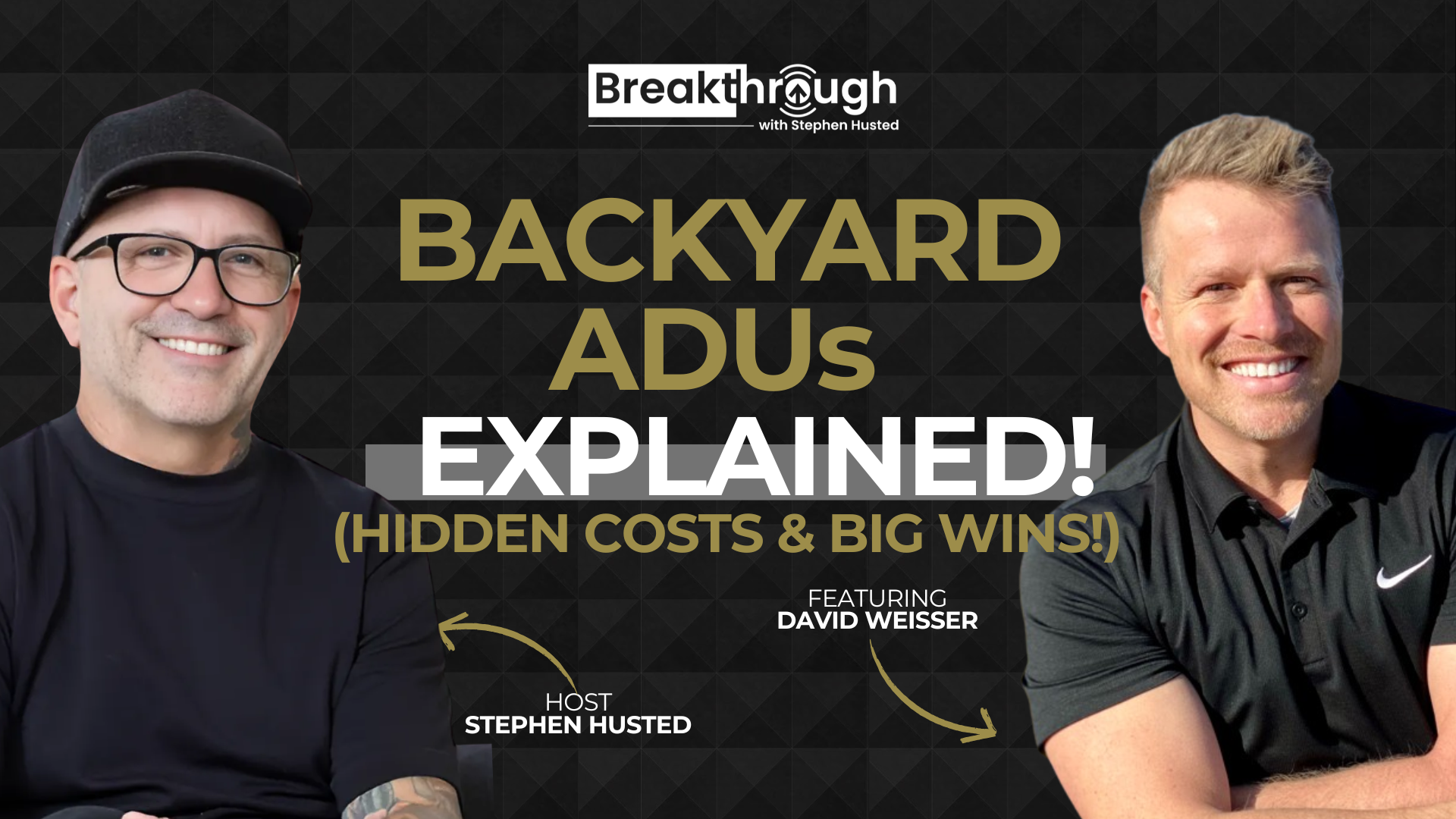
In this episode, Stephen sits down with David Weisser, a real estate expert and contractor specializing in building high-quality DADUs in Seattle. With over 20 years in the industry, David has helped investors transform properties with sleek, functional backyard homes. But he’s not just about construction—he’s a pilot, a boating enthusiast, and a problem-solver who’s figured out how to build these homes fast.
Stephen & David Talked About:
00:00 – First Steps into Real Estate
05:46 – The First Investment Property
12:16 – Lessons Learned and Moving Forward
18:42 – Family and Community
25:59 – Education and Career Path
34:54 – Discovering a Passion for Real Estate
36:20 – The Challenges of Flipping a House
37:48 – Navigating the 2007 Market Crash
42:30 – Starting Fresh in San Jose
49:05 – The Importance of Collaboration
49:52 – Reflecting on the Impact of COVID-19
53:42 – Balancing Success and Personal Life
TRANSCRIPT
∎ Teaser / Highlighted Clip
[David Weisser] (0:00 - 0:50)
My impression is get in now in the next five years, do as much data plays as you can before it's harder to find a deal. If you don't manage growth well, and what I mean by that is having the right people and the right systems in place as you grow, then it's going to get ugly. And that's one thing you've got to really watch out for as a general contractor is making sure you don't run out of money.
To be able to grow past that, you've got to get the company out of your head and on paper so that other people can actually have the information they need. If you want to grow, you're going to have to change how you structure your business and to grow past yourself means standardized work and creating systems that other people can follow. I know what it's like to live in an uninspiring, dark apartment or house, and it's just like, you don't have to build them that way.
∎ Podcast Intro:
[Stephen Husted] (0:51 - 3:47)
Brace yourself for a wild ride into the unexpected. This ain't your typical success show. I'm here talking to real folks who've been through it all, skipping the fancy business talk for authentic stories.
We're diving into childhood dreams, teenage escapades, and everything in between. No scripts, just the stories that truly mold success. Each episode takes you on a journey through those breakthrough moments that paved their way.
No fluff, just genuine stories. So whether you're chasing dreams or just love a good story, buckle up for wisdom, laughs, and the unexpected. This is The Breakthrough Podcast, where success is a journey, not just some fancy destination.
Don't miss out. Hit the subscribe button now and join our breakthrough crew. I got some incredible stories to share and you won't want to miss a single one.
∎ Guest Introduction:
Hey everyone, welcome back to The Breakthrough with Stephen Husted. I'm so glad you're here because today I have a guest who's doing some truly incredible things in the world of real estate and development. Joining me is my buddy, David Weiser, a dad who is a builder, contractor, and real estate expert with over 20 years in the game.
David's been working closely with investors to transform properties by building high quality ADUs and DADUs. He's mastered everything from feasibility studies to construction and has a knack for simplifying what could be a complicated process. In this episode, we're diving into David's journey, his thoughts on the future of real estate in Seattle, and how he's managed to scale his business while keeping every project efficient and client focused.
Plus, he's sharing tips for anyone looking to step into the world of ADU development. Oh, and trust me, you don't want to miss the part where he talks about the adventurous side from flying planes to boating in Puget Sound with his daughters. This conversation is packed with value and inspiration, so let's get into it.
∎ Podcast Proper:
How's everything going? Going good. Yeah.
Busy. Busy. You are?
Well, I'm glad to get you on. I was talking to one of my business partners who we just closed, well, we're going to close soon here on our first project in Seattle with this particular investor. And I had told her that I have, she's like, Oh, you know, I want to talk to this guy, David.
He was at the meetup that we're at the last time we flew out, which was about a month ago. And I'm like, Oh, David's going to be on my podcast tomorrow. She's like, you got like everybody from Seattle on your podcast.
I'm like, it's just, that's the way it's working out. And then why not? You know, this is the best place to get an hour of undivided attention and get a lot of cool information on what people are doing out there and building daddies and ADUs and all this really cool development.
That's pretty damn exciting. Honestly, I don't know. I haven't been this excited for real estate in a long time.
[David Weisser] (3:48 - 4:48)
So yeah, that's awesome. It's a good time with the real estate market in Seattle. And it's one of those things where now is the time to jump in because it's not going to last forever as far as ADU game.
So what do you, what do you think about that timeline? I would say, you know, we probably have like a five to 10 year window here, as far as capitalizing on that, the daddy game. One thing that you're going to want to get ahead of is just the general public getting, starting to have an understanding of, Oh, I've got a backyard.
I could, you know, can raise the price of my property because I know some investors are going to want to put an ADU on it. So right now we're at the beginning stages of a lot of this development. And over time, homeowners will become more aware of the game.
And I, my assumption is that property prices are going to go up and it'll be a little harder to make these investments pencil as well. So anyways, yeah, my impression is get in now the next five years, do as much daddy plays as you can before it's harder to find a deal.
[Stephen Husted] (4:49 - 4:57)
Let's give the audience a little bit of backstory on what you do and how you're involved in this particular strategy. So what do you do on a daily basis?
[David Weisser] (4:58 - 6:29)
Yeah, well, I, so I'm a daddy builder. I primarily work with investors. A lot of my clients are real estate investors.
A lot of my clients work at either Amazon or Microsoft. They got really good paying tech jobs and they're just getting into the real estate investment game. And so a lot of these daddy plays are really great entry level real estate investments outside of doing a flip as far as development goes.
And so anyways, so I work with those clients to build their daddies. So our clients are going to buy in single family residential homes, and then we're building their daddies on the back. And typically they're condoizing those lots and then selling both off separate.
Some of them are holding them and renting them both out. And then a lot of them just turn around, sell them and then do the next project. So I've streamlined our process for investors.
So we make it super easy turnkey. You know, if they want to put a daddy on their lot from A to Z, we've got everything covered. So we take care of the initial feasibility, making sure they can actually build on the lot and everything checks out on a, from a code standpoint.
And then if feasibility checks out, then we help with the entire permitting process. And we have models that they can choose from in-house models that they can choose from, and we get to do all the permitting and then get it built. It's all the utility hookups, everything ready to go.
And we got finished packages that investors can choose from. So they literally can just choose a finished package. And all I got to do is just sign.
And when we get it done, we make it super easy.
[Stephen Husted] (6:30 - 6:48)
Do you think this strategy is easy for a beginner investor? Like, cause you brought up that they come from Amazon. They have a tech job, so they're technically working a W-2.
They're doing this strategy. Do you feel like it's a good entry and that they can pull it off without having a lot of knowledge?
[David Weisser] (6:48 - 7:54)
Yeah, no, I think they do. So, I mean, just like any, well, with the construction industry and then even with the real estate industry, you got to have the right people on your team and be working with the right people that are going to lead you down the right path. So like, if you're working with a real estate agent, that's going to sell you a limit of a property and you don't have that knowledge.
I mean, there's going to be risk there, right? You know, when it comes to the construction side, if you're shooting in the dark as far as a contractor goes and it's a contractor that's going to take advantage of you, then, you know, there's a lot of risk there. But if you get in the right networks and have the right referrals and you have good contractors that are trustworthy, have been proven to be trustworthy, and you've got good real estate agents that are trustworthy, you can't go into these things blind, but if you have those right people on your team, there's a lot of it's taken care of.
And again, you got to understand what you're investing in and understand the key components, that's just wisdom. But yeah, I mean, our clients can just be very new to the game and we can execute well for them and they do really well and they literally just sit back and watch.
[Stephen Husted] (7:56 - 9:54)
And it's definitely, I know it sounds like a broken record to say it all the time, but your team, no matter if you're doing ADUs or DADU plays, development, it really boils down to that in general and real estate is your team. If you have two bad components on your team, it almost snowballs into just a really bad situation across the board. And I've realized that out in Seattle.
I've told this before, I wasn't planning on investing out in Seattle, but I started to meet some people at BiggerPockets Conference, had them on my podcast and started hearing little bits and pieces. And so then I started, you know, I talked to some local agents that are doing, you know, ADU and DADU plays. And then I talked to Wholesaler and then I talked to another contract and then it started
I'm like, OK, wait a minute. I know everybody out there now. I got a team.
So this is a much smoother process when you have everybody that's really been through it and been through all the bad things, too, which is the key, you know, and learning all those little things about oil tanks, how to decommission an oil tank. Trees, you know, all these little nuances that you have to kind of look into when you want to go down this path. And so having those right people that have gone through it and the contractors as well that have done enough of them that they know what they're looking at and how to approach it.
You know, like you came when we first when I first reached out to you, you had a feasibility study, you know, I would say a rough draft within 24 hours. Yeah. You know, like I already knew kind of what I could do on the project that we're going to be involved in together.
So, you know, that was really valuable. It gives us some time to make quick decisions to move forward on that project and get things moving. So definitely the team scenario is really huge.
When did you first get into the game of making ADUs and DADUs? DADUs or do you do ADUs as well?
[David Weisser] (9:54 - 11:13)
Just DADUs. And I mean, sometimes it can be synonymous, but when you say ADU, you're talking about attached ADU. We just do detached ADUs.
And I got in the game about I've been a contractor for I've been in business 13 years, but the DADU portion was in the last three years. So we started like right around right in 2020, like during the pandemic. And so I just started doing DADUs because I was just seeing the trend.
And so I prior to that, the decade before that, I did commercial construction, primarily tenant improvement. So we built out primarily medical clinics, doctor clinics, veterinary clinics, things like that. So I did that for 10 years and started to do these ADUs as well because I had really I had so many friends asking me about ADUs.
It was constant. People were like, hey, do you know anything about building ADUs? And I just started to see that it was a pretty common thread with in the community.
So and in Seattle, right around 2019, changed their code to accommodate ADU development. And that's when it really started. So I started doing it in tandem with our commercial and then eventually about a year and a half ago, two years, just completely phased out of commercial and solely started building DADUs.
But yeah, I've been building the DADUs for about three years. And I mean, we've got quite a few we're going to build this year. It's just getting busier and busier.
[Stephen Husted] (11:14 - 11:24)
Yeah. How do you manage all of them? I mean, it's hard because you have to have all these subs and crews.
Like, does it get a little chaotic at times? And I mean, how many projects do you think you have going at one given time?
[David Weisser] (11:25 - 13:38)
Right now, we've got seven going and that'll keep growing. So this year we'll probably do, I don't know, probably 14, 15, maybe 16 DADUs this year. But I mean, as you know, it's just all about the team, like we were talking about.
So yeah, and that's the thing. If you don't manage growth well, and what I mean by that is having the right people and the right systems in place as you grow, then it's going to get ugly. But we've really like, for example, we've just hired, I just hired somebody that I've actually been talking to the last two years about coming to work for me.
And it was just a matter of the right timing. But just getting people on your bench, the right quality people that have the right experience and are good people and then pulling the trigger when that time comes. So we just brought somebody on and it was the perfect timing for us and for him.
So you got to grow slowly. But yeah, we're able to manage it well. It's just a matter of having quality people.
And then the other side of that coin is having really good systems in place. And that just takes time and intentionality, you know, just with the purpose of creating systems and standard work, standardized work. And then you just work on that.
You tweak it, you iterate, you iterate. And so those two things, the people that you got and the systems you have in place are really the lifeblood. And then, like you said, the subcontractors, that takes time.
That also takes experience. I've been in this industry total for about 20 years. And so you get good at being able to read subcontractors and get a feel for them.
And when you work with them, kind of understand what you've got, what you're working with. So I do the vetting as we bring more subcontractors on board. But once you get a good subcontractor, you make sure you keep them and you, and you treat them well, you pay them on time, you know, jerk them around with the schedule.
And when you can keep those guys, they work for you, you know, and they'll show up. And when you're in a crunch, they'll perform. And so really that's the lifeblood of being able to execute well as a company is, is your subcontractor, your subcontractor.
So, I mean, there's a lot of effort that goes into that. And then there's, and then once you get the good ones, you just keep them, you keep using them. And it's essentially, they become part of your team.
[Stephen Husted] (13:39 - 16:04)
Yeah. And they know it's like a constant flow of business. So they don't, and so it gives them job security on that, on that front too.
And they just, and especially when everybody on the team's working really good together, then it's just a good culture all the way around. And it's like hard to break from it. But once it's, once it's bad and there's one, it kind of trickles in a lot of ways because it happens.
Then it starts trickling on all your job sites. Then you start catching it, you know, and you're like, okay, we got to get rid of this one particular person and go find the next one that's going to fit in the team. And you brought up a really good point when you, about systems, because it is the same systems for the contractor side and systems for the investor side.
Because right now, what we're going through, we closed on one property and then we wrote on one 17th, the one that you're going to be involved in, but we didn't think we were going to get one 17th. We just accidentally got it. And so now we're like, oh, okay.
So now we have two full rehabs of the main houses. We're building out one basement. The one 25th project is going to essentially at some point have two daddies.
And then we're going through planning on one 17th all at once. And this is the first, our first go at it. I'm like, okay, we have to pay for, you know, two surveys, two arborist reports.
You got the architect. We have all these different little movie. We got the oil tanks and all these different things.
But every time something comes through and we actually hire an assistant that all she does is that she's dedicated only to Seattle development and anything comes through a bill, whatever we're working through, it's all systemized so that we know on the next project, we go, okay, we're going to end up doing this, this, this, possibly the oil tank. We have to look at the, you know, everything is going to be systemized. And then we know how much we're spending too, like what our soft costs are.
And we can keep that in a system so that we know how to underwrite even better. There was a couple of things that I didn't catch. You know, the oil tank was one I'm like, oh, okay.
We have to work on that. And just a lot of different little scenarios, landscaping, you know, how to account for that when you got a bigger lot and you got a little bit more, you're going to pay for more or fencing and just different little things. And so systemizing it from the beginning in the first, I feel like the first couple are definitely going to be learning lessons and it's going to take time to.
Put your systems in place, but then it just gets better over time because we know, you know, and that kind of goes with probably building daddies, right? Same thing.
[David Weisser] (16:05 - 18:16)
Oh, a hundred percent. I mean, even more so there's so many moving parts when it comes to building a daddo and from a place of executing on the work to place of quality control and compliance and make sure, making sure things are getting done correctly. So systems in the field, though, quality control, compliance, inspections, and then you're constantly dealing with issues in the field and those that, and dealing with those, I mean, there's just a lot, like, for example, like our standard work as far as checklists, like through the entire project, you know, we have checklists for every stage of the project.
So we have a checklist prior to breaking ground checklist, we have a bidding check, even before that, for period of construction, we have a bidding checklist, and then prior to execution of the work, a checklist, and then a checklist for excavation, a checklist for foundation. I would imagine like checklist items, if we were to tally them up, I would imagine we have a couple thousand checklist items of making sure this was done, making sure this was done correctly and make sure this is done. So anyways, who does that on your team?
The superintendent does. So the onsite superintendent, as he goes to those portions of the project, he would be checking those items off. So we use a software and each project gets a new template and then every phase of the project, each of those items have got to get checked.
And so if forever, ever reason there was a warranty claim, or we run into an issue where something wasn't done right, we can go back and actually look and be like, was this checked off? If it was, but it wasn't done, who checked it off? We use a sauna, which has an auditing trail.
And so you can go back and see who was the one that actually checked that item off and, and there could be discussions around that item within a sauna and you can have conversations between me and my superintendent or admin or whoever. So there's, you just have really good record keeping too. And you actually know, can go back and look and see what happened.
So anyways, but yeah, the superintendent is the one that manages those checklists. And then all of those items have to be checked off as the project progresses.
[Stephen Husted] (18:17 - 18:22)
Break down the team that's on, that handles everything within the business and on how these projects get done.
[David Weisser] (18:23 - 19:24)
So we've got a admin, full-time admin in the office. And then they're, they essentially are just the gatekeeper and managing calendars and schedules and emails. I actually have my admin manage my email inbox and manage my calendar.
So any document processing so that the admin would do a subcontractor compliance, so subcontracts, subcontractor insurance compliance. So that's one thing that we really have to track and make sure that they stay compliant with their insurance. So getting certificates of insurance on file and put it into our software.
So we know exactly when those policies are expiring to make sure we get updated policies before they expire, if they're going to be on our job site. So there's a lot of subcontractor compliant work and it's when you're dealing with contractors with small residential, it's just like, a lot of times you're dealing with small companies, you know, even like a guy in a truck type companies sometimes. And anyways, when it comes to administration, they're typically not the sharpest tools in the shed.
[Stephen Husted] (19:25 - 19:25)
Better at their craft.
[David Weisser] (19:27 - 20:38)
Just let me frame, damn it. When we pour foundation. It's crazy how much time we have to spend on like, you know, and dealing with that.
But so our admin takes care of all that stuff to make sure everything is airtight when it comes to that side of things. And then we've got a full-time bookkeeper. And one of the big things that the bookkeeper does is capsule management.
So, you know, on a project we have about 30 different items that get paid and some of them get paid several times over the course of the project. And so you've got a lot of outflow. So if a daddy was $350,000 to $400,000, you know, as far as the outflows and the inflows for that, you've got to be able to predict that.
And so we have some pretty in-depth systems in place to where on a real-time basis, on a daily basis, items can get updated and we can actually have a dashboard view of what our cashflow is based on current projects and projected projects, and that's one thing you've got to really watch out for as a general contractor is making sure you don't run out of money. And so if you're writing a few, you know, writing checks at the end of the month for half a million dollars, you got to make sure that you have a half a million.
[Stephen Husted] (20:38 - 20:39)
That's going to get replenished at some point.
[David Weisser] (20:40 - 20:52)
So anyway, so that is the, so that's the bookkeeper. And that's a really critical piece, being able to have someone that has enough time and is adequately trained and can update information on a daily basis.
[Stephen Husted] (20:53 - 21:16)
Did you run into problems in the very beginning? Like, because you've been doing this for a while now, you've obviously learned a lot of tricks to the trade, so to speak, right? Yep.
So you've had some of those issues and you've worked through all those pain points to put in these systems in place and run it smoother so that you can focus on just quality and at scale and being able to do more projects. Is it kind of how it started to spin?
[David Weisser] (21:16 - 22:28)
Yeah. Yeah. I mean, like a lot of businesses, small businesses, you start with this yourself, right, and then you grow from there and kind of the number one trap, you know, for small business owners, you begin managing everything yourself and you run the company in your head and to be able to grow past that, you've got to get the company out of your head and on paper so that other people can actually have the information they need to do what you do and, and replace what you do. And so a lot of, I just know a lot of business owners, it's hard to get past that and be able to like relinquish work.
But not only that, it's like so much of it, you have to tell them actually how to do it versus they're not able to just go read a standard work and figure out how to do it on their own. And so their, your time is still being demanded in order for them to do their work. So anyways, at some point, like you just have to decide, like if you want to grow, you're going to have to change how you structure your business and, and to grow past yourself means standardized work and creating systems that other people can follow and then allowing them to just go do that work.
So, yeah. So it's just been a lot of figuring out how to replace myself and that you have to be very intentional and strategic about that. And it takes time.
[Stephen Husted] (22:29 - 23:02)
That's hard to do. Yeah. It's hard to do.
You put systems in place and people in place, but like you said, you still, it's still your business. Yep. It's almost like it puts you in a different role.
The role is more of problem solving and putting out fires and things like that. I don't know. That's, it seems like what I go through a lot, you know, it's like, Oh, I put all these assistants in place and bookkeepers and all these people that are really helping the whole team, but then I'm still like overseeing the whole scenario and working on all the problems because it comes to me either way.
[David Weisser] (23:02 - 24:06)
But kind of the next step for that for me has been, and that's when it comes down to actually training and retaining good people, right? Cause eventually if those people are with you long enough, they can be able to think for themselves and think and act in a way where they would know how you would, how you would act. And so that takes time and, and you do, there has to, there is going to be a level of handholding, but if you work with somebody long enough and they get enough experience with you, then they can actually start to make a lot of the decisions on themselves.
So that's one thing I'm doing right now with some, with some of the, some of those on my team is, is like, I need you to start making these decisions on your own without asking me and if they end up not being the best decisions, we can go over that, but I've given you full license to make those decisions. And if it ends up being not what I would have chosen, like you're not going to be in trouble because I've told you to just make the decision and don't ask me. And so I'm kind of in that phase of starting to go down that path.
But yeah, at some point your people got to be able to operate on their own.
[Stephen Husted] (24:06 - 24:39)
And so definitely, I mean, that's what you want to get them to. And then, then it's, you can go focus on some of the bigger things and whatever the goals are within the business that you want to achieve. What is your favorite part of building?
When, when it comes to building a data, like what part of it are you like, do you get really excited about design? What's your favorite part of it? It's such a interesting development in itself, right?
Yeah. You get drawings, you look at the drawings and it's like, okay, it's the drawings, but it's a whole different story once it's built, you know, and just the way it looks. So what is your favorite part?
[David Weisser] (24:39 - 27:03)
I love seeing things come out of the ground. Like that's just, that's just, I, anytime I see production happening, I'm just like, I love it. So for me, like the first part of like excavation, as soon as the hole goes in the ground, I've just love, I'll go out there and just walk around in the, you know, in the hole and the trenches, I love that portion of it.
And it just, as things progress that, so it's the excavation. And then once that, then you do the foundation to me, that's not as exciting, but then once the frame goes out, I just love, I love framing and that's a good, that's a part that I really enjoy. And then for whatever reason, like once the frame has gone up, once drywall goes in, there's something about going in and like the smell and the humidity and the drywalls in, so now you can actually see, get the feel for how the space feels.
Just like for some reason, the drywall or the taping phase, the muddying phase, I just love there's something nostalgic about it. And then after that's all done, as soon as finishes start going again, going in, that's really fun. You know, once you get paint and the flooring goes in and you just get to feel how the space feels, but I just, I love just seeing it work happen.
I mean, the planning phase is fine. The design phase is fine. A lot of, for us, we do build a lot of the same daddies over again.
So we, I've already gone through the design phase and so we're reusing a lot of designs, but yeah, I just love seeing things come out of the ground. But the design phase, when we designed some of these daddies, I mean, I put a lot of thought and intentionality into it as far as the end user and what people really want and what they need and what's going to make for a really nice home. Some people design daddies, I mean, they're just like cracker boxes.
The things are ugly and just, and they're just awkward. And I've seen some, and you're just like, I would never want to live here. And so just the way our daddies flow and the ceiling heights and the window placements and the natural light, especially being in Washington, you know, natural light is a big, it's a big deal.
Thinking through all those things, it just makes for a really nice place to live. And to me, I just, there's something really satisfying knowing that we, whoever's going to be living in there for the next 50, a hundred years, they're actually going to, that's going to be something that's going to provide a lot of value and bless them, you know, I've, I know what it's like to live in a uninspiring dark apartment or house. And it's just like, you don't have to build them that way.
[Stephen Husted] (27:05 - 28:26)
No, especially in Seattle. I mean, you got some bad weather there for a few months there. So you need to have something light and bright to cheer you up when that sun does come out.
So it totally makes sense. You know, I don't know if you know this, but our agent Ian Love, his daddy that he just finished, we're using his design for 117th. So, you know, it just kind of worked that way because Jaclyn, we'd brought it up to Jaclyn because we were going back and forth with that lot from the information we found and that issue with the tree that was on our 80% on our lot, 20% on the neighbors.
And they're like, you can cut it down. And it's like, then we got into this back and forth. And then finally, you know, between Jaclyn and me and Ian, we just decided to build his, you know, and his was a two, two.
And he's like, look, it's going to fit good on the lot. It's going to go good with the neighborhood. Let's just move it forward.
So I'm like, okay. And I saw it in person, so I knew I liked the look of it, but there's a lot of really cool designs and I've seen some really awesome ones recently where on the two story part, you know, they're pushing out what I would say would probably be the primary bedroom. And they're like pushing out by the window to grab more far, I guess, floor area ratio.
Yeah.
[David Weisser] (28:26 - 28:27)
Yeah. Yeah.
[Stephen Husted] (28:27 - 28:33)
I'm learning more and more about that part too. Like just, you can tweak out just a little bit to get a little bit more square footage. Yeah.
[David Weisser] (28:33 - 30:15)
What are your little tricks there? Well, in Seattle, they don't use FAR. So FAR stands for floor area ratio and a lot of jurisdictions have FAR code.
Seattle doesn't. So in Seattle, it's just ground coverage or lot coverage. So in most zones you can have 35% lot coverage.
So whatever the house takes up. So the house takes up 20%. Then you have another 15% for the daddy or most lots in Seattle.
You have just enough space to get a full size daddy on there. What is a full size daddy in Seattle right now? It's a thousand square feet, a thousand square feet.
So livable. And so you can actually have a garage, a garage doesn't count against that. And you could have, um, as much garage space as you want, but you're still limited to the lot coverage.
So most lot, most homes with a lot coverage requirements, you're not going to be able to get more than a one car garage on there. So we have, our model is called the Haas model. It's a three bedroom, two and a half bath, one car garage.
The footprint on that is 750 square feet. In most lots, you're going to have like 500 square feet additional from the SFR, 500 to 750 square feet, sometimes a thousand, but it's more rare. Typically you're right around the 500 to 750.
So that model, three bedroom, two and a half bath, one car garage is 750 square feet. Say for example, you only had 600 square foot of lot coverage allowable. Then what you could do is what you just suggested is on the bottom floor, you're at 600 at the top floor, you cantilever to get additional square footage.
That's technically not lot coverage, but it's increasing your overall square footage. So that is something you can do.
[Stephen Husted] (30:15 - 30:20)
What's the other trick too you can do? I think that you can get a, put a bike hook.
[David Weisser] (30:20 - 30:44)
Oh yeah. Yep. Yeah.
You can get, there's a couple different, we haven't utilized that recently on projects, but if you get bike storage, you can get a little bit more square footage. And some of that kind of depends on your zoning and where you're at. But we actually haven't done that on any of ours, but I know of other investors that have been able to grab just a little bit more square footage based on the bus system and whether they have a bike rack and things like that.
[Stephen Husted] (30:44 - 30:57)
Seems like there's got some good changes happening soon here and in 2025 in the summer, as far as building daddoos too. Three bedrooms, two baths, 1500 square feet. That's massive.
Yeah.
[David Weisser] (30:57 - 30:58)
Yeah. It's going to be a big.
[Stephen Husted] (30:58 - 30:59)
That's huge. Yeah.
[David Weisser] (30:59 - 31:00)
That's so crazy. Yeah.
[Stephen Husted] (31:00 - 31:01)
That's what I want to hear
[David Weisser] (31:01 - 31:04)
Now we've got to go redesign all of our daddoos that we have.
[Stephen Husted] (31:09 - 31:23)
Everyone's doing addition to their daddoos. Yeah. And then trying to get away from doing HOAs as well as having the daddoo being in an HOA, is that another thing that's on the table as well?
[David Weisser] (31:23 - 31:57)
I know that just came out and I haven't fully reviewed it, reviewed it. So I got to look at that. I know in Seattle, there really isn't, we haven't run almost all, I've never run into a daddoo worthy property that was at an HOA.
It's just rare in Seattle. A lot of other jurisdictions have HOAs, like there's HOAs in Kirkland. Bellevue, but in Seattle proper, it's not really an issue, but yeah, I have yet.
I know that just came out recently, like last week and I have not fully reviewed it all as far as that portion of the HOA goes.
[Stephen Husted] (31:57 - 33:42)
So the one project, the first one we bought on 125th, that lot is a 12,500 square foot lot, a hundred feet wide. And so, you know, obviously we're building out the main house. We took the existing garage in the backyard that went right down the driveway and we tie that into the daddoo scenario, I think you and I talked about that and then you said, yeah, you never work off of existing garages, but that one we're building as big as we possibly can.
And then we're planning now the anticipation of doing the three, two in between the single family. And we had such a big lot. I'm like, well, let's just wait because we could obviously put a three, two with a two car garage at that spot.
I mean, it's so big and we don't have any issues with trees. There's one, but it's in the very back corner of the lot. So we're just going to quote unquote, land bank it for the time being and wait for that to change.
And we're going to hold the main house now. When our first intentions were to sell all these projects, like we weren't going to keep anything. But now I think we're changing our tune and going to keep some of them.
Yeah. You know what I mean? Just hold them.
And we don't really care about, you know, cashflow at this point. We just rather have the appreciation play more. So we've done all that in the Midwest.
We get the cashflow there, but even that, I have to say this, but the cashflow in the Midwest and just, I don't know, it's a kind of an interesting word to say, because you might get two to three, $400 in cashflow, but you're just one big major issue away from losing all that in a year, you know? But that's not really the reason we're getting into all this, but what is your role in the very beginning with a designer or an architect?
[David Weisser] (33:43 - 33:57)
So there's two kind of modes that we follow. One, we'll get a client and they're not working with an architect and they're looking at buying a lot in there. And so we'll jump in, we'll actually help with feasibility and making sure they can actually build on the lot.
And then from there
[Stephen Husted] (33:57 - 34:02)
What's feasibility? What's feasibility for the audience to know what that term means?
[David Weisser] (34:02 - 34:28)
So feasibility. So they're intending to put a datu on the lot as an investment. So before they buy that lot, we're checking all the different things as far as code goes, that would prohibit them to be able to build a datu or fully utilize a lot to build a full-size datu.
So anything that could be a roadblock to the construction of the datu, we'll look at those things. And there's about 30 different things that we look at to make sure, because I mean, yeah. What are the roadblocks?
[Stephen Husted] (34:28 - 34:30)
What kind of roadblocks do you go through?
[David Weisser] (34:30 - 37:37)
Yeah. So for example, the main one first is the basic like lot coverage code. So it's like, if you're like an NR1, 2 or 3 and your lot is over 5,000 square feet and you can have 35% lot coverage.
So what we do is, and we can do this all from GIS maps, but we can go on and online, figure out what the lot size is and then measure from satellite view, measure the footprint of the SFR and then do the calculation and figure out, okay. So the house takes up, the SFR takes up a thousand square feet of the lot. So say that 35% lot coverage is 1500 square feet.
So the house is a thousand means we've got 500 left over. So we look at that. That's the first thing we look at because there's a lot of lots that I'd look at and they only have like 250 square feet of additional lot coverage allowed.
And so I know clients that are, you know, they're, they're, they're about to move forward, they're about to close and, and they are, and I do feasibility. I'm like, ah, you're going to be building a very small daddy. And obviously that would be a deal killer.
You know, if you could only have like 200 square foot and you did two stories, that's a 400 square foot daddy, you know, it's a little cabin. So that's the first thing we look at from a code standpoint is we look at that. There's like reverse corner lots.
You've got to be careful with reverse corner lots in Seattle on a reverse corner lot, depending on the layout of the neighbor's lot and your lot. You know, either side could be dictated as the backyard. And if one side is dedicated over the other side, whatever the front yard is, you have to have a 20 foot setback.
So sometimes people think this is their backyard and the city will not consider that the backyard. They'll consider that the front yard. And they're thinking they could put the daddy five feet from the property line.
They're going to have to be 20 or 25 feet back from the property line. And there's been times where they can't build anything. So there's a lot of like code gotchas that you got to be really careful of things like that.
And then we just look at from a construction standpoint, is it, where's the sewer, where's the water, where's the power coming in, what's the topography like, you know, if you have a steep slope. Oh, one thing we look at is ECAs, environmental critical areas. If there's one of those on the lot, a lot of times customers don't realize there's an ECA on their lot and you can only build, you have to be 15 feet away from an ECA.
And so sometimes that'll kill a deal. The power lines too is a big one too. If you have high voltage power lines, you have to be 15 or 14 feet away from the high voltage power line.
Not your service lines, but the high voltage. But some of these projects are right on the alley and the power line is right on that side of the alley. And if they're going two story, they may have to push their daddies further into the lot to stay away from that power line, and that may push them into the SFR too close to the SFR.
So things like that, that you've got to be looking out for. So we have about 30 different things that we look at. Another big one too is the housing authority.
There's some Seattle's housing authority, depending on the zone that you're in, or you may be required to pay into the Seattle's, forgetting the name of it, but they're the housing authority act where you, some of these projects, if you're going to develop, you're going to have to spend another 20 to $40,000 in.
[Stephen Husted] (37:38 - 37:39)
Oh, really? I didn't know about this.
[David Weisser] (37:39 - 37:51)
Yeah. It's not an NR1, NR2, NR3 zones. There are other zones required and you got to watch out for that too.
Cause I've had customers that were about to buy properties and I showed them that like, Hey, you're going to have to pay into this for like, what?
[Stephen Husted] (37:53 - 38:31)
That's a big chunk too. We learned about the reverse lot. You taught me about the reverse lot right off the bat.
Cause the 117th project is a reverse lock. We found that out. Yeah.
And then I literally found that out the day that I was, we were in Seattle looking at it. And so we finally went back to it and looked at far, we have to push it, which I guess it makes sense because it, what it does is it lines you up with the neighbor's house. Is that part of it?
Instead of you coming closer to the street, it would be off, right? Just does. I understand the theory behind it, but yeah, thank God our lot was deep enough that we were able to pull everything off.
[David Weisser] (38:31 - 38:57)
Yeah. I've run into situations where customers bought lots and then they would have thought by the way the house looked that this was the front yard, but it's not like the city is not going to consider that the front yard. And so then it's like, okay, well then this is the backyard.
Cause you, so, and then when, when it came to putting on that side, there wasn't enough space between the setback and the main home to even put anything in there.
[Stephen Husted] (38:58 - 39:27)
Yeah. Our lot's 8,700 and we did a parking spot between the daddoo and the house. Yeah.
And then we did, we're going to curb cut the left side of the main back for the main house and then we're good. But yeah, but it did hold us back from doing a three bedroom. Yep.
And that's why we ended up going with Ian's like, look, just build this. It fits good. It's going to go great with the neighborhood.
It's going to go, it's going to blend good with the main house. You're going to be fine. Yeah.
[David Weisser] (39:27 - 40:07)
Okay. The curb cut, that's another thing too, that we do, we check for feasibility. You can only have so much curb cuts.
So if you have a corner lot, depending on how much curb cut or the length of the, of the property line will dictate whether you can actually do another curb cut. So you got to be really careful with that. Cause if you're assuming that you're going to be able to get, do a curb cut and get a driveway into the daddoo in the backyard, you may not be able to.
So that's another thing you got to look at too. And another thing too, you got to be in Seattle's majority of the time. If you have an alley, even if you're on a corner, if you have an alley, you have to, your driveway has to be from the alley, can't be from the corner, some, most of the time.
So anyways, those are all things to think about.
[Stephen Husted] (40:08 - 40:15)
Yeah. There's a lot of things up front. You need to kind of, you know, you're doing as much upfront, but there is a little bit of calculated risk as well.
[David Weisser] (40:15 - 40:16)
Yep.
[Stephen Husted] (40:16 - 40:40)
Yeah. And do you find that even when you check all the boxes, there's still things you run into? When are you out of the clear?
Let's just say that who's going to be at that point of contact. That's going to say, okay, is it the architect and the designer, or is it like when they finally start putting it on the lot that you understand exactly what you can do because they know everything as far as setbacks or any kind of rules or anything like that. Like when are you kind of out of the clear?
[David Weisser] (40:40 - 40:42)
Yeah. I mean, there'd be two phases. That makes sense.
[Stephen Husted] (40:42 - 40:42)
Yeah.
[David Weisser] (40:43 - 42:09)
There'd be two phases. So the first one would be, it would be when your permit's approved. Once your permit's approved, you're good to go.
Okay. But after that, anything underground, so like in our contracts, we guarantee the price of the structure, but we don't know what's underground. And so we have provisions in our contract.
Like if there's, we discover something underground subsurface that we didn't know was there and that we have to deal with, like the customer's going to have to pay for that. So once the slab is poured, then you're kind of in your next clear, as far as any unforeseen costs underground. Like for example, we did a dadu up by Northgate and we went to dig for the foundation and there was an abandoned septic tank underneath right where the foundation was going to go.
It was like an old concrete septic tank. There was no way we would ever known that was there. And so that had to be removed.
And it's a big septic tank. So you got to excavate the whole thing. I mean, you got to fill it back up.
So that costs the customer another $5,000. But I mean, so that's, that's the, that calculated risk. So, but once you're done digging in the ground, then you're, you're in the clear.
There's no surprises after that. There shouldn't be. Okay.
So it's like once, once you're approved, then you know, you can build it. And then, you know, you're good. You can build it.
And then when it comes to construction, as far as any surprises, once you're out of the ground. Um, and that includes the foundation running the water and the sewer and the electrical. So running all your utilities, getting the foundation.
And once those are in and buried and you're going vertical, you're good.
[Stephen Husted] (42:09 - 42:11)
What's a typical timeline.
[David Weisser] (42:11 - 42:22)
Start to finish. That's about six months. We can, sometimes we can get them done like four and a half months, but on average, we're like five, five and a half, six months, but how does a four and a half happen?
[Stephen Husted] (42:22 - 42:26)
Is it just the flow of it? Everything is no issues.
[David Weisser] (42:26 - 43:01)
Yeah, exactly. If we just don't, if everything. Yeah.
If everything is, it runs smoothly and we don't, subs don't slow us down. We'd be in a more than four and a half. One thing that's kind of hurt us a couple of times is Seattle city light.
They're, they're just notorious for just not very well run. And so yeah, so we really, on some of our projects, we've been done completely done and just waiting to get our final inspection, but we can't get our final inspection until we get power hooked up. And Seattle, we're just sitting waiting for Seattle to come hook us up.
[Stephen Husted] (43:02 - 43:13)
And sometimes they can put you out like months as far as getting, when you reach out for them, like I know that it's supposed to be that you want to get some, you want to be proactive on scheduling. Like what is your typical safe zone on that?
[David Weisser] (43:13 - 43:47)
Well, we cannot schedule. Power hookup until we've installed the gear and haven't had that inspected. So we got it in install the new meter box and the new meter and get everything wired up and, and then they will come and look at it and then get us on the schedule.
So we just try to get that at the beginning of the project, get that done as quick as possible, get that inspected and then get on the schedule for hookup. So, but how far are they out? Usually the last couple of projects we did, they were from the time that we requested hookup, I think they were like two months.
[Stephen Husted] (43:49 - 43:49)
Okay.
[David Weisser] (43:49 - 44:00)
Which is ridiculous. I mean, I've worked in other jurisdictions. Like you can literally get a hookup the next day.
It's so bad. It's just so bad.
[Stephen Husted] (44:00 - 44:07)
And you're waiting two months and how, as far as when the electrical is all done, when are you done with the project from that point? Typically.
[David Weisser] (44:08 - 44:51)
On that portion, when they come and the gears and they can inspect, we're probably about like two months into the project. And then, so that leaves another like three to four months before the project's done. But I would say, I think on our last, like on our last few projects, for whatever reason, electrical didn't get approved until kind of like halfway through the through or more, I think we actually waited like three months or more.
Whatever the timing was, we were done. I remember the full timing, but we were done and we literally waited a month to get hooked up. So, but we're, so we're very hyper vigilant, you know, making sure we're not wasting a day.
Like we're applying for that service right away. We're getting that done. We're getting the gear in as fast as possible and then getting that inspected and then getting on their schedule.
[Stephen Husted] (44:52 - 45:29)
Yeah. Because once again, you've learned the hard way. And then you have to revise and, you know, figure out how to make this more efficient and smoother.
Because time is money for everybody involved. Yeah. What, what are, as far as dattoos that are getting built right now, as far as aesthetics and like how they look, like, what are you seeing right now that you really like are like, Oh, that's really cool.
And different changes. I know I've been seeing some really upgraded ones that have been super cool and come to find out some of them have been done by like actual designers that own these particular dattoos. So are you seeing anything really cool that stands out that people are doing?
[David Weisser] (45:30 - 46:31)
Oh, I see a lot of, a lot of cool stuff. Dattoos and even, you know, not dattoos. We're actually going to be adding to our interior finish package choices right now.
So right now it's pretty basic. We typically have one interior finish package that customers can choose just to keep it simple because then we can source all that stuff. So we work with the designer to design, find something that aesthetically looks really good and is trending, but also is reasonably affordable.
There's, so there's products out there that look really good and meet the trends, but you know, don't break the bank. So we're actually going to be adding, have a couple of different styles of looks, but you're seeing a lot of good stuff out there, typically like right now we're going for like the lighter, airy tones, but I am starting to see some of that darker type of like cabinetry and darker wood looks and darker paint colors starting to come back in. We haven't incorporated any of that in our dattoos, but I'm starting to see some trends going that look good.
[Stephen Husted] (46:32 - 46:38)
Yeah. Where do you source all your material? Where is it?
Is it pretty local? Where is it coming from for the most part?
[David Weisser] (46:38 - 47:43)
Yeah. So countertops would be local. Flooring suppliers would be local.
And like with the flooring, we're just going to make sure that's a product line that isn't going to be gone tomorrow and we can get an ample supply of it. That our suppliers actually keep that material in stock, you know, versus having to order it from Georgia and have it actually manufactured and then shipped. And so if we can get a product that actually is readily available, that's good.
So those flooring countertops are local. Cabinets are local. We use a company called Belmont.
They're down in Kent and they have a very massive warehouse, pretty high-end operation. We can actually get cabinets sometimes in like nine days. Oh, wow.
Unreal. Yeah. And then as far as like fixtures and things like plumbing fixtures and light fixtures, a lot of stuff that we order that online, so we'll order that from build.com, a lot of stuff we order from build.com and there's a bunch of door hardware and also all of our door hardware and like bathroom hardware, we order off of Amazon. So we just have all that stuff shipped and it's all itemized. It's already all.
[Stephen Husted] (47:45 - 47:45)
You've saved.
[David Weisser] (47:46 - 47:53)
Yeah, all we got to do is just go in there and just order it and click order and just order the same stuff over again. And it's super easy.
[Stephen Husted] (47:54 - 48:31)
So I do that sometimes with my clients and listings. I did this one project and I got the neighbor's house. And so I just literally ordered everything again.
Just click done. Yeah. We're doing this package.
It was super easy. And I've asked my other contractor, you know, here in Silicon Valley, we have a lot of like builders supply shops, you know, where you can get pretty much everything, countertops, cabinets, fixtures, hardware, you name it. It's all there.
And I've asked him, he's like, no, we don't have, I'm like, I'm like, not Lowell's, not Home Depot, like something that's more for builders. And he's like, no, it's pretty much individualized out in Seattle.
[David Weisser] (48:32 - 49:01)
Yeah. I've seen some of that stuff advertised before. I've never gone and looked at one of those shops, but like for us, as far as the design goes, we have a specific design and look and a lot of times those things are, you know, just not normal things that people, you know, are going to carry, right.
So we'll like, we'll find something on that we really like and it's on Amazon. Yeah. It's just so easy to get.
And so it just makes sense just to, I mean, rarely do I ever find anybody that can compete with prices on Amazon. So
[Stephen Husted] (49:02 - 49:50)
That's true. That's true. Yeah.
And you get a big selection too, you know, and you can really find some cool design stuff to kind of switch it up a little bit. Our new business partner that we're closing on this property on Feeny, she's a designer and so she's already been to both of our projects that me and my other business partner have. And it's funny.
I'm like, oh, we're bringing in a whole not because she's looking at things in a whole different lens, you know, everything. So it's been pretty interesting. And we're trying to build out how we are going to, you know, look at stuff to, you know, we want to design some that are more unique, but we'll see how that all plays out when the big picture.
But yeah. So besides building daddoos, like what do you do for fun? What keeps you sane?
[David Weisser] (49:51 - 50:09)
Yeah, well, I've got two daughters, 13 year old and a 10 year old. They're amazing. We have a lot of fun together, a lot of fun adventures in the summertime.
We do a lot of, a lot of boating. Oh really? So yeah, we do a lot of boating.
There's a lot to see in the Puget sound in Washington in the summertime. It's such a blast.
[Stephen Husted] (50:09 - 50:11)
Yeah. Where do you go? I like to know, where do you go?
[David Weisser] (50:12 - 51:47)
We're, we're in the South sound. So like commencement Bay area and around there, Fox Island, Gig Harbor. And anyways, it's just, it's always calm.
It's nice. And it's warm enough in the summertime. And we've got humpback whales.
We've got orcas, seals, sea lions, porpoises. There's so much to see. And we do, we do a lot of exploring and combing and we'll do a lot of tubing too.
So that's, that's what we do in the summertime. I'm an aviation enthusiast. And so I've got my pilot's license.
And so I love to fly. It's actually just recently building an airplane, a kit airplane. Oh really?
Interesting. Yeah. How long is that going to take?
Well, it was going to take too long. So I sold it. It was a dream of mine to build, to build.
It's actually a common thing. A lot of small aircraft are actually kit built and type of flying I did was bush flying where you could fly in and land, you know, in the back country off airport. Anyways, so I was building that and anyways, it just was going to take me 10 years to finish.
So, so, but I still fly. It's really, the Pacific Northwest is just a gorgeous place to fly and explore. So that's one thing I really love for myself.
But other than that, in the summer times, it's just getting out and getting the sunshine in the winter time. We do a lot of snowboarding, skiing, a lot of that in Washington. Where do you go though?
We primarily go to Snoqualmie or it's called the Summit in Snoqualmie. So it's in the past, headed over to Eastern Washington. There's a bunch, lots of spots in Washington, but that's not too far away.
That's like a 45 minute drive from Seattle.
[Stephen Husted] (51:48 - 52:31)
It's a beautiful state. I'll tell you that, you know, if it had weather like California, I think it'd be neck and neck. I mean, seriously, it's so pretty there.
I just think it's beautiful. And I just couldn't believe how big Puget Sound was until I got there. I'm like, wait, there's a beach here?
Can't be like a beach. It's gotta be like a, must look like a lake. And I get there, I'm like, this is a beach.
There, you don't sit, there's water forever. You know, I'm like, okay, this is legit. The mounds are so beautiful.
It's just got a good, just a beautiful backdrop to it. It's got a lot of density. I can see why they're housing, having housing shortages and problems because it's just really nowhere to build, so to speak.
Is that, that's the big problem, right?
[David Weisser] (52:31 - 53:10)
Yeah. Yeah. And Seattle and in the surrounding areas and Washington state, but it's, it's in the urban areas.
There's more people moving there than there are places to live. So that's why the state has just been all over this. And that's why the ADU, DADU game is just an amazing play right now because the demand is there.
And you can still sell these things for, I mean, they're still considered affordable housing. You know, they're set, you can sell these for a dadu on a condoized lot for 750, 850,000. And there's people that are just lining up to pay for that versus otherwise they'd be spending over a million for old, you know, home that needs to be updated.
[Stephen Husted] (53:10 - 53:52)
With a better location, you know, with a location. And do you think that because here in California, the whole living in someone's backyard for it's just a new concept, so to speak, to be able to buy something in the backyard, everyone's like, I would never live in someone's backyard, which is interesting, but you buy a condo and live with, you know, 20 people around you and doors everywhere and people walking by you and that's okay, but you know, have a little bit of separation in a backyard and a great neighborhood does, I don't know. I don't, I think I would take that over a condo living in a condo.
Do you know what I mean? And it's different in Seattle too. That's one thing about Seattle's location and just the way they sit on the lots with the alleys.
They do feel a little bit more private, so to speak.
[David Weisser] (53:52 - 55:14)
Oh, a hundred percent. Yeah. And the alley is the game changer.
I mean, that's, that's the ticket. Is the alley or a corner lot. So you have a, most of these projects that we do are on alleys or corners, corner lots and yeah, they 100% feel like your own home, you know?
I mean, a lot, a lot of the developments like in outside of Seattle, but when you get into the more suburban areas of the track home developments, a lot of these homes, they have tiny backyards. I mean, that's like a common thing here in Washington. You have in the new developments, you have about 15 feet of space from the back of your, you know, back patio to the fence before the next property.
It's just a common thing for the, so the yards would be small. And so in Seattle, when you're splitting up these lots, they'll typically have about 10 feet of yard behind the daddoo and that's definitely accepted and it feels private. So, I mean, they can literally pull out and pull into their garage from the alley into their daddoo and they've got a backyard.
So yeah, I mean, it'd be different if you were having to walk to the backyard and that's a whole different game. But if you have an alley or you have a corner lot, like it feels like your own private home. It's not perceived as a daddoo or it's just not perceived as, originally daddos were like in the backyard and it's just perceived as a home and they're, I mean, there's three bedroom, two and a half bath.
[Stephen Husted] (55:15 - 55:56)
I mean, it's crazy. Yeah. And you know, you get the right location and you don't need all the maintenance of a yard, you get enough to, you know, have a barbecue, have friends over, you know, have your dog go outside and you're good to go.
You got your, the surroundings is where it's at. You got your parks and Puget Sound. I mean, it just, it makes sense, but I'm, I'm excited for you to get going on mine.
We can definitely, I think we should start doing some lives on Instagram. Are you on Instagram? Yeah.
Okay, cool. We're going to do some lives together during the project on 117th. I think that'd be really cool to kind of tell people where we're at, you know, what we're going through and I think that'd be kind of cool.
So I don't know. I just thought about that. Where can the audience find you?
[David Weisser] (55:56 - 56:13)
I'm on Instagram and on Facebook. It's just at David Weiser on Instagram, at David Weiser on Facebook. But yeah, I try to make sure we at least post a couple of times a week on to give updates on our projects.
So sometimes not the best, but we try to get as much content out there as possible.
[Stephen Husted] (56:15 - 56:33)
We're going to do a lot of content on 117th. I can tell you that. So we're going to, that's going to be good.
Yeah. Love it. Cool.
Well, I appreciate you jumping on and I'll be talking to you later on this week. So yeah, we got to get ours going to it. Yeah.
Right on David. We'll have a good day and I'll be talking to you real soon. Thanks a lot for coming on.
[David Weisser] (56:34 - 56:35)
That was good. Yep. Thank you.
∎ Podcast Outro:
[Stephen Husted] (56:36 - 57:05)
Thank you for tuning into our show where we hope you found inspiration and gain valuable insights. If you enjoyed this conversation and want to stay updated on our latest episodes, be sure to subscribe to our podcast and share it with others who might benefit from it. We appreciate your support and look forward to bringing you more candid conversations and breakthrough moments in the future until next time.
Take care and keep exploring new ideas and strategies.