Episode 42 - The Good, The Bad & The Ugly of Real Estate Partnerships with Joe Tran and Tony Ngo
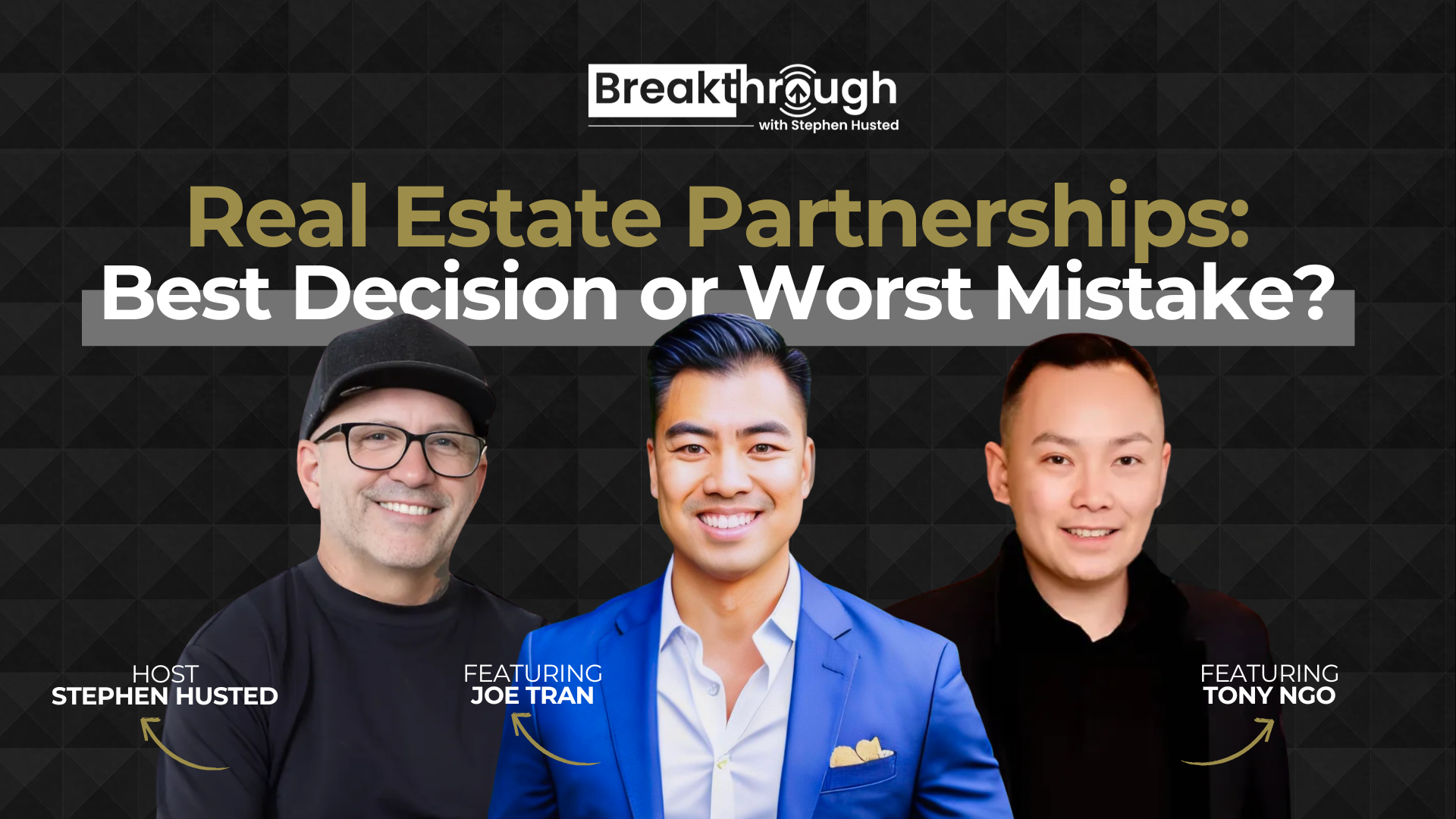
Would you go into business with your best friend?
On this episode of Breakthrough with Stephen Husted, we’re diving deep into the world of real estate investing and business partnerships with Joe Tran and Tony. Joe, a former pharmacist turned full-time investor, and Tony, a master deal-maker, share their journey of building a thriving real estate business together—without killing each other in the process. Joe and Tony didn’t start as business partners; they met through a real estate networking group and quickly realized they had complementary skills. Joe, with his analytical approach, and Tony, the deal-making visionary, found the perfect balance. But not all partnerships are smooth sailing—Stephen and the guys dive into what makes a great partnership, the mistakes they’ve made, and how they navigate disagreements while growing their portfolio.
Joe, Tony and Stephen talked about:
00:00 – Meet Joe and Tony
05:37 – How They Met and Why Networking Is a Game-Changer
06:50 – Joe’s Transition from Pharmacist to Real Estate Investor
10:53 – The Unique Halfway Home Investment Strategy
22:57 – The Real Challenges of Partnerships (and How They Make It Work)
30:27 – Why They Stopped Working with Outside Investors
42:15 – How to Spot Bad Wholesale Deals
57:55 – The Importance of Patience and Knowing When NOT to Buy
TRANSCRIPT
∎ Teaser / Highlighted Clip
[JOE AND TONY] (0:00 - 0:17)
And I remember working on my first week in the pharmacy and I'm like, oh, cool. So I get this paycheck and is this what my life is going to be like for the next 23 years of my life? There's got to be more.
And I was like, shit, Stephen, we just got this property. And it ended up being our most profitable and cash flowing property we've ever invested in.
[Stephen Husted] (0:17 - 3:10)
Solve her problems. Forget about the price. Solve her problems and then we can figure out the price.
If you solve that actual problem, you might be able to have something way more valuable than you think. That's an important thing for, I say, a new investor that'd be listening to this is to be patient. You don't need to go over the top and get aggressive and think that you can make a deal work.
If you're not a problem solver or you can't take issues coming up in front of you right away that you got to deal with, real estate investing is probably not for you.
∎ Podcast Intro:
Brace yourself for a wild ride into the unexpected. This ain't your typical success show.
I'm here talking to real folks who've been through it all, skipping the fancy business talk for authentic stories. We're diving into childhood dreams, teenage escapades, and everything in between. No scripts, just the stories that truly mold success.
Each episode takes you on a journey through those breakthrough moments that paved their way. No fluff, just genuine stories. So whether you're chasing dreams or just love a good story, buckle up for wisdom, laughs, and the unexpected.
This is The Breakthrough Podcast, where success is a journey, not just some fancy destination. Don't miss out. Hit the subscribe button now and join our breakthrough crew.
I got some incredible stories to share and you won't want to miss a single one.
∎ Guest Introduction:
Some people talk about success, others make it happen. Today I've got not one, but two incredible guests who are doing exactly that.
Joe Tran and Tony. These guys are real estate investors, business partners, and absolute deal-making machines. They've been in the trenches, built something impressive, and know exactly what it takes to win.
In this episode, we're diving into their journey, how Joe went from being a pharmacist to a full-time investor, and how he and Tony teamed up to build a thriving real estate business. We're talking about their strategies for finding off-market deals, how they've scaled their portfolio, and the hard lessons they've learned about partnerships along the way. Plus, they break down a wild story about turning an adult care home into a cash-flowing detox center.
This episode is packed with insights, laughs, and straight-up real estate wisdom. You don't want to miss it. Let's dive in.
∎ Podcast Proper:
All right, buddy. Thanks for jumping on. We can get straight into the story that we were just talking about offline, about how I found you guys, was through Michael Hudson, and he had posted a video of you guys talking.
I think you were going through a house, and I just DM'd him and said, hey, I'd like to get Joe on the podcast. He's like, sure, and he connected us like that. Isn't that wild?
Just a one-minute clip, and now we're going to have an hour of conversation and hopefully get to learn some stuff about you and what you're doing out there, because what I saw in one minute got me intrigued.
[JOE AND TONY] (3:10 - 3:44)
Absolutely. Yeah, happy to be here with my partner, Tony, as well. Hey, guys.
I'm Joe. A little short summary about me. 11-year pharmacist, got into real estate back in 2005, initially doing property management up in Seattle.
I went to college up there for school, and then went over to Pullman to finish up my doctorate and came back home. I remember working my first week in the pharmacy, and I'm like, oh, cool. I get this paycheck, and is this what my life's going to be like for the next 23 years of my life?
There's got to be more. I just started getting into more properties and investing, and then I met Tony a few years ago. Real estate's been pretty much the bread and butter since then.
[Stephen Husted] (3:44 - 3:50)
What was Tony's role? Tony, when you guys met, what was Tony doing at that moment that connected you guys?
[JOE AND TONY] (3:51 - 3:51)
Real estate?
[Stephen Husted] (3:52 - 3:52)
Just real estate.
[JOE AND TONY] (3:53 - 4:09)
We're part of this group called ARIA, the Asian American Realtor Association. I just thought it was a way to just network with other people, but I have five core friends in that group that I all met through ARIA. We joke around together.
We eat together. We invest together, which is really cool.
[Stephen Husted] (4:10 - 4:33)
Yeah, that's good. That's one thing I've noticed about going out to Seattle recently, because I fly out there maybe once a month, every other month. You guys have the best networking groups.
It's insane. Everyone that I've been to has been very intriguing and really good positivity to it. It got me so inspired that we're going to start our own here in Silicon Valley.
[JOE AND TONY] (4:33 - 4:34)
Oh, no way.
[Stephen Husted] (4:34 - 4:42)
I'm just like, hey, we're just going to format it the way that we've been going to the ones out there. Kudos to you guys for having really good groups.
[JOE AND TONY] (4:43 - 4:52)
Yeah, absolutely. We love it. My cousin, Ty, is part of 10x.
I'm pretty sure you've heard of 10x group up there with Francis and Alicia, and then obviously a big ARIA group up there as well
[Stephen Husted] (4:53 - 5:03)
I know some of your history. You were a pharmacist and you got into investing. Where are you investing?
What have you guys been doing as far as strategies at the moment?
[JOE AND TONY] (5:04 - 5:31)
The tough part right now is just the interest rate. Last year, we did a couple of births, and that's pretty good. One, we're breaking even.
The other one, we went a little further out, and it was for halfway homes. The tenant that is renting from us is halfway home. Oh, cool.
That probably increases like 20% of the average rent we could have collected, and they'll stay forever. That's pretty cool.
[Stephen Husted] (5:32 - 5:39)
What's that process like? Do you have to get different permits through the city to run it? How long does that take or no?
[JOE AND TONY] (5:40 - 5:53)
No. Technically, they form an LLC non-profit each time they open a new house or a new chapter, and they just guarantee us the rent. They deal with the vacancy factors.
Okay. The landlord.
[Stephen Husted] (5:53 - 6:49)
All right. The non-profit is basically on the lease, and then they pay you directly. Okay.
That's cool. I have a client here in San Jose, and he bought a duplex, and that's what they did. They turned into a halfway home, and he loves it.
They pay on time. He's done rent increases here and there, and they're totally fine with that, and they keep the property up, and it seems to be a win for everybody involved. It's interesting that you do that.
I've been thinking about that, too, over the years. The only reason why is I'm clean and sober myself, and when I got into investing, it was just something on my radar was to do a halfway house where I could actually go in there and maybe speak to people on my journey and was a drug addict and got clean. It's interesting that you bring that up.
Are you planning on doing more of those, or is this just a one-off type property?
[JOE AND TONY] (6:49 - 6:54)
Within our portfolio, we probably have at least a dozen.
[Stephen Husted] (6:54 - 6:55)
Okay.
[JOE AND TONY] (6:55 - 7:13)
My first one I started was, I want to say, six, seven years ago, but I knew about it over a dozen years ago because one of my clients rented to them, and then later on, I walked into this house pre-COVID, and it had so many rooms, so I connected, and then that's how I started, and we kept on adding.
[Stephen Husted] (7:13 - 7:22)
Interesting. What else do you have to do to the property that increases the value and what you can rent it for? Is it just more the room count is the big thing?
[JOE AND TONY] (7:22 - 7:46)
Yeah. The one that we saw first was a seven-bedroom somehow, and then we actually added two more, so it was nine. At that time, they paid about 25% more than the current rent.
The cool thing with this group is they'll stay forever as long as we're not stumblers. Right. After three or four years of the same tenant, you're winning because there's no turnover.
[Stephen Husted] (7:47 - 7:55)
Then where do you like to buy these type of properties? Is there a certain type of neighbor? Do you want to be by transit?
Is there certain buy boxes that you're looking for?
[JOE AND TONY] (7:56 - 8:33)
Yeah. They prefer to be within five, 10-minute walking from transit. It's kind of saturated in Portland.
We actually bought a couple places in South Dakota per their request. The main guy that handled the West Coast division, he wanted us to buy some properties over in South Dakota. With a group of us, we own maybe four or five, and we've never seen it.
We connected with a realtor. They had their people. They walked it.
They liked it. We signed for it. It's been three or four years, and we still haven't seen it.
It works out pretty well.
[Stephen Husted] (8:33 - 8:38)
Do you think that it rents almost as higher than, let's say, doing Section 8?
[JOE AND TONY] (8:39 - 9:07)
Yes, at least 25% more. I just like it because it's consistent. Yes, there is a little bit of rent trouble, but then they'll make payments, and there's zero vacancies.
That's one of the biggest things. Then the second piece that I have in all my contracts are if repairs are under $300 or $500, the house takes care of it. They do it, so we're only responsible for the bigger items.
[Stephen Husted] (9:08 - 9:20)
Interesting. The house manager will be the one that handles ... There's a clogged toilet.
They'll take care of it, and then at the end, they just show you the invoice. No, they just take care of it.
[JOE AND TONY] (9:20 - 9:40)
Yes, anything like $300 or $500 per item, the house is responsible. Anything bigger, we're responsible. Yes, we did some sewer line repairs, hot water, but it's not like a normal home where every single thing that's wrong with it, they'll call you.
We only deal with the bigger tickets.
[Stephen Husted] (9:41 - 10:00)
Interesting. When you go to buy these properties, are you doing full site in South Dakota? Because we're out in Kansas City and Detroit and Tennessee, and Kansas City, we'll go in there and just fully gut the whole house because we don't want any phone calls after the fact.
Is that what you're doing out in South Dakota too, or you're buying them as is and just fixing them as you go along?
[JOE AND TONY] (10:01 - 10:17)
South Dakota, they walk through it, they like it, it's livable for them, then it's just turnkey operation. In Oregon, we buy more distressed properties, so we turn it completely, so it's almost a brand new product before they move in.
[Stephen Husted] (10:18 - 10:41)
Really cool. So funny that you brought this up. It's literally on my mind.
It has been for a couple of years, but I'm just like, okay, I don't know the bandwidth. You know how you go. You get into a strategy and you just want to focus on that strategy and not be chasing shiny hot objects all the time, which is- We all have that problem.
You know what I mean? Especially on social media, when you see somebody do something, you're like, whoop.
[JOE AND TONY] (10:42 - 11:56)
Got to do it. That's one of the things that we had too with our Tigard property recently. I think it was the video that you probably saw with Michael Hudson was we're walking through our brand new home that we originally found as an adult care home.
11 bed, nine bath, 5,000 square foot home. We renovated this thing to have everything that an adult care home needs, right? Support bars, we wind up the hallways, wind up the door trimming.
We took that thing down to the frame. We had to get permits, architecture involved. And then once we finished it, we're like, man, we're deeper into this than we thought.
And then the broker, we're trying to get this thing listed for sale. He's like, no way. You guys aren't going to get this valuation, what you guys are aiming for.
And we're like, crap. So what are we going to do? So Tony and I are trying to figure out ideas on how to pivot this thing.
And coincidentally, somebody who runs a drug detox center reached out to us and was like, hey, your house is the perfect model for us to run a detox program out of your house. It's 11 beds. We can take care of all these kids kind of going through this halfway program and see if we can bring them, you know, restore back to normal function and things like that.
So this home that was supposed to be as an adult care home from 2023 is when we started this project. Now we're going to be able to get a lease on it to have somebody rent it for 25, 30% more than what the average rent should be and having run potentially a detox center out of our home.
[Stephen Husted] (11:56 - 12:00)
I love that. I love that. And where is this at?
Is it in Seattle?
[JOE AND TONY] (12:00 - 12:02)
Tigard. Tigard? So close to Portland?
[Stephen Husted] (12:03 - 13:01)
Oh, Portland. Okay. Yeah.
Really? That's so cool. I love this.
And I think that the reason why, of course my backstory, but I just think that it's helping the community. That's a huge part of it that people can argue about that compared to having a bunch of Airbnbs where neighborhoods can complain about it, even though, you know, there's a need for those too. But this is something that I think is, that's a really great thing that you guys are doing.
It's really cool. I think this could be the gentle push to kind of look into this. I tried where I'm at in San Jose looking into it, but even with the higher rents, it's expensive here.
Like, it's really, really expensive. It just doesn't pencil out correctly. What we've been doing in Seattle makes a lot of sense to buy these smaller homes that are two-bedroom, one-bath with basements and then build in a daddy.
Like those make sense on paper. Like I can walk through those numbers, but California, unless you've got a ton of money and deep pockets, like you got to really think out of the box, so to speak
[JOE AND TONY] (13:01 - 13:04)
The whole different ballgame out there. I can't even imagine jumping into that playing field. That's wild.
[Stephen Husted] (13:05 - 14:15)
Yeah. It's crazy. I got a message from Thatch a while back.
He DMed me on Instagram. He's like, dude, California, you can sell the ADUs as a condo now. I'm like, yes, you can.
But if I flew him into San Jose and I took him through the neighborhoods, he would know point blank that it's not the same as Seattle's market and it's not the same as Southern California. So I think Southern California and like San Diego area, they have alleyways. Their properties sit in ways that they could actually really build these.
We have lots that are big, but just the way they sit amongst the rest of the homes, you would go on the side yards. You'd be in their backyard, but you'd be surrounded by four more houses. Really nowhere to park either, but it could be a massive lot or there's a big lot and the house is sitting right in the middle of the lot.
But I've seen some interesting things lately where if the lot's like a 7,500 square foot lot, they'll literally build an ADU on the side of the house, run it to the sidewalk and just be as narrow as like a king bed, right? And they just run it across the building.
[JOE AND TONY] (14:15 - 14:16)
Oh my gosh.
[Stephen Husted] (14:16 - 14:23)
That was interesting. I'm like, okay, that's cool. That'd be great for renting, but it's not the most ideal thing if you wanted to sell it type investment.
[JOE AND TONY] (14:24 - 15:04)
So like in Portland, they're doing cottages. So like 5,000 square footage, they'll put six homes on 5,000. So it's so crazy.
Yeah. They use the word cottage and it's all detached and it's decent. Now they have options for cottages.
So instead of the dadu word, it's like you could have six homes, sometimes three attached on either side, or sometimes it's all detached and it's cottages. So it's like two level, 1,200 square footage. They'll sell for like 500.
It's just no parking. No parking for your home. Yeah
[Stephen Husted] (15:05 - 15:07)
How much to build?
[JOE AND TONY] (15:09 - 15:31)
Those number, a friend of mine, I want to say maybe three, 350, three? 350 with the land. So they'll sell for 450, depending on the area.
Sometimes you could get a little more, let's say north of 500. So there is profit in there. It's just how long with the city and then what if it doesn't sell?
[Stephen Husted] (15:32 - 15:41)
Yeah. At those prices, I think you probably could just flip it around as a rental, right? And probably be doing okay or no?
[JOE AND TONY] (15:42 - 16:05)
It's rough. I was looking at a 300K, 20% down, seven and a half interest rate. It's like a two, one, or I want to say it's like more than $3,000 and you probably can only collect maybe 25, 2,700.
So you're kind of negative. Yeah. Unless you're going to leave all of your equity in, then maybe you could break even.
[Stephen Husted] (16:06 - 16:56)
Right. Yeah. It's definitely a puzzle of trial and error on different strategies, right?
And how you can either, you do a couple of flips to keep your cash position strong and then you keep some because you don't want to keep getting hit with taxes all the time. Or because then if you keep enough of them, then you could potentially, if you're not burying out of them correctly, that you can then run at it. It seems like it's always a game.
Or it's like you start to realize that. And then since you're online and you have a community, I don't know if you go through this, but you have friends and family and coworkers that want to invest too. And so they're like, okay, hey, can I just bring the equity?
And you guys are already doing it. And then you want to take it on because you want other projects going. It's a big addiction too.
[JOE AND TONY] (16:57 - 17:06)
We've done that too. We've had family and friends reach out and oh, hey, can we split on this property together? It's like, you got to choose your partners wisely.
We're learning that very quickly.
[Stephen Husted] (17:06 - 17:17)
Yeah. Let's talk about that part. This is an interesting topic is picking partners, partnerships in general.
So what have you gone through, good and bad on partnerships?
[JOE AND TONY] (17:19 - 19:21)
Man, I can go on for days on this topic. It's so controversial, right? Because I'll listen to different podcasts and a lot of bigger pockets are like, no partners, go on your own.
Everybody has their own goals, past dreams, whatever. I feel like the reason why my path for real estate accelerated so quickly was due to my partnerships. I think me being locked into that clinical mindset of looking at clinical articles, basing all my clinical decisions as a pharmacist, based on what's black and white, real estate, as we know, is not black and white.
It's literally an art. Not at all. Totally different.
So my first partnership was on a four unit multiplex in Hillsborough. And I was looking at the numbers and I just sat on this thing. I just got listed on the MLS in the morning.
And I was like, Hey Stephen, I'm looking at this property. Like, I think these numbers pan out, but it's not good enough. And he was like, Joe, are you stupid?
Like, it's like clear as day. Just ran an offer on it. I'm like, are you sure?
Like we got to make sure this thing pencils. And I was like, what more do you need to see? And then he was like, on top of that, slap another 50 K on top of it to make sure we win it.
And I'm like, are you joking right now? I got to go clock it to the pharmacy in like 20 minutes. I put together the offer, the listing agent texts me and he was like, Hey, are you sure this is what you want?
You want to put 50 K on top of this? And I was like, are we the only offer? Are we literally going to pay for the can on top of that?
And he was like, congratulations. So it just took your offer. And I was like, shit, Stephen, we just got this property.
And it ended up being our most profitable and cashflowing property we've ever invested in. So that partnership was great from the get go. All right.
We still butt heads in terms of how we manage the business and things like that. But for the most part, it's good. What year was this?
This was 2019, 18, 19. So prior to COVID a little bit, and man, that thing's just through the roof. Purchase price, I think was like 675.
It's probably worth a million at this point with all the improvements we've done to it and all that. And it honestly hasn't been very much allowed us because Stephen's very hands-on. And so we did a lot of the renovations ourself.
And after that, working with Tony and learning about how he does his burrs and his flips, it's literally just boom. I went from four properties now to eight on our own.
[Stephen Husted] (19:21 - 19:23)
So Tony's the mentor here.
[JOE AND TONY] (19:23 - 19:38)
Tony's the mentor. His mindset, the way he runs is like, I feel like for me, it's just limiting belief after limiting belief. I cannot do this because of this reason.
And for him, it's just like, shut up, buckle up, let's go. And here we are now, and it's been amazing.
[Stephen Husted] (19:39 - 20:09)
Yeah, that's great. And I think that in everybody, and I'm sure, Joe, you bring your superpowers, and then the magic happens when they're different. When both people have different viewpoints and ways of thinking through things, then that's where the magic happens.
I think if you have too much of the same, it clouds judgment and how to move and do things from what I've experienced. Because all my partnerships, they're all different in every which way, which is good.
[JOE AND TONY] (20:10 - 20:36)
I can't agree with you more. Tony has said it before. It's kind of like the yin and the yang.
Tony is really good with ideas, entrepreneurial based, amazing negotiator. For me, it's like working in the pharmacy, I was the manager for a period of time, and it's all about workflow management optimization. How can we really bring out the property for maximum efficiency versus he's like, I don't give a shit.
Let's just go on to the next one. And I'm like, let's figure this out. But how it worked.
No, it's amazing. I love it. Why don't you try it?
[Stephen Husted] (20:36 - 23:06)
Yeah. Screw the details. I see the big picture.
I'm working in the future. I'm already 10 years ahead of everybody in my brain. Exactly.
That is me and the partnerships. The wild part would be, I'd go out to the bigger pockets conventions and just started meeting people from Seattle. And so then I'd have them on the podcast and I just had one here, one there, one here.
And then I had Ann Curry on the podcast and we got done. And I started going through. I'm like, wait a minute.
I have a contractor. I know property management now. I have agents on the ground.
I'm like, wait a minute. I got a team. Seattle's two hours away.
Okay. That's an easy flight. Check, check, check.
I literally got off the podcast, went onto Instagram stories and I was like, I think I'm going to invest out in Seattle. I'm going to fly out. I'm going to take a look.
I want to get on the ground and see what they're doing. And then fast forward, just from the podcast, I've already started investing out in Seattle, but then I take that vision to the partners and I'm like, this is the direction. This is where I'm going.
And I have to state my case. I tell them what my vision is and how I'm going to execute it. And either they get behind me or they don't, or they have questions, but most of them, they just get behind me because they trust that I'm not perfect, but they trust that I have enough vision and passion for what I'm trying to do, you know?
And, but then you also need the, the other team members to have the other skills, like the automation or the followups and the, and just the systems in place so that somebody like me or Tony can sit and create, create the visions and move that forward. And negotiating part is huge too. Like that's exactly, I'm already, I'll look at a property and I've already felt gone through 10 steps on how I'm going to negotiate through it.
One way or another, I'm thinking of analyzing different things and trying to figure out, sometimes it's confusing to my brain, but yeah, that's cool. I'm glad you guys are teamed up like that. It's always, it's really cool.
Who else do you guys partner with? Do you guys separate? So let's say somebody came to you guys, had, you know, a bunch of money, wants to invest.
Are you guys structuring a part? No, no, no.
[JOE AND TONY] (23:08 - 24:17)
Unless it's family's money and with no inputs, then yeah, sure. We'll give them a return or we'll give them equity or whatever, but the main thing is no inputs. If not, then we have access to bank money and stuff.
Like, why do we need the inputs? We tried last year with a couple of different things and it's just hard. Like we want to ride together and level up together, but everyone has a lot of different personalities and it's just hard to swallow.
So maybe our new vision is let's just make the big bucks and just invite everyone to go play versus try to, I don't know. Trevor, you're in for the ride and then try to justify where we're making a certain decision because we have all sorts of friends who are like, dude, you guys are doing so well with real estate. Let's win on this together too.
And then once you start getting into it, they're like, but wait, so why is my money going here? Where's these resources coming from? How come we're taking, and then now you're spending more time explaining and teaching them how to do real estate versus them just essentially trusting us with the capital and then bringing the returns together.
[Stephen Husted] (24:17 - 24:36)
And watching the process along the way too. Like if someone's going to partner up and they're going to bring capital, I'll update you every week. I'll tell you the good, the bad, the ugly, but it's not a, and if you're new, this is not where you start to interject some type of thought process if you haven't been down that road.
[JOE AND TONY] (24:36 - 24:37)
Exactly.
[Stephen Husted] (24:38 - 24:49)
You really need to step back and, but be very honest in what's going on. And it's true. Then what happens is it derails you.
You start thinking about these negative things and you lose focus on the big picture.
[JOE AND TONY] (24:50 - 24:50)
A hundred percent.
[Stephen Husted] (24:51 - 25:42)
Yeah. I know where you guys are at on that. I have to say no a lot to partnerships.
I just went out to dinner with a gentleman last night who I know from mountain biking. And not that I told him no, but I feel like I would do him a disservice and that I don't have time to dedicate to another scenario because I'm the type that I really want to see everybody win and make money. And I'll then put them first.
Like I'll think about their well-being and it's like, I lose track of the big picture of what I'm trying to do. So most of my partnerships, they're very chill in the background. Like they don't do much of anything.
We'll have meetings and talk about things and I'll give them updates and it works. I've learned bad. I've had some bad situations too.
[JOE AND TONY] (25:42 - 26:21)
It has to be easy, less friction. Like yesterday we had a cool coffee meet. And then, so the new friend was saying, it's a pie.
It doesn't matter how big or small the pie is. It's just when you do invest, we all eat versus trying to grab the biggest piece. Because at the end of the day, we're not taking all that pie to our grave, right?
But then we want to ride along. We want to enjoy, but each one got to have a different role. And then we could share the pie.
There's plenty of pies out there, but some partnerships, I don't know. It's too much nitpicking. And I learned that you got to stay away.
It's just tough.
[Stephen Husted] (26:21 - 29:26)
Yeah, I agree. And you know, I've started doing some coaching, some mentoring of some clients have come to me that have money, they inherited some money and they want to invest. And so I've helped them and they wanted a partner.
And I said, no. And I said, hey, how about this? Why don't I put you on a retainer for the next six months and I'll take you from point A to B to buying your first investment property.
How to choose a market, how to put your team together, how to vet your team on the ground, meaning your agent, your property manager, your contractor, how to deal with getting an LLC, you know, all the little steps that people don't really understand until they get into it, which takes a long time to actually start to really learn that. And they've come to figure out that it's not it is hands on and not as hands off as they think. And that's worked out pretty good.
And it came to me very organically. And I spend time with them. And I have another gentleman that we're going to start right now.
He works in tech and he wants to invest. And I tell them in the beginning, look, if we started a partnership, I'm taking 50 percent of the equity right off the bat. Like you're going to bring equity to the first deal and we can use my experience to get the hard money.
But you're taking care of the down payment, the closing costs, the soft costs, the carrying costs during that project. I'll get you the construction money. Yeah, that's how I'll structure it on the first one.
And it's a trial to see if one. My other role is if I can't talk to you on the phone on a monthly basis and get along with you, I'm not investing with you. Yeah.
I want a more deeper relationship with my partnerships on a way that it's not just about real estate as well. I want it to be about a lot of other things, too. What are you doing for like fitness and like your health and like your family, like all that.
It's kind of like a mini network, right? It is. So I found that having these students now has been interesting to frame out, to help them.
And I'm thinking about doing it, doing more this year as well. I should have done it a long time ago. Social media, you start to get people, they either do a course or they're doing some type of mentorship and everybody's thrashing them about you're just a guru and blah, blah, blah.
Look, I'm not a guru. I'm actually in the trenches and I've done it and I do it. I own properties and I'm willing to tell you, I'm not going to fluff the situation.
I'm going to tell you everything, the good, the bad, the ugly of what goes on. But I couldn't get past myself on the fact that the minute you start to do that online, you are a guru. Yes.
It doesn't matter how good or what your intentions are and if they are good intentions, that doesn't mean people are going to perceive you at having good intentions. It's crazy, right?
[JOE AND TONY] (29:26 - 29:29)
Like that limitation or the stigma to be a guru now, right? Is that crazy?
[Stephen Husted] (29:30 - 30:14)
Yeah. Because I think that there was a lot of people, especially like during COVID, but kudos to the ones that did this. But I remember this lady who popped up on my feed on Instagram and she told the journey of buying a property, rehabbing it, turned it into an Airbnb, was in Memphis.
And literally she finished that and she was getting a lot of traction on these videos, right? Then boom, she had a course. Boom.
Then back then you could grow your audience quick on social media. She's got a course. She was selling that course for like five grand per person, you know what I mean?
And she'd only bought one property. She rehabbed one house, turned it into one Airbnb, and she's an expert now.
[JOE AND TONY] (30:15 - 30:15)
Back then, yeah.
[Stephen Husted] (30:16 - 32:03)
But so then that kind of, I started seeing more and more of that, but I couldn't get out of my own way of, look, people are coming to me and they need help. So I'm actually doing them a disservice for not helping them. And that they will go another direction and make a bunch of mistakes.
But it was just a kind of a learning. It had to come to this point. You guys have a ton of knowledge, right?
You could share it and teach it to the masses if you needed to, right? And you could save that audience, but you could go onto a webinar and the two of you would ultimately save people time and money, right? Because you can teach them the things that you did wrong, right?
And the things you did right. And I think if you have it, you got your heart in the right place, it's very powerful because that's how I learned. From like Instagram, found somebody, I'm like, oh, Midwest, Midwest.
Oh, I can get on a plane and let me fly out there. I met my agent on Instagram. I DM'd him.
Next, I was on a plane to Kansas City, went through the neighborhood and there it started. But I trusted him and he gave me a lot of good insights, talked to me about it. So we live in a powerful period for information.
It's good and bad. It's easy to get distracted, but look at, you guys got on here and I didn't tell you anything about that I was looking into a recovery type living place, right? And then you come in and say this and I'm going, of course, here's going to come that moment when you guys are going to give me some great information that I could use down the road potentially, but it resonated with me.
You taught me something.
[JOE AND TONY] (32:04 - 32:29)
It's crazy. The world just has its ways. It's really amazing how you just have an idea and it just manifests itself in its own way.
It just appears, right? Right. I just feel like life to me has changed in that direction too.
Like working day to day, my old nine to five, it's, this is all, it's the grind. It's what you're destined to be. But the minute you hop out and hop that, put on that entrepreneur cap, things just manifest itself in its own way.
You just have to believe it. You truly just have to believe it. No manifests itself.
[Stephen Husted] (32:30 - 33:13)
Yeah. It's, it's such a wild. And I think now that we have the connection that we do before back in 2009, the, the, we would not be having this conversation.
I wouldn't know you guys, right? You'd be doing your thing and I'd be doing my thing. It was all, we're all kind of in our own little cocoons back then.
And now this is bringing us together in ways to like share information, which is, it's pretty wild to go through. Yeah. That's what I've noticed.
Like, it's really cool. So what do you guys have on the horizon? What have you been thinking about that you're intrigued about that you haven't started yet?
Is there anything? Are you really focused on where you're at right now in the direction you're going?
[JOE AND TONY] (33:14 - 33:17)
Man, there's so many things, you know, Tony's ideas are always running.
[Stephen Husted] (33:19 - 33:24)
Probably think of a bunch of them right now. You can see his gears turning right now, right?
[JOE AND TONY] (33:25 - 34:49)
Tony and I just finished the business mastery with Tony Robbins a couple of weeks ago. And that really just, I feel like it just shaved off like decades of being like a pinball machine, but then that pinball around and trying to figure out what's the most streamlined way to streamline your business, right? Not only are Tony and I doing flips, burrs, things like that, but we also have our own real estate group together.
And at first it was just a two band show and we're just bringing our deals together. Now we've added on team members, assistants. We have a showing agent.
We're looking to still expand our team and how to better optimize our team. And I feel even at a time when the economy's kind of in a rocky place, we don't know where this administration is going to go with interest rates and all that. It's very volatile right now.
Our business has been doing very well and I'm so grateful for it, but now it's like, how do we continue to scale the business in a safe and effective way where we can still capture a lot of that and still provide our clients with the valuable service that we can provide? And so this year, 2025, we have some very lofty goals on how to make sure our clients are our number one, our best forward facing ways possible to make sure that they're getting the service that they need. At the same time, we're still looking for deals.
We want to keep looking for investments, trying to find and reach out to wholesalers and find out true deals, great deals, not stuff that's going to blow in front of us. So I feel like you said, these Googlers are selling these $5,000 courses and these amateurs are trying to sell wholesale deals to you. And they're like, they're really scraping the bottom of the barrel in order to make it work.
It's insane.
[Stephen Husted] (34:50 - 35:08)
Even the, no, even the pro wholesalers, I'm on all these lists come to me and I'm just like, I look at it and I'm like, God, you guys are, who are you sending these deals out to? It's almost, it's like, just send it out. Somebody will do something with it.
[JOE AND TONY] (35:10 - 35:12)
And you guys are rolling like many times a day.
[Stephen Husted] (35:13 - 35:35)
Yeah. And it's crazy because then I'll see it like a month, three weeks later, I'll see that same deal with a price reduction. I'm like, okay.
Like why are you wasting the seller's time, your time, the investor's time? Either get it on a contract correctly and keep to the formula that always works and just get a good deal.
[JOE AND TONY] (35:36 - 36:39)
This is the song that Tony's been singing. It's just crazy. Yeah.
Well, there's a couple of different type of buyers out there. And it's like semi retail. Like the grandparents just try and find a deal for their kids or grandkids.
So those are people that they're trying to catch or else they're trying to catch first time flippers. If that's going to make a mistake. But as long as the wholesaler guys earn their money, they earn the money and they don't care about the end results.
So that kind of sucks. Or maybe they'll just, you know, lock it in with the seller. And then the next wholesaler guy, the third wholesaler guy will get the right price and it'll sell.
It's just going through the process of going through the motions. And for me, I don't really care for that. I like to have the buy now button price.
If I see something, I kind of, the wholesaler guys got to give me a buy now or an option of last look. If not, I'm not going to walk the property because they all always want you to walk it because it's building up the hype. And then they could tell everyone else to bid against each other.
[Stephen Husted] (36:39 - 37:00)
They want you all there looking at each other like you got poker faces going on the property. Yeah. Yeah.
And not all, but some definitely just don't have a business model in place when it comes to being a wholesaler. So it's new to them. So they really don't understand it.
[JOE AND TONY] (37:01 - 37:01)
The process.
[Stephen Husted] (37:03 - 38:15)
It is. Yeah. You know, and it is, I think then it's really a big disservice for the seller too.
Cause I'm a realtor in Silicon Valley and I've wholesaled out in Kansas city. And I only did it because I just wanted more deal flow. And I wanted to be able to get cherry pick from the deals.
And if it doesn't work in my buy box, I'll just, I'll sign it out, sell it. And I just learned real fast that whole game. And I had a couple of people calling and they'd call me and go, I really don't know how to deal with this lady.
She's 80. And I'm like, dude, did you ask her? Like, why does she need to move?
Why does she have to sell? Where is she moving? Oh, she's moving.
She wants to be by her family. Okay. She's got a lot of stuff in her house.
Okay. She needs help moving, solve her problems, forget about the price, solve her problems. And then we can figure out the price.
But if you don't, if you haven't gone through learning how to do that, someone's taught you how to do that, or you've worked in real estate enough to know how to deal with a seller, then it's, it all goes wrong. And they just want to lock up a contract. Think that somebody's just going to buy it.
And this, this is not 2020. You could do that in 2020. Yeah.
[JOE AND TONY] (38:15 - 38:34)
Yeah. It's really, you say it's common sense, right? But like a lot of these guys, they just lose sight of what's realistically in front of them.
What are the pain points of the seller? What can you help alleviate from them? Instead, they're just so focused on their dollar, but they lose sight of what's the actual problem in the first place.
You saw that actual problem. You might be able to have something way more valuable than you think.
[Stephen Husted] (38:34 - 38:52)
Absolutely. Yeah. That's a big thing.
I know. So I only wholesale for about like a year and a half. And then I just was like, it was rubbing me the wrong way.
And then who I was having to deal with, I can't do this now. I got to refocus my energy. Yeah.
So what do you guys like to do for fun? What are your hobbies?
[JOE AND TONY] (38:54 - 39:12)
Exotic. Not like dancers because it's in Poland. I'm in exotic cars.
Exotic cars. We like exotic cars. Yes.
Where do you both live? Vancouver, Washington.
[Stephen Husted] (39:13 - 39:14)
Oh, you're in Vancouver. Okay. Yeah.
[JOE AND TONY] (39:15 - 39:24)
Yeah. Yeah. Across the river.
It's when he's actually 10 houses down. This partnership is just amazing. Just literally he walks up the street and he's like, all right, I'm already here.
I'll go down and get a workout or whatever.
[Stephen Husted] (39:25 - 41:32)
Good. Yeah. That's great.
Funny enough, I'm married and have a daughter all because of Vancouver. All because of Vancouver. So check this out.
Yeah, this is crazy. 2005, July, I got clean. And that January, I was flying out to Vancouver to go to an AA convention and flew into Seattle, then got into Vancouver.
And I'm going to go through customs and everything. And I'm walking up and I got a t-shirt on. And this lady's just standing there and she's looking around.
She's all smiley. And then she sees me and she just starts going, oh. She sees that I have tattoos.
And she walks up and she just looks at me. Passport. Give her the passport.
And she's like, have you ever been convicted of a felony? And I'm like, no. She's all right.
Comes back. She's all, come with me. Puts me in a room.
Tells me that, what am I doing going to Vancouver? So I tell her. She's like, where are you going?
I'm going to an AA convention. Where are you staying? I'm like, oh, I don't know yet.
This is kind of last minute. She's like, you have to have a plan. I'm like, no, I don't.
I've traveled the world without a plan. What do you mean? I don't need a plan.
And she did not like that comment. And she comes back and said, you were arrested in 1989. I'm like, yeah, I was arrested in 1989.
She's like, yeah, you were convicted of a crime. I'm like, no, I wasn't. I wasn't convicted of anything.
And she's like, no, we got to send you home. So she literally, they put me on a plane. They had sheriffs, cops, whatever, bring me onto the plane.
Two of them. It was almost like, I was like Hannibal Lecter. They're bringing me on the plane and everybody on the plane is like, what's going on?
Like, they sit me down, give me my passport and say, have a good day, Mr. Husted. That's wild. And this is Vancouver, Canada?
Yeah. Vancouver. Flying into Vancouver.
[JOE AND TONY] (41:33 - 41:34)
Vancouver, Washington.
[Stephen Husted] (41:34 - 41:37)
Oh, you're back in Washington. Okay. Funny.
Oh, gosh.
[JOE AND TONY] (41:38 - 41:51)
We'll go with the story. How did you, you'd be like, sorry, this is a mix-up. I was, okay, I was arrested, but I wasn't convicted of anything.
Even that is constituted as like, you cannot enter Canada?
[Stephen Husted] (41:52 - 43:04)
Yeah. You're supposed to, if I think you're, if anything you do, I don't, this is what I remember. If you were convicted of a crime and let's say it's yours, you're supposed to actually document it prior to going to Canada.
You're supposed to tell them up front or something like that. That could be wrong, but this is what happened to me. So then I flew home and I had a week off because I was going to Vancouver to hang out.
And so, you know, I wasn't supposed to be in a relationship. My girlfriend at the time, she was an ex-girlfriend, comes by the house and we made our daughter and it was all because of Vancouver. So I thank them all the time.
Like, Hey, we, and I always want to go back now and go through this whole scenario again and to let them like bring my daughter and my family. She also didn't like that. I brought up, there must be a location in Vancouver that is kind of, there's a lot of drug activity.
I think I had mentioned that area and she didn't like that either. Like she didn't like the fact that it was bringing up, okay, he's going to an area that has drugs. He's going to an AA convention.
I don't know. Guys got tattoos. He got arrested.
Arrested in 1989. Dude, that was so crazy.
[JOE AND TONY] (43:05 - 43:16)
That's so wild. They take that so, like people change, right? There's an evolution of how, it's just so crazy how that is still stuck in their mind.
This is such a big thing. That blows me away.
[Stephen Husted] (43:16 - 43:34)
Yeah. And you know what? And I just realized I didn't even know Vancouver, there was Vancouver, Washington.
So you just taught me something. So there you have it. Like, okay
So walk me, where's Vancouver, Washington in relation to Seattle? How far was it? Two hour, two 20 hour drive up to Seattle?
South?
[JOE AND TONY] (43:35 - 44:02)
North. North. Okay.
We see Portland from our window. Literally. So Tony's house, river, you see the Portland airport right there.
I mean, you literally, all you see are planes flying back and forth. It's a 10 minute drive over to Portland, but Vancouver is a little bit of a hidden gem. Reason why is because Washington, as you may know, we don't have income tax.
And then we buy all of our stuff, iPhones, laptops, whatever, over in Oregon where there's no sales tax. I don't. I buy everything here.
[Stephen Husted] (44:07 - 44:13)
But it's a sweet spot. I'm learning so much today. This is great.
Yeah. I now know where Vancouver is
[JOE AND TONY] (44:16 - 44:43)
It's really cool. Cost of living here is super cheap. I was born and raised in Vancouver, Washington.
So I've seen how Vancouver has grown and like we're getting an in and out here. We're getting all these great restaurants. So Vancouver is really blowing up.
We have an awesome waterfront now. All of our Portland friends are coming over to Vancouver because a lot of crime and issues over in Portland they're dealing with here. It's way more clean.
Deal with a lot of the BS and stuff like that. So I love Vancouver. Absolutely.
[Stephen Husted] (44:43 - 44:50)
And so what's the price points like to buy a, you know, in a, in a decent B plus neighborhood, you know, a three bedroom, two bath.
[JOE AND TONY] (44:50 - 44:55)
Like what are the prices, you know, at curious 49 K for a median price point.
[Stephen Husted] (44:56 - 45:27)
I'm sorry. Did you say 49,000? 489,000 audio cut out just at the right time.
Found you. I've been like, hold on, book it a flight. He's only got eight.
What? I was like, no, no, no, he didn't. Something cut out there.
480. Okay. Yeah.
That's cool. When you brought up the in and out, is that kind of like a joke because you guys don't have a lot of like little downtowns and new little shopping centers popping up? Is that what you're getting out on that?
[JOE AND TONY] (45:28 - 46:29)
So 20 years ago, my dad had a closest shop. He owned a printing business in downtown Vancouver. Cause there's nobody there.
It was literally like downtown. I was just waiting to die. And then I think people just came over from Portland, just with the new life and everything going on, know the crime and everything.
So when people started coming over to Vancouver, we got some pretty cool little shops and things like that, little cocktail bars, some kind of fun. And then like all of a sudden within the last 10 to 15 years, downtown Vancouver is just flooded with life, creativity, innovation. Now we have a beautiful waterfront.
We have like the Pikes place of Seattle coming in in 2027. So a lot of really big things and no joke. I'm not sure how in and out ran their algorithm to say Vancouver is going to be a pretty good spot to open up two restaurants here.
So we're going to have one in right in the middle of suburban Vancouver, and then one up in Richfield, which is about another 15 minutes up North from where we're at here. So it's really cool to see the life come back to Vancouver again. I'm really excited about it for sure.
[Stephen Husted] (46:29 - 46:38)
Yeah. And you can start to notice it, right? You start seeing cranes going up and there's a lot of development going on and you're going, okay, this is going in the right direction compared to the wrong direction.
[JOE AND TONY] (46:39 - 47:30)
Yes. Yeah. Yes.
I'm actually, I'd love for something at downtown Vancouver to do like a midterm rental, short-term rental, because I feel like it's a great place to have bachelor, bachelor parties. The downtown, it's still very homey. It's still cozy.
But then if you want that really nice Ritz-Carlton vibe, then you have the waterfront where there's really nice restaurants, El Gaucho is out there. So it's pretty cool. So the waterfront, you said it's similar to Pike's Place.
Is that what you said? Yeah. So we have a Pike's Place kind of theme of like farmer's market, little markets that are in there, merchants selling their stuff.
So that's going to be up and coming in 2027. But then the waterfront itself is like a really cool hangout area with a lot of really nice five-star restaurants, hotels. We have a $1.3, $1.5 million condos being sold out there right now. So the amount of life coming in, we're seeing McLarens and Lambos, whereas before people didn't know what those were here in Vancouver 20 years ago.
[Stephen Husted] (47:30 - 47:39)
So it's really cool to see. Interesting. So do you think it's like transplants moving there because of the cost of living?
What do you think, what do you see in there that's changing?
[JOE AND TONY] (47:40 - 47:51)
I feel like it's just everything. A lot of new investors coming in, a lot of new innovation, creativity, a lot of businesses coming in. And I think the fact that we don't have income tax, that's huge for businesses.
[Stephen Husted] (47:51 - 47:51)
That's a big one.
[JOE AND TONY] (47:52 - 48:00)
Yeah. Peace Health Headquarters is here. HP Headquarters is here in Vancouver as well.
Nautilus, the workout equipment, they're here as well.
[Stephen Husted] (48:00 - 48:00)
Oh, yeah.
[JOE AND TONY] (48:00 - 48:03)
Cool. Yeah. A lot of life, a lot of businesses in Vancouver.
[Stephen Husted] (48:03 - 48:17)
How does it work for you guys out there as far as like doing a flip? Like how is it taxed when you do a flip? Are you getting the city tax and the state?
Like how does it all play out? Obviously, I know you've got the federal, but like how is it? Is it more beneficial for you guys?
[JOE AND TONY] (48:18 - 49:18)
So it depends. If we're selling in Washington, then we pay the exile tax. Exile tax will be like one point something up to 500K and then it keep on going up.
So it's off of the sales price versus the profit. So that kind of sucks. If I'm flipping in Oregon, then of course, there's Oregon taxes and it's averaged about 10% on top of where it's at best.
For us as Realtor, if we do flip, as long as we have a bigger portfolio, we just buy bigger property and do cost saves to offset that. For our current, the game is to more have better stuff versus cashing out on stuff because cash, if you sell within a year, you pay tax. But if you try to be smart and hold it for more than a year, the market could turn and there might not be profit.
It's pretty much a double-edged sword. Flipping is not the game unless you need short-term cash. But then that short-term cash, you're going to pay taxes anyway.
[Stephen Husted] (49:19 - 52:08)
Just like I said, it's like a maze puzzle of trying to figure out the big picture of where money gets allocated towards and then what are the strategies and how do you keep that reserves of cash going? We've ran into that several times, especially in the Midwest, because we just kept buying and burning, burning, and interest rates were low, and the market was going up. You could do no wrong, and then things changed.
Then you're like, okay, now you got to get smart. You got to really pay attention to what you're doing. I'm curious to see how all this development we're doing out in Seattle plays out, numbers-wise.
I'm eager to see. We got into contract literally on three from June to November. We bought three properties.
I went out there in March, beginning of March, checked it out, spent a few months just getting things all lined up. Then by June, we bought our first. July, we bought our second.
November, we bought our third. All three of them are just two-bedroom, one-bath. No, I take that back.
Two of them were two ones, but they all have basements. The first one we bought had a 12,000-square-foot lot, which is massive. We built out the basement, so we turned the two-one into a four-three.
I condoized the lot, so now I have it ready for the dadu in the back that's in planning, but then also did the condoize the third one with anticipation of the new law changing. I did it all up front. We did it all up front because our condo attorney said, you want to have this all defined if you sell off the main house and if you have to move a fence a little bit, you could run into a problem.
Then I just quickly pivoted. I'm like, wait a minute, let's not even sell the main house. We kept it.
We're just putting tenants in and going to do a cash-out refi. We did a hard money loan on the dadu build out for the full amount, and then we'll sit on that land bank, that third project until time comes. We might even be able to do another one at some point to see how it keeps changing what they're doing, but all of them have had basements.
We've taken everything from a two-one, but we haven't sold anything. We haven't finished building anything. I don't know where the numbers from what we bought to the carrying costs and the soft costs of the permit, everything, where we sit yet.
It seems like it makes sense, but I don't know until it all either sells or we keep it and do a refinance and I get to see numbers. It's intriguing. I'm back to being a student, and I love being a student.
I think that's what keeps us fresh in this.
[JOE AND TONY] (52:09 - 52:26)
Yeah. Always learning. Always learning.
You're an open mind, but that's really cool because me being in Seattle, and I know the local areas, being there for five years and all, but to be able to find deals like that and structure, I'm really excited to see your end result and what's going to happen with this. I'm definitely going to follow your journey and listen in and- Yeah, it's cool.
[Stephen Husted] (52:27 - 53:19)
It's cool. Then sometimes I go, one day when we got on a contract, the second one, I want to say it was by accident. The reason why, it was a corner lot, really cool house, had a basement, big 7,500-square-foot lot, perfect for building a datu.
Then you could build that datu and it just would immerse into the neighborhood. It'd feel like it was already there. For some reason, we wrote the offer in our own names.
It was me and my business partner. They got four offers. The highest offer, and I knew that it was going to go higher than what we wrote at too, but we're like, oh, we'll just submit.
We wrote at 870, and they got an offer at 11. Wow. But the seller didn't want to work with a builder, so she literally instructed the listing agent to accept our offer.
[JOE AND TONY] (53:20 - 53:22)
Wow. That's insane.
[Stephen Husted] (53:26 - 56:20)
That's crazy. It was crazy. My agent called me up and he's like, you're not going to believe this, but the seller didn't accept an offer at 11.
It's going to go with your offer because she didn't want that lot developed. I'm like, you never told the agent that's what we're going to do. He's like, I don't know if I brought it up, but he didn't ask.
You're in contract. Yeah. So we got in contract.
Congratulations. Yeah, we got in contract, and guess what? It didn't appraise.
I think it came in at 830. So we wrote at 870. It came in at 830.
It was a 3.2, but now it's a 5.3 and a half. So we added a bedroom and a laundry room and finished off the basement, and then we added a powder room upstairs, and then we took one of the bedrooms and turned it into a master suite. So we kind of closed.
We went way over budget, and now I'm going, okay, is this adding the bedroom and the half bath, all this going to pay off? I'm just crossing my fingers. I'm hoping we added enough value to it, but the big key is we got the lot in the back and that's in planning, but the neighbor came out.
The neighbor in the back, she saw the surveyor out doing the stakes. She's like, wait a minute. I thought nobody was building on that.
And my contractors are like, no, we're going to build. It's going to go into the neighborhood. It's going to be beautiful.
It's not going to be a problem. And there was actually a tree 80% on my lot, 20% on hers. There's no fence line, and this tree made it so that I went from a 3.2 to a 2.2. I could have cut it down. I could have cut it down, right? Because it's 80% on my lot, but this lady thinks it's her tree and you wanted to be a good neighbor, investor, and I just said, leave the tree, do a 2.2 and call it a day. And that could have been a greed moment where I just wanted more money because I could get more out of 3.2, but I decided, I'm not going to do it. I don't want to feel like that in investing. I know that sometimes these daddoos, we call them ADUs in California, they don't go over well with everybody. Not everybody is on board with them.
So I try to stay under the radar as much as possible. But yeah, I'm intrigued to see how it all plays off. But that house, the one on the 7,200 square foot lot, we're selling that one.
So we'll put it on the market sometime early March, I would say, and then just have the loan on the daddoo and take it from there. So we'll see. Are you guys in contract or anything
What's going on development-wise right now that's cool? You guys got anything going on?
[JOE AND TONY] (56:21 - 56:28)
Just our Tiger project. We're just trying to figure out how to finalize that and then look for different opportunities.
[Stephen Husted] (56:30 - 56:42)
Yeah. And sometimes you go a period of time, you might not have a deal, right? Or something's just not making sense.
But the key is to not get so emotional that you got to buy something.
[JOE AND TONY] (56:42 - 57:09)
Exactly. Yeah. The worst thing for sure.
Yeah. So we're just analyzing our deals, making sure that numbers pan out. Obviously, we're competing against the interest rates right now.
That's the biggest hurdle for us. So yep. Like you said, not in a rush.
If we find something that's worthwhile to look at, we'll consider. But right now we're kind of in a holding position until something does come up. There's just so many things right now, new administration.
We still don't know where that's going to settle out in the next 100, 120 days. True. For that to kind of settle out.
[Stephen Husted] (57:09 - 57:22)
That's an important thing for, I say, a new investor that'd be listening to this is to be patient. You don't need to go over the top and get aggressive and think that you can make a deal work.
[JOE AND TONY] (57:22 - 58:18)
Yeah. Most of us are not that smart to just make that work. But back in 2019, I was coming off a rush of 2018.
So I had crews and stuff or contractors. So I bought stuff in 2019 just to keep them busy. So like, oh yeah, I could break even.
But at least I have my crew. And then in a couple of years when the markets shift a little bit, they'll still work with me. So I did that.
But instead of breaking even, I ended up losing money. And then COVID happened. I was like, shit, there's $20,000 worth of interest per month.
And the market is sinking. So I learned that let's not think about other too much. And if the deal makes sense, yeah, let's do it
But if it doesn't, don't worry about it. And whenever stuff happens, it all happens. But just don't fight it or just don't try to make something work just to keep your contractor going.
[Stephen Husted] (58:19 - 1:00:49)
Or just to feel like you got into a deal finally that you can say that you did to make you feel good. Because even if you're running numbers and you're good at doing that and it's a no-brainer, it's a calculated risk always. Because there's always something, there's always some outside forces that can derail a project, a deal.
There's just things that pop up. And it's good to talk about them too. I had talked about this in Kansas City during COVID.
I had bought this property. And I'm trying to keep another one of those keeping my contractor busy because everybody was fighting for contractors. And so I'm like, okay, I'll just give him all my projects and be on my side.
He did the floors incorrectly. There was gaps everywhere. And then he took the countertops.
And instead of it just being a slab, it was like five different pieces put together. And he would send me photos, right? Hey, every week send me photos of the project, right?
But it would be like at the front door, hey, the kitchen's done, right? And I'm like, oh, the paint looks good. The floor looks good
The countertops in great. So fast forward, he's out the door, right? And then the appraiser comes in and appraiser reaches out.
He's like, do you realize what this contractor has done on this project? And I'm like, yeah, he did a rehab of a three bedroom, one bath, 1300 square foot home, new kids. He's like, yeah, I'm going to send you photos of your countertops.
He's like, you don't know what this person did. He's there is gaps everywhere. There's so many because the photos would hide all that.
And that was a huge learning lesson. And then after that, I realized, okay, now I got to have, when you have, do you do hard money and you're on a construction thing? Let's say you're going to run a draw and the hard money lender will send out a third party to research and make sure that what is being done is getting done correctly.
So I just found somebody that works in construction that does that for me and had to come out there because I was even burned at times with the lender's third party inspector coming out, not catching things. You know what I mean? So I was getting to the point, I'm like, oh, I can't catch a break.
This person didn't catch this. So I found somebody on the ground that knew construction and they just come out there with the blue tape and they would just tape away, send photos and go, here's your problems. That's great.
[JOE AND TONY] (1:00:49 - 1:01:08)
You had a problem and even putting in these safety guards, it still didn't fall through, but you were able to pivot and figure out a way that would work for you so that way it doesn't happen. I think that's a very good problem solving thing that people need to remember is you may go through the notions and if it doesn't work out, you have to be able to pivot or figure out a way to solve that problem.
[Stephen Husted] (1:01:08 - 1:01:59)
And I think that's real estate in general. That's something I bring up to new investors. If you're not a problem solver or you can't take issues coming up in front of you right away that you got to deal with, real estate investing is probably not for you.
You better think of something that like go put into an index fund or figure something else out because especially if you start growing your portfolio and you got a bunch of properties, those days where you're getting hit with 10 problems when you wake up, you're like, oh, here's my day. Oh, we're having problems today. This is going to be one of those days.
Who am I calling? What's my team doing? Well, I really appreciate you guys jumping on.
I'm glad I got both of you because you're right, it was a yin and yang moment, which is really cool. Yeah. Yeah.
So where can we find you? Where can the audience find you?
[JOE AND TONY] (1:02:00 - 1:02:18)
Yeah. So I'm usually on my Instagram. My Instagram handle is at Jtrezy, J-A-Y-T-R-E-Z-Y.
That's a high school name that I kept for a very long time. Never bothered changing it. Otherwise, we're both part of real estate performance group.
My email is J-O-E-T-R-A-N.R-E-P-G.com. Cool. Great.
[Stephen Husted] (1:02:19 - 1:02:40)
And I'll put it in the show notes. Do you want to add anything? No.
You're good? You're like, I'll stay behind the scenes here. That's good.
Well, I appreciate both of you guys jumping on today. It was great catching up. And thank you for teaching me that there's two Vancouver's.
So I definitely learned something new today.
[JOE AND TONY] (1:02:41 - 1:02:53)
Absolutely. This was really smart. Great to be honest with you.
Thank you. All right. Well, have a great day.
I'll talk to you soon. And then if you want that connection with Halfway Home, just let me know.
[Stephen Husted] (1:02:53 - 1:03:03)
That'd be great. Thank you. I think that things happen for a reason.
The fact that you brought that up, it's just my own little weird moment in my head. So I appreciate that. Thanks, you guys.
[JOE AND TONY] (1:03:04 - 1:03:05)
Awesome.
[Stephen Husted] (1:03:05 - 1:03:36)
Thank you.
∎ Podcast Outro:
Thank you for tuning into our show, where we hope you found inspiration and gained valuable insights. If you enjoyed this conversation and want to stay updated on our latest episodes, be sure to subscribe to our podcast and share it with others who might benefit from it.
We appreciate your support and look forward to bringing you more candid conversations and breakthrough moments in the future. Until next time, take care and keep exploring new ideas and strategies.