Episode 50 - Feeling Stuck in Business? The Coaching Advice You Actually Need with Jason Drees
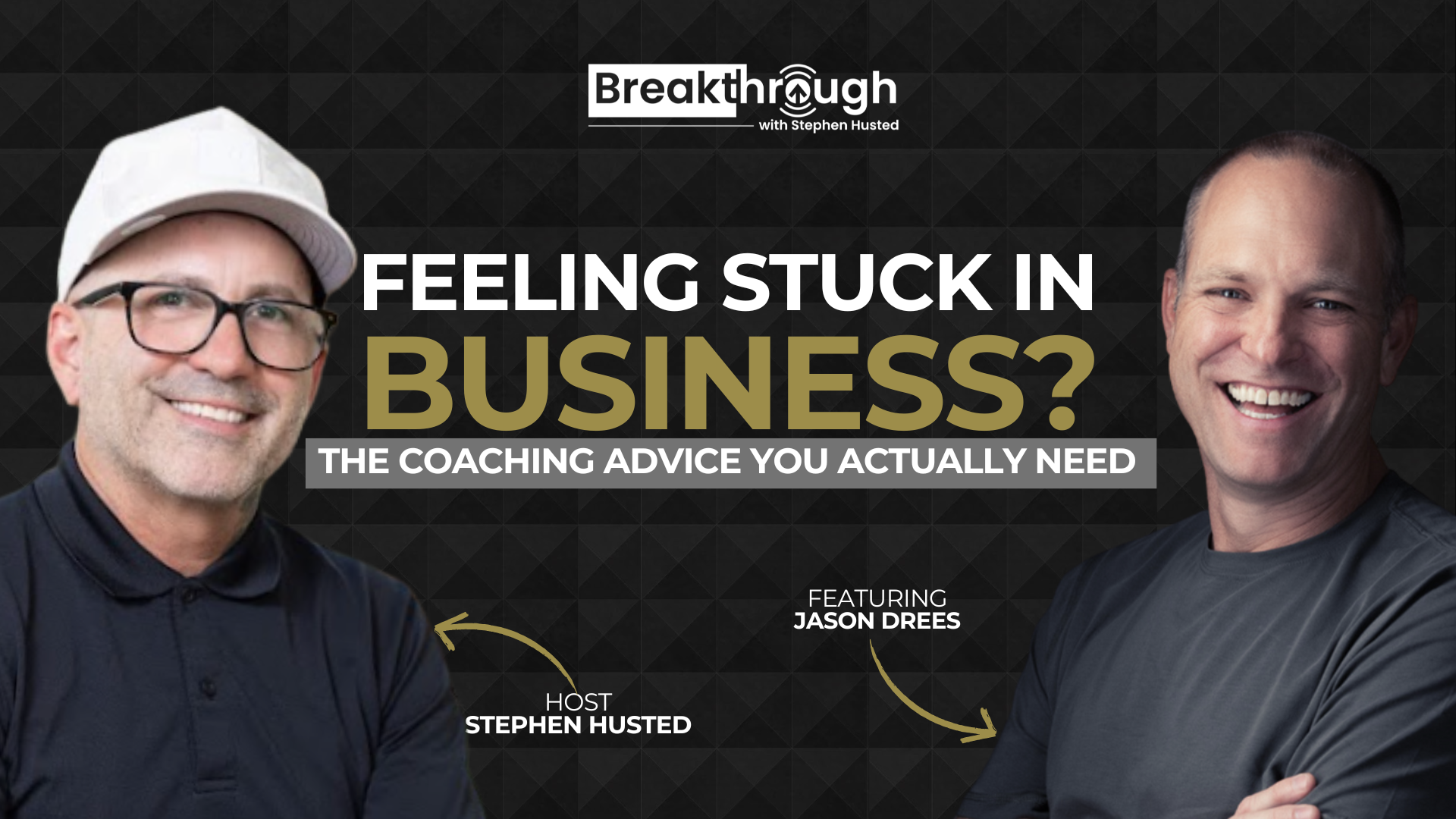
In this powerful episode, Stephen sits down with mindset performance coach Jason Drees for an unfiltered, high-impact conversation on personal transformation, entrepreneurship, and what it really means to “crush it” — even when life hits hard. From surviving layoffs with a pregnant wife to becoming the #1 coach at Tony Robbins, Jason shares how one gut-wrenching challenge (yes, involving dog food) became a defining moment in his career.
Whether you’re a real estate investor, a founder in burnout, or a high performer stuck in plateau, this episode gives you practical mindset strategies that go beyond motivation. If you’re looking to scale your business and evolve past the old version of yourself, Jason drops real coaching insights you won’t hear anywhere else.
Stephen and Jason talked about:
00:00 – Introduction and Crushing It Mindset
02:52 – The Dog Food Story: A Turning Point
03:12 – Becoming a Tony Robbins Coach
04:29 – The $2,500 Challenge and Eating Dog Food
07:32 – Achieving Success and Coaching Others
19:01 – Early Career and Speaking Skills
23:40 – Struggling with Burnout
25:10 – Effective Coaching Strategies
30:07 – Client Profiles and Common Issues
33:58 – Scaling a Coaching Business
38:17 – The Importance of Having a Coach
TRANSCRIPT
∎ Teaser / Highlighted Clip
[Jason Drees] (0:00 - 0:29)
And he said, okay, Jason, how would you feel if in 10 years, Dash is hanging out after school with his buddies in junior high, and one of his buddies asked him, Dash, why do you live with your grandma? And Dash says, oh, we live with our grandma because my dad wasn't willing to eat dog food to create financial independence. It was this gut punch of all gut punches.
He said, or do you want Dash's friend saying, how come you get to live this amazing life? Because my dad would do anything, including eating dog food.
∎ Podcast Intro:
[Stephen Husted] (0:29 - 2:15)
Brace yourself for a wild ride into the unexpected. This ain't your typical success show. I'm here talking to real folks who've been through it all, skipping the fancy business talk for authentic stories.
We're diving into childhood dreams, teenage escapades, and everything in between. No scripts, just the stories that truly mold success. Each episode takes you on a journey through those breakthrough moments that paved their way.
No fluff, just genuine stories. So whether you're chasing dreams or just love a good story, buckle up for wisdom, laughs, and the unexpected. This is the Breakthrough Podcast, where success is a journey, not just some fancy destination.
Don't miss out. Hit the subscribe button now and join our Breakthrough crew. I got some incredible stories to share, and you won't want to miss a single one.
∎ Guest Introduction:
Before we dive in, let me tell you who's joining me today. Jason Drees. Now, if you don't know him, get ready.
This guy is not your average coach. Jason's the real deal. He's worked with some of the biggest names, helped people triple their income, breakthrough plateaus, and most of all, make real mindset shifts that actually stick.
And what I love? He doesn't sugarcoat anything. He's been through the grind, startup life, layoffs, food stamps, and somehow still chose to eat a can of dog food over giving up on his vision, literally.
That's the level of commitment we're talking about here. This conversation got deep, uncomfortable, real fast, but in the best way. Let's get into it.
∎ Podcast Proper:
All right, man. We're rocking it. So for anyone that started off, the first thing I asked Jason was, how are you doing?
What was your response?
[Jason Drees] (2:16 - 2:17)
I said, I'm fucking crushing it.
[Stephen Husted] (2:18 - 2:33)
A couple of times. With authority too. Absolutely.
It's a fact. So talking about crushing it, is today different than some other days? Why did you say that right away, you're crushing it?
Because things are always different.
[Jason Drees] (2:34 - 2:37)
Things are always different, but I'm always crushing it.
[Stephen Husted] (2:37 - 2:40)
No matter the shit that's going on, you're still crushing it.
[Jason Drees] (2:40 - 2:47)
I'm still crushing it. My results change, my impact changes, my effort changes, but I always give it everything I've got.
[Stephen Husted] (2:47 - 2:50)
Okay. So the definition of crushing it can be a lot of different things.
[Jason Drees] (2:51 - 2:55)
So sometimes it can look differently, but I always play at my maximum level.
[Stephen Husted] (2:55 - 2:59)
How long did it take you and your journey to get to this point where you started thinking this through like this?
[Jason Drees] (2:59 - 3:07)
It was a culmination of things, but the biggest one was probably the dog food, eating the dog food 12 years ago. Have you heard the dog food story?
[Stephen Husted] (3:07 - 3:10)
No, but I'm picturing a visual of it.
[Jason Drees] (3:11 - 8:15)
The dog food story is what, it was a combination of working and coaching at Tony Robbins. And I can tell you the story if you'd like. Yeah, let's hear it.
So 2012, I was in tech sales, had a startup company, hired a Tony Robbins coach. And after coaching with that coach for a couple of years, I actually started in 2010. In 2012, he asked me, have you ever thought about becoming a coach?
And that question changed my life, like got struck by lightning. Six months later, early 2013, I'm in Tony Robbins coach training program. We moved from, my wife, our one son was born, she was pregnant with a second.
We moved from the Bay area to Sacramento to reduce our living expenses so my wife could say, she quit her job. And then a week after we moved there, three weeks before my second son was born, I got laid off from my tech job. At the same time, I got accepted into the Tony Robbins coach training program.
So there was excitement and also terror being broke, having another kid coming. So it took about six months of training before you actually start making money as a coach at Tony Robbins and would make it through the training. So that was like September when I started.
And I was struggling, you know, we were on literally food assistance from the state. And I was trying to build my business in the chamber of commerce while I'm trying to ramp up and earn clients at Tony Robbins. And for some reason, all those tech companies I spent 15 years working for all of a sudden stopped hiring people in the Sacramento area to work in the Bay area, which had happened.
I've seen it very commonly for 10 years. All of a sudden they weren't doing it, so I couldn't get a job. So in February 2014, I'm talking to another coach on my team and I said like, I need money.
Like I'm struggling right now. It was like, I need 2,500 bucks this week to pay rent. And he says, well, go get 2,500 bucks.
I'm like, okay, done. And then he says, okay, now record a video and post it to the Tony Robbins coaching Facebook page because the coaching team and the 120 coaches and all of the leadership team communicated through a Facebook page. At Tony Robbins, it was like a little old school, good old boy, hazing kind of environment.
So you had to earn your way to a full time. It was like you had to earn it and prove it. So I'm sitting here going, I've been coaching for less than six months and I'm afraid of putting that on there.
So he said, go post that video saying, I'm going to hit $2,500 by close of business Friday and it was Monday. And if I don't do that, I'm going to eat a can of dog food. And when he asked me that question, I like froze, like the words wouldn't come out of my mouth.
It wouldn't come out. And I'm like frozen. And he's a brilliant coach and he knew that my oldest son named Dash and he was three years old.
And he said, okay, Jason, how would you feel if in 10 years Dash is hanging out after school with his buddies in junior high? And one of his buddies asked him, Dash, why do you live with your grandma? And Dash says, oh, we live with our grandma because my dad wasn't willing to eat dog food to create financial independence.
It was this gut punch of all gut punches. He said, or do you want Dash's friends saying, how come you get to live this amazing life? Because my dad would do anything, including eating dog food.
So I said, yes. So I posted the video and then like Tuesday comes, my stomach is twisting and not Wednesday, Thursday, Friday. And on Friday I closed two clients in the exact amount of $2,500.
And they both said, it was like 4.30 PM on Friday. They said, can I pay on Monday? And I was no way going to screw up that money by forcing them to pay.
So I said, yes. So I failed the challenge. So Saturday morning, I walk into my office and at the beginning of the week, I said, can I get the dog food that looks like steak?
He goes, no, generic liver flavor out of the can, just straight. So got generic liver flavor out of the can. And right before I started eating, I walked into my office and I first thought it was a punishment.
Something shifted, something like snapped at that point. And what happened was I made a decision to eat that dog food and do something disgusting because I said so, because I fucking said so. So I proceeded to eat the dog food.
I didn't know that dog food has chunks of bones in it, so you can't chew it all the way. So you're like swallowing, chewing, and there's hard things. It was nasty.
I got about 75% down before it started to come up and I served my purpose. So I stopped. And ever since that moment, what I realized is that the stomach twisting was basically the part of me that thought it was okay to set a big target and not hit it because he'll just live in the vision of the next big goal.
That part of me died that week. So that was like February, 2014. We get to July 1st, 2014, the first half of the year is done.
The coaching director is reading off the metrics and the number one metric on the coaching team is renewals. Basically, when your client's contract ends, the percentage that buy, renew their contract, that's the highest rated metric as a coach. And at less than six months there, I was the number one coach out of 120 coaches with 100% renewal.
Then within the next six months, I'm coaching other coaches on the team. The next year, I tripled the income of every other coach on the team. And basically, that's when I realized what making a decision really was.
And that video is on YouTube if you want to watch it.
[Stephen Husted] (8:16 - 8:27)
Great. That's so wild. Do you think that the dog food scenario is really what kind of kicked you in gear?
Was that fear of having to eat it?
[Jason Drees] (8:27 - 9:23)
It was the first time in my life I made a decision to do something difficult and hard and did it anyway, regardless of the outcome, because I could basically skate my way to the top 10% of anything that I was in, work, teams, it was always easy for me. But nothing really inspired me until I became a coach and I was still trying to create more wealth for my family. But that was one of the foundational pieces that got me fully in the game.
So many people are not in the game. They're wanting to be in the game. I see this so often with real estate investors.
They're trying to analyze all the risk away. You want to play basketball because basketball's fun and you make a lot of money, so you want to play basketball. So you're standing on the sideline, ready to go in, and then the person you're going to sub for gets elbowed in the face and gets their nose broken.
And then you're like, so you're just like this doubt of getting in the game. So that really removed the option of not being in the game and that put me in the game and that changes everything.
[Stephen Husted] (9:24 - 9:35)
So speaking of going into the game, what's a pattern you see in high level individuals that you coach that puts them in the game? Is it more that they're just not afraid and they don't care about losing?
[Jason Drees] (9:36 - 10:13)
It's a decision, really. It's a decision. It's a standard.
Like, you know, I coached Brandon Turner for seven years, like eight years. Yeah. I never had a coaching call where I had to ask him if he was going to take the action.
Not once. As soon as he decided to do it, it happened. Now all the people who were on the newer end, the learning ramp of success, they're like the lacking the certainty to do the action because they want to make sure it works first.
But that's not how life works. So we end up trying to play safe and try to, but it's no, you got to start fucking swinging for the fences. You can't just sit here and wait for the perfect pitch because every time it's the perfect pitch comes in, you already missed it.
So you've got to swing the bat.
[Stephen Husted] (10:13 - 10:20)
You got to be in the shit. You got to be in it. You have to
And regardless of the outcome, you got to really fucking love the process of it.
[Jason Drees] (10:20 - 10:27)
And then you got to deal with everybody looking at you funny because you're doing, because the percentage of the population that does this is a single digit.
[Stephen Husted] (10:28 - 10:46)
Yeah. And you'll get drilled on social media, especially when you start to tell your story, so to speak, and maybe do one like inspirational post on there and people are start going, who are you? Yeah.
You know, the ones that knew you from a long time ago. Who are you? But it's really a reflection of them going, who am I?
[Jason Drees] (10:47 - 11:00)
I had a black sheep in my family. I had my brother-in-law calling me, telling me he's going to raise my family because I'm a deadbeat dad. Shit like that.
Yeah. He didn't call me though when I made like seven times when he did the next one year, you know?
[Stephen Husted] (11:00 - 11:15)
Well, it's people that change their patterns in life and go through different things. It affects everybody around them. You might not know when you're in it, but it makes them have to like rethink where they're at.
Are they happy where they're at in life?
[Jason Drees] (11:15 - 11:15)
Oh, absolutely.
[Stephen Husted] (11:16 - 11:30)
It makes them very uncomfortable, even though you want to help and you want them to be inspired to go on their journey, evolve because it's okay to evolve over time. You know, you don't need to be the same, but it's an interesting dynamic.
[Jason Drees] (11:31 - 12:47)
Yeah. Because when you start to play at the level of greatness, right? You don't start out great.
It's a path, but it's a standard. When you start to do those hard things, you start to reflect in everyone else who's not doing it. So they start to feel where they're not being great and they feel bad, right?
Because they know they should be playing at a higher level. And what actually happened, like becoming a coach was incredibly challenging for me financially, emotionally, because I wanted people to support me because I did something new. I did something difficult.
I did something challenging and I was successful. And I looked around and nobody noticed. So I kept going.
So I did the next hard thing. And when I did the next hard thing that was difficult, I achieved it. I looked around and people were like, why are you doing that?
And at those times when it's really tough and really difficult, when you're on your journey to greatness, because it brings up all your past shit you got to deal with, when you want the external acknowledgement. And the thing is you don't get it right then. You don't, as much as you want it, the time you need it the most, you never get it.
So you actually start to create that certainty and that satisfaction and that acknowledgement yourself. And then what happens, you start ignoring what everyone else thinks. And then eventually you look around and you're getting all that feedback when you no longer need it.
That's exactly how it works.
[Stephen Husted] (12:47 - 13:52)
Dude, that's so, it's wild. You say things, I remember that last podcast we did on yours and it was the most craziest timing. It was just, everything was in its right place.
That is exactly how it happened. You sent an email, Hey, come on podcast, look, free 30 minute coaching. Right?
And I'm like, well, that's cool. I'm going to jump on with Jason. And then here I'm starting my next little phase and I'm meeting with people on this team.
And they're like, they're saying all these different things. Then I'm on social media. The interesting thing about social media was I was then getting little messages from, you know, mindset people that were saying how you have to get, you need to be okay inside.
You have to work on yourself. You have to take some steps to be able to get your message out because that was what happens is you try to get your message out and you revert back to that little trauma when you're a boy. And then it roadblocks you and then you get imposter syndrome and you have all this other shit that starts to come out.
So the message, it's like short firing. You're not getting it out correctly. You're getting some of it out, but not all of it out.
[Jason Drees] (13:52 - 14:16)
It's just crazy. And the reason why the timing was right is because that's what I do. What I told you on that podcast wasn't pre-recorded or it was complete flow, right?
Yeah. So the flow that I speak from is a response to the people I'm talking to, whether it's an individual or an audience of people. I hear that all the time.
Oh my God, I needed to hear this because I always wondered where this voice comes from, but it's literally a response to the audience.
[Stephen Husted] (14:16 - 14:37)
Yeah. It was crazy. I knew it was a good exchange because I got done and I was like, I had stress sweated once again.
I knew I was uncomfortable. I was like, okay, great. Because I know when I go through those moments, there was something in there I needed to hear to move me forward in this whole thing, which was crazy.
So did you take the action after that call?
[Jason Drees] (14:38 - 14:38)
Yeah.
[Stephen Husted] (14:38 - 14:49)
We talked about it. Yes, I did. Yeah.
And I still think about it. You can have all the awareness in the world, but if you're not doing something about the awareness, it's just awareness.
[Jason Drees] (14:50 - 14:51)
Yep.
[Stephen Husted] (14:51 - 14:58)
True. I've learned that more and more and I think that the problem is when you want to open up yourself, it's uncomfortable.
[Jason Drees] (14:59 - 15:32)
Yeah. Because the growth to the next level requires the next version of you. The next version of you requires processing and integrating the old stuff that cannot exist at that level now.
So if you want to scale straight up, you have to be able to integrate. That's why most people do it at a pace like this. They don't know how to integrate that growth.
And my magic as a coach is integrating that growth. That's what my coaching really does, is it aims people at the full level of their potential. And then when all the stuff comes up, I can help them process it faster than anyone else can.
[Stephen Husted] (15:33 - 17:44)
That's a big key to it. The processing part. Yeah.
And I would say that I've been doing this, the steady, gradual, like not too fast because every time there's something fast, some of it really just makes me uncomfortable. For instance, mentorship. I didn't want to be a mentor.
Those people post videos online with Lamborghinis and people call them gurus. I don't want to be that. That's not me.
They're not authentic. So I'm going to fight this one. I'm going to fight it, fight it.
But then all of a sudden, the universe brings me these people that come to me that want guidance, but they're closer people that I've known since high school. And I see where they're at. And it gives me a lot of joy to help them step up.
But then it's like, oh, okay, so now you're going to go another level and you're going to hire a marketing agency and you're going to be a mentor. Wait a minute. Am I mentoring 40 people?
How far am I taking this? Do I really want this? Is this really me?
You know, like all these different things that it's just all this emotional stuff gets, it gets swirled around. And after I got done with you, I had my next session hour and a half with this company that we hired and it was all mindset and it was all getting healthy and all this. And it just, I was done by the end of this.
Just done. It was you first. And then they came in, just took me out.
And then a couple of days sat by and then I rethought through things and I said, you know what? I'm going to be okay. Just keep moving forward.
Stop taking myself so goddamn serious. You know what I mean? It's like, what the hell is going on here?
And then on the backside, you get that DM in Facebook or a DM in Instagram. Like, dude, you're really changing my life or, you know, thank you for posting that. Or I'm looking to do this with my business.
And then it's like, okay, you got permission to fucking do what you're supposed to be doing. Stop trying to play at this level that's safe. I think playing safe and being comfortable, let's just say the word safe, but I think safe is like reverts back to being safe as a little kid.
[Jason Drees] (17:44 - 17:50)
Oh yeah. We still have a mammalian survival mechanism, right? That's where the fear comes from.
It's being triggered.
[Stephen Husted] (17:51 - 19:02)
Yeah. I did like three sessions of hypnosis on fear. I've done hypnosis so many times since 2005.
Is it gone? I did hypnosis in 2005 for, I had just gotten clean and I was a meth addict for a very long time. So then I had a bad, you know, like addiction to sex, bad sex.
So I went to hypnosis and that lady said, well, are you afraid of, what do you fear? I don't like sharks. She's like, cool.
And she put me through that whole song and dance. And when I got done, every time I thought about a girl prostitute, I had a picture of the San Jose shark, San Jose shark, shark was on the head. So I called my girlfriend that is now my wife and I said, we solved it.
She's like, why? I'm like, I see sharks. What?
Yeah, it's all sharks. So it's worked for me on a few occasions. This last one, not so much, not so much.
You know, that's one thing I just tweak and I move on. Figure it out.
[Jason Drees] (19:02 - 19:04)
Well, you need different tools for different levels.
[Stephen Husted] (19:04 - 19:13)
I think you do. You do. So I'd like to get back to your early days.
What kind of jobs did you have growing up?
[Jason Drees] (19:14 - 20:34)
I'm curious about this. My first job was at the golf course in high school, range kid, golf car. Then I did retail high school, retail clothing.
I worked as a polo specialist at Robinson May, where I learned how to dress actually. Then I worked at Circuit City selling computers. And then I got a tech sales job at a company called Ingram Micro, which was a technology distributor, which was basically my first like real job.
Then I was in tech sales for 15 years before I became a coach. Did you like tech sales? I was good at it because I'm smart and I'm technical and I'm personable, but it paid well and I could always shape it so I could work my own hours, which was nice.
And flexibility, work from home most of the time. It was the best job I'd found so far, but it wasn't really satisfying. But really what it was, I was doing from like 2005 to 2013, I was doing product demonstrations like for businesses.
So I would be carrying my equipment around and presenting to small teams, big teams, and just over and over again. Looking back now, I realized that was the beginning of my speaking career. All that work I did, I learned how to speak, I learned how to control the room, I learned how to connect with everybody in the room, to influence the room
And it's the exact stuff that I use today as a coach when I'm speaking at events. But that was the early days of it.
[Stephen Husted] (20:35 - 20:40)
How did you, did you like speaking? Was that something you felt like you were confident about doing?
[Jason Drees] (20:41 - 20:46)
Yeah, I was never really nervous public speaking. A couple of times with some of my bigger events, the first few times it was, but I don't really get nervous anymore.
[Stephen Husted] (20:47 - 21:19)
Yeah, those, I've done a few and I'm scared. They just unraveled. And a lot of it, I have, I got really bad anxiety.
Some always wound up. I mean, just to do this podcast, I went on a two mile run before it. It just calms me down so I can focus talking to you.
But you can move past that anxiety. Yeah. Yeah.
Permanently. You definitely need to. Yeah.
What do you mean by I can move through it? Just like holistically or? Well, part of the way you said it kind of sounds like an identity.
Is it an identity? That's a good question.
[Jason Drees] (21:20 - 21:29)
Like labeling it as a crutch, you mean? Yeah. We have to move past the old identity.
You move past the identity of an addict. Yeah. Now you have the next identity to move past.
[Stephen Husted] (21:30 - 22:16)
Like just get rid of the whole anxiety thing and say, screw it, the anxiety's not there. Yeah. Yeah.
Yeah. I think that one's more fresh because my wife works at Apple, so I went to Apple Wellness and was looking to get diagnosed, get on medication, felt like I needed something. And he put me through a test.
He's like, hey, good news. You don't have ADHD. I'm like, okay, cool.
And he's all, yeah, you got high level anxiety. I'm like, what? What's that?
He's like, yeah, it's kind of similar, but you probably got it when you were younger, you know, had trauma or something and it streamlines. I'm like, so let me put you on medication. I'm like, all right.
And took some medication, was at a stoplight and thought about just hanging myself. I called my wife. I think I'm going to get off this one.
She's like, really? I'm like, yeah, I just pictured, had a visual of me hanging myself.
[Jason Drees] (22:17 - 22:21)
It's surprising how much of people's lives can be shaped by a diagnosis that took five minutes.
[Stephen Husted] (22:22 - 23:14)
Yeah. It was crazy. But you want to hear something crazy about the whole interaction.
So he's like, hey, I need you to have a good, healthy diet. He didn't know anything about fitness that what I did. If you can work out, I'm like, oh, well, I'm a semi-pro mountain biker and I just started running.
What's running do? Because I had started running and just caught onto the whole runner's high. Right.
And that's a thing. Real. That's a real thing.
And he like stepped back and was like, if I could package running into a pill, I can cure ADHD, anxiety, PTSD, all in one. It's food for the brain. He's like, so I would highly say to keep running.
So I just ran, got off the meds and stopped altogether. Yeah. I only did it for a week and it was, it's never worked out personally, though.
Try other ways.
[Jason Drees] (23:14 - 23:50)
Yeah. Right. Yeah.
Yeah. Because I don't believe any of those medical permanent diagnosis isn't correct. I just don't.
Like I believe our bodies are so powerful and everything can heal, you know, and you, what you call ADHD is just an ability to have a hyper focus, which is actually a superpower at certain times. And every superpower, every superhero has a weakness. Totally.
That's true. So one of my kids has ADHD, but he's going to be really fucking successful because he can focus like a madman. Yeah.
Until burnout. Well, yeah. How's that any different than anybody else?
You know. Do you think so? Yeah.
I struggle with burnout because I focus intently and obsess over things.
[Stephen Husted] (23:50 - 23:54)
Do you think it's a common thing between entrepreneurs or do you think that's across the board humans?
[Jason Drees] (23:55 - 24:02)
The great ones. Yeah. Yeah.
Getting into balance and taking care of yourself and not being in burnout. That's the afterthought. That's phase two.
[Stephen Husted] (24:03 - 25:04)
Yeah. The mindfulness. And you'll, you know when the time's right because you just start to dwell on it.
Yeah. I know that was one thing that I got from this lady from this marketing agency and she told me, I want you to work for three hours straight because what you do in three hours is what most people do in eight. And then I want you to step away, I want you to go on a walk, I want you to go in the mountains, I want you to do some exercise.
Once again, another person who doesn't know my backstory. And I was like, okay. She's like, because you'll tend to just keep going and honestly, you'll move the needle more in three hours than you're going to move and doing it prolonged throughout your day and stop the busy, the to-do list, busy stuff, and focus on what's the most important things in your business that really makes you happy and that is creative, that will move that needle and help others.
Everything else you need is an afterthought. Yeah. She was nailing it.
A hundred percent. I was going through all this. Yeah.
This was all from starting from our podcast to this.
[Jason Drees] (25:06 - 25:07)
So it sounds like you need the next goal.
[Stephen Husted] (25:07 - 25:27)
Yeah, I think so. God damn. Yeah.
Yeah. Everything in its right place. That's what I call it.
Yeah. That's awesome. This whole coaching scenario.
Did you think you were going to be a good coach and did you find passion in it or did you think you were getting into it? It was a money thing. Break that down.
I want to understand that part.
[Jason Drees] (25:28 - 26:44)
It was like a lightning bolt hit me that was like, oh my God, I'm going to be a coach. First time I was ever really excited to learn something. That's cool.
And I didn't really think about being a great coach or making money actually. I was really just, I'm excited and I think I'm going to love doing this. And I get a lot of people asking me like, it must be great to like help all those people and get all that acknowledgement.
And it is, but I don't really coach to get that acknowledgement. I coach because I really enjoy operating in what I call a level of mastery. And that's what I enjoy doing.
As it continues to evolve, I've been coaching like 12 years now. So that's, it's just, even if I had a billion dollars, I'd still coach. That's what I'm here for.
There's a lot of times I wish I could coach myself because I can move clients faster through stuff than I can do on my own. But my gift really doesn't apply to me that way because what I've realized is that my ability to do that comes from living all the life that I have lived and all the challenges and the obstacles I have and the things I've been through is that's what creates my wisdom and the coaching content that comes out of me. So I live it.
And then I can compress that to other people and just transform them. Like literally, I have a person who's had a fear or phobia their entire life. One call with me, it's gone.
[Stephen Husted] (26:44 - 26:44)
How has it gone?
[Jason Drees] (26:45 - 27:21)
So is it the awareness comes, what do you think is shifting? I elevate people to a higher state of consciousness. And from a higher level of consciousness, you can very easily change anything in your mindset.
Just like swapping out pieces. So it's literally you can rewrite your reality just, but you have to be in that elevated state of ownership. And my magical gift is that when I'm talking to people, I hold like this frequency in the call or in the room that allows people to easily do that.
I don't know how I do it. Like I can't, I've tried to teach the coaches on my team and none of them can do it. It's just, it's my gift.
[Stephen Husted] (27:21 - 27:26)
Do you think that all coaches have their own little gift? They do. They do.
Yeah.
[Jason Drees] (27:26 - 27:48)
What it really looks like is I unlock people from all their past limitations, fears, and doubts and future limitations, fears, and doubts. So they can be the fullest version of themselves. That's what I really do.
And I do it very quickly. Most clients don't even need to work with me longer than 90 days. It's usually a 90 day, boom, transformed, you're unlocked.
You're unlocked. Yep.
[Stephen Husted] (27:49 - 27:50)
That's crazy.
[Jason Drees] (27:50 - 27:55)
Now they may call me in six months because they're locked up again, but that's just part of the process. There's always another level. Always.
[Stephen Husted] (27:56 - 28:01)
Yeah. There's somewhere else they want to go. And so it's like, they need to kind of reframe that and move through it.
[Jason Drees] (28:02 - 28:05)
Yeah. Because there's always another level. Always, always, always, always.
[Stephen Husted] (28:06 - 28:29)
Yeah. That's another thing that lady had said to me. She's like, you're in your second, you're in your next one.
That's why nothing makes sense right now. And it's uncomfortable. And there's a lot of things moving around and a lot of emotion up and down is because of that.
Yep. You know? Cool.
So a lot of the things you were taught through Tony Robbins, is that still something that you plays into how you coach people today?
[Jason Drees] (28:29 - 29:36)
I still use like the coaching structure and the coaching skills that I use on how to coach, create rapport, connect, things like that. Like those are the fundamental coaching. There's the foundation of how I coach, right?
Whichever school of methodology, I don't follow his coaching. Like I don't use his call syntax anymore. I don't use this.
I'd say I probably use 5% of what I learned there compared to a lot of the other coaches I've seen move on who basically regurgitate his content. Like 95% of my content is new. There's a few things, like some of the decision-making stuff I use, I'll pull his stuff.
Occasionally, if I get a client who's in a massive amount of trauma, which I actually don't get too often, I actually wish I got more of those. I mostly just get the entourage of people that want to make money because I actually really like helping people like that. But if there are times if a person's in like a state of reaction or trauma, then my tools don't work because they can't get to that level.
So you have to use like a more physiological-based tool like Triad and things like that. And I've done like that probably twice in the past two years, you know. But for the majority of the stuff, I'm not using any of his content.
[Stephen Husted] (29:37 - 29:42)
How do you determine that they have the trauma piece? Is it just a first consultation and you can kind of feel it?
[Jason Drees] (29:43 - 30:13)
Well, the tools I run with them don't work. They can't do them. Because really, it's the state of elevated consciousness that I bring people to is really a state of ownership.
And it's like an ownership of everything in your reality. And someone in trauma can't take ownership and is still in a reactionary phase of something that happened. Life is overwhelming, they can't take ownership of it.
Yeah, that's a whole different level. You try to ask him to say the statement, I take full ownership of my life and everything in it, and they literally can't say it. Then you gotta use a different tool, yeah.
[Stephen Husted] (30:13 - 30:21)
What does your typical client look like? And what are they going through? Do they all have very similar issues that over the years?
[Jason Drees] (30:21 - 32:10)
Yeah, there's basically six reasons. Let's see, what are those six reasons? Most people, my ideal client or my common client is usually making at least $300,000 a year.
At least the ones that work with me directly, and 500 or more is usually where I focus as the seven figure earners and up. Because my magic is accelerating those who are already great. Any coach can get you started, but that's my gift is the acceleration.
Most people come to me to make more money, or to get more done in less time, add leverage, or they don't know which direction to go, or they're trying to shorten their time to get goals, or they're completely lost, or they're stuck, or they've plateaued. I see that a lot where people have made money, got comfortable, and they plateau, and then they can't get to the next level. Interesting.
Those are the most common, yeah. Pretty much everybody signs up is money, but I coach every area of their life. They're signing up for money, but I coach them in every area.
Money is just one part of it. It's just one part, but very few people will walk through the door that says, hey, feel better about yourself. I'll break the door next to it that says, make more money.
Do both. Yeah, that's why I sneak that stuff in. I do that a lot of times.
I'll sneak in. While I'm helping them fix their business, I'll get them aligned with themself, and I'll sneak it into repeat after me statements when they're not expecting it. Like, not good enough and things like that, because everyone has to deal with not feeling not good enough.
It's like the core human condition. Is that a big one? Yeah.
It's the biggest one everyone has. It's the root of every limiting belief. Every limiting belief will eventually get to, I'm not good enough.
As Tony Robbins said, we're not good enough, and we won't be loved. He says those are the two greatest fears. It always comes down to those.
Everybody tries to get rid of those, but it's not like you get rid of those. It's like you make peace with those, because they're never going away. Not until we're fully integrated, unwinded, enlightened to ego, which none of us are at this point.
[Stephen Husted] (32:10 - 32:29)
The not good enough one is an easy one to fall into. Just simply, if you're on social media and you follow top, anybody top in the industry you're in or whatever's going on, you're going to feel that directly, or no, I'll take that back. You might be feeling that indirectly, which is probably even worse.
[Jason Drees] (32:29 - 32:30)
Yeah.
[Stephen Husted] (32:30 - 32:40)
Like it's easy to go, oh, I mean, I go through it all the time. That person delivered that video on some type of investment strategy, and God, they said it really good. I would never say it like that.
I wouldn't be able to pull that off.
[Jason Drees] (32:40 - 32:49)
Why people aren't in the game. Yeah. That's their excuse.
I need to fix that first, but it's like, no, getting in the game is how you fix it.
[Stephen Husted] (32:49 - 34:14)
Well, yes, but I think also too, what I've learned, which is great, is maybe that person can deliver it that way, but my superpower is over here doing it this way. And I think that's a good approach to it because you can't sit around comparing yourself to everybody out there. It's not good.
And especially when you hear it from, I don't want to call them big influencers, but you know what I'm saying, people online, I love hearing them talk, whether they write a thread and put it out on there. And a lot of them are just the shit they've gone through. It's something that they were thinking about in the shower and then wrote it down and put it out there.
A lot of these issues haven't been solved. They're just putting it out to the universe. It's the way to get it out and get it resolved is just getting it off your chest.
I think when you can really approach everything that's going on in your life head on, you make big progress. That's just the reality of it. Is this comfortable?
It's going to uncomfortable as it is. It definitely feels good down the road when you've gone through some of them, for sure. I don't want to ever feel like I've solved life.
It doesn't make sense to me. Yeah. That's not it.
So you're a coach, but you run a business too. So how's that been to scale a business? Because you went like during COVID.
[Jason Drees] (34:15 - 34:15)
Yeah.
[Stephen Husted] (34:15 - 34:32)
You went through some shit during that. I know you did. You had to have.
Yeah. I hate running the business. I know.
That's the part that sucks. It's like a bunch of puzzles you have to solve. You're like, wait, can I just coach and everybody just follow what's supposed to be going on and let's just move along?
[Jason Drees] (34:33 - 34:44)
Yeah. Because the majority of my time over the past four years has not been coaching. It's been running the business.
So I'm actually focused on getting more back to that and streamlining things and simplifying because it just got way too complex.
[Stephen Husted] (34:44 - 34:46)
And how? How did it get complex?
[Jason Drees] (34:46 - 35:20)
Too big? Too fast? Just too many different programs and trying to juggle all these things.
And I spent a lot of time trying to grow the clients for my coaching team instead of trying to grow the clients for myself. People who coach with me and people who coach with my client, my coaching team, that's two different businesses. They're two different things.
By doing both, I'm not doing either one great. So I'm really trying to focus more back on, oh, I'm focusing more now back on just Jason Dries coaching as me. The team, that's something else.
Yeah. I'm probably going to be rebranding it with a different name. Yeah, that's cool.
[Stephen Husted] (35:20 - 35:23)
And then you know what? That's the whole discovery of it, right?
[Jason Drees] (35:23 - 35:23)
Yeah.
[Stephen Husted] (35:24 - 36:03)
And you know, that's interesting you bring that up. That's a thought that I have because this team is explaining me the backend and like, hey, you'll have like a sales coach that will make calls to your potential mentees. And I'm like, well, how am I mentoring all these people all at one time?
And then who's below me to do that? And then how to, you know, because I give a lot to the ones who I do mentor and I talk to them on a daily, weekly, sometimes a daily basis, some of them, how am I going to do that? How am I going to provide that same kind of value?
And I have all these weird thoughts about that. Where's this all go? It's an interesting pattern.
[Jason Drees] (36:04 - 36:07)
Yeah. If it didn't have to scale, what you'd be doing is just fine.
[Stephen Husted] (36:08 - 36:18)
That is true. That is true. Yeah.
Sometimes I wonder if I do have these thoughts sometimes. I mean, just doing all these things because it's who I follow that do these things. Do you know what I mean?
[Jason Drees] (36:19 - 36:22)
Yeah. If you're doing what everyone else says you should do, you're following your conditioning.
[Stephen Husted] (36:22 - 36:51)
I always go the opposite direction of most in a lot of different things, probably, and it hurts me in the long run. If you're a real estate investor and you start shooting content, starting a podcast, it's pretty in line with what most people are doing. And I actually enjoy, I love doing podcasts.
I do have that thought too. Is this the path or is there a different path that I can back myself personally that doesn't feel like everybody else's? You know what I mean?
There is, yeah. It's inside you.
[Jason Drees] (36:51 - 36:51)
It's one of your voices.
[Stephen Husted] (36:52 - 37:09)
Yeah. It was funny. I was talking to this lady about when she was like, well, we're going to frame some way.
We're going to put out content. And I said, yeah, let's make one that's more like, let's make some funny content that it's like, instead of the Lambo, can I have like a beat up car? Can we just mock that whole setup?
[Jason Drees] (37:10 - 37:10)
Yeah.
[Stephen Husted] (37:10 - 37:57)
Can we just mock that? Because I'm already successful. I don't need to show it.
I don't. Maybe some people need that to like, you've got to have that Lamborghini or whatever that is to attract those people. But she was laughing.
She's like, whatever you want to script up, you know, we can get in front of you. I'm like, okay. Yeah.
Life's a trip, huh? Especially when you're doing around a lot of people run your own business. There's so many moving parts and different things you have to think about on a daily basis.
Look at what you're going through. You scaled up. You went through your pain points.
You want to get back to your roots where you know you, you can succeed. Even more probably gives you more purpose, right? Enjoy it more.
This is how it is. It's not just about selling real estate and buying real estate or coaching. There's a bigger picture.
And hopefully at the end of this, all these learning lessons move people.
[Jason Drees] (37:58 - 37:58)
Yep.
[Stephen Husted] (37:59 - 38:23)
Awesome. I just want to know why that email came through. Yeah.
I'm like that. I'm like that, Jason. I take things like that.
I call it signs. It is. But I told my assistant, did you see that email from Jason?
She's like, well, I did. She's like, didn't you get coached by him? I go, I didn't get coached by Jason.
It was one of his team members.
[Jason Drees] (38:23 - 38:23)
Yeah.
[Stephen Husted] (38:23 - 38:59)
Speaking of getting coached, coaching, that was my first coaching that I've ever had. Here's what I learned from it. This is my takeaway.
Not that we became friends. I can't even remember the name of my coach, but there was also COVID. So there was a lot of things going on.
I don't need a friend. I don't need a friend. I need someone to just drill the shit.
Yep. Reframe it. I don't need a rah-rah cheerleader.
I don't need that. But I do need a coach, a mentor. I don't have anybody.
Why am I gone this long?
[Jason Drees] (38:59 - 39:01)
You should get a coach. You need a coach now too.
[Stephen Husted] (39:01 - 39:05)
I know. I know. Well, that was something else that was said by them.
[Jason Drees] (39:05 - 39:06)
Yeah.
[Stephen Husted] (39:06 - 39:14)
They said that to me. You said it first. And then I got up an hour later and had an hour and a half.
I had four Zooms that day. I was done.
[Jason Drees] (39:14 - 39:14)
Yeah.
[Stephen Husted] (39:16 - 39:17)
With the messaging.
[Jason Drees] (39:17 - 39:18)
Mm-hmm.
[Stephen Husted] (39:18 - 39:33)
That messaging, you're going to take it and run with it? Or are you going to put it in the back of your mind and think about it, not do it, and then feel like shit because you keep not ... Right?
I appreciate you jumping on today, by the way. Yeah. Yeah.
Where can the audience find you?
[Jason Drees] (39:33 - 39:47)
Jason Dreese Coaching is the simplest way. Also, check out YouTube, Jason Dreese Coaching. YouTube is the magic spot.
Yep. YouTube is the magic spot. Also, my book, Do the Impossible.
And my next book, the goal is to ... I'm going to release that this year. Second book.
[Stephen Husted] (39:47 - 39:56)
Good for you, man. Yeah. I appreciate your time.
Yeah. Thanks for jumping on. Yeah.
Maybe you'll get an email from me. Maybe you will. Maybe I will.
[Jason Drees] (39:56 - 40:07)
Actually, I got your number. I wonder why am I getting this email? Actually, email is probably the worst way.
I'm basically about done with email. I'm just like ... It's just ...
I agree with you. I don't look at mine anymore.
[Stephen Husted] (40:07 - 40:08)
It's so terrible.
[Jason Drees] (40:08 - 40:15)
It's like I can't even ... I don't even ... I got your number.
Text me if you want me to respond. Let's just say it that way. Okay?
[Stephen Husted] (40:16 - 40:53)
Thanks a lot, Jason. Awesome, brother. I'll be talking to you soon.
You have a great day. Thanks for the conversation. You keep crushing it.
All right, brother? Awesome to talk to you, man. All right.
Thanks. See you, brother. Bye.
Bye.
∎ Podcast Outro:
Thank you for tuning into our show, where we hope you found inspiration and gained valuable insights. If you enjoyed this conversation and want to stay updated on our latest episodes, be sure to subscribe to our podcast and share it with others who might benefit from it.
We appreciate your support and look forward to bringing you more candid conversations and breakthrough moments in the future. Until next time, take care and keep exploring new ideas and strategies.