Episode 52 - Real Estate Development: Multi-family Strategies, and ADU Consulting with Stephanie Gutierrez
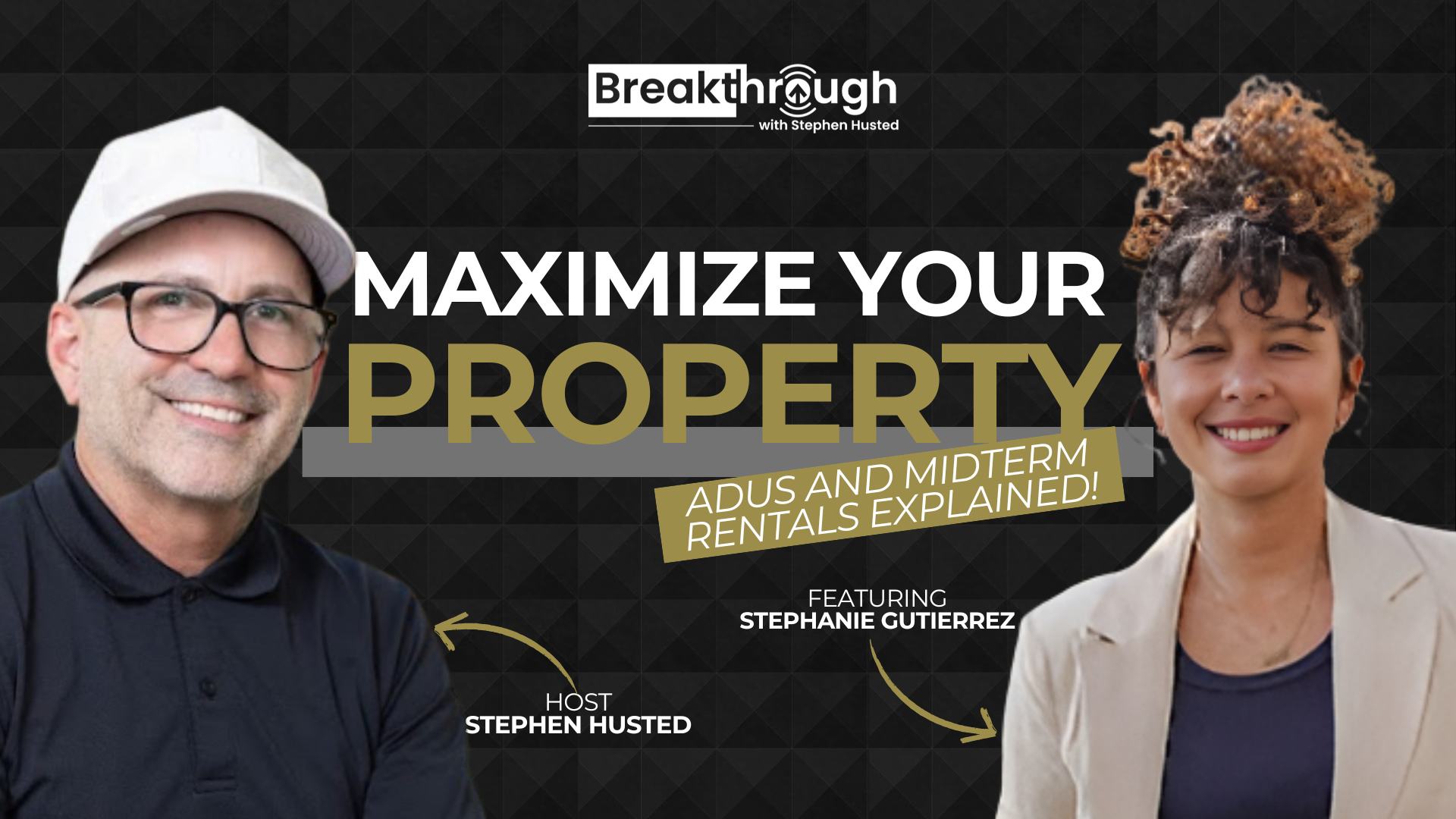
In this episode, we sit down with Stephanie to discuss the current trends in real estate, including the optimal length for podcasts, the benefits of shorter, straight-to-the-point episodes, and how tools like Blinkist are changing the way we consume information. Stephanie shares her extensive 15-year journey in real estate that began as a receptionist and evolved into managing teams and property management. She now focuses on ADU (Accessory Dwelling Unit) consulting and multi-family investments, especially in California and Florida. This episode is packed with insights and practical advice for anyone involved in or considering a career in real estate development, investment, or property management.
Stephen and Stephanie talked about:
00:00 Introduction
03:40 Real Estate Journey and Experience
10:02 ADU and Midterm Rental Strategies
15:23 Financing and Creative Solutions
17:11 Multifamily Opportunities and Legislation
31:09 Equity Partnerships and Strategic Management
32:02 The Creative Potential of ADUs
35:02 Challenges and Considerations in ADU Development
37:40 The Importance of Trust and Knowledge in Real Estate
48:45 The Evolution and Future of ADUs
TRANSCRIPT
∎ Teaser / Highlighted Clip
[STEPHANIE GUTIERREZ] (0:00 - 0:34)
And what I like to say is an ADU strategist, because we don't just consult. I'm not just going to sit here and reference the code and tell you what you can build, but I'm also looking at every angle. What's the ROI on that ADU?
What are rents going for? What is a potential ARV going to be? You know, what's a better place?
Should it be long-term or mid-term? Well, what's the cost? What's the time frame?
We're looking at everything. What's your loan balance going to be versus your rent? I do a full-on analysis.
I'm not just telling you, yes, you can build up to 1,200 square feet. And this is what the law says.
∎ Podcast Intro:
[Stephen Husted] (0:35 - 2:37)
Brace yourself for a wild ride into the unexpected. This ain't your typical success show. I'm here talking to real folks who've been through it all, skipping the fancy business talk for authentic stories.
We're diving into childhood dreams, teenage escapades, and everything in between. No scripts, just the stories that truly mold success. Each episode takes you on a journey through those breakthrough moments that paved their way.
No fluff, just genuine stories. So whether you're chasing dreams or just love a good story, buckle up for wisdom, laughs, and the unexpected. This is The Breakthrough Podcast, where success is a journey, not just some fancy destination.
Don't miss out. Hit the subscribe button now and join our breakthrough crew. I got some incredible stories to share, and you won't want to miss a single one.
∎ Guest Introduction:
Today's guest is someone I've been wanting to sit down with for a minute, Stephanie Gutierrez. She's a licensed therapist, a coach, and honestly, just one of those people who gets it. Not because she read about it in a book, but because she's lived through it.
Grief, transitions, identity shifts, all the messy real-life stuff that most people avoid talking about. Stephanie goes there. In this episode, we unpack what it looks like to hold space for yourself when you're used to holding it for everyone else.
We talk about grief, not just in the lost sense, but the kind that comes when your life changes and you're not quite sure who you are anymore. It's raw, it's real, and I know it's going to speak to a lot of you. Let's dive in
∎ Podcast Proper:
Cool. Stephanie, how are you?
I'm great. How are you?
I'm doing good. Well, it's funny, I get a guest on, and we usually are having this intro before we go live.
It's always something that's pretty important. Actually, it's a topic that typically we're going through in our businesses. We started talking about the length of a podcast because my thought process has been changing recently based on how I watch and listen to podcasts.
[STEPHANIE GUTIERREZ] (2:37 - 2:38)
Exactly.
[Stephen Husted] (2:38 - 3:14)
I don't think I ever do an hour anymore. I'll do 20 minutes here, and then I'll go back to it, and I'll go back and get things. But then, I think what's changed, my whole outlook is I have a blink list.
Do you know what that is? Yes. Yeah.
Now, I'm addicted to blink lists because I get 20 minutes, I get exactly what I need out of that book in an audio form, and I move on with my day. Exactly. Yeah.
Do you think that's a good way to go with podcasts now is to try to set the expectations of 20, 30 minutes, maybe 45, an hour if it's just flowing? Do you think that it really matters this day or what do you think?
[STEPHANIE GUTIERREZ] (3:14 - 3:29)
Yeah. I honestly think that shorter podcasts that get straight to the point and really give knowledge and valuable information, it shouldn't take more than 20 to 30 minutes to really talk about a specific conversation or topic, right?
[Stephen Husted] (3:29 - 3:29)
Yeah.
[STEPHANIE GUTIERREZ] (3:30 - 4:42)
Like I told you offline, I used to do my episodes for over an hour, and I just found myself not enjoying it as much and trying to come up with topics to fill in the conversations for the next 30 minutes. And I find that typically within the first 20 minutes, I mean, I actually got this idea. I was on Brandon Turner's podcast, and I was on his Cashflow Fridays episode, and it's 20 minutes straight to the point.
I mean, he was drilling me with questions, but I liked the style of it. It's 20 minutes straight to point talking about a specific strategy that works, and I think that's a lot more valuable, and people will actually listen to it because I'm like you. I listen to a lot of podcasts, and I usually go for those 20 to 40-minute episodes.
Anything more than that, I just don't have the time or I find myself doing something else and coming back to that episode. But to each their own, some conversations can take up to an hour, but it really just depends on the flow of the conversation. So I'm looking forward to today's.
I like the fact that you skipped the intro already, and you get straight to it.
[Stephen Husted] (4:43 - 5:41)
It's like a modeling of Joe Rogan. He just started off casually in conversation, and I've always treated the podcast that way. I don't prep any questions.
I get a little bit of a background on my guests, and that's it. And then the rest is I just let it go. And I also give my guests an opportunity like, look, I know you're on a lot of podcasts.
I don't want you to have to regurgitate a bunch of information over and over. I don't know if that's really very valuable. So I try to go in other directions, but the shorter scenario, I think it's easier too to just give it, especially if you title it correctly, and you're telling them this is what you're going to get in these 20 minutes.
This is what you're going to learn. Have at it, and then move on. Exactly.
Move on with your day. Move on. So let's get into it.
So we have some things in common. You do, you're here, you're based in, are you based in California? Yes.
Okay. But you work in real estate throughout the United States for the most part.
[STEPHANIE GUTIERREZ] (5:42 - 5:46)
Yeah. Mainly California and Florida. Coastal living, by coastal.
[Stephen Husted] (5:47 - 5:52)
Yeah. And so give me a little background on your real estate journey from the very beginning to where you are right now.
[STEPHANIE GUTIERREZ] (5:52 - 7:20)
Yeah. So I've been in real estate for over 15 years. I started off as a receptionist at a century 21 office in South Bay.
For those people who are familiar with Southern California, it's a local beach town. I started off there and then eventually started managing that real estate office to then managing real estate teams in Palm Springs, and then doing some property management there. In 2017, I got divorced and then moved back to LA area and started actually selling real estate.
Up until that point, I was more in a management position, behind the scenes managing teams, but always involved in the real estate field. Once I got licensed, I was working with a lot of investors. And eventually in 20, I want to say 2019, 2020 is when I really started taking on this ADU consultant role, which is a huge niche within the SoCal space when it comes to real estate investing, because it's really hard to cashflow in Southern California unless you have a strategy where you're building more homes on existing lots or existing property.
So I started taking that on and then got into midterm rental management as well. So kind of been in every aspect of real estate for the last 15 years. It's all I know.
I breathe real estate and I really enjoy helping others.
[Stephen Husted] (7:21 - 7:36)
We have a very similar background. Nice. What you really do, which is really cool.
I mean, I started off as a realtor and then got into investing, midterms, now into... I'm not doing ADUs, but I'm doing DadUs.
[STEPHANIE GUTIERREZ] (7:37 - 7:38)
There you go.
[Stephen Husted] (7:38 - 7:41)
I'm doing the Seattle play. It's the same thing.
[STEPHANIE GUTIERREZ] (7:41 - 8:14)
It's the same exact thing. And a lot of the things that we're adopting in California, it comes from people that have already implemented ADUs in Seattle and now being able to sell them off if cities opt into it. We're getting that from Seattle and Washington, right?
You guys have been doing it already. So yeah, I love that. I mean, so you know exactly where real estate takes you.
There's so many different avenues that you can take. I think you just need to pick one, hone in on it, and really focus on that specific strategy.
[Stephen Husted] (8:15 - 8:27)
That's the key point right there, is to pick something and really focus. It's really easy if you're on social media and you follow all these top investors, you're not going to know what direction to go.
[STEPHANIE GUTIERREZ] (8:27 - 8:32)
You're going to want to do it all. You're going to want to do probates, you're going to want to do the cash flow.
[Stephen Husted] (8:32 - 8:32)
Sub two.
[STEPHANIE GUTIERREZ] (8:33 - 8:40)
Sub two, all of that. And it's like, they all work, but you got to pick one. You can't do all of them, unfortunately.
[Stephen Husted] (8:41 - 9:04)
No. I mean, you can pick a strategy and work through it for a few years and then go, okay, you know what? I got this running.
Now I'm kind of want to look into this. It's okay to pivot at different points. And it's okay to also let go of a strategy.
1000%. That's another thing. I've said this on a couple episodes.
I'm done doing short-term rentals. I'm done.
[STEPHANIE GUTIERREZ] (9:05 - 9:58)
Yeah. I think a lot of people are done doing it because it's tough. Short-term rentals are not easy and a lot of local cities are banning them.
And the future for short-term rentals isn't looking that great, which is why I never really got into short-term rentals. But when I saw midterm rentals, I was like, okay, this is the one. Because I do a lot of long-term rental management as well.
So comparing long-term to midterm, I still favor midterm. But people also have to consider with midterm, even, you got to consider furnishing costs. You got to consider the overhead.
It's not as passive as people make it seem. Maybe compared to short term it is, but you're still very actively involved in the hospitality business versus long-term. It's very black and white and you're a landlord, but you should care about your tenants as well, even in the long-term space.
[Stephen Husted] (9:59 - 10:40)
Yes, definitely. I know for the midterm scenario, one thing is the tricky part is managing your calendar correctly. Right.
That's a big thing that you can fall into little scenarios where the seasonality of something and the location and your property could sit for a couple of months. You have to factor those things in. Every market is different.
I'm okay with keeping the midterm scenario. That I started in 2015 and that's okay. Back then it was just fully furnished rentals, like executive rentals.
I think that when I started getting into the daddoo play, I just wanted to hyper-focus and I didn't want to deal with a Sunday morning call that Keurig went out.
[STEPHANIE GUTIERREZ] (10:41 - 10:42)
Right, right. Exactly.
[Stephen Husted] (10:43 - 10:44)
You just have to focus on your strategy.
[STEPHANIE GUTIERREZ] (10:44 - 10:49)
The daddoos that you have, are they all midterm or long-term and midterm?
[Stephen Husted] (10:51 - 10:54)
This whole Seattle play has just started a year ago.
[STEPHANIE GUTIERREZ] (10:55 - 10:55)
Okay.
[Stephen Husted] (10:55 - 11:10)
We're basically in right now, we are taking the main house and then building out the basement, stabilizing the house, in planning on the daddoos, but we have six in planning.
[STEPHANIE GUTIERREZ] (11:11 - 11:12)
Okay, nice.
[Stephen Husted] (11:12 - 11:29)
Right now. We're almost got permits on a couple of them. They're going to start building.
We're just starting that journey. We're excited. I would love to do it here in California.
I'd love to do it in San Diego. What are you super excited about right now with ADUs?
[STEPHANIE GUTIERREZ] (11:30 - 13:44)
I would say obviously the ADU MTR strategy is a big one. I currently have eight units in Hermosa Beach. It's a combination of duplexes with ADUs and so far they're doing great because they're very close to Altadena and Pacific Palisades, where we recently had the fires.
You've got a lot of people that do need somewhat long-term housing, but not actually long-term, long-term, three to six months, six to nine months. Even with that, the people that have been affected is one thing, but you also have a lot of contractors coming in and people just wanting to help. They also need housing.
The ADU MTR strategy is one that I'm very excited for. I feel like that's the one that makes the most sense in Southern California if you're wanting the cash flow. If you don't care too much about cash flow, then you're banking on appreciation only.
That's fine too. That's in the residential space. In multifamily, there's a new legislation that just passed.
It's called SB 1211. What that allows you to do, it allows you to go from what used to be two detached ADUs with multifamily up to eight. You can have an eight unit.
If you have enough, let's say, detached garages or carport spaces or clear space, enough to build another ADUs on that eight unit, you can, but they have to be detached. That's something to keep in mind, but you can have a fourplex. If there's enough space to add another four back there, you can.
I'm really excited for that one. That's the one I'm focusing on this year, is SB 1211. Finding a duplex, a fourplex, six unit, up to eight or even 20.
You could have a 20 unit, a 30 unit, and add up to eight detached. People are doing it at scale. I have a friend up in the Bay Area who's doing about 40 ADUs on a 300 unit building because it's five different parcels.
You're allowed to do eight per parcel. It's so crazy. Crazy, right?
[Stephen Husted] (13:45 - 13:46)
Yeah, they're getting that density going.
[STEPHANIE GUTIERREZ] (13:47 - 14:23)
Exactly, but the space is there and we need it. You can underwrite for long-term rents as you should, but if the midterm is a strategy, even better. That's one that we're keeping an eye on here in California.
SB 9 is also another strategy. As you know, with SB 9, you can subdivide your lot and then add another ADU to it, but it is lengthier and it does cost a lot more, so that's for a more type of long-term investor who's okay with going through that process.
[Stephen Husted] (14:23 - 14:28)
What got you excited on the first one? What was that light bulb moment? I've had them too.
[STEPHANIE GUTIERREZ] (14:29 - 16:09)
Yeah, here's what I've seen just from consulting so much in the residential space. People are limited to options when it comes to financing their ADU. Unless you have equity or you have 150,000 laying around, you are limited to how you're going to finance your DADU or your junior ADU or your ADU in your backyard.
In residential, I find that a lot of people are limited to the financial options, whereas with multifamily, it's very clear on how you're going to get the funding for it. It's going to go based off of the potential rents and the income that the building will be producing on its own. The building sort of qualifies itself and it's much easier when it comes to lending.
Plus, there's a lot of unused multifamily space in SoCal and Orange County. You've got a lot of mixed-use spaces that they're not using storage spaces. They're not using a lot of space that could be converted.
Aside from the SB-1211, we still have the 25% density rule as well. In multifamily, we have what's called the 25% density rule, which means you can convert 25% of the existing structure on top of being able to build the eight detached. If you have, let's say, a five-unit with mixed-use commercial space that you're not using and it's considered storage, you can convert 25% of that on the existing structure plus the SB-1211
It's like being able to use these different laws and kind of stack them together.
[Stephen Husted] (16:10 - 16:11)
Get creative with them.
[STEPHANIE GUTIERREZ] (16:11 - 16:28)
And get creative with them. I think that's why I'm a lot more passionate in multifamily, and that's one thing that I'm also pivoting to is still help people in residential, but economies of scale, it just makes a lot more sense to focus on multifamily this year.
[Stephen Husted] (16:29 - 16:34)
On the multifamily play, you can't condoize and sell them off, or is it a different...
[STEPHANIE GUTIERREZ] (16:34 - 18:18)
Not yet, but we had AB-1033 that passed this year, which basically says your cities can opt in to want to participate in being able to sell off your ADU and condoize it. And so far, San Jose has a pretty streamlined process. They have their own checklist.
Berkeley just passed or opted in. I think Santa Monica is talking about it. I know Long Beach, where I'm from, is very ADU-friendly, so I see them also adopting it.
And then eventually, every city in LA or California will adopt it. So I see a lot of that happening next year, because I feel like since AB just passed this year, it's going to take time for the cities to get on board, opt in, have an actual process for it, have a checklist for it. And I did have a permit processor on my podcast, and we were talking about the fees associated with it.
So it's also not something that's going to be very inexpensive. You've got to consider that. So I think being able to sell off your condo, if it's just a single-family home with a detached garage, is probably not going to be the ideal scenario, unless the parents are selling it to their kids, which is one scenario that I have right now.
But in multifamily, I mean, I know you guys are doing this, right? I know Thatch, I follow him, and it seems like they're building multiple ADUs and selling them off as condos. So I don't know what the cost is like out there, but I'm sure once cities have a streamlined process here, we'll know and we'll see a lot more of that, which I'm excited for, because that'll create a lot more inventory on the real estate side.
[Stephen Husted] (18:18 - 19:05)
Yeah, I'm trying to pull this off in San Jose too. The difference in San Jose compared to Seattle, here's a great example. We bought this house that was a little 2-1 basement.
It was only on a 5,000-square-foot lot, but the house sat really close to the street, so it was all backyard. And then it sat to the very right of the lot, so then it had 16 feet to the left of it to get to the backyard. And we can build two ADUs in the backyard, three twos, and I think they're changing square footage up to 1,500-square-feet.
Yeah, I've seen that. So now we got two there. It's crazy.
I mean, on a 5,000-square-foot lot. That's insane. It's insane.
[STEPHANIE GUTIERREZ] (19:05 - 19:10)
Because that's actually not a huge lot, but it's your average lot size for...
[Stephen Husted] (19:10 - 20:09)
It's an average lot size, but it's where the house sits on the lot. It's so close into the corner to the right. It's like the perfect place to be, where in San Jose, you might get to see a that's on an 8,000-square-foot lot, but the house is right in the middle.
Exactly. You can only fit an RV. How do we pull this off?
So that's the part. And plus, we don't really have a lot of alleyways in San Jose. Some in downtown, but for the most part, there's no alleyways.
So you might get big lots, but if you put an ADU in the backyard, someone's going through side gate to get to it. So it's very few and far. I'm starting to understand that I'm going to have to broaden my horizons on this scenario
I have a good friend, a contractor here. We do projects together, and he builds a ton of ADUs. Nice.
Up here. And he's kind of gotten me on board. I think we got to look at everything, multi, the whole shebang.
[STEPHANIE GUTIERREZ] (20:09 - 20:29)
Really do. Yeah. You have to have different options, whether it's residential or small multifamily.
I would say, look at SB1211 as your strategy for a duplex, triplex, up to 20 units, somewhere between eight to 10 even.
[Stephen Husted] (20:30 - 21:11)
So financing, I've found now in Seattle that I can create my own financing. I call them up and ask the most wildest questions like, hey, we just finished that main house. We're doing a cash out refinance, but I think I just want to, can I just get a loan for the DADU build out?
Yeah. We'll just do a standalone for that. I'm like, okay, great.
Yeah. 10,000 all in for closing costs. And they're giving me $400,000 to build a DADU.
I'm like, why am I going to tie up my cash on that? It's wild the whole way they structure out there. Is it the same here in California?
Do you work with good lenders that really know how to think out of the box for all this?
[STEPHANIE GUTIERREZ] (21:11 - 22:34)
I'd be curious to see how they're structuring the loans out there because yeah, here I've struggled to be quite honest, at least in the residential space. Yes. If it's not a HELOC loan, it's a HELOC renovation loan, which sounds like, you know, kind of like what you guys are doing.
But other than that, I mean, people are getting very creative with 0% interest credit cards. I have a client in Sacramento, her and her husband have done, I think five ADUs now, and they're all owner builder. So the husband has a lot of construction background, but they were pretty creative in the way that they financed it.
They got 0% interest credit cards for the first 12 months and that paid for all the soft costs. And then once they got their plans approved, then they kicked in the HELOC. And then once the HELOC was completed, they did the cash out refi and then paid off the HELOC.
So yes, I see a lot of that. I mean, people just getting creative, tapping into their 401k, getting gifts from family members, getting a loan between a couple, husband and wife. So a hundred thousand each, you know, something in that range, because I'd say on average, most people are spending between 150 to 350,000 for the ADUs.
I haven't seen 400,000 unless it's more on the high end. But then again, you guys are doing big ADUs.
[Stephen Husted] (22:35 - 22:36)
Yes. Yeah.
[STEPHANIE GUTIERREZ] (22:36 - 23:04)
On average, I think in California, most of them are garage conversions. So you see a lot of four to 600 square foot ADUs. I'm starting to see a lot of bigger units because, you know, even up in the Bay area, they are giving you a lot more space, 1400 square feet.
I've seen 1600 square feet ADUs. So we'll probably start seeing a lot of those. And a lot of the new constructions I see are coming with the detached ADU plans already.
[Stephen Husted] (23:05 - 23:33)
Yeah. Yeah. Yeah.
There's this house that's over in San Jose in this neighborhood, Cambrian neighborhood, corner lot. And they built a two-story brand new home. And then at the very, very corner of the lot, I think they had added, like, you know, on a 2000 square foot lot, they built a three, two at like 1200 square feet.
And so they had the main house on for like 28. And then they had the smaller little house on the market at 15, 16.
[STEPHANIE GUTIERREZ] (23:34 - 23:35)
Wow. No garage.
[Stephen Husted] (23:36 - 23:45)
No garage. No garage and no yard. I mean, a teeny yard, a teeny yard, bigger than a 200 square foot yard space.
Yeah, it was small.
[STEPHANIE GUTIERREZ] (23:45 - 23:46)
It was small.
[Stephen Husted] (23:46 - 24:08)
But you know, the thing is, it's 15, but you, you know, you're not in a condo or a townhouse and you got good schools and you got three bedrooms. Right. I know it sounds wild.
I know some people would be like, what one, one five, that's crazy. But you know, you have to factor in it's good schools from elementary to high school. Right.
So somebody would pay for that.
[STEPHANIE GUTIERREZ] (24:09 - 24:15)
I don't know. People will pay a premium because of the simple fact that it's not in a, in an HOA community.
[Stephen Husted] (24:16 - 24:16)
Correct.
[STEPHANIE GUTIERREZ] (24:16 - 24:23)
That alone, I mean, you're saving yourself HOA fees and everything that comes with the condo living.
[Stephen Husted] (24:24 - 24:47)
Right. Yeah. That one in itself, it was a pretty rundown home and it was in the middle of a lot.
And when I started seeing them building it and then I saw them pouring foundation on the small, I'm like, God damn it. I know I should have took that address down. Like I need to start being more, you know, intentional with these corner lots.
Yeah. And just start marketing to individuals to try to.
[STEPHANIE GUTIERREZ] (24:47 - 26:47)
Yeah. Because a lot of people want to do it, but you know, they either get held up because of financing or they just don't want to actually go through with the process because, you know, a lot of social media will make it seem like you can build it in six months and it's going to be a hundred thousand. That's not how it goes.
And many times, even your, whatever your budget is or your proposal is, you still got to factor in maybe another 10 to 30,000 just to be safe. You know, when people are getting a HELOC loan, if I give you a proposal saying the ADU is going to be 220,000, don't get a HELOC for 220,000, get a HELOC for 250 or 60, you know, you don't have to use it all. And if you don't use it all, that's even better, but give yourselves that wiggle room because to your point earlier, like, you know, for a lot of these properties that don't have alley access, if the ADU is going to be in the back and it has to be connected to the main sewer line, we're talking 50 feet of trenching, you know, 30 feet or more, it's not going to be cheap to do that.
And that alone can drive up your cost between 10 to 20,000. If it's new construction, you got to add solar panels. That's another 10 to 15,000, depending on the square footage of the house.
I'm already at 30,000 just because of those two. If you do septic, that's another, you know, expense and timeframe. So it's all these little things that you have to factor in.
And sometimes people just don't want to deal with that. So if we can come in and, you know, share that vision with SB 1211, that's kind of my same thought process. A lot of these older, tired landlords that have a 10 unit or an eight unit that maybe isn't performing well, maybe they're better off selling it, you know, and then we can take on the project and actually scale it and go from an eight unit to a 12 unit or however many units are allowed.
And then they can do a 1031 out of state or I don't know, go somewhere else where it does cashflow.
[Stephen Husted] (26:47 - 26:55)
Yeah. It's so it's, this is such the coolest, I have to say, this is my favorite time period in real estate right now.
[STEPHANIE GUTIERREZ] (26:55 - 26:56)
It really is, right?
[Stephen Husted] (26:56 - 27:34)
It really is. And I just, I've been in real estate since 2008 and, you know, did the agent thing. That's cool.
Still doing that, still serving clients and, you know, helping them invest. That's my, my lead thing is like, yeah, you can sell this house or you've got a house that you inherited and then you want to, you know, buy your primary, but then you want to buy invest, probably like that's my wheelhouse. Like I'm passionate about that part, but the whole development side, I think that's kind of why I wanted to step away from the short-term scenario because it takes away my focus from something that I really, truly wake up passionate about doing.
You know what I mean? Like I wanted, you're talking, telling the information. I'm just going, yeah.
[STEPHANIE GUTIERREZ] (27:35 - 29:03)
No. And I, as you can tell, right, I'm very passionate about it too. And being a woman in the space, I will say has, you know, it's pros and it's cons because I don't have a blueprint.
When I started this real estate journey and specifically the ADU consulting journey, you know, you're surrounded by men in the contractor space, the architectural space. And so I just found myself like really passionate about it. And just like you, I still am very focused in the real estate space as far as actively helping clients, but nothing makes me happier than actually helping investors and growing with them.
So if I can help you not just buy real estate, but show you how to maximize highs and best use. And then from there, rinse and repeat the process. And we kind of grow together.
That's part of the other reason why I'm also shifting to multifamily because in multifamily, there's a lot more opportunity for sweat equity or for partnerships, right? Versus you can do it a residential as well. But I feel like in multifamily that those conversations come up a lot more where, you know, people are like, Hey, what if we partner up on this deal and you run the whole ADU consulting side of things and I'll put the capital.
And then we have somebody else run the operations, you know, so you would kind of team up. And that's sort of my goal that I'm really passionate about doing that and, you know, helping people along the way.
[Stephen Husted] (29:03 - 29:31)
And that is, well, you bring up a really good point there. So it's good to just have people around you that have their own skills, right? Do you know what I mean?
And you put that puzzle together and then you move through projects. It's a huge key. I finished a project here in San Jose in Willow Glen and I met a lady who was on this design team and we started talking and she's like, Can I shadow you and, you know, learn how to invest?
I'm like, Oh, it takes too much time. That's really hard to do.
[STEPHANIE GUTIERREZ] (29:32 - 29:33)
It'll be about two years and a half.
[Stephen Husted] (29:34 - 30:51)
I'd probably scare you if you sat in on conversations all the time. And she was excited, you know, but kind of all chasing the shiny objects, a lot of different scenarios, wanted to build a apartment complex from the ground up with no experience on that, which is fine, but it was interesting. We had coffee a couple of times and finally I'm like, well, let's go out to Seattle together.
Let's see, you know, what you think of it. Met her husband and we flew out and we ended up partnering up on a project, but she's a designer. Nice.
So she's, you know, took the lead on something that I would typically be doing in the project would be design and all that part. And I played a lot of roles. Most of my partnerships, they're the equity partner and I'm the day-to-day, I find the deals, I kind of manage the strategy of everybody.
And it was just a breath of fresh air for her to step in and just like design, you know what I mean? And I'm like, okay, then I can refocus on what is that bigger picture? You know, what else can we do?
How do we spread awareness to this? How can we get other people involved? How can we get other people?
You know what I mean? So it allowed me to do that. And I think that's where, you know, having people that really are just really great, because I'm sure there's things in the business you really don't like, but you just outsource it.
[STEPHANIE GUTIERREZ] (30:52 - 32:48)
Exactly. And rather than outsourcing it, if you can all kind of work together and bring your skill sets to the table and combine them and everyone, you know, is transparent about the expectations, then it, you know, it's being creative. So I really liked the creativity part.
And I think that's why we're passionate about the ADU play, because it requires a lot of creativity and problem solving. So when people ask me like, well, how do you see this going? Or what's like the main thing that people are doing?
Creativity, like you just have to get creative because every scenario is different and every motivation is different. Another thing I like about ADUs is that it gives you so much flexibility, right? A lot of people are doing it for cash flow and being able to have more income to offset other expenses.
But there's multiple reasons why people are building them. People are building them for office spaces. If you're homeschooling your kids, it can be your home school office, flex space, it can be a wellness center, a yoga studio, it can be for assisted living.
You know, I have people clients who have to pay six to $8,000 a month for their parents to be in assisted living 24 hour care. It's ridiculous that you're better off building an ADU for them. Or vice versa, you know, downsizing to the ADU and renting out the main home.
It can be a rental right now. And when your kids come back from college, it can be their, their main home, which is another one that I'm working on right now. So it's, it serves different purposes at different times of your life, depending on where you're at.
And so I always tell people when they're designing, think about that. Don't just go with whatever for now, if you're thinking of renting it for the next five to 10 years, but at some point, it's going to be your primary, or it's going to be for family, then you know, just put that thought process into the design and functionality. Yeah, perfectly well said.
[Stephen Husted] (32:49 - 33:07)
That was great. That's really good. I love it.
It was funny when Jackie was booking you and I said, so I'm like looking through, you know, everything where you've been and I go, well, Stephanie is going to be the perfect guest today for me. It's like, I'm hosting it, but I'm on my own podcast today.
[STEPHANIE GUTIERREZ] (33:08 - 34:07)
Right, right. I can't wait to have you on mine because my podcast is on all things ADU, specifically ADUs, but I talk about different real estate strategies. And I really want to focus on the podcast this year on highlighting different markets, not just Southern California, but what is happening in Washington, what's happening in Oregon, Massachusetts, now Florida, different States are now opting into ADUs.
So it's going to be a nationwide thing where every realtor is going to need to know this. Every investor is going to have to underwrite with this play. It has to be a must.
Right. And I really am passionate about the development side of things because I think ADUs is like that, that first baby step into baby development, right? So we can get into development on that level, then it just opens up your mindset to then want to do bigger and better projects.
And as you said, as you grow and you evolve, so does your strategy and that's okay.
[Stephen Husted] (34:08 - 35:16)
Yeah. And totally. And it's just great to watch something go from nothing to something and then providing housing for whatever purpose it is out there.
It's just a really cool, I mean, if you really think about it, you're done with a project, but you're not done with it. It's yours. You know what I mean?
And you're providing something throughout there. And that's just really cool to look around. It reminds me of, so this is a crazy story.
I was selling this house and this older gentleman showed up, I think he was close to 90. And he opened up the door and he goes, this was my first child at home. I bought this at 23.
I'm like, really? And he started telling me this whole story that he was a masonry guy and he did all the brickwork in the neighborhood, but then he kept scaling up into bigger commercial things. And then he built all these century theaters in San Jose, which were these domes and just all these different things.
And he has a legacy. He built buildings. You know what I mean?
They're here. They're not going anywhere. His name's on that.
So that part's really cool about just developing in general.
[STEPHANIE GUTIERREZ] (35:17 - 36:37)
Yeah. I think the development journey has really taken me on this inspirational path where I started off showing a lot of investors properties and then them asking me, what can I build in my backyard? Or what can I do with that garage?
How can we create some income? And I didn't know anything about ADUs and I didn't know what was allowed. I didn't even know anything at all.
And so when I started doing more research and just feeding myself with knowledge and understanding this strategy, I went from being able to help someone convert their garage to now the rooms that I'm in and the conversations that I'm in with other developers doing 300 units, 500 units, adding 60 ADUs, 180 ADUs. I'm just like, what the hell? Like the little garage conversion is nothing compared to these projects.
But being able to see the plans, being able to see the numbers on something like that, it opens and it stretches your mindset to endless opportunities and possibilities that, oh my God, if this person is doing it, I can do it too. And obviously you have to start somewhere, but I just love how you're able to really stretch your unlimited and somewhat limited beliefs that I still have to work through.
[Stephen Husted] (36:37 - 36:41)
Oh, yeah. Well, we have, we all have that. We all have that.
That's okay.
[STEPHANIE GUTIERREZ] (36:43 - 37:53)
Right. Yeah. But those are good reminders, right?
When I surround myself with those types of people who are doing things at scale, it really is just that. The same way you convert one garage into an ADU is how you do 100 or 30 and 60, but it's easier said than done. It's very important to know who you're working with, the architect that you're working with, the contractor that you're working with, your team.
I'm big on that. I do a lot of meetups because of the fact that there's so many people scamming because with opportunity comes the other side, right? The dark side, people who don't have good intentions.
So they'll take on your money and then just run with it. And we're seeing a lot of that. So a lot of it, unfortunately, is because the homeowners don't educate themselves or have enough knowledge to make certain decisions.
So I always tell people, just empower yourself with knowledge, read the HCD handbook, understand how contractors work, how a payment schedule works. I just try to give them as much knowledge to help them make better decisions when they choose to work with someone. Don't just go with the cheapest contractor in town.
[Stephen Husted] (37:55 - 37:56)
Cheap causes a lot of problems.
[STEPHANIE GUTIERREZ] (37:57 - 37:59)
Cheap is always more expensive. It is.
[Stephen Husted] (38:00 - 38:04)
Either walk away or they take too long and it just costs you more time.
[STEPHANIE GUTIERREZ] (38:05 - 38:31)
Yeah, they walk away. I have so many people who call me back and they're like, hey, I haven't heard from my contractor. I'm like, okay, send me a picture of your project.
It's framed up and it's been like that for six months and the contractor hasn't answered. I'm like, he's not coming back and nobody else is going to want to take your project for liability purposes. So now you got to pay to tear it down and start all over.
Fortunately, how do they do that when they barely had enough to fund the first project?
[Stephen Husted] (38:33 - 39:34)
It's a big thing. I talk to a lot of NTs that I'm taking them through the process, that you got trust is earned. Don't just trust people because you had a good conversation on the phone.
Because you're trying to develop that relationship to keep things moving. It doesn't work that way. You really need to have systems in place.
You have to be educated and get general knowledge and surround yourself with people that have already been through it, that can help you achieve what you need to do and understand where things are on a project. She's a good friend and she bought a couple of properties in St. Louis and she was having problems with her property management, but things were going on for too long, but she didn't tell me. Finally, she does.
I'm like, what? This much time? This should have only taken two weeks, but you're in it for three months now and then the things happen at the property.
You have to hire and you got to fire quick. You have to be quick to fire. You got to be quick to fire.
That comes, I think, on times of being burned. Right.
[STEPHANIE GUTIERREZ] (39:36 - 41:07)
One too many times. One too many times that I've gone through it myself. Property management company, anyone, even realtors.
You got the good ones, you got the bad ones. You have good contractors, bad ones. You have good architects, bad ones.
Property management companies, HOA management companies. This goes to any business, right? Not just real estate.
You've got ethical people and you have non-ethical people. At the end of the day, you are dealing with people. We're in the people business.
I always tell clients, don't just talk to them on the phone. Go ask them to show you some of their current active projects. Look at how the team is communicating when you're on site.
Look at their reviews. Look at case studies. Don't just go based off of what's on Instagram.
That can also easily be manipulated. Just educate yourself. I think referrals are always a good option.
If you come referred by someone who has worked with someone else in the past, that's always a good sign. I think vetting people is a huge part of the process because as a homeowner or as an investor, you don't realize this, but you're taking on a whole lawn developer hat. The moment you decide to build an ADU, you have to understand architectural plans.
You've got to understand construction. You've got to understand financing. You didn't even sign up for this.
You thought you were just going to sign up to get the garage converted. You didn't just buy a house, you bought a whole full-on development. You bought a whole business because it really is.
[Stephen Husted] (41:07 - 41:08)
It really is.
[STEPHANIE GUTIERREZ] (41:09 - 41:25)
You bought a business when you buy property because that's really what it is, right? The property isn't passive. You're not just going to find a tenant and have the property run itself.
Even with long-term, there's some work to be done, so it's never fully passive. That's for sure.
[Stephen Husted] (41:25 - 41:32)
Yeah, definitely not. Which is okay. I mean, it is okay for the ones who are okay with that.
[STEPHANIE GUTIERREZ] (41:32 - 41:56)
Yeah. I mean, at the end of the day, it does create freedom, right? You are a business owner and like any business, if you're intentional with your time, you time block, you have systems, processes, it should run fairly smoothly, right?
Even on the property management side, it should, but you have to make sure you have systems in order for that to run smoothly or just work with somebody that knows what they're doing.
[Stephen Husted] (41:57 - 42:10)
Yeah. Get around the right people. Who's coming to you?
Do you get a mixture of buyers and then sellers, and then you're working with investors as well? Are you a mixture of all three? How's your business?
[STEPHANIE GUTIERREZ] (42:11 - 44:41)
A mixture of all three and realtors. A lot of realtors send me their clients or reach out to me because they have active clients that want ADU consulting services. I offer two different types of services.
I'm either an ADU consultant that works with your team. You already have an architect and a contractor that you want to work with, and you've already identified your team, but you need help. I'm almost like a transaction coordinator, right?
I manage the architect, the contractor, and the client, and the lender, and make sure everybody's communicating well, and I give you weekly or monthly updates. If we have any hurdles when talking to the city, I also get involved with that. That's an hourly rate plus 10-hour packages is how I sell it, or it's a monthly rate every single month until the project is complete.
The second option is more of a referral type of service where I just refer you to two different contractors that I have in Orange County and LA. I usually don't work with more than two or three at a time, and it's been the same people that I've been working with for years. With those, I usually initiate the feasibility inspection.
I'll get that locked in. I'll send someone from either team that I'm referring you out to to do the feasibility, and then they take lead from there. I'm always available on the back end to help them through that journey, but I trust the people that I refer.
It can be a design and build firm, or it could be just an architect or just a contractor because some people have different needs. They're like, hey, I already have an architect. I just need a vice versa.
Then once the project is completed, then depending on the exit strategy, I also help them. If it's midterm rental management, I'm also helping them set up the buildout, the furnishings, the property. Then if it's long-term, I refer them out to the property management company that I work with, and they handle it from there.
That's so cool. I love it. You have your own little niche too.
I do. It's my own little niche within the niche. The whole purpose is for me to be able to help you full circle.
I'll help you buy and sell. Then we help you look at highest and best use for that property. Then once it's done, we help you manage it, rinse and repeat the process.
It's supposed to be a full-on service.
[Stephen Husted] (44:41 - 45:04)
That's kind of where my journey has been going too, which is interesting because it happened very organically. I think it happened more because I was the one taking that lead. I was doing it and telling to people and talking to people, so then they would come to me.
It started just going, oh, well, okay, I can help this. Then it was like, okay, how do I price this out? This is new.
This is not a commission check. What am I doing?
[STEPHANIE GUTIERREZ] (45:04 - 45:06)
It's more of a consulting fee.
[Stephen Husted] (45:07 - 45:22)
That part has been a little interesting to play into, but it's also good. I love the fact that it happened organically too. It wasn't just some trend that popped up that I was chasing for.
It's just something I really love doing.
[STEPHANIE GUTIERREZ] (45:22 - 46:53)
Yeah. Part of it is a trend, but you did it right on the perfect timing, I guess. We both did, right?
Here we are. I think a lot of people put thought into building an ADU, but they definitely don't put thought into the managing, like what happens after the ADU has been built, especially if it's a rental. Did you think about how you're going to screen the tenant, how you're going to handle maintenance, how you're going to handle move-outs, renewals, notices?
Did you think about that? They're like, no, but we would like to work with you again because it's why you helped them with the sale and the purchase. You helped them with the ADU consulting, so it only makes sense that they would also reach out to you for the management.
Then more than that, when they decide to go out and buy more property, then the hope is that they also go with you. You become an advocate. You become a consultant for them.
What I like to say is an ADU strategist because we don't just consult. I'm not just going to sit here and reference the code and tell you what you can build, but I'm also looking at every angle. What's the ROI on that ADU?
What are rents going for? What is a potential ARV going to be? What's a better place?
Should it be long-term or mid-term? Well, what's the cost? What's the timeframe?
We're looking at everything. What's your loan balance going to be versus your rent? I do a full-on analysis.
I'm not just telling you, yes, you can build up to 1,200 square feet, and this is what the law says.
[Stephen Husted] (46:55 - 46:56)
ChattGPT could have told you that.
[STEPHANIE GUTIERREZ] (46:56 - 47:15)
Exactly. You're right. These are the types of things that ChattGPT still doesn't know how to do 100%.
There's still that human touch and that creative part. I'm sure if you prompt it right, it would do it because I do use ChattGPT for a lot of things, but I still need a fact check
[Stephen Husted] (47:16 - 47:21)
I'm seeing what it does. I'm trying to see, let's test it out here. Let's see if this trick works.
[STEPHANIE GUTIERREZ] (47:22 - 47:45)
Yeah. SB1211, I just asked it a couple of things and I was like, oh, that's wrong. Same thing with SB9.
You just have to be careful with the information. It's definitely a tool to help us and make our lives easier, but you still need a true professional, a strategist that's going to help you really analyze a property in real time.
[Stephen Husted] (47:46 - 47:53)
Strategist, that's the key word right there. Yes. That's the key word right there
When did you first do your first ADU?
[STEPHANIE GUTIERREZ] (47:53 - 48:58)
So this was 2018-ish, around there. 2017 is when ADUs really started becoming popular here, and then 2018 came around, and then 2020 more legislation, and then 2022, 2023, 2024. It's like every two weeks there's a new- Something new.
Something new popping up. But yeah, it was around that time and it took about a year and a half, and now I think maybe a year is what it would take on average. Sometimes it can take a little bit longer.
You must have a team behind you, right? I do have a team. Yeah.
The design and build company that I work with is at ADU West Coast, based out of Seal Beach. I've been working with Cameron for years now. We're actually also thinking about partnering up on future deals with SB1211 as a strategy.
So I work with him mainly, and I do have two other architects that I've worked with.
[Stephen Husted] (48:59 - 49:05)
What about running numbers on deals? Are you the strategist behind that, or do you have people that do that too?
[STEPHANIE GUTIERREZ] (49:05 - 49:06)
I usually do that.
[Stephen Husted] (49:06 - 49:10)
Yeah, because everybody has their little thing that they're really passionate about.
[STEPHANIE GUTIERREZ] (49:10 - 50:35)
I usually pull the data, and I do the underwriting, and I'll look at potential ARVs. Another thing I do a lot too is I charge a fee for agents who want to list their property with an ADU or with plans for an ADU, because they need help calculating what the future ARV would look like. That's a skill in itself that I've learned through appraisers, through my own experience, and just from what I'm seeing in the market.
Sometimes I'm pretty accurate with some of these ARVs. I recently comped one in Long Beach. A realtor friend of mine, he was also the investor.
It was a duplex, and he added two ADUs to it. He bought it for, I want to say, 700,000, and he added two ADUs for 700 square feet each. So I just kind of did my research, and I look at comps like you would for any sale, but you also have to take into consideration the fact that it's an ADU, the location, and I take a specific percentage of that price per square foot in the area, and then kind of average out what it would list for.
So for that one, I had said 1.475, and I think it recently sold for 1.4 or slightly under that.
[Stephen Husted] (50:36 - 50:38)
So it wasn't too far off. That's wild. That's good.
[STEPHANIE GUTIERREZ] (50:39 - 50:39)
I love it.
[Stephen Husted] (50:39 - 50:46)
Yeah, that's a skill in itself, right? Yeah, definitely. That's great.
I appreciate your time today.
[STEPHANIE GUTIERREZ] (50:47 - 50:50)
This was fun. We said 20 minutes, and look at us.
[Stephen Husted] (50:50 - 51:10)
I know. We're at 52. But you know what?
We were going through this. I'm going, okay, people can come back to this, but this was packed with a lot of information and a lot of knowledge on the space that you truly are passionate about, and I totally am too. So it's cool.
I got so pumped just having you on right now. Thank you.
[STEPHANIE GUTIERREZ] (51:10 - 51:22)
Yeah, I'm looking forward to having you on mine because I can't wait to hear more about what you're doing and then also what's really happening in Washington and what the strategy is for that market.
[Stephen Husted] (51:23 - 52:09)
Yeah, it's so cool. It's so cool the fact that I'm always stepping back from going, am I missing the big picture here? What's going on?
Yeah, yeah. Do you know what I mean? That house I was telling you about that we can build the two, the house right across the street sold a daddo like 830.
It was just one. Just one. Just one.
I'm like, okay, we're going to have two of these in the backyard. And here was the other part that made me kind of freak out. This was before they're changing the square footage.
Oh, wow. So we're even building these bigger, like two, 300 square feet bigger. I'm like, oh my God.
Yeah. To me, it's just crazy. And I know that this play is going to have a, we got a good decade, I think.
I think so too.
[STEPHANIE GUTIERREZ] (52:10 - 53:11)
And who knows? Maybe less than that. I think in places like San Diego, San Diego has a bonus ADU program.
So if the property sits within a transit type of zoning, you're able to build unlimited ADUs. They recently, I don't know if you saw this, they modified that law and restricted certain zoning types because they don't want people overbuilding in certain neighborhoods. So it made me think like, maybe, I don't think they'll ban ADUs, but they could put some restrictions around the size, the amount of ADUs at some point.
Right now, I don't see that happening because we're still so far behind on housing that the only way to create more units is by allowing people to build on the current lots that we have, but especially in high dense areas. But at some point, I think something will, I don't know, will happen.
[Stephen Husted] (53:11 - 53:13)
Yeah. The same in Seattle too.
[STEPHANIE GUTIERREZ] (53:13 - 53:14)
I don't know.
[Stephen Husted] (53:14 - 53:17)
Half a mile from transit, you can just pack it in there.
[STEPHANIE GUTIERREZ] (53:17 - 53:25)
That's crazy. Yeah. But who knows
Maybe they won't. Maybe they won't. Hopefully not.
You're going to have some pissed off neighbors.
[Stephen Husted] (53:26 - 53:29)
No parking too, right? Isn't like the parking scenario too?
[STEPHANIE GUTIERREZ] (53:29 - 53:40)
Yeah. No parking. Even with multifamily, you don't have to provide parking as long as they're transit within half a mile.
And even then, they're talking about probably getting rid of that. So yeah.
[Stephen Husted] (53:41 - 53:44)
Cool. Well, where can the audience find you?
[STEPHANIE GUTIERREZ] (53:45 - 54:11)
You guys can find me on Instagram. I mean, where you found me at stephsellsadu. You reached out to me on Instagram and I did respond.
So I do respond to my DMs. So yeah, just reach out and then we can schedule a call. You guys can also go to my website, adugginvestments.org. And in there, I have all the different services that I talked about today.
Awesome. Thanks a lot. Thank you.
[Stephen Husted] (54:11 - 54:11)
You made my day.
[STEPHANIE GUTIERREZ] (54:12 - 54:18)
Thank you so much. Yeah. I'm so glad you reached out.
I'll definitely see you on my podcast soon as well.
[Stephen Husted] (54:18 - 54:21)
That'd be great. All right, Stephanie, you have a great day.
[STEPHANIE GUTIERREZ] (54:21 - 54:22)
Talk to you later.
∎ Podcast Outro:
[Stephen Husted] (54:23 - 54:52)
Thank you for tuning into our show, where we hope you found inspiration and gained valuable insights. If you enjoyed this conversation and want to stay updated on our latest episodes, be sure to subscribe to our podcast and share it with others who might benefit from it. We appreciate your support and look forward to bringing you more candid conversations and breakthrough moments in the future
Until next time, take care and keep exploring new ideas and strategies.