Episode 8 - Constructing Dreams: Jess's Journey from Blueprint to Portfolio
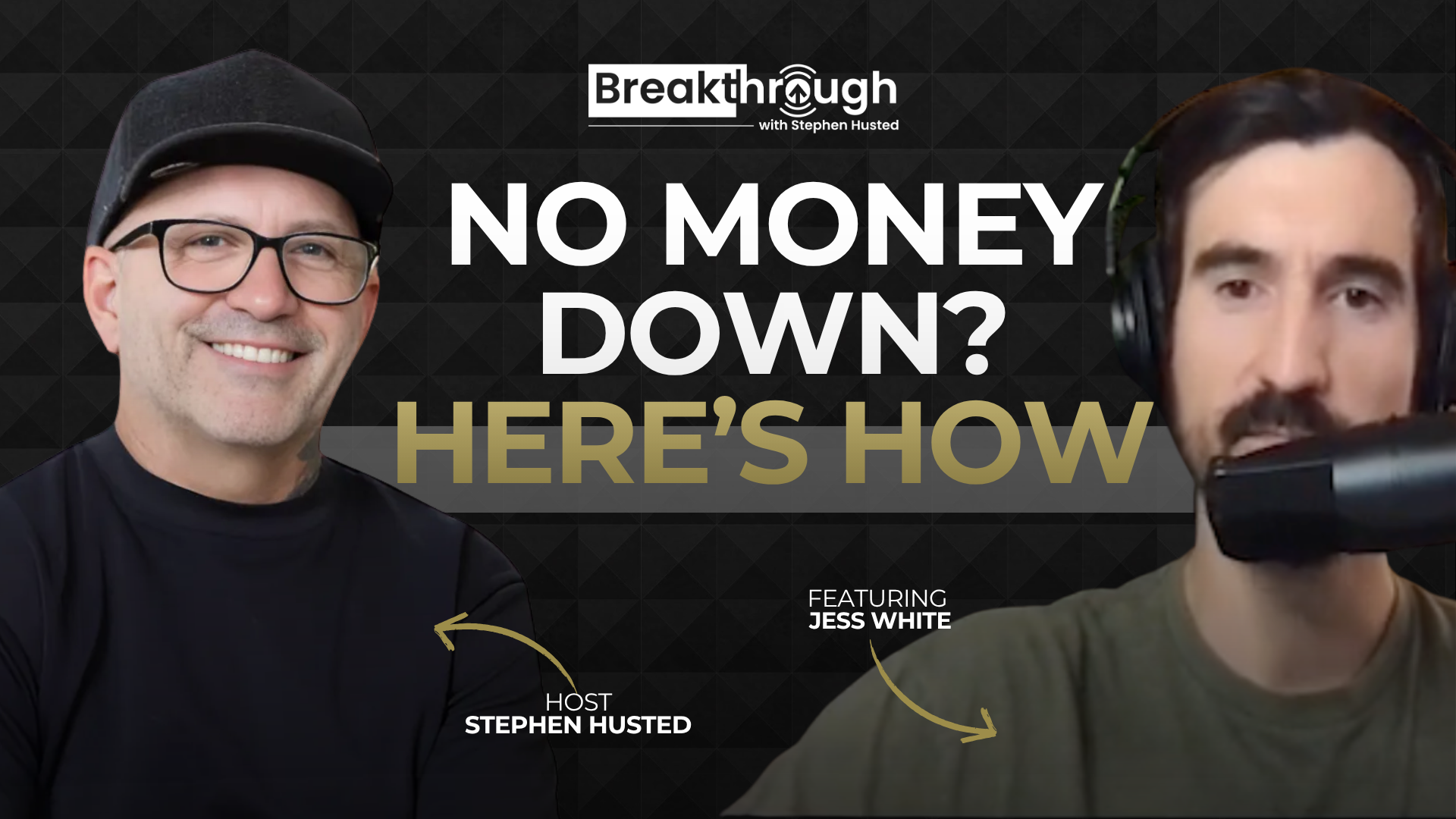
Welcome to another episode of "The Breakthrough with Stephen Husted." Today, we're sitting down with Jess White, a real estate powerhouse who's redefining success in the industry. We unravel Jess's journey from modest beginnings to becoming a true titan in real estate. Throughout this episode, we'll delve into the pivotal strategies that propelled Jess to the forefront of the real estate game. From innovative no-money-down approaches to cultivating genuine client connections, Jess imparts the keys to his extraordinary achievements. Get ready to learn from a genuine trailblazer.
Takeaway 01: From Ground Zero to Real Estate Jess's evolution from considering duplexes to constructing his inaugural property. How taking initiative and learning by doing became the bedrock of Jess's real estate triumph.
Takeaway 02: Mastering Real Estate Content Creation Jess shares his insights into content production and harnessing social media's potential in real estate. Learn Jess's approach to identifying motivated, driven clients in the fiercely competitive real estate arena.
Takeaway 03: Fostering Enduring Client Partnerships Strategies for cultivating robust, enduring relationships with clients in the dynamic real estate realm. How feedback and testimonials serve as potent tools for augmenting service quality and reputation.
TRANSCRIPT
∎ Teaser / Highlighted Clip
[Jess White] (0:00 - 0:51)
If I can theoretically build this house for 80% of the appraised value, I can do this for zero down and my mind exploded. Sure enough, we did. We built it for zero down.
We hit that 80% mark and I had to go like 5,000 over, which is not much. And I'm like, oh my gosh, like this is amazing. I just did this house and I would have spent $40,000 trying to get a crappy duplex.
And then I told people in the neighborhood, I'm like, yeah, I'm going to rent it. And all the builders thought I was insane because they were just so against renting. They're like, oh, they're going to trash your house.
I got $1,700 for the rental. My debt was $950. And fast forward from 2017 to now, that same house is about to rent for $2,500.
∎ Podcast Intro:
[Stephen Husted] (0:51 - 2:37)
Welcome to The Breakthrough with Stephen Husted, the show that takes you behind the scenes with successful entrepreneurs, real estate investors, and other movers and shakers in the business world. In each episode, we'll sit down with our guests to explore their personal and professional journeys, including the challenges they faced, the breakthrough moments that propelled them to success, and the strategies and the tactics they used to get there. Get inspired by new ideas and strategies and get to know our guests on a deeper level.
Join us for candid conversations, powerful insights, and plenty of breakthrough moments. Please help us grow by subscribing and sharing the podcast. And welcome to the show.
∎ Guest Introduction:
Ladies and gentlemen, get ready to deep dive into the world of real estate. Our guest today is Jess White, a real estate powerhouse with a journey that will leave you inspired. Jess shares his incredible journey into real estate from devouring real estate podcasts to building his first investment property.
We'll also uncover the secrets of strategic financing with minimal down payment and the power of taking action in real estate investing. But wait, there's more. Jess and I even share our personal journey towards connecting with clients on a deeper level and how shared interests can strengthen those business connections.
So whether you're into real estate investing, content creation, or simply forging a meaningful connections in business and in life, this episode with Jess White is a must listen.
∎ Podcast Proper:
All right. We are live.
Right on, Jess. Appreciate you jumping on and doing this.
[Jess White] (2:37 - 2:38)
Yes, sir. Thanks for having me on.
[Stephen Husted] (2:39 - 2:43)
Yeah. So how many have you gone on to as far as podcasts recently?
[Jess White] (2:43 - 3:17)
Oh, man. At least five. And what's funny is I used to get nervous before I would do a podcast.
I'm like, oh my gosh, what am I going to talk about? And now I get more excited about being on a podcast because I know how easy it is versus hosting one. Because when I'm hosting one, I've got to really, really be present and really be an active listener.
And I'm writing down notes and I'm saying like, what am I going to ask next? I'm always thinking about it. It's really hard for me to be in the moment as a host because I'm always thinking about that next move.
How do I make this flow?
[Stephen Husted] (3:18 - 3:35)
I think there's a little bit of an art to it and it definitely takes practice to flow with somebody. And you just never know who you get on, how they flow. And you have to kind of carry their weight too sometimes, I've noticed.
Yeah.
[Jess White] (3:35 - 4:30)
Yeah. You know what's funny about podcasting is I've had people ask me, what's your goal with the show? There's like a million podcasts.
And for me, it's really, really simple in that there really isn't a goal other than the ability to connect with other people and improve my communication skills and be able to create content in the meantime. Because I think what's the worst case scenario? Let's say in two years, I've put out maybe 100 episodes and I find out, you know what, nobody really cared.
But guess what? During those 100 episodes, I met 100 different people. I improved my communication skills.
And I always say this, is that I can be a 10 out of 10 on a subject. But if I can only communicate at a two out of a 10, then I'm always going to be perceived as a two out of a 10 in any subject. So this is an opportunity for me to perfect and really improve my communication skills.
[Stephen Husted] (4:32 - 4:56)
Yeah. When you say it about communication, do you feel like it's harder to communicate once you go live on a podcast compared to how you are face-to-face with somebody? Not really.
Because you said a two out of 10. I think sometimes when I'm communicating in a podcast or on video, I sometimes get lost in my thought about what I'm going to say.
[Jess White] (4:56 - 5:29)
ADHD. Huh? ADHD.
Oh, yeah. And it's why these kind of conversations create much better content. Because when you're trying to go basically on short-term memory and on the fly, it's just like, oh, I'm going to hit record and start creating.
That doesn't work very well, at least for me. And it sounds like for you, it doesn't as well. Whereas some of, I guess, my finest thoughts are just amongst a friend when I wish I would have just hit record.
Because it just comes together more organically and just, I don't know. I don't know how to say it.
[Stephen Husted] (5:31 - 6:35)
I agree with you on that. I think it's interesting. I've been doing more of a soft-run podcast with my good friend who's a mortgage broker.
And we'll go into it talking about financing and the market and all this stuff. And it's kind of repetitive. And then all of a sudden, he'll just bring up something about mountain biking.
And I'll go right into a story. And then a couple of minutes go by and then he's kind of roping me back in. And it's funny because we've taken clips from that.
And those clips are the ones that have done the best online on Instagram. Because there's a little bit more of an emotion behind it. There's a story behind it.
And I think people like to hear, they want stories tied into life events on top of what you're doing on top of business and everything. I think it all kind of correlates together. I think people don't want to hear just a bunch of stale talk that seems a little bit more scripted.
I agree.
[Jess White] (6:35 - 6:48)
It's why shows like, for example, the Joe Rogan podcast. It's why they're so popular. There is no real structure, but it's very real.
And it's conversational. People just like really being a fly on the wall for conversations.
[Stephen Husted] (6:48 - 7:23)
Mm-hmm. Did you ever notice about some of the podcasts that you listen to? We'll use Joe Rogan, for example.
Do you ever wonder why it seems like they know a lot? He's on topics all day long and has some good understanding of the topics that he's on. Either he's doing research or his team is researching it, so he has some good flow with it.
But some, it seems like they just know a lot. I don't know. That's an impression I get sometimes on certain podcasts.
[Jess White] (7:24 - 8:16)
Yeah. And I think it's easy to put myself in a comparison role where I'm like, man, he does such a good job. He knows so much more than I do.
But if I look at how many episodes he's done, he's done thousands of episodes. And it's like he's had that many hours, thousands of hours. Some of them are four or five hours an episode.
You're looking at 15,000 hours of practice. This is kind of a funny analogy, but imagine I'm a cyclist or I'm a runner and I go on someone's Strava and I say, man, they're averaging 21 miles an hour. They're pushing out 250 watts, man, in a two-hour ride.
And then I look at their statistics for the year and how many miles have they ridden a year versus how many miles have I ridden this year? And it's like, how can I even compare those two? Because it's not that they're better.
They're just putting in more reps. They're putting in more work. Same goes for anything else.
[Stephen Husted] (8:17 - 8:20)
That was a great analogy. You know you've done one perfectly with me.
[Jess White] (8:21 - 8:23)
Well, that's why I said it.
[Stephen Husted] (8:24 - 8:38)
That's almost similar to when we first met. We were just sitting on that boat and just started randomly talking. And once we found out that you're a triathlete and I'm a cyclist, it was like, boom, we already have something in common right then and there.
[Jess White] (8:41 - 8:48)
Yeah, definitely. I've got my bike loaded up in my truck right now. I've got a ride here in a little bit that I'm looking forward to.
[Stephen Husted] (8:49 - 8:53)
What do you got on the plan? You've got a race coming up. Are you got on the calendar for something?
[Jess White] (8:54 - 9:29)
Yeah. So I'm doing my first ultra marathon. I'm doing Catalina Island.
So it's 50 miles. It's an out and back. It's a big elevation gain.
It's 8,400 feet total on the 50 miles, which for me is a ton. And so that'll be my first ultra. Then I'm doing Houston Marathon eight days later.
And then that's a pause for running for a bit. And then I'm getting back in the triathlon stuff. I've got one on April 1st.
Then I'm doing Morro Bay, California in May. And then Wisconsin full Ironman in September.
[Stephen Husted] (9:29 - 9:32)
When did you get into doing triathlons?
[Jess White] (9:32 - 11:41)
I got into it this year in January. Pretty much couch potato, doing very little physical exercise. I had a membership at Planet Fitness.
I would go like once a month previously. And about two years ago, my dad passed away of COVID very early on during the pandemic, a little over two years ago. And he was 66, died hours after my birthday, and sat there by his bedside.
And I just thought to myself like he was in pretty decent good shape, but he never was really consistent with exercise. And I'm like, I don't really want this to happen to me and just all the pain that happened to me and my family and losing my dad. And I just thought, why not go to the end of the extreme and just find a big goal to pursue?
And an Ironman sounded cool. And I picked one 90 days later. It was a half Ironman in Puerto Rico, San Juan, Puerto Rico.
And I just thought, all right, I mean, that's kind of how I learned. I throw that parachute on as I jump out of the plane. I did terrible on the race.
I averaged 13.9 miles an hour on a Salsa gravel bike. I did the race on the same bike. I used tennis shoes, no clip-ins on that first race.
I had no idea how to swim, barely made all the cutoffs. But it was like I had this switch in my head. I'm like, this is amazing.
I've got so much room to improve. I love it. I found this awesome community in the town where I live in.
And it's just a bunch of good guys. And I get to surround myself with just good people that are, I mean, in addition to being healthy, it seems like if you're able to do a triathlon or at least have a decent bike, I mean, you've got to have something halfway decent going on in your life for the most part. And so the guys I get to hang around are somewhat high caliber.
And I just got hooked, man. I love it. And I've got that tall, lanky build for it.
[Stephen Husted] (11:42 - 13:13)
Yeah, good for running too, for sure. And swimming, actually. And I think that that was a little bit similar to my story as far as getting into mountain biking and racing.
I just went full gas from the beginning of it and was racing within a couple months on a borrowed bike, wearing vans and went out there and did a cross-country race one day. And then the following day did a downhill race. And the downhill was no joke.
And I used to BMX as a kid, but I hadn't done any downhill racing. And there I am in front of all these people doing a pretty fast course. I was like, whoa, what did I get myself into?
But I got through it. And I think that was it. And that was just a good...
I think doing triathlons or just cycling and anything like that, it's just another arm to our daily discipline of what we do in our life. It makes us better in everything. It's not just about breaking your last record.
It's more about you improve, but then you improve in your work life. You improve on your family life, your mental ability, how you think. It's all tied together.
I don't know if a lot of people understand that until they get into it.
[Jess White] (13:14 - 13:51)
Matt Stauffer Yeah. And it's such a healthy outlet versus turning to anything else, whether that's junk food, alcohol, whatever, anything that takes the edge off. Now I get to the point where if I don't do some kind of physical exercise at least every 36 hours, I'm like, oh gosh, I'm feeling kind of down.
I'm so prone to depression. And exercise just snaps me out of that super quick. And you talk about ADHD, something we've both talked about.
That is like a game changer exercise.
[Stephen Husted] (13:52 - 15:21)
Big time. Justin Jackson I want to talk about it a lot. And I can tell you this interesting story when I was on a ride one day and I met up with this gentleman, older guy.
And we rode and he's like, hey, let's go get coffee. And we ended up spending like four hours together. And he was asking me questions about my bike.
He said, why do you have a track? And I said, oh, all my friends have specialized. So I just wanted to be a little different.
But my daughter has a specialized. He said, that's cool. And so we rode.
And at the end of the day, I'm like, we rode for the whole day. And at the end, I asked him, I said, so what do you do? And he's like, I work at Specialized.
I'm like, what do you do there? He's like, I'm the CEO. So he was the founder.
And we had a lengthy conversation about ADHD too, because he has it. And I told him that if I get about an hour, hour and a half in, it resets my brain. It gets my thoughts in order.
It calms me down. I think it would do the same thing as if I was on a drug, but I do it with exercise. And I can preach this up and down.
And I tell a lot of people that have ADHD to get a bike ride because it will reset you. And now my family, if I miss a couple days, whether I'm super busy and just not taking care of myself, they'll tell me, you need a ride. You need to go out because you're coming unhinged.
You're just not there. And it makes sense. And then I get out and I feel good.
[Jess White] (15:21 - 15:24)
Man, that's such a good point. So relatable.
[Stephen Husted] (15:25 - 16:09)
So I know that that last post on Instagram, you hit me right where... It's interesting about Instagram and people I follow, they'll put something out there that it strikes a nerve. And I literally want to just call them.
It's in that moment. And I want to have that conversation about what's going on because I'm right there too. The market is shifted and I don't want to carry a ton of debt.
I want to make smart moves going into 2023. Where are you at on... Because you've got a lot of things going on just like me.
I think you've got bigger projects going on than what I have. I'm almost done with all mine. But what are you trying to...
Where do you want to be in Q1 at this point?
[Jess White] (16:10 - 18:19)
That's a great question. And like I said in that post, the key word for me going into next year, and I don't want to wait till next year, right? I'm starting that now, today, is peace.
And I've been just pedal to the metal. Let's grow, grow, grow. I want to be a millionaire by 30, right?
I just turned 30 in October. And I hit that milestone, right? And a little bit over that, I'm just like, okay, that's cool.
But now I've got a bunch of stress because I grew, grew, grew, grew, grew. And then I took on a lot of non-real estate debt over the past six months, just growing. And a lot of this has paid off, but I've got lines of credit out.
I've got credit cards I've racked up. And it's like, people don't really talk about this stuff. It's not the sexy stuff, right?
But it's the reality of growing a business when you want to succeed. And a lot of those growing pains have caused me a lot of stress in the meantime. So what I'm working on right now, I've got seven cabins.
I just closed with two partners of mine. I'm building a new construction house. I'm flipping two houses right now.
And amidst that growth, just to be totally transparent and honest, I'm looking at my bank account. I'm like, dude, the money's just dwindling out. I was just getting hit with things left and right.
And I started looking at my portfolio. I'm like, well, I could sell a couple of properties. Basically, that would re-stabilize my portfolio.
And that would put a good bit of cash cushion for me and really reset my peace, which to me is so, so important because I can just keep growing and growing and growing and grinding and grinding, but I can't live like this forever because it affects all my relationships.
[Stephen Husted] (18:22 - 19:48)
Exactly what I'm going through. I'm just at that point where we have one project left and I just want it done. And I didn't take anything on in the last quarter.
I'm just like, no, I'm not doing anymore. I just want this one finished. I want to regroup, re-evaluate where I want to be and what I want to do and then get some debt paid off.
I've even thought about selling a couple of properties too to just pay off some debt, get some cash in the bank, sit there because it's interesting because of all the interest rates hiked up and getting stuck in projects that didn't work out well. We got bit a few times and a lot of it was just appraisals coming in low. And these were properties that when we bought them, we did hard money and we had an ARV on them that the appraiser gives that to the lender and they were nowhere close to where we ended up.
And so we lost hundreds of thousands of dollars. Well, we didn't lose it, but we just didn't get that cash out, which put us in another position that now we had to bring our own money to the table. And that was like, okay.
And so I just knew right then, I'm like, slow down. Just slow down, get regrouped and then make some more logical decisions moving forward just that makes sense. So you're not in a position.
[Jess White] (19:49 - 20:29)
Exactly. And what's funny is I've been talking to a few people here and there and they're all saying the same thing, right? A lot of people are stressed.
People I've met at BiggerPockets and it's like people have sent me messages like, oh man, I'm in the same position. I've screwed myself a little bit because the market has shifted. I have two flips in the market right now.
I have one, I'm the agent on it and I also own it. It's fell out of contract twice in the past three weeks. Based on the inspection period because I don't know what the deal is and just things like that just keep happening and happening.
[Stephen Husted] (20:32 - 20:43)
Do you guys do inspections on your properties? So when you're the listing agent, because I know you list properties. So do you do your inspections up front or do you let the buyer do them and then if they find things, you guys have to negotiate at that point?
[Jess White] (20:43 - 20:45)
I'll let them do it. Okay.
[Stephen Husted] (20:45 - 20:59)
Yeah, it's different out here. We do all the inspections up front so that when the buyer writes an offer, they're typically non-contingent offers because they've looked at all the inspections and there's really no wiggle room out at that point.
[Jess White] (21:01 - 21:02)
I like that.
[Stephen Husted] (21:03 - 21:03)
Yeah.
[Jess White] (21:04 - 21:05)
So what about you, man? What are you working on right now?
[Stephen Husted] (21:08 - 22:27)
You know, mostly I've been working on the media stuff. It's kind of where I've been is getting that more in place. I have a couple ideas of what I want to do this year and I just want to put that in place.
I think I want to do some midterm rentals and want to build some cabins out in the Smokies. It's like the two big goals. I don't know if I want to buy any more single-family homes out in Kansas City at this moment.
I think the one thing that I learned from this past year was, yeah, we had a lot of growth. We bought a lot of properties, but I thought about it for a minute. I'm like, you know what, I kind of bought for the amount of issues that I had to go through, I'd rather have big projects and have the same issues.
You know, if they pencil out, if it makes sense on paper and there's lots of room there. I'm a little hesitant about the building part. That'd probably be something I would talk to you down the road here, but I think that it's something that I want to, I don't want to pick, I just want to do a couple of things.
I want to stay focused on those things too. You know, our Airbnb on the Smokies is doing good. We're learning a lot on that one as well and I don't want to be spread too thin.
I think that's a big part of it.
[Jess White] (22:28 - 22:49)
You talk about picking your lane, picking your thing and not having too many things. I heard this quote I like. It says, the squirrels you find dead in the road are the ones who didn't know which way to go.
Yeah. I'm going to go this way, that way, this way, that way. Instead of just being like, this is what I do and that's what I'm going to do.
Yeah.
[Stephen Husted] (22:51 - 23:11)
It's hard when you're a real estate investor because we're connected with all these people that are doing interesting things and it just fires you up. You just want to chase shiny objects. It's just the way it is.
But you have to understand that if you're trying to chase everything, you end up with nothing. You're not putting that growth in.
[Jess White] (23:12 - 24:47)
On the note of the direction I wanted to go next year. 2021, 2022, it was get passive income, get passive income, get passive income. I've got that.
I've got basically a basic level of freedom for passive income. But I think 2023, I want a lot of active income. I left my job 15, 16 months ago and I thought that I quote wanted to retire and I quickly realized that idle hands and sitting around doing nothing are not good for you at all.
Work is very good for man and it's good to work. And the thing that I guess I never really thought about was instead of trying to escape, find a meaningful work, find work you enjoy. And I've finally gotten to that place to where I love what I do.
I love the real estate business. The big thing for me is autonomy of my schedule and being able to go and do fun things and being able to just say yes on a Tuesday morning at 10 o'clock or shoot right now, it's 12 o'clock on a Thursday here. Get to do a podcast.
Not everybody can do that. It's got to be after five or on the weekends. And that's not how I want to live my life.
But next year, I'm going to be building a lot of houses for a lot of active income. And my strategy, whether that's building or flipping, it's like it would be build, build, rent or flip, flip, rent to where I've got active income, but then use some of that to go buy rental.
[Stephen Husted] (24:47 - 24:53)
Not all of it though. Are you sticking to around where you live?
[Jess White] (24:53 - 24:53)
Yes.
[Stephen Husted] (24:53 - 24:54)
Is that where you've been? Okay.
[Jess White] (24:54 - 24:55)
Exclusively.
[Stephen Husted] (24:55 - 24:56)
Where are the cabins at?
[Jess White] (24:57 - 25:01)
The cabins are 35 minutes north of where I'm at on a lake.
[Stephen Husted] (25:01 - 25:06)
Oh, cool. So you guys got the land, you're subdividing the land and building.
[Jess White] (25:07 - 25:09)
No, these are existing cabins.
[Stephen Husted] (25:09 - 25:10)
Oh, they are. Cool.
[Jess White] (25:10 - 25:25)
Much easier. There's a pocket listing. We got over 450.
These are really small, like little studio cabins. Cool. How do they rent?
95 a night. Okay.
[Stephen Husted] (25:27 - 25:29)
And what's the occupancy level? What are they?
[Jess White] (25:32 - 25:48)
Let's see. Out of the seven, one of them gets like 120 a night. The rest are close to 100 a night.
We're hoping for 8,000 a month average for all that. Debt service is about four grand a month. Okay.
[Stephen Husted] (25:49 - 25:54)
All remote. You guys will be just managing them yourself and have your cleaning crew and everybody just taking care of them.
[Jess White] (25:55 - 25:55)
Okay. Yeah.
[Stephen Husted] (25:55 - 26:02)
That's pretty much it. Yeah. That's awesome.
How is building? Tell me, how did you get into building?
[Jess White] (26:03 - 27:48)
Yeah. So building, oddly enough, was kind of how I got started in real estate. So I started in, well, really 2016, 2015.
I read Rich Dad, Poor Dad, right? Classic story. And I realized like, oh man, I really want to get into this real estate thing.
I was like, I hate working under this fluorescent light all day and in a cubicle. It's horrible. It's this big scam.
And this was like my answer to prayer, right? And so I just went off the deep end, ADHD, obsessive. That's all I did was just consume material for financial independence, real estate, all that stuff.
I got all into the fire movement. I was consuming dozens of podcasts a week. I mean, all day long in my ear.
And so finally, I told my wife, I'm like, hey, I really want to buy a rental property. And she says, no, we're never going to buy a rental property. I'm like, oh, my heart is broken.
Well, she worked in property management at the time as a property manager for a 300 unit apartment. She only saw the bad stuff. And so eventually, I kind of convinced her, started looking for a duplex because that's kind of what she, for some reason, that's what everyone thinks of when they first start.
And everyone I looked at, it just looked kind of old and ratty. And I just thought about what all could go wrong. And my dad at the time was unemployed.
He had built one house back in 2008. Didn't go well. Terrible timing, right?
Decided to build his first spec house. So he just got out of it. And I just thought, man, what if we build a house as my first one?
[Stephen Husted] (27:48 - 27:55)
Did that give you reservations? Did that give you reservations, the fact that he wasn't successful in that? Did that?
[Jess White] (27:55 - 28:30)
No, because I just wanted to make it a rental. I didn't care about profit margin. He was successful in building it.
If he would have kept it, it would have been fine. So that was my thinking. And I told him he didn't have any kind of job.
He's like, yeah, I can probably try to figure this out together. But he still didn't know a lot, right? He wasn't super well-versed in building.
He had a basic understanding. And I said, okay, I'll pay you $10,000 and we'll just try to figure this out together. He was my boots on the ground.
I was living in Willow Glen at the time, right there on Foxworthy and Pearl.
[Stephen Husted] (28:31 - 28:39)
Oh, my God. I can't believe. Isn't this crazy that we met on a boat and come to find out you lived in Willow Glen, I lived in Willow Glen.
It's just crazy.
[Jess White] (28:39 - 28:43)
Yep. It is wild. Yeah, right over there by DGDG.
[Stephen Husted] (28:44 - 28:44)
Oh, yeah.
[Jess White] (28:44 - 31:02)
But anyway, I built that house remotely and my dad was kind of my boots on the ground. It was a fairly equal workload, but he was kind of picking up materials and he'd go do draws and we kind of figured it out together. And we got to the end of the build.
And what's kind of cool about the building process is that, I don't know if you're familiar with how they give you a loan. Basically, you give the lender your plans and your cost and they say, all right, cool. This build, we're going to appraise that, let's say for sake of math, $100,000.
And you go, cool. And they say, we'll give you 80% of that. And so, at the closing, your lot is your first draw.
They take that out of the draw. And then once you go over that 80%, it all comes out of pocket. That's considered your down payment.
And then I had this epiphany. I was ready to put like $40,000 down. I was ready to go.
I'd saved for a long time. And the lender called me one day and he says, hey, Jess, I just wanted to see, did you want to make the lot your first draw and down payment? Or did you just want to make your down payment kind of at the end after you get past your 80%?
I'm like, I have to put money down? He's like, oh, no, you don't have to if you don't want to. You can just do that on the back end.
And then I realized, if I can theoretically build this house for 80% of the appraised value, I can do this for zero down. And my mind exploded. Sure enough, we did.
We built it for zero down. We hit that 80% mark. And I had to go like $5,000 over, which is not much.
And I'm like, oh, my gosh, this is amazing. I just did this house and I would have spent $40,000 trying to get a crappy duplex. And then I told people in the neighborhood, I'm like, yeah, I'm going to rent it.
And all the builders thought I was insane because they were just so against renting. They're like, oh, they're going to trash your house. I got $1,700 for the rental.
My debt was $950. And fast forward from 2017 to now, that same house is about to rent for $2,500.
[Stephen Husted] (31:03 - 31:10)
Whoa, there you go. Not to mention all the principal pay down and just all the benefits.
[Jess White] (31:12 - 32:08)
Lots of that. And now some of those builders are reaching out to me being like, man, I think I want to do this rental thing. Because I think about if I would have sold that house, I would have made like $20,000.
It's the whole idea of killing the goose versus keeping the golden egg. And you mentioned something about selling a property and kind of stabilizing. And here's the way I put it sometimes.
I used to say, I never, ever want to sell. And that's my goal, right? Is to hold, hold, hold.
But sometimes if you're on a farm, you have to kill a cow, you have to kill a chicken for meat. But ideally, you keep them around for milk, for eggs, you shear the sheep, you don't kill it. But sometimes you got to kill them.
And same goes for a property. Sometimes for the health of your business, you got to kill off one of your properties and then sell it.
[Stephen Husted] (32:09 - 32:29)
Or it's another opportunity. You just don't know what that is going to play out. So I think that- Very true.
I think it's smart. I think that you probably got those contractors excited because they saw a proof of concept from you. And how did it go as far as you finding your contractor?
How was that process?
[Jess White] (32:30 - 32:31)
What do you mean finding my contractor?
[Stephen Husted] (32:32 - 32:38)
Well, you picked who built the house. You had a general contractor build it? Yeah, me and my dad.
Oh, you guys built it?
[Jess White] (32:39 - 32:41)
Yeah. Well, we hire out individual contractors.
[Stephen Husted] (32:41 - 32:43)
Okay, so you sub-contracted it.
[Jess White] (32:43 - 32:46)
Yeah, we are the builder. And so we hire everything out.
[Stephen Husted] (32:47 - 33:20)
Okay. All right. And that saves you money as well.
No builder fee. Yeah, no builder fee. And you're subbing it all out.
So you had somebody go in there and lay the foundation, framing, go in there and... Okay. So how does it work in Texas as far as...
How is the permit process? And is it speedy? Because here it's slow.
If you got a lot here in California, you got a lot in Willow Glen, you know, dude, you're not building that thing for well over a year. It's just that's the way it works.
[Jess White] (33:21 - 34:02)
Yeah. Around here... No, I'm building at a different county now.
But the original county I'm in, I hate to even say this, but you literally walk up to the tax assessor office, not tax assessor office, county clerk, whatever. And you bring in a form that says it's one page, Microsoft, word, Comic Sans font. And you...
Oh, yeah. I bring them the plans and that and they go, all right, cool. That'll be $1,000.
Here's your permit. Done. And that's it.
Now, the county I'm working in now, it's about seven-day lead time from submitting your plans and your permit request. But there's still nothing to it.
[Stephen Husted] (34:03 - 34:07)
Wow. And so how long did that first build take you?
[Jess White] (34:08 - 34:09)
About six months.
[Stephen Husted] (34:10 - 34:24)
Six months, start to finish. That's locking up and buying the lot and then getting it built. So then after that, you got it built.
How long did it take you to get your tenant in place and stabilize and just the whole thing starting to cash flow? What did that look like?
[Jess White] (34:25 - 35:10)
Well, we advertised to rent it out before we were even done. And so we already had a tenant lined up. And the coolest part, the other kind of epiphany moment I had was I was on what's called a 12-month interim construction loan that converted to a permanent.
So the first 12 months are interest-only, 3.5% at the time. That's great. And so I was paying like $450 a month in my interest-only payments.
But I finished in month six and then I rented out for six months on interest-only payments. And that little lag time allows you to stack up cash reserves. And then after that, I'm like, I'm hooked.
I called the bank. I'm like, I want to do two more. I'm like, okay.
[Stephen Husted] (35:13 - 36:04)
So what you just said is a really big point. And I think a lot of people who want to get into investing, they get online and they go down the rabbit hole, bigger pockets. They start following people on Instagram and they see people executing and doing all these different strategies and they want to.
But they just either can't pull that trigger or they got fear on really the direction they want to go. And it's interesting because the thing is when you did that build and you finished it and then afterwards, you're like, I'm ready for more because you broke through that friction. Whatever that issue was in the very beginning, if you even had them, there's definitely some thought of like, how am I going to pull this off?
You pull it off and then now you can move it even further because you put in those steps. I mean, do you feel like that's a big part of investing?
[Jess White] (36:05 - 36:55)
Yeah. I mean, the biggest thing you have to have to make it in this industry is not knowledge, it's action. Because you will learn and there's going to be some pretty strong learning curves and it's going to suck.
But there's only so much you can learn from reading a book, from listening to a podcast, from listening to someone like me on a podcast right now. Like, oh, I like what that guy's doing. I wish I could do that.
When I mentioned my dad, it's like, well, you had your dad. He didn't know what he was doing. I didn't know what I was doing.
Neither of us did and we just kind of figured it out. He was making $20,000 a year at the time. Like, I didn't come from anything.
Like, there's no secret sauce. The sauce is get in there and fail forward. Right.
[Stephen Husted] (36:55 - 37:38)
And I think some people, and that goes with a lot of things, honestly. That goes with getting on here and doing a podcast or learning how to shoot content. I have had so many people reach out like, I don't know how you get on camera.
I go, dude, I have ADHD so bad. You know how long it takes me to make a video? Sometimes it takes me an hour to make a one minute video.
I put a lot of repetition in and I'm okay with failing. I think failing is just, you learn so much when you fail and you can take those and move them forward. And I think some people just don't want to fail because either it's them hurting themselves or what they think other people are going to think of them if they did fail.
And I don't know. I just, I don't have a problem with that part.
[Jess White] (37:38 - 38:33)
Yeah. And that's pretty beautiful. Is this kind of, it's been a process and still is for me to let go about what my peers or other people think about me.
Occasionally, you know, I feel I've always felt a little bit anonymous on my Instagram investor Jess, you know, because it started off, it was like a break off from my original Instagram and just kind of started building up. And then over the past year, every now and then I'll see like someone I went to high school with or someone from my hometown, and I'm like, all of a sudden this anxiety hits me like, they're going to judge me. They're going to think I'm weird.
And it's like, who cares? And I think about what you said with content, right? And I was talking to someone, they said, if you can't go back and look at your first few pieces or first year of content and just go, Oh, what was I thinking?
Then you didn't start soon enough.
[Stephen Husted] (38:35 - 39:44)
100%. Well, it's interesting. You just brought that up.
I had a video I found from like in the very beginning, and I'm on my couch. I'm laying back on the couch. You know, I'm talking with my camera up.
And I took the video, I went, I found it, I went, Hmm, I want to take this and put it to one of my other videos. Like, this is where I am now, and show the progression from that video. Well, so my editor got it.
And he ended up editing it didn't realize that there was a second part to it. And it got thrown onto Instagram last night. And I didn't review it.
My assistant looked at she's like, Yeah, I like it. It's great. Okay, so it goes out and I see it and I'm like, and I immediately delete it.
I take it down. Because it's like, something that I did a year ago. And it just was just so bad.
I thought it was bad. And everybody else was like, Well, I liked what you had to say. But I wanted to use it in a different format.
I wanted to show people like, Look, you know, this is how it could be in the beginning. But it you know, if you put some time in, you can actually get better at it.
[Jess White] (39:45 - 40:44)
Yes, dude. Man, when I first started making content, started on like Tick Tock, because Tick Tock felt kind of anonymous, right? Uh huh.
Yeah. Yeah, dude. That's so true.
And dude, I had after like my first my 10th video, one of the videos went viral. I lost my freaking mind. I'm like, Oh my god, what am I gonna do?
It got 1.7 million views. My followers went to like 11,000 Tick Tock followers every night. And it was insane.
It just like rattled my brain. But there was there was days early on making content, which I've been being terrible about making content recently. But early on, when I was in California, I would do it my hotel.
And then I'd wake up the next day and be like, Oh, it's almost like I just was intoxicated doing it or something to wake up the next day. What was I thinking? It was terrible.
[Stephen Husted] (40:46 - 42:48)
Yeah, it can be like that. But but it's super on the on the flip side of that I had a my, my real estate license needs to get updated. I have to go take a course, right.
And I know a friend of mine who's an agent, and we're on the same four year plan scenario. So I text him, I said, Hey, let's go do our, our course together. And he's like, Oh, I already signed up for Friday.
I'm like, Oh, bummer. And then he calls me. And he said, Hey, man, I just want to tell you, I love your content.
You're just absolutely crushing it. He's like, dude, and just, he's like, I know I have to do it. I know my my broker just tell me that he's a broker saying that we got to make video, we got to shoot videos, we got to make content, we got to make content.
He's like, I'm just, I don't like the way I look. I don't like my voice. I don't like everything.
I just, I just can't break through. And I told him, I go, look, it took me six months before I even made my first I tried for six months, and I just couldn't, I couldn't do it, couldn't figure out how to get past looking at a camera. I didn't like my voice.
My bottom teeth were crooked, that it just really stood out. I saw my skin on my neck, you know, I'm getting older, you know, I could see that I was like, Oh, my gosh. I said, No, I'm not stopping on this.
I'm just going to keep going. And I told them, like, look, you don't have to be out to come out and be a media company. Why don't you just instead of, you know, doing a Merry Christmas, a post on Facebook, why don't you just shoot a video?
Like start small, do just start doing small things, you know, you don't have to jump right into it. Because I think that everybody's having this pressure now, and a lot of industries, if they're not shooting content, they're going to be irrelevant in a lot of ways. I mean, I think that's, it makes sense.
But it's also adding another layer of, you know, anxiety and onto people. Do you get? Because I know you've mentioned that you've burned out several times, what are you going through when you're going through that burnout?
Is it a mental thing? Or is it? Is it just the fact that you're thinking about it too much?
[Jess White] (42:49 - 43:49)
Yeah, I'm thinking about it too much. And then I get the FOMO of like, Oh, gosh, it's been, you know, two weeks since I've posted anything. And sometimes when I'm creating content, it feels like I'm in my office for hours and just slogging away and putting stuff together.
And I'm just like, I'm doing it because I know it's what I need to be doing. I know that there's a high ROI on it. You're building a personal brand.
But then there's just some days when I just want to throw my phone out the window, unplug, I get tired people calling me tired people texting me people. I wake up on Monday morning, all the messages start flowing in, not from social media, but just in general. And sometimes I just want to unplug.
And I guess I put too much pressure on myself to, I guess, have a content schedule. I've heard from so many people, Oh, you need to, you know, have a content schedule post this many times a week. And then I'll get, I'll miss that.
And I'll just kind of get down to myself and shame myself and just be like, whatever. That's pretty much it.
[Stephen Husted] (43:50 - 45:21)
Yeah. I've noticed that a lot of people that either I follow who there's several from the convention that came back and everybody was shooting. And then all of a sudden the weeks went on, they started slowly kind of fading off.
And I've even had my good friend say, you know, take some time off. You got to break from that. You got to relax.
And I think that for me instead, I'm a creator, like forget about shooting content, you know, it's a hairdresser for 30 plus years. I DJed. So I am an artist.
So this stuff is really fun to me. Like I love creating things and it's your canvas. It is, it is.
And it's funny because it reminds me a lot of being a hairdresser, you know, you become a hairdresser and you're, you have good intentions. You want to grow, you want to create, and you're just not there yet. You have fundamentals.
You can do a little bit of it, but you have to keep putting work into it. The more you put work into it, the better you get. And it's also one of those things where I'm never satisfied when I, when I was a hairdresser, like I very rare that I would say, oh, I really love that haircut.
I love that color. And I think that it's the same thing with creating content. I think the minute that you think you got it all figured out, um, is when you're definitely not growing anymore because you're, you're just, you put your foot off the gas and it's like, okay, I'm done.
I'm good. And that's when everything flat lines.
[Jess White] (45:21 - 46:30)
That's so good. And I think a lot of people complicate it when it comes to content. They think that I need to create this.
Uh, I need to provide value in some way, which, you know, value is good, but sometimes value can look like just simply documenting your life. And sometimes when I think I'm not creating content, um, I just throw out my phone and just start adding stories. Like it's just a day in my life, man.
It's my kids, some exercise, like this is what's going on. This might be stupid. 90% of you might think I'm an idiot and that's okay.
But you're, you're building up connection with people and, and realtors are the worst man. Some of the tacky crap they put out there and just, it can be really bad to me. It's just like the really cheesy infographics.
You see, you know, reasons why this is the best time to sell your home. And it's some, they just share a LinkedIn article. I'm like, no, like you don't even have to do that.
Right? Like what you're doing is great.
[Stephen Husted] (46:31 - 48:20)
You know, it's funny you bring that up. Um, if you went back into my Instagram and you scrolled all the way to the beginning, 2012 when Instagram came out. So when Instagram came out, people that were using it were photographers, hairdressers, tattoo artists, people that had good creativity, very visual.
And I, I remember I had a listing and I was like, Oh, I'm going to, I'm going to do this. I'm going to shoot a photo and I'm going to do it in black and white. And I'm going to put on Instagram and I'm going to list open house.
And I remember people at my office were like, that's stupid. Like no one's going to look at that. And I go, Oh no, I'm going to use this platform to do really cool stuff artistically.
And of course it caught on. And then all of a sudden people are throwing up their, their cheesy open house flyers and the whole, their whole graphics were just, just listed pending and sold and me, me, me. And I completely dropped off because once again, I'd never thought of myself as one of those type of people that's going to like sell, sell, sell and look at me.
And it was really hard for me like that part of it. But once social media kind of changed and creating content and knowing that I can go out and just provide value and give tips and be yourself, be myself, give life experiences, talk about things that I've gone through to hopefully help somebody else. The ball game was all, it was over.
You know, I knew this, this, I can accept and I can do it and be comfortable putting it out there because I'm helping people. And that was a huge change for me. Um, and it just made a whole, just nine day differently.
And I think a lot of agents aren't going to change. They're going to keep doing the same, they're not same path and it's hard to not to.
[Jess White] (48:21 - 48:58)
Yeah. And the reality is, you know, people do business with people. They like, they're not going to do well, that some of those agents are going to get business, right.
They'll have the cheesy graphs and, you know, Christmas cards and things like that. But the reality is the person that's going to want to use you, Steven, as an agent is someone that's going to be like, I resonate with you. I like your story.
You know, maybe it's like, I like biking or I like, you know, something you've told me about your past or whatever it is that resonates with me. And then it's just a way for them to, to add value back to you and connect.
[Stephen Husted] (48:59 - 49:44)
Yeah. And you get the right people in front of you too. You know, clients that actually, I, you know, I closed on a property out in Scotts Valley and the gentleman worked at Specialized, you know, we got into contract next, you know, a couple of days later, we're on a five hour ride together.
He's young, he's young too. And, you know, I'm giving him, you know, my life experiences and like where he's at, like, Hey, this is your first house. But next thing you have to start looking into is, you know, buying rental properties.
You know, you guys are young, start now, get that mindset going so that when you're older, you guys can do whatever you want. You can travel the world and he's just all for it, you know? And it's like, this is the type of client I want.
I can spend five hours, you know what I mean? It's just, it's just amazing. You know, social media has done that for sure.
[Jess White] (49:44 - 49:58)
It's a win-win for both of you too. And nothing makes me feel better too, than being able to genuinely contribute to someone's just life wellbeing and be able to mentor someone that is hungry. That's the key word.
They got to be hungry.
[Stephen Husted] (49:59 - 50:02)
Absolutely. And you can weed that out. You see that quick.
[Jess White] (50:03 - 50:04)
Oh yeah. Yeah. Yeah.
[Stephen Husted] (50:04 - 50:08)
Yeah. Talk is cheap at points, you know, you have to see some action and yeah.
[Jess White] (50:09 - 50:10)
That's so true, man.
[Stephen Husted] (50:11 - 50:13)
It was great chatting with you.
[Jess White] (50:14 - 50:16)
Yeah, man. Sounds good. Thanks so much for having me on Steven.
[Stephen Husted] (50:17 - 50:23)
I appreciate it. I appreciate you coming on and let's keep in touch and you have a great rest of your day and go crush that race. Okay.
[Jess White] (50:24 - 50:24)
Thanks, man.
[Stephen Husted] (50:25 - 50:25)
All right, dude. Bye.
[Jess White] (50:26 - 50:26)
Bye.