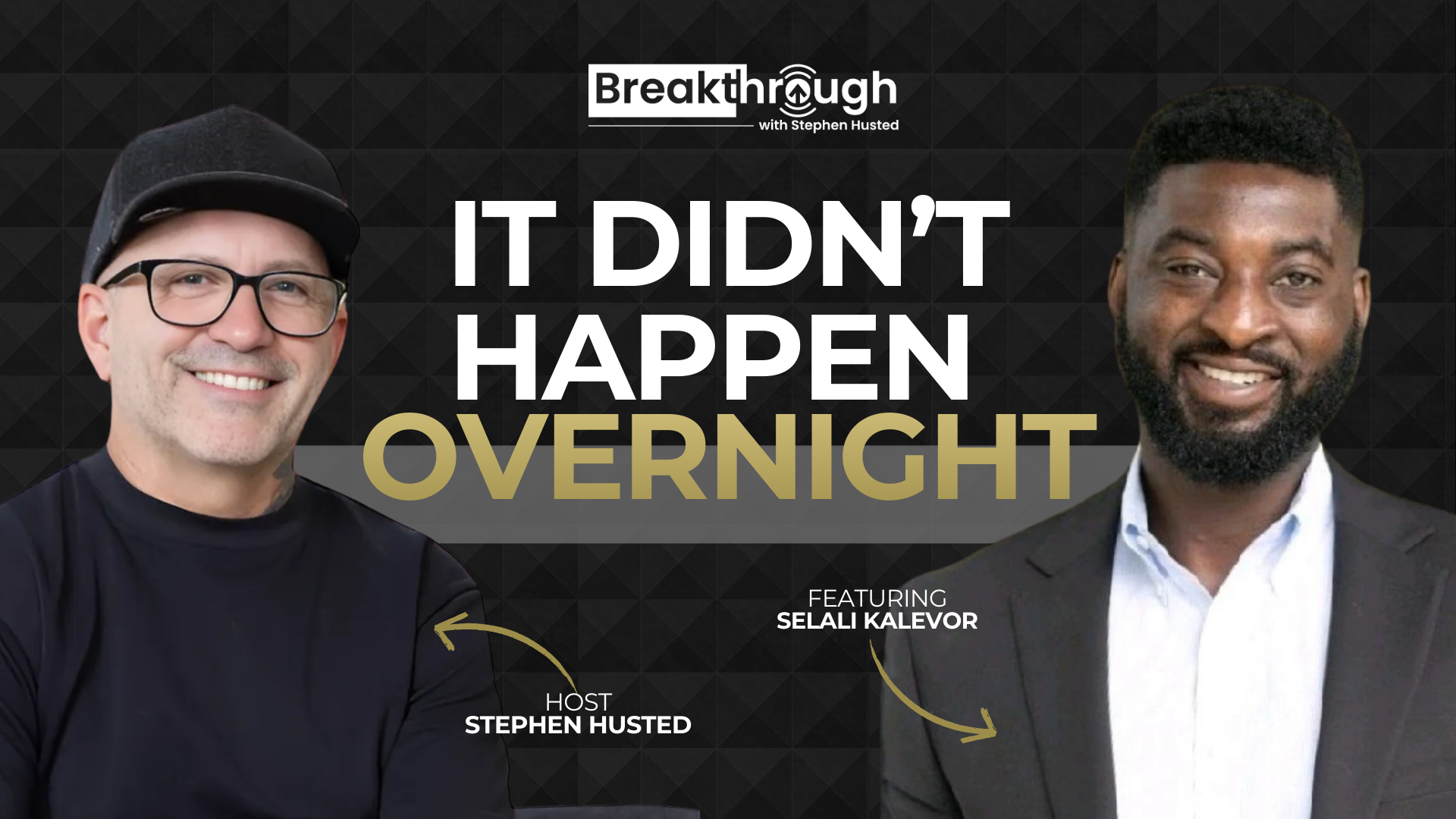
Episode 67 - Property Management vs Asset Management with Selali Kalevor
The people who truly had financial freedom weren’t just saving or investing in stocks. They were building through real estate and business ownership.
Most property managers collect rent and fix leaks. Selali does something different. A child of Ghanaian immigrants, finance grad, former wealth management analyst, and now a Seattle-based real estate broker and asset manager, Selali came to this conversation with a perspective you don't hear often. He doesn't manage properties. He manages outcomes.
In this episode, Selali Kalevo and Stephen get into what it really takes to build wealth through real estate, not just the strategy, but the mindset, the grit, and the willingness to impose yourself on the life you want.
Stephen and Selali talked about:
0:00 — Intro
4:35 — Selali's background & what drove him toward real estate
6:22 — The two wealth patterns he noticed among his richest clients
9:55 — Impose yourself on the situation" how he builds his network
10:11 — High agency mindset: no excuses, bring solutions
13:13 — Stephen's rock bottom story
21:34 — How he approaches landlords: "What is your goal with this property?"
22:00 — Case study: turning a duplex into a 5-unit development deal
29:15 — His 200-door goal and why he calls himself an asset manager
33:00 — Grit as his #1 superpower
42:24 — His 9-year plan
45:10 — The above, beside, and below accountability strategy
TRANSCRIPT
∎ Teaser / Highlighted Clip
[Selali Kalevor] (0:00 - 0:16)
Don't make it too complicated. Focus on your goals. Start reverse engineering it.
And one thing that really helped me to dissect my actionables for these goals was first principles. Start with the goal and then reverse engineer that into micro actionables that will get you there.
[Stephen Husted] (0:16 - 0:21)
You can tell the ones that are really hungry, and you also can tell the ones that are not as well.
[Selali Kalevor] (0:21 - 0:22)
Easy to spot when you have it.
[Stephen Husted] (0:22 - 2:42)
You can easy to spot too. I don't know what that is. I don't know how you have to understand.
I hear people go, I want to invest in, I want to do this, and they want this like instant gratification. And I go, what if I told you it took you, it would take you nine years to buy your first investment property? Would you still do it?
And they're like, probably not. Like, all right, that's cool. It took me nine years.
Yeah. But I never gave up on that dream. That's great.
You know what I mean? Like, how bad do you really want it? On everything, not just investing.
∎ Podcast Intro:
I'm Stephen Husted, and you're listening to The Breakthrough Podcast, a space designed for clarity, curiosity, and the stories that move us. Here, we step away from the noise and into the moments that define us. The early influences, the hidden struggles, and the breakthroughs that reshape our lives.
From personal reinvention to building a life through real estate and entrepreneurship, these conversations remind us that success isn't a straight line. It's a series of honest decisions, brave actions, and small shifts that change everything. This is where those stories live. Let's begin.
∎ Guest Introduction:
Today I'm joined by Salali Kalavor, a real estate broker, investor, and property management entrepreneur based in Seattle. Salali actually started his career in wealth management, working closely with high net worth clients.
And what he noticed was a pattern. The people who truly had financial freedom usually built it through business ownership or real estate. That realization pushed him to pivot fully into the real estate world.
Today, he's building a brokerage and property management company focused on what he calls true asset management. Not just collecting rent, but helping owners make smarter, long-term decisions with their properties. In this conversation, we talk about how he built his network from scratch in Seattle, the grit it takes to grow a real estate business, and how he's scaling his management company toward a 200-door portfolio.
So if you're interested in building wealth through real estate and thinking more strategically about your investments, you're going to get a lot out of this one. Here's my conversation with Salali Kalavor.
∎ Podcast Proper:
[Stephen Husted]
All right, we're live.
[Selali Kalevor] (2:44 - 2:44)
Awesome. Awesome.
[Stephen Husted] (2:45 - 2:47)
How's it going, buddy? Thanks for joining today.
[Selali Kalevor] (2:48 - 2:55)
You're very welcome. I love to have a conversation about real estate wealth building and goals in general. So here to take this where the conversation goes.
[Stephen Husted] (2:55 - 2:59)
Yeah, that's awesome. And you're based out in Washington, correct?
[Selali Kalevor] (2:59 - 3:10)
Yes, sir. Currently based out in Washington, Seattle, Washington, living on the east side Bellevue suburb of Seattle, the Ritz Carlton of Seattle, they say. But very enjoyable area, you know, love the nature.
[Stephen Husted] (3:11 - 3:43)
What a beautiful state it is. I swear, you know, but it tricks you. I'd come out there when I first started to invest out in Seattle.
I flew out there, I think it was like in May. And then I went in like July and I'm like, oh, this place is amazing. It's so beautiful.
And the mounds and the water and everything. It's just really cool vibe. And then I went there at the end of November one year, I was like, oh, OK, this is dark.
This is scary. I was like, I don't know if I could take this on.
[Selali Kalevor] (3:44 - 3:52)
Yeah, you have to be preoccupied in the gloomy winters, but it helps you keep focused on work. So when the sun comes, you really enjoy the summer. I got to say.
[Stephen Husted] (3:53 - 4:03)
Yeah. How do you do it, dude? I really am generally curious.
Like, how do you go through the weather when it's cold and dark for like periods of time? How do you stay motivated or want to get outside?
[Selali Kalevor] (4:03 - 6:54)
Yeah, that's a good point. That's a good point. So oddly enough, I was raised about three hours south of Seattle.
It's similar weather. Vancouver, Washington, on the border of Oregon and Washington. And then coincidentally, I picked up snowboarding in my early teens for the wintertime because I was an outdoor athlete for most of my life, played soccer.
So I got used to the weather when it came to competition. But like you said, going to get groceries in the rain is definitely not the funnest thing to do. So I always made it an effort to have something to look forward to in the different seasons out here.
Summer is pretty easy to keep busy. Very beautiful. You know, outside of that, December, January, February, try and get some snowboarding and hiking.
And then outside of those two specific seasons, just keep focused, keep grinding. Focus on real estate specifically. Go to networking events.
Keep motivated by being around motivated people in life. Life really opens up when you're around ambitious people and they're talking about, all right, it's October, you know, and Seattle is raining. What can we do?
Maybe we start a real estate project. Maybe we're flying to a different state. Just got back from Atlanta, meeting some gentlemen, building some DADUs in Decatur.
Pretty impressive guys. And they were moving the strategy of DADUs in Seattle, which is kind of the new thing in our area, to Atlanta. And we were talking about just generally speaking, appraisers can't even really appraise DADUs in Atlanta because it's not really a commodity.
It's not a productized service. So you see a lot of acre lots with a rambler with a thousand square foot. And one of my buddies is building DADUs here, has a friend in Decatur.
He's like, I have a little bit of money to spend. So funny enough, I just got back from Atlanta before our podcast here, and I was carrying pounds of concrete on my back with the boys. Just the learning experience.
I'm the real estate guy. I'm the negotiator. So I do property management and the sales.
But again, being around motivated people got me out of the weather. Landed in Atlanta, it was 70 degrees and I was looking around and the boys were like, hey, you can find us some deals in Seattle. I said, no, I'm getting dirty with you guys.
So we get trenches and lo and behold, they said this is going to be the first DADU in the zip code. And they hopefully will expand that service, not only throughout that suburb of Atlanta, but more into the city as well as density increases, zoning allows. But to your point, a long way of answering a short question.
Number one is keep a competitive sport, at least for me, for those folks that are competitive, snowboarding, hiking, do that to get yourself physically active and then mentally stimulate yourself. Whatever your vocation is, I know ours is real estate. Whatever your vocation is, really drill down into that in the wintertime, because when you get outside and it's gloomy, at least you can look to a nice nest egg for the vacation if you do want to fly out of Seattle and wait for June, July, August.
[Stephen Husted] (6:54 - 7:01)
Yeah, the beautiful time there. That's for sure. How have you surrounded yourself with like-minded individuals?
[Selali Kalevor] (7:02 - 9:02)
That was a great question. I guess I'll share a little bit of my background and then how I jumped into surrounding myself with those people a bit intentionally. But kind of the backstory is, you know, a lot of it came from motivation of self-reliance for myself goals.
You hear everybody talk about dreams. What are your goals? What are your dreams?
And that was a little bit too sappy for me when I was a younger guy. A lot of bravado in my early twenties. Dreams.
What do you mean dreams? Like, what are your goals? Figured out after college, you know, child of immigrants, African immigrants from Ghana.
So went the, wanted me to go to lawyer, doctor, engineer route in college, ended up studying finance, jumped into wealth management. And through my experience in wealth management, I saw the, if you've seen the Pursuit of Happiness with Will Smith, I saw that movie and I said, I'm going to be a stockbroker. That's what I want to be.
First couple of years out of school, I was in the wealth management space and that opened my eyes to what self-reliance and financial independence really meant. I was seeing a lot of commas behind liquid net worths and what that was doing for families and families being able to travel as they please, where they please. And I realized, wait a minute, through conversations, I was the analyst for this firm in Bellevue and I was able to have conversations about how they accumulated the wealth, what it meant for them.
What are their goals in life at this juncture of which they don't need work, right? And they're able to create opportunities financially for other family members. So that was very inspiring to me.
Now I got to have a lot of conversations where people opened up about their whole lives because we were talking about how to allocate their resources accordingly to mitigate risk and maximize gains, as well as allow them an income that would not touch principles. So I say that to say, spent a few years in that wealth management space and then realized for myself, my ability to create a similar outcome, I believed would solely come through physical real estate rather than stocks. I heard from a lot of the wealthiest clients that I ever worked with, they typically came from two routes.
[Stephen Husted] (9:02 - 9:06)
Okay. I want to know, what was the pattern that you've noticed between these individuals?
[Selali Kalevor] (9:06 - 11:05)
I think that's a key. Definitely. The two biggest facets that I found of those that were economically reliant was either came from a history of business ownership or self-employment or real estate, which is kind of a derivative of that, right?
One or the other. These are the biggest two commonalities I realized from these two folks. And the key to that I realized was number one with real estate is the unlimited vertical for an entrepreneur, right?
There's so many niches of real estate, right? We can discuss right. Property management, brokerage, syndication, development, general contracting, rehab, fix and flip, birth strategy.
I mean, you name it, real estate's got it nationally as well. You look at the landscape of Seattle, it's a very tech focused city. And one thing I know about tech, which I had to learn after the fact of being in a wealth management space, kind of archaic industry, love it.
You know, no disrespect, but we're definitely, we're always catching up to trends. In Seattle, you realize now, especially with bigger pockets, right? You can invest anywhere in the United States remotely.
You can manage properties remotely. You can do almost anything remotely. I have a couple virtual assistants, virtual team members that are rock stars for my business.
I couldn't do business without them. I couldn't even go through my schedule without my team members. All right.
So that was the thing I realized basically in tandem that it was the juncture that transitioned me to making these interactions with motivated people. So the short story of it is I started a self-employment venture as a mobile loan signing agent shortly after my wealth management experience, which even opened my eyes more. So basically I call it, I was the Uber for escrow documents.
So I did about 5,000 loan signings and I got to sit down with people who were transacting in real estate, buyers, sellers. People refinancing that earned me about 5,000 one hour interviews with people who were transacting in real estate. Because I'm sure, you know, Steven, that stack of loan documents is not small.
[Stephen Husted] (11:05 - 11:06)
It's not at all.
[Selali Kalevor] (11:07 - 11:08)
So I come to you.
[Stephen Husted] (11:08 - 11:09)
An hour could be three hours.
[Selali Kalevor] (11:09 - 14:27)
You got it. You got it. So sit down and have a conversation.
You know, it gets to a point where you memorize the kind of a structure of the appointment. And then I get about 40 to 30 minutes to say, Hey, what brought you to this table? And I'll just listen, you know, and these are people that would say, Hey, you know, refinancing my loan down to this amount.
My mortgage is changing from this. I'm going to reallocate those funds into my retirement. Another person saying, Hey, I'm acquiring this asset to redevelop and then build a townhome complex.
This is how the negotiation went. Hey, I'm financing this at this price. And then I'm going to refinance out my money.
And then I'm going to rinse that into the next property. So that got my mind prepared to jump fully into the work of brokerage and property management. So you asked me to circle back to motivated people.
I'm going to summarize it to this, right? I gained a pretty visceral picture of what I wanted for myself in life. I was able to get it to a point of clarity that allowed me to actively pursue it.
And it made it very clear for me to pursue people who I saw were doing the things I wanted, quite frankly, to make it quite easy for you. One of my closest friends owns a junk hauling business. And I kid you not, I met him doing a loan signing, grabbed his hand very firmly, looked him in the eyes.
And I said, I love what you're doing. I'm taking you out for lunch on Thursday. What time works for you?
I'll tell this to my, uh, the younger folks in my community, especially the young men. Sometimes you have to impose yourself on a situation, right? Not rudely, but as you see something you want, be comfortable fighting for it.
I'm willing to go into a room and say, look, there's three people I need to speak to and I'm going to speak to them regardless of what hurdles there are. Right. And this is how I teach my team as well.
Not big on excuses. I'm big on high agency, right? Don't talk to me about the hurdles.
Don't talk, bring up a solution. And then let's have a discussion about, Hey, if you want my help on drilling down this solution, but I'm the type of guy cold calling a hundred people a day. I'll door knock.
Hey, you've never met me. You don't know who I am. This is why I'm in front of you.
I come in peace. And this is what I'm trying to do for you. My biggest property management client just would close them about 60 days ago.
And I was cold calling and tried to get ahold of him about 12 times. And the guy said, I like your hustle. Here's one of my biggest properties.
I'd like for you to take care of it. And I tell this to all of my buddies as well. It's just, it's not sexy.
If you want it, fight for it. Right. And then it's nice to focus on outcomes, right?
But us as entrepreneurs, we have to focus on the inputs, right? Don't make it too complicated. Focus on your goals, start reverse engineering it.
And one thing that really helped me to dissect my actionable is for these goals was first principles. Start with the goal and then reverse engineer that into micro actionable is that'll get you there. You want a 200 door property management business by what date, how many appointments you need to set by that time?
What's your closing ratio? What are your funnels of sales and marketing? Same with brokerage, same with any entrepreneurial venture, but the entrepreneurial endeavor yields the derivative of economic independence, as we all know, all of us entrepreneurs, whether we fell into it backwards or we pursued it.
I feel that generally we are focused on that self-reliance, that comfort for our lives.
[Stephen Husted] (14:28 - 14:58)
Yeah. And you kind of learn that not knowing you have that vision, then you get the clarity and then you're reverse engineering it going backwards. And then you had, you're like, okay, what are these steps to get to this point?
You know, and then you, as you go through and you finally, maybe you execute and you do see some success from it. You look back at those steps that you took to get there. A lot of the times it's, at some points it's really slow.
You can even feel like you're going backwards, but then over long periods of time, you realize how much, how far you've gone, you've come.
[Selali Kalevor] (14:59 - 15:49)
You got it. I mean, I always tell, and I feel like I'm getting old cause I'm doing that with a young man yesterday. And he was just saying, he's thinking a lot about life.
And I just told him, don't be too hard on yourself. Because one thing I know, and my dad used to tease me about this is the best teachers in life is hardship, right? I always say it's empty stomach, empty pockets and heartbreak for some is the best teachers that you're ever going to have, but those are the lessons that really ingrain your character.
I know for me, the lessons that have crafted me that I could tell you in 30 years for the hardest times in my life, but I feel fortunate for those because any hard time you get through becomes a story to be told about an experience, a testimonial, not an opinion, right? You can tease. Absolutely.
Yeah.
[Stephen Husted] (15:49 - 18:01)
Absolutely. Yeah. And that's funny.
You just bring up something. I remember when I bought my first house, I had no business buying that house. None.
I was a drug addict. Didn't know anything about real estate. Should have never been buying it.
Was put in a situation from a friend that was lending and was like, you should just buy this house. Okay. I'm going to buy a house.
I didn't even know what closing costs were. Like I got in that house and everything I, at the worst point of my life, not the best point, the worst, like I'm going to lose this house. Then I got clean and I gained clarity and I knew I was going to have to rebuild everything from the ground up.
Every single thing. And then I read one book that like, Oh, I should learn how to invest in real estate. Okay.
As everything is bad, everything was bad, but I had clarity at that point. And it's just interesting. Now I look back, my story never started, but you know, the only thing that I remember about this buying that first property was I actually did a house hack.
And the reason why I did the house hack was I knew damn well, I couldn't afford the mortgage. So I'm like, okay, I got three bedrooms here. I'm putting two friends in and then I'll get my, what I was paying in rent to about what the mortgage was.
But back then, 2004, that's when we had arm products and that payment was fine at the point that it was at, but once it adjusted, it was like triple. At that point, it was so crazy. And I just remember and was so uneducated about the whole process.
Seriously, like no business buying that house. And I'm really serious about that. And I remember that payment adjusted.
I was like, what in the heck am I going to do now? This is insanity. And then I got my real estate license 2008, and then I watched the whole market crash and everybody's losing their houses.
So yeah, it's interesting how some of your, what you've gone through is what really fuels the direction you go down the road.
[Selali Kalevor] (18:02 - 20:35)
A hundred percent. Right. And I want to say congratulations on that journey as well.
That is definitely something that takes a lot of perseverance and strength to get through. And that's the hero's journey you just described as well. Because what is a leader without experience or testimony to hardship?
The best leaders I know come from household, like turbulent households. One of my good buddies, one of the guy that straight A's figured it out. But if you ask him about his story, similar household wasn't stable.
And my other, my biggest client, the one I just received fortunately on the property management side, similarly, tough background, got foreclosed on his first deal. I was building three, four, $5 billion projects in Seattle in his third. So I looked to him and those are the people that kind of gravitate towards as well, is that those that have came through hardship, you know, I had FOMO myself during COVID through all my life savings and my emergency fund on one property as well.
I was forced to figure it out because I knew I had a mortgage. I can't afford, but I'll figure it out. 15 days later, I had an Airbnb, 30 days later where I was a super host and still have that property.
And I still look at it and I say, I was sacrificing good food to make sure that house and mortgage was fed. But again, to your point, I got to say that the cheers to the hero's journey and real estate is really a vehicle to help you understand that journey, because it's one of those vehicles where typically you are coming into with debt and debt means you have to perform. It means it's calling for you every first of the month.
Something needs to happen. Something needs to be paid. Some property, for example, to your point, I do have a property management company that I'm growing as well.
And I feel very fortunate on that front because you can build it with no debt, just hard work and a phone, right? And it's pretty low leverage. You've just got to be committed to solution seeking.
But again, it's just the hero's journey through and through. There's a lot of variations of that journey, but the similarity of every hero's journey, those who are top performers in any industry is if you ask them, you'll find hardship is just about how far you dig deep and they're going to tell you. I chose to go to war with this hardship.
I didn't let this hardship define me. And that's the key about life, especially as an immigrant coming to America is just how bad do you want it? Right.
I looked to the right of my desk and I've got a note that says nobody cares. All right, David Goggins, just figure it out. If it's a 2 a.m. night, 3 a.m. night, if it's overnight, how bad do you want it? And it's going to kick you while you're down. Are you willing to go back and get back up and fight again?
[Stephen Husted] (20:37 - 21:40)
Yeah. And there's something to be said when you start from the bottom as well, you really have to do some serious soul searching and you really do need to under, if you have the clarity that, you know, you want to go down a different path, you also have to realize that path is going to test you in so many different ways. One day you could be on top of the world.
The following day, you can be second guessing your entire existence on what you're doing. And I think investing in general, that's one part of our life journey. Let's just call it what it is.
It's one thing, but it also teaches you things about yourself as you go along. Dramatically being an entrepreneur is it can be very rewarding and there's a ton of fulfillment from it. And then it can really push you down too and make you insecure at points on, you know, am I really good at this?
It's easy to, especially online to compare yourself to others and where they're going. And there's always somebody better looking, better body, more richer. That's a interesting ball game to play.
[Selali Kalevor] (21:40 - 26:12)
It is. And reading helps a lot to your point is just, I always, regardless of how far you get in this game is never ending. Get all your pieces.
I know I'm a big fan of Alex Hormozy and he mentions it, but at the end of your journey, you take nothing you win with you, call it a win or whatever. You get that five, 10, $15 million house, the $15 million of assets and liquidity, that private jet, whatever it may be. You don't take that with you.
When you go, you push all those pieces back to the center of the board. So one thing that has been helpful in that journey of entrepreneurship, right? For me, it was the just reading of Stoic philosophy as well.
Sometimes I do weird things. I'll sleep on the floor for a day to say, well, I'm thankful for having a bed. You think about the hardest thing that ever happened to you.
I look around myself and I wonder who's got it harder. Traveling helps as well. But in the entrepreneurial journey, I think I'm very fortunate with real estate because it's, especially in this day and age is you go on YouTube and you could find thousands and thousands of stories of very successful entrepreneurs that went through hardship, right?
And when it comes to the outcomes of real estate is just, we're very fortunate in this information age, technology age to just study those that came before us to say, Hey, you know, my strategy in real estate is property management for its recession resistance. And then I also like the asset management component of it from the real estate standpoint, because at its core property management essentially is just problem solving and a meeting of the minds. You have a landlord, you have a tenant, you have a contract in the middle.
Tenant foresees the contract means X landlord foresees the contract means Y you're in the middle to communicate to both parties to make sure they're both happy. So me personally, what I enjoy out of that relationship is number one. Again, imposing myself on the situation.
I spent this weekend sanding down doors, moving the hinges, fixing a hot water heater, changing door knobs, but out of that work, I was able to have a conversation with the tenant that say, Hey Salali, if I were to buy that piece of land over there and construct a new home, is that something you could help me So of course, earning the relationships, right? The, the landlord as well. He's like, I really appreciate you stepping out to do something that seems rudimentary, something that, you know, is not really the best use of my time, quite frankly.
However, it shows that I care because I do. I'm going to shake the tenant's hand and say, Hey, did I resolve the things that were giving you issue in this house? He said, yeah, dropped off my business card.
And now we can have a discussion about helping them find a home. Another one of my clients, a retiree, they own a couple of properties. And what I like to focus on is highest and best use analysis.
I got put on my pursuit of happiness hat. I say, I like to ask my landlords, what is your goal with the property? Right.
Cause sometimes folks are looking at it from a one dimensional lens. It's like, I want cashflow. It's like, that's not good enough.
Let's break that down. What does that mean to your life? Right.
It's like, well, I need X amount to live comfortably in my life. Here's my layout of my finances. So coincidentally, one of my clients had a property, a duplex, which she was generating income from in South Seattle, generating an okay amount, a couple thousand, and then we're discussing raising rents on the tenants, you know, which I said, of course, you know, that is my job.
If we need to have that discussion. However, again, what is your goal with the property? She said cashflow.
So we broke that down. So I did some research. So I realized that the duplex needed some deferred maintenance.
So the duplex is about, I want to say 70 years old. So I looked into the zoning records and I said, were you aware that your zoning was upzoned to a higher density? We have two units on this parcel.
You could add another three. You could actually redevelop the whole parcel into five units. And let me do you one better.
What if I could have you keep your rental income for two years, give you more income in the form of interest from an acquirer and then allow the acquirer to pay the tenants so they could comfortably vacate the home and then allow the developer to put five townhomes on that. How would that sound? And she said, slowly, that sounds amazing.
I would have never thought of that. So these are the things that I like to really focus on in my vocation. My trade of real estate brokerage is really the highest investment use analysis to make opportunities for everybody.
Make an opportunity for a landlord to sell this property, make interest income, because typically a developer is going to add market rates today. I mean, we're looking at 10 to 12% development costs. And I know everybody, we love the city.
We want to do everything we can to make sure we partner with them. But permitting typically is not a one month turnaround.
[Stephen Husted] (26:13 - 26:14)
No.
[Selali Kalevor] (26:14 - 28:05)
It might be six to nine months. And when you really delve into the finances, Seattle real estate, we're looking at median home prices around a million. So if you're buying an asset of a million withholding costs at 10% carry, I mean, you're spending $60,000 just in waiting for permits before you paid for the plans.
I structured this opportunity. And then not only that discussed a reallocation of the funds to earn the client more income. So in my bigger pockets discussion, I don't believe in property managers.
I believe I'm specifically an asset manager because my goal in my pivot to real estate was to use this asset of real estate as a vehicle for everybody's goals. The tenants goals, the landlord goals, and it's difficult to parse out a goal that suits everybody. But when you really care, you just ask about people's goals.
You really can find those solutions, right? For that landlord, you know, Hey, I don't know if raising rents is going to be the who of you to achieve your goals, right? One month of vacancies is going to wash away those gains.
How about we sell this property, reallocate your investments, maybe into a different real estate asset that performs better, or even maybe a real estate investment trust. We have multiple options. I can talk to the stock market focus.
If we want to have that conversation to those tenants, Hey, how long do you see yourself renting? Do you want to position yourself to buy the next couple of years? Do you want a house hack to your point?
One of my properties has an ADU on the bottom floor. Discuss with the tenant. Hey, you know, I know this is right at your budget, respectfully.
We've discussed with the landlord. He'd be open to having you sublease the ADU if you'd like, you know, supplement your rent, and if it takes you two years, three years to get qualified to buy a home, I'd love to help you with that. And let's talk about what that home means for you in five years.
Do you see yourself moving? All right, let's position yourself to make sure this home can be a rental for you. Get you that first step on that game of monopoly, as we call it here in the United States.
Right. Because this game is, it's a game of ownership. That's America.
[Stephen Husted] (28:06 - 28:07)
It's a building block scenario.
[Selali Kalevor] (28:07 - 28:08)
Building block.
[Stephen Husted] (28:08 - 28:31)
Absolutely. You brought up an interesting point. So I never thought of this.
I never asked my property management companies that, you know, what kind of conversations they're having with tenants? Is it strictly just, you know, them renting? Or is it like you, you just brought up, do they have their own goals to potentially want to buy at some point?
I guess, how do you approach that one?
[Selali Kalevor] (28:31 - 31:47)
That's a great question. That's a great question. And I will say typically I like to impose myself again on the situation.
Right. Number one, because you have to earn the trust of both sides to really make your life relatively easy, right? Because at the moment, one of your clients on either side thinks you don't care.
You're not addressing their concerns, valid or invalid. Regardless, you need to show that you care. Lost that opportunity.
So for my tenants, I'm very personable. I'm a seven day a week type of guy on, on shifts, Saturdays, Sundays, I'm working. I'm stopping by the tenants.
Whenever I move in a tenant, I let them know my background. I asked them about their background. Where are you from?
Why are you renting the property? Why does this suit you? What are your goals?
And I like to create a little bit of a profile. So I'll take notes because I always liked to, I read a book called the go giver. And that book essentially helped me to understand how to be a resource to everybody in anybody.
When you listen to their goals, you can connect people with resources as well. All of my tenants, they do have my cell phone. I don't recommend this to property managers, but when they call me, I'm there in 24 hours.
If I don't have, you know, and this is crazy, but my VA has really helped me to understand who I need to tend to, you know, they triage my calendar. But what, one thing I really do and I'll summarize it like this is I really focus on listening to goals. Why are you here?
Why is this a good place for you? Like one of my tenants that just moved into South Seattle said, Hey, I'm from Arizona, you've got a great job in downtown Seattle with this XYZ technology firm. We're going to rent for a couple of years.
We're waiting on identifying when it makes sense to sell our Arizona property to maximize on the two, five rule for capital gains, residing in the primary residence for two out of five years. We're currently renting it. Once we sell that, we're likely going to buy here in the next one year to two years.
I said, Oh, that's awesome. You know, let me ask you, would you be looking to buy a house similar to the one you're renting? It's like, we love the neighborhood.
We probably would just convert it to this. So, all right. Were you aware that the landlord is also a builder and general contractor, and he has the plans for this building.
We might be able to alter them slightly in the next year. If you were interested in buying a house like this, just like that is wonderful. So that we had an hour conversation about a future purchase.
But the short of it to be honest with you, Steven is having an intense be interested, and that's the key. If I can summarize it in one sentence, it's be interested rather than interesting. I try to have an 80, 20 principle when it comes to me learning about somebody and I'm sitting down and I'm not on a podcast, just throwing out all of these goals is I try to speak 20% of the time and listen 80% of the time.
And I feel that I really need to save this information. I'm pulling out my cell phone and I'm taking notes and I ask them respectfully. I love your goals.
Mind if I take a few notes about those and I'll save it in the CRM and I'll go through every properties notes for the landlord and tenant, go through goals, try and memorize birthdays, try to memorize anniversaries, move in days, and let them know, Hey, I'm a human too. I'm not a robot. I'm not going to call you just when something's wrong.
Sometimes I'll call my landlords just to check in. How are you? How was the new year?
What are you looking forward to this year? And that is my focus for my business.
[Stephen Husted] (31:47 - 31:56)
Phenomenal. I love that you're taking notes on, you know, just what people are into and what they're doing. That's a brilliant move.
How many doors are you managing now?
[Selali Kalevor] (31:56 - 32:09)
So right now I'm just under 30 and we're being very selective on who we onboard. So, like I mentioned, we're focused on asset management rather than property management, so I'm systematizing these conversations because I'm getting.
[Stephen Husted] (32:09 - 32:11)
I like how you did that. I like how you're framing that.
[Selali Kalevor] (32:12 - 34:44)
We definitely, we don't accept everybody. So we do interview people that we onboard. So we actively offer leasing analysis, a complimentary, or I call it highest and best use analysis.
So we identify the property, make sure that we're a good fit because I really like, I tell clients upfront, you know, I'm not a property manager, I'm an asset manager. I'll get you your property rented and fully compliant, but my goal is to make sure we have a relationship so I can be your go-to for any real estate discussions. So our expectation is within the next 18 months, we want to get to 200 doors.
So we're organically climbing. We should be breaking 35 here within the next two weeks. But right now our big focus is that 200 door count to focus on where we want to pivot, because at that point at 200 doors, we're going to be either a franchisable or sellable opportunity, so I believe this is something I'm going to hold close to heart for quite a bit more years.
I don't know that I have it in me to sell my nest egg because it took a lot of time to get the momentum on bigger pockets prior. I was working with a team and since then I've pivoted to do my own, build my own shop so that I could cater to clients in the manner I saw fit because people are really not delving this deep into people's relationships. I can tell you that from the competition, it's just something that's difficult to do at scale.
And as a founder of a company, I believe my best time is focused on those tenants and landlords talking about goals. The rest I can operationalize, but what I've found is me specifically, I do have that niche specific skillset of having that conversation about goals and then crafting that into a material opportunities. We're also selling quite a bit as well.
Our team is very busy, but the goal is by Q4 next year is 200 doors. By Q4 this year, 50 doors, operationalized, fully systematized. And then Q1, 2027, don't want to let out all the secrets, but I have some big things in store for the company, but 200 doors is my expectation by Q4, 2027.
And we'd love to have a conversation at that time and see where we're at. But we've started growing a lot in the last 90 days and I've been the chief slowdown officer primarily because technology is not my strong suit. So websites, all the, you know, the bells and whistles, I'm the type of guy to walk to your door, shake your hand and say, let's have a nice beverage and talk about goals in life.
And my virtual team members are saying, Salala, we need to do this with the website, this with the website. I was like, Hey, you got this. Call me if you have any issues.
[Stephen Husted] (34:44 - 35:08)
Yeah. And that's, you have to understand that as well as a business owner, a CEO of your businesses, you definitely have to understand, you know, what are your superpowers and the rest needs to get delegated first and foremost, else you're basically jumping into doing stuff that you only can do half-assed instead of, you know, having that put onto somebody that's probably way better than you at doing it.
[Selali Kalevor] (35:09 - 35:09)
Yeah.
[Stephen Husted] (35:09 - 35:39)
And you have to free up to, you have to get to the point where you're doing the things that are going to move the needle the most, and that's where the VA's definitely come into, I say this all the time, you know, there's days, you know, when I'm just not feeling it. And that's okay, because I know I have a team behind me that are really working hard and see the vision and know where we're going. And that is such a key to growth, I think, in any business and your superpower.
So I know you like to talk to people, but what else do you see? What else, if you had to like pick a couple, what are they?
[Selali Kalevor] (35:42 - 35:45)
Grip, I'm going to say, it's got to be the biggest thing, quite frankly.
[Stephen Husted] (35:46 - 35:51)
This has been the word. I'm not kidding you on like the last three podcasts.
[Selali Kalevor] (35:52 - 35:52)
Really?
[Stephen Husted] (35:52 - 35:57)
That I've had on. Yes, absolutely. Grip keeps coming up.
Comes up.
[Selali Kalevor] (35:57 - 40:13)
It's funny because it's really been a defining part of my life just because in my background, I've always been in arenas where it's kind of like I look around and if I'm just speaking generally to the folks around me, I've noticed that I've always had to definitely fight for the opportunities that I'm looking for, which I'm totally fine with, for example, very fortunate to be on a top performing brokerage team as well.
We sell, we're a top 1.5% team in the state of Washington in terms of volume. And I'm relatively new to the brokerage world, not necessarily new to business, new to the brokerage world, but I acclimated to this team and I was interviewed and the managing broker of the team, he asked me, he's like, Salali, why should I be on your team? And then I leaned in and said, cause I'll outwork every one of the team members on your team.
You tell me what the metrics of success are and I'll double it. And it's funny because a lot of my very good friends say this about me as well. I have a buddy that owns a seven figure cleaning company and calls me for sales advice.
I always tease him. I say, Hey, look, I'm trying to catch up to you. I always call him.
I said, Hey Ali, you know, he's got a team of 50 subcontractors doing cleaning for hospital contract. He's kicking butt. Right.
But I say this to say, I'm the type of guy where my managing broker said I can point and shoot Salali. Like today I'm going to be at 150 dials before 2 PM. Like I have a block of time for that.
My VA is going to do another hundred. We're at 250 for today. We're going to have $3,000 minimum done by the end of this month.
And that is our commitment minimum. I'm going to meet a new person at least, well, not just one person. My minimum is three new potential clients per week.
If I don't do that, that's a failed week. Regardless of whatever I have doing, regardless of if I'm working with four buyers and three sellers at the time, regardless if I'm selling through five town home listings and I'm doing open houses every single weekend, like without fail, I will meet new people. So I say this to say, grit is a good all encompassing focus, but I've got to say, you know, cause I was a pretty average student, but when it came to being in wealth management, left wealth management with five investment licenses that my dad said, wow, I know folks in their forties and fifties that couldn't get that license.
I said, well, you know, when you want something more than you want to breathe, when you want something more than you want food, when you want something more than you want water, it really defines your effort level. I told my managing broker, I'll sleep on a box on the sidewalk to figure this out. Like I am all in everything I need to do.
I have no emotions about feedback for growth when it comes to entrepreneurship, when it comes to real estate. But yeah, I've got to just say grid because the one thing about grid is it's an adaptable trait. You don't need to be special.
You don't have to have extra horsepower up here to have grid, but you don't have to have a perfect SAT. You don't have to have a perfect test score. You don't have to know all the people, but you have to be willing to say, like I came into Seattle knowing three people, you know, my first year in business, I sold a decent couple million dollars of real estate, but it came from grit.
Like I look at the deals. I'm like, most of the people that I did business with never knew I existed in the year that we transacted. I'm working on a few million dollar projects right now.
And two of the clients that I'm working with right now is I never knew Salali existed and he imposed himself into my life, you know, I say that respectfully, because when you impose yourself with a good smile, I'm kind of easy to spot in a crowd about six foot and kind of easy to see, so it's like, fortunately people kind of gravitate towards me by my good friend says I need to smile a bit more, but when I do, it becomes pretty easy to make friends, but again, that 80, 20 principle, try to reverse that. And I listened for 80%, talk for 20%. And my go-to line, you put me in a group of 200 people.
I'm going to meet 150 of those people within two hours. And my go-to line is shake a hand, meet a friend. What's your name?
And that's it. What were your jobs growing up? Oh, I love that.
I love that. Funny enough, up until I was 22, I challenged myself to get, but so have you seen dirty jobs with micro?
[Stephen Husted] (40:14 - 40:14)
Yeah.
[Selali Kalevor] (40:15 - 40:50)
I focused on getting the hardest jobs I could find because coming from really, that's what your, that was the goal. That was the goal. And part of it was a chip on my shoulder because my dad coming from Ghana, he always used to say, you know, I came from a village in Ghana and this is what I was.
I created like, he always used to talk about the hard jobs he had and he used to hang that over my head because he felt I had a more comfortable life. So he said, I used to be a dishwasher like for months on end. It's like, I did that or I worked at Chipotle.
I used to wash about 250 dishes per shift, like by hand, like hot water, blisters, all that. I was a laborer. I worked on it.
[Stephen Husted] (40:50 - 41:17)
I like washing dishes. I don't know. There's something, I don't know.
It's something calming that like, it breaks the pattern of my, my brain from going crazy all day. Like if I get home, there's like maybe a few days, it's like, oh, okay, I'm just going to clean the dishes. And there's randomly, I heard that Jeff Bezos does the same thing sometimes.
That's hilarious. If you haven't yet been traumatized, grab the dishes, clean the dishes.
[Selali Kalevor] (41:17 - 42:44)
You got it. You got it. And that's where the grit comes from too.
I guess the last job of security, one of the defining ones was I worked on a tree nursery and I think it looks great, but I mean, I'm talking probably the hardest physical labor I've ever, I lost about, I mean, I'm about 210 pounds now. Back in college, I was probably 190. I lost about 25 pounds that summer from being out in the heat, planting trees, creating dry river beds, I was working with felons and they became my friends.
But then I learned, wait a minute, this is a job that will define me for the rest of my life to say, Hey, if I can do this, I can do anything. Pulling trees out as stumps by hand, shovels, pickaxes, jackhammers, ATVs, dragging these trees out, loading them on the trucks, replanting them, getting cuts, bruises, broke a finger, closing one of those tree delivery doors, slammed it right on a finger. Next day I had a cast working just with my left hand and my buddy was helping me is like throw concrete bags on my shoulder.
I had to cast on one hand, one on one shoulder, one on the other shoulder. And owner was definitely, if I could think of a Navy SEAL instructor, he's definitely that guy who's like, rub some dirt in it and let's get back to work. He's like, oh, it's swollen, throw it in some ice, let's get it back to work.
Do you consider yourself a deep thinker? When I'm by myself, yes.
[Stephen Husted] (42:45 - 42:59)
Let's say the year is starting to end, right? And you're kind of reflecting on that year on that path. And now, you know, you're going to go into a new year, which is kind of in real estate, a reset.
So to speak, right? And a lot of things, you start to set new goals. How do you get to that point?
[Selali Kalevor] (43:00 - 45:21)
That's a great question. I start with the why. Is my why from last year, the same as this year, right?
And this comes to first principles. What am I in pursuit of? What is my hero's journey?
I start with the why, because so far for the last five years, my why has been the same or six years since Q1 of COVID, my why has been the same and it really starts from what is the life I'm trying to create for myself? I drew a picture. Everybody has a different picture and that picture involves, I'll just speak generally, it involves a bit of acres.
I'd say more than 10, less than a hundred. It involves me having the financial wherewithal to have a certain quantity of my relatives. I won't throw out the number, but I have a handful of relatives that I'm very passionately interested in having, be able to live comfortably on my property.
Number two, number three, that economic self-reliance. I have a number in my head. I've created a factor of 5% interest rate that'll allow me that comfort in perpetuity.
So that number I'm in pursuit of, but to get to that number in summary, speaking to, thinking deeply, I realized this roller coaster of entrepreneurship. My goal didn't need to be a derivative of the highest dollar amount I make in entrepreneurship, but my ability to soothe out the roller coaster, right? There's a lot more high leverage opportunities that I could look into, high ticket closings, things of that nature, but I thought to myself, I'd said, it's not so much the home runs that I need to make as much as consistent second and third basis.
What are the vehicles that allow me that? And I said, property management and brokerage. And pretty soon I'll be dabbling into ground up development.
That is my third approach in this business. And then fourth will be syndication. So that'll be accomplished in the next four years.
I'm going to have these four tiered businesses in synergy, and that will allow me to engineer this outcome, this dream I have for myself. I've got a nine year plan to make that happen, four years to get the businesses systematized, nine years to achieve the goal, but that's really the motivation and it's just me being philosophical, sitting down and saying, what do I want out of life? And does it align with the habits that I'm keeping daily?
[Stephen Husted] (45:22 - 45:24)
Do you get impatient by your goals?
[Selali Kalevor] (45:25 - 45:26)
Yes, very.
[Stephen Husted] (45:27 - 45:31)
That's the, that's the most wildest thing to go through.
[Selali Kalevor] (45:31 - 45:33)
Oh yeah, man. Yeah.
[Stephen Husted] (45:34 - 45:45)
Patience is definitely, I cannot say that's on my list of things that I'm good at. I'm impatient, but I'm patient, which is strange. If that makes any sense.
[Selali Kalevor] (45:45 - 46:59)
No, it does. It does cause if you operationalize the word is what do you need to do in the meantime, right? Cause you become impatient when you're only focused on the outcome, right?
But if you can figure out what to occupy yourself with in the meantime, and this is, again, I got a shout out to Alex Ormosi, he's been a very impactful internet presence for me, but when I thought about that, I realized, all right, this is the goal that I want, and I'm looking at other people that are close to the kind of the life that I would want, which is not really helpful. Comparison is a thief of joy, stoic philosophy as well. So I just try to stuff all of the.
Impatient thoughts to the side and just focus on doing the thing, right? If I'm feeling impatient, could I pick up the phone and do another dial? Could I have another conversation?
Could I be talking to a client about goals? Cause I feel like the antonym for impatience is action as well. If you're taking action, you can't focus on the non controllables.
If there's controllables that you can take care of to get you to your goal faster, attack them with violence, with violent effort, violent work ethic. But if there's non controllables in the situation to achieve your goals, there's no use to worry about it. So that's how I try to roll.
[Stephen Husted] (46:59 - 47:23)
Yeah. It's definitely a balancing act in itself. How do you handle the things that in the back of your head, you haven't been putting in the work because we have them, you know, we have those.
And that could be some type of fear, some insecurity, something that's, you know, we know we should be doing it, but we're not doing it, but that doesn't take away the fact that we are doing a lot.
[Selali Kalevor] (47:24 - 47:25)
A hundred percent. A hundred percent.
[Stephen Husted] (47:25 - 47:46)
Do you know what I'm saying? It's something that, you know, you have to lean into and you understand that process. We do every little thing that we do.
We understand where we're going with it. It's just like, are we going to take that step or do we need to put our, our attention and other things, but we do know that we need to work on this part because this is probably going to make something else better too.
[Selali Kalevor] (47:47 - 49:30)
Right. That was a great point. Specifically for me, the way I do that is.
So number one, I call it the above the side and below strategy. So the above, right. I've got a mentor who we talk about goals on the business side, very successful gentlemen, shout out to Daniel owns another cleaning company.
Great, great dude. So he pours into me. And for example, one of our conversations, he says, slide right down your top 10 goals.
He looked at them. He's like these nine, throw them away. Focus on this for the next two weeks.
And that two weeks later, we have a conversation. How did you achieve those goals? And just as an attestation to my goals, if I really want them, I will perform my up strategy, my side strategy.
I have an accountability partner. I have a buddy that checks in with me. We talk about our goals very openly.
And he asked me slowly last week, we had a discussion about this. Did you achieve this? I'd ask him, Derek, we spoke about this being your goal in the next 90 days.
What is your progress on that? We were just speaking last night about cold calling. Did you achieve your volume, your down strategy, your mentee, find somebody you can pull up the mountain as well.
Somebody you can pour into, are you speaking to them about testimonials again, or opinions? A lot of people have opinions. It doesn't come from hardship.
Are you speaking through testimonials? Hey, young man, I'm telling you this because if this is what I did and this was the outcome, the testimonial, it's like, Hey, if I were in your shoes, this is what I would do. A lot of people like to say that.
I'm like, no, you know, I threw everything I had on a property. My loan officer told me I should buy it. It was a bad strategy, but I figured it out by house hacking, right?
So it's testimonial that gravitates for a lot of young men, especially that want to learn from experience, not from what I saw online. That sounds good.
[Stephen Husted] (49:30 - 50:55)
Yeah, I totally agree with that. I totally agree with that. That's interesting.
You bring that up. Lately, I've been speaking at rehabs and just trying to get that energy to these individuals to push them in that direction. And it was interesting the first time I spoke, because I remember how I was when I was in rehab.
You know, I don't think it's like, you don't want to hear this, like you're just hanging on. You want to make it through. You've got a lot of things to clean up and you just really don't even know who you are at that point.
So I tried to keep it more on the story of where I was and where I am today, but kept that where I am today more light to kind of give them more permission, like, look, stay with this. It's not going to be a perfect lineup to where you want to go and you're going to have a ton of self-doubt and you're going to gain a lot of knowledge if you stay with it, whatever that is. And it was interesting because afterwards they got done and I was that wasn't like an AA meeting at all, like, all right, well, this is what I'm coming to tell you.
If you take some of that information and it goes in the back of your head and you stay clean, great. That's showing grace. And I think that's another big part of our entrepreneurship journey is helping others.
You get those people come in front of you for whatever reason they want to get into real estate or they want to do this. They want to start their own business. And you can tell the ones that are really hungry and you also can tell the ones that are not as well.
[Selali Kalevor] (50:56 - 50:57)
Easy to spot when you have it.
[Stephen Husted] (50:57 - 51:54)
It's easy to spot too. I don't know what that is. I don't know how you have to understand.
I hear people go, I want to get investing. I want to do this. And they want this like instant gratification.
And I go, what if I told you it took you, it would take you nine years to buy your first investment property. Would you still do it? And they're like, probably not.
Like, all right, that's cool. Took me nine years, but I never gave up on that dream. That's great.
Do you know what I mean? Like how bad do you really want it? On everything, not just investing.
I think the more you can stay locked in and really try to go to where you want to go with your goals. You wake up so excited. You know what I mean?
Your week seems like, Oh, what are we doing this week? You know, like I feel like if you get to that point where these goals, you have so much energy going towards them. That doesn't feel like work.
It's work. It's a ton of work, but it brings so much fulfillment that, you know, you want to keep going through. It's almost like a drug.
I feel like I just replaced drugs. That's what I did.
[Selali Kalevor] (51:55 - 51:59)
Well done. This is a good vehicle for that.
[Stephen Husted] (52:01 - 52:14)
Yeah. That's why I get so excited talking to other entrepreneurs. You know, we speak a language, especially when you're going through things, you know, and we tell each other stuff.
It's interesting to hear how it brings up some of the things that we're going through. And we could, it could be unrelated too.
[Selali Kalevor] (52:16 - 53:06)
And to that point, I mean, again, man, I've got to say a huge congratulations, Steven. What a journey. I'm proud to see it.
Yeah. The hero's journey is never, it's never great when you're in it, but I mean, it's just your ability to leverage your experience and testimonial to pour into others is very impressive, so I want to say again, it's been a great conversation with you and I would expect we have a couple more at least, but man, proud to hear it and you being able to pour back into your community and that's, I believe for those entrepreneurs that want it hard is like, once you feel like you're getting through that hero's journey, you're getting towards your goals, a bit closer. You have a system, life is on the up and up.
It behooves us to pour back into those that need it, right? It's just, all it is that one conversation that may change somebody's life forever.
[Stephen Husted] (53:06 - 53:06)
Absolutely.
[Selali Kalevor] (53:07 - 53:38)
So if it's one person or a group of people, right, it's, that's really what life is about. Get through the journey. Don't make excuses, right?
I'm big on high agency. You're a high agency guy. The world doesn't happen to us.
We happen upon the world. If the world kicks us, we're kicking back. If it bites us, we're biting back.
If it gives us a left hook, we're giving a right back, you know, but high agency. Same. You said it took you nine years.
I think I was right behind you, seven and a half on my phone. Yeah, I was right behind you, right?
[Stephen Husted] (53:39 - 53:40)
But you were locked in, right?
[Selali Kalevor] (53:40 - 53:41)
I was locked in. I knew.
[Stephen Husted] (53:42 - 54:22)
It's hard to go through it because you're seeing what's going on, different time period for me, because there wasn't really any social media, but it was like, I know that this vision is going to come, but I have, these are the steps I got to put all this work in. This is what I got to do to get there. And it's not going to get handed to me.
It's, it's just not. And you might see people that get it easy. You can find people that start in real estate and just start to crush it right off the bat for whatever reason, how that happened, or they bought a stock or they bought Bitcoin or did whatever.
And it blew up real quick. There's some outliers there. But for the most part, most people, it's been a slow burn.
[Selali Kalevor] (54:22 - 54:23)
Yes, sir.
[Stephen Husted] (54:23 - 54:39)
Slow burn. And a lot of people don't see that, but it's taken decades to get to that point. And you got to be able to put that type of vision together and that kind of timeline to see what it's all about.
[Selali Kalevor] (54:39 - 54:40)
Yes, sir.
[Stephen Husted] (54:40 - 54:44)
This is good. Glad you had, I'm glad I had you on.
[Selali Kalevor] (54:45 - 55:18)
I appreciate it. It's been an honor. As we are entrepreneurs, we all have similar goals.
And I think this is, we need more of this, right? Interactions, talking about candid objectives about life goals. Why are we doing what we do?
Because this world, I mean, it's a lot of uncertainty, but the one certainty is, and we've said it multiple times is grit will get you through. Look around yourself and look at what you're thankful for, whether it's running water, clean water, or a bad place to put your head, but just keep grinding because goals that are earned easily are not worth the time.
[Stephen Husted] (55:20 - 55:25)
Absolutely. That was great. Perfectly said.
I think we'll end it right there because that was it.
[Selali Kalevor] (55:26 - 55:27)
Love it.
[Stephen Husted] (55:29 - 56:08)
Really appreciate you coming on today. I'm so glad we're going through this new route of finding our guests. And it's interesting because before a lot of the guests that I'd have on, I've been following them for a while.
So I kind of understand them and now it's people that I really don't know. And it's just, it's a breath of fresh air to get people on and get inspired and walk away from taking something from this conversation and put in the back of my head. And I think I usually think about all, everyone who I have on my podcast, when I'm done, a couple hours, I kind of think about the conversation and how do I apply some of the things that I heard and learned?
It's really cool. So I appreciate you jumping on today.
[Selali Kalevor] (56:08 - 56:13)
I appreciate the time. It's been an honor. And hopefully I gave a little bit of value to you and your guests.
[Stephen Husted] (56:13 - 56:19)
You did. Yeah. You dropped some wisdom.
It was great. All right, buddy. You have a great day.
Okay.
[Selali Kalevor] (56:19 - 56:19)
You as well.
[Stephen Husted] (56:20 - 56:20)
I'll talk to you soon.
[Selali Kalevor] (56:21 - 56:21)
Sounds good.
[Stephen Husted] (56:21 - 56:22)
So much.
[Selali Kalevor] (56:22 - 56:23)
Thank you.
∎ Podcast Outro:
Thank you for tuning into our show where we hope you found inspiration and gain valuable insights. If you enjoyed this conversation and want to stay updated on our latest episodes, be sure to subscribe to our podcast and share it with others who might benefit from it. We appreciate your support and look forward to bringing you more candid conversations and breakthrough moments in the future.
Until next time, take care and keep exploring new ideas and strategies.