Episode 68 - How They Built 26 Units Through BRRRR and Smart Partnership with Sam Farman
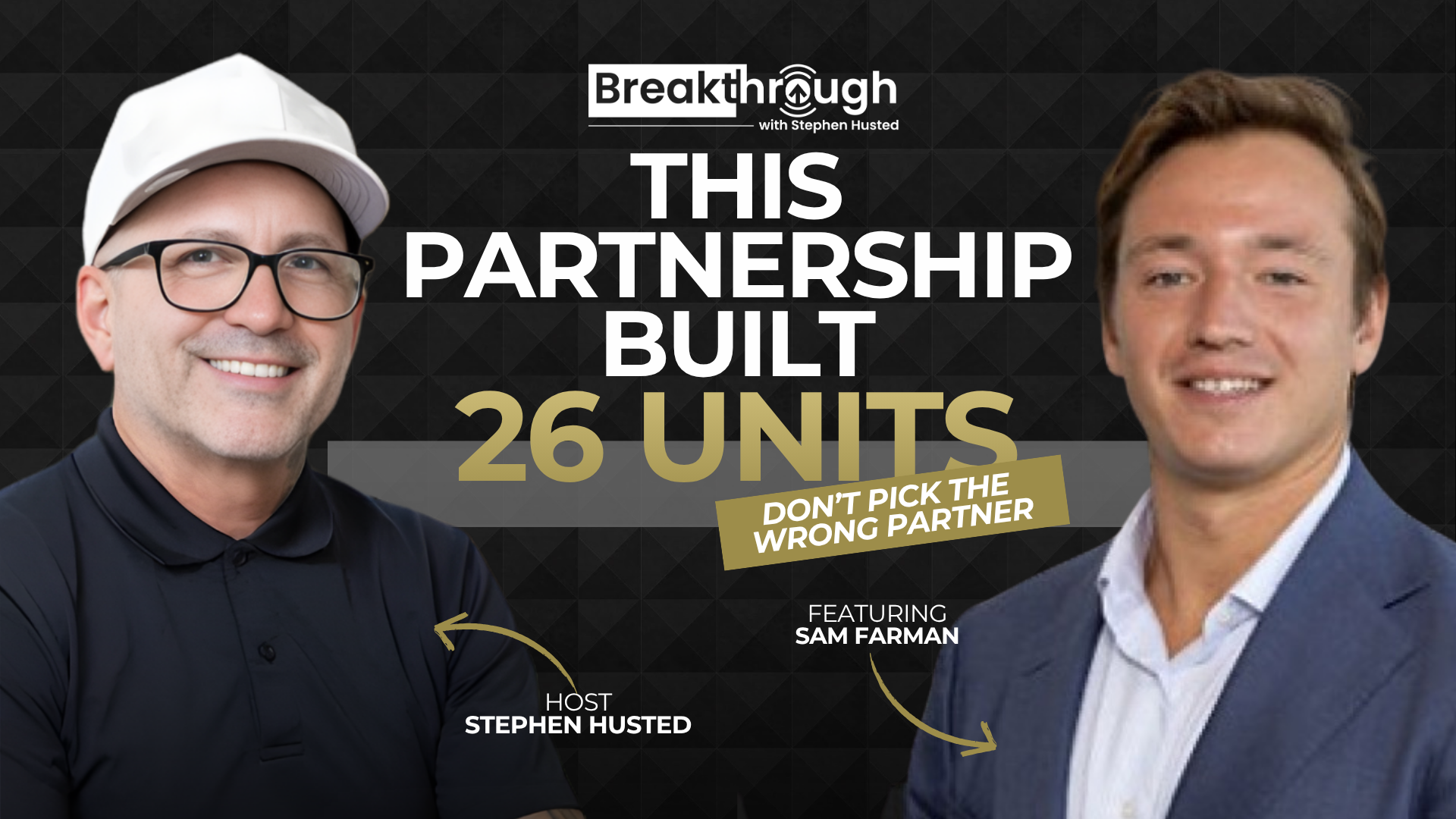
In this episode, Stephen sits down with Sam Farman, a New York-based real estate investor who, alongside his business partner Joe, has spent the last several years steadily building a rental portfolio that now includes 26 units. Their story didn’t start with a giant apartment building or a flashy first flip. It started with learning the fundamentals, buying smaller properties, using the BRRRR strategy, and figuring things out one deal at a time. Sam shares how they went from their first duplex to scaling into multifamily rentals, why having the right business partner matters more than most people realize, and how some of their biggest lessons came from things going wrong, not right.
Stephen and Sam talked about:
00:00 Intro and Greetings
04:13 How Sam and Joe Started
05:55 First Deals and BRRRR
07:39 Scaling to 26 Units
10:10 Partner Strengths and Roles
15:47 Choosing Partners Wisely
21:23 Burst Pipe Lessons
28:29 Fixing Costly Breakdowns
36:22 W2 Job vs Going Full Time
38:54 Making It Work While Working
40:38 Advice for New Investors
44:40 Lessons From a Rough First Deal
48:25 Marathons and Investing Mindset
52:01 Final Thoughts
TRANSCRIPT
∎ Teaser / Highlighted Clip
[Sam Farman] (0:00 - 0:17)
We've grown to a 26 unit portfolio, mostly two bedrooms and three bedrooms, some mixed use, but mostly residential. And looking at hopefully closing within first quarter of this year on another six to eight units, which would be very exciting for our portfolio.
[Stephen Husted] (0:18 - 0:45)
The first day of lockdown. So we own a loft in downtown San Jose. And that first day of lockdown, the stock market crashed.
It was a midterm rental. So we had somebody in there was fully furnished and they called me and they said, Hey, we're going back to North Carolina. We're out of here.
We're leaving in two hours. And so they just pack up and leave the furniture is ours. And then a neighbor calls me and goes, we have a bursted pipe.
Your unit's flooding.
[Sam Farman] (0:45 - 1:17)
I think it's mandatory. If you want to be successful again, I think there's a lot of misinformation being taught right now that you can buy a duplex and repaint the walls and then it will rent for quadruple the market rent. And you're going to move to Bali and never come back.
And you're just going to collect your rent check. And then when you come back in five years, that property will have 10 X magically. I'm making a comical example of it, but that is what a lot of people think.
And it's not true at all.
∎ Podcast Intro:
[Stephen Husted] (1:18 - 2:51)
I'm Steven Husted, and you're listening to The Breakthrough Podcast, a space designed for clarity, curiosity, and the stories that move us here. We step away from the noise and into the moments that define us, the early influences, the hidden struggles and the breakthroughs that reshape our lives from personal reinvention to building a life through real estate and entrepreneurship. These conversations remind us that success isn't a straight line.
It's a series of honest decisions, brave actions, and small shifts that change everything. This is where those stories live. Let's begin.
∎ Guest Introduction:
Today, we're talking about what it really takes to build a real estate portfolio from the ground up. I'm joined by Sam Farman, a real estate investor based in New York, who together with his partner, Joe, has spent the last six years growing a rental portfolio to more than 25 units. Like many investors, they started small, learning the fundamentals through the mortgage industry, studying resources like bigger pockets, and taking action on their first deals.
In this episode, we talk about how they use the BRRRR strategy to scale from a small duplex into multiple properties, what it takes to build a strong partnership, and the real lessons that come from managing properties and dealing with the unexpected. So if you're thinking about getting started in real estate or scaling your portfolio, this conversation is packed with practical insights. Let's get into it.
∎ Podcast Proper:
Cool. Sam, how are you?
[Sam Farman] (2:52 - 2:57)
Doing well.
Thanks for having me on. Been super excited about this. Yeah.
[Stephen Husted] (2:57 - 3:00)
Yeah. It's awesome. So we didn't get Joe today.
He was busy.
[Sam Farman] (3:01 - 3:07)
Yeah. Conflict came up, but that's okay. I can speak for the both of us.
And I'm sure he's okay with me saying that.
[Stephen Husted] (3:07 - 3:12)
Yeah, not a problem. So how's it doing out in New York right now? Is the weather still bad?
[Sam Farman] (3:12 - 3:20)
Yeah, it's cold. The snow, the big snowfall has come and gone, but it's definitely cold. I grew up around here.
I think we've seen it before.
[Stephen Husted] (3:20 - 3:21)
This is nothing new.
[Sam Farman] (3:21 - 3:23)
Yeah. Nothing to go too crazy over.
[Stephen Husted] (3:23 - 3:41)
Yeah. One of my business partners, she's in Chicago, and she just sent me two photos of, I guess there was a broken hydrant, and that water froze and went higher and froze around the cars. The cars, nobody's getting out on this whole block.
And it was just the craziest photo.
[Sam Farman] (3:41 - 3:52)
I live in New York City. I don't have a car, which in my opinion is just a wise decision. The people who have cars in the city have been struggling.
That I sympathize with.
[Stephen Husted] (3:53 - 3:56)
Yeah. Through New York, is it better just not to have a car or a driver?
[Sam Farman] (3:56 - 4:04)
In my opinion, public transportation. Yeah. It's the easiest.
Yeah, by far. Uber for larger trips, I guess.
[Stephen Husted] (4:05 - 4:07)
So what do you and Joe do together?
[Sam Farman] (4:08 - 5:57)
Yeah. So Joe and I have been investing in residential real estate for, if it's 2026, then it's been about six years now. Joe's a year older than me.
We went to college together and we started doing it after I graduated. So a year after he did. And we actually had a background in real estate together a little bit.
Joe actually still works for this company today. He's one of their top loan officers, but we interned together at a mortgage company. And founders of that company were really good to us.
They taught us fundamentals about real estate. They walked us through the nuts and bolts of the 2008 crash, all that interesting information to us. And we weren't just working, they were mentoring us as well.
And I think it kickstarted something in both of us where we really gained a lot of interest for the industry. After I graduated, I didn't love the mortgage business in general. So I went in and I started working for a large property manager in New York.
And Joe was also working for this mortgage brokerage. And from there, we really were doing our best to basically figure out the way we could invest together. Joe found BiggerPockets actually, and put me onto it.
We consumed basically everything that they... And I apologize for just dropping BiggerPockets so casually, but everyone in the real estate world refers to them that way. And Joe also actually, funny enough, gave me a copy of Rich Dad Poor Dad for my birthday after graduating college.
So we were really just sharing resources with each other. I was getting a lot of expertise in the property management side of things. Joe was getting a lot of expertise on the loan side of things.
We figured the two of us together couldn't fail. Obviously that was naive, right? Easily could still fail.
But we actually both bought individual properties first. I bought a single family investment property while Joe bought a live-in flip that him and his wife lived in.
[Stephen Husted] (5:57 - 5:57)
Where was that?
[Sam Farman] (5:58 - 7:50)
Mine was in the market we invested today in Pennsylvania. Joe's was in Long Island where he was living. And we were bouncing ideas off of each other through that point.
And then I think it was four months later, we decided we couldn't hold off anymore. We bought our first multifamily together. I actually did the very popular BRRRR strategy where we actually did some of the work ourselves.
And had a contractor do the stuff that we weren't qualified for. And did a cash out refinance six months later. Got really good quality tenants in there.
And used that cash out refi to really start building. And we took that refinance money, we bought a triplex, started repeating the process. We eventually sold the original property and 1031 exchanged it into a larger one.
I love telling this story because from an initial two-unit purchase, we created seven units, right? We refined our capital out and were able to purchase a triplex with that money. And start the hard money process all over again, rehabbing that one.
And we then 1031 the higher valued duplex into a larger residential small apartment building. And really just started to show us the power behind real estate. Now granted, you could say everybody was getting that lucky in 2021, 2022.
But we always say, we still have to take the risk. We still have to execute properly, right? We couldn't just, it's not like you just threw paint at the wall and then said, okay, now it's worth a hundred K more.
And here we go. Bank, please give us our money. There's still all those due diligence and checkpoints in place that we had to go through.
So that's how we got started. I think since then we've grown to a 26 unit portfolio, mostly two bedrooms and three bedrooms. Some mixed use, but mostly residential.
And looking at hopefully closing within first quarter of this year on another six to eight units, which would be very exciting for our portfolio, of course.
[Stephen Husted] (7:51 - 8:40)
What was the common denominator in all of it from the very beginning? Because your story is very similar to my story and a lot of other people's stories. And sometimes people that want to start to invest and they're newer, they have some fear behind the whole scaling part of it.
And rightfully so. But a lot of it too starts off with, you really learn as you go along. You get in front of people and then you hear something and it could be, you hear something about something you can get as far as lending is concerned.
And you're like, oh, whoa, I can do that. They have that kind of program. You start to just hear things in real time.
Either it's going to work in your favor on the deal that you're in currently, or you're already thinking about the next one because it's something you just learned. Did you go through these different moments where you're having those light bulb moments?
[Sam Farman] (8:41 - 9:46)
It's so funny that you say that because we were actually talking the other day. BiggerPockets was really, I guess I shouldn't even say starting. It's just when I started listening.
So there's a big difference in that. But back in 2019, 2020, 2021, I used to love, the host would always ask this question at the end to their guests, which is, what's something that you think makes real estate investors give up, fail, or never get started? And Joe and I used to always listen and be like, we are not going to be one of those people who gives up, who fails, or who never gets started.
I'm not going to do all this research and then let myself become an extra part of that statistic. So I think it was motivation, not only to build, obviously, passive income and build wealth and all of those very nice motivators, but it was also just a commitment to each other and to ourselves that we were capable of doing this and we were going to follow through. I think that it would have been a disservice.
It just would have been a shame, genuinely, to do all that work, do all that research, do all that learning, and just throw in the towel.
[Stephen Husted] (9:46 - 10:01)
Yeah. I mean, you gained all that knowledge as you started to scale. And then I'm sure you started to see between the two of you, where you shine and where Joe shines in that business so that you can feed off that too.
Did you go through that as you're going through your scaling?
[Sam Farman] (10:02 - 12:08)
Absolutely. I mean, I can tell you his strengths and my strengths very easily. And what's funny is he could tell you the exact same.
Joe is hyper analytical, extremely conservative with his analysis. It's extraordinarily important, right? Especially in this day and age, when you're analyzing property, a lot of the typical, I feel like even when we originally got started, you could kind of be a little more lackadaisical with your analysis.
Now rent growth has slowed, it's no secret. Rent growth is stagnant. Prices are high.
Rates have been very high. They're starting to come around. We'll see.
I don't have that crystal ball, but they're not ideal, right? So things are difficult. It's no secret, in my opinion, that buying property and making a cashflow is a challenge now.
I think it's still doable by all means. But Joe's real strength is that he is such a good analyzer of deals. He is really, really good at being analytical, good at being conservative, making sure he has comps for rent, comps for future ARV, comps for appraisal, all of the above.
He's run multiple different scenarios. Are we going to get a 15-year turn, a 30-year turn? What if we buy down this rate?
Or if we finance our closing costs by hiring the purchase price? He wraps out every different scenario. I would say I am more of the gung-ho one of the group or of the pair.
If it works on paper, I'm ready to just slap it down, paying it down. My philosophy, as I'm getting older, I'm starting to get away from this. But when we were starting out, I was like, working in property management, I figured, let's get the asset.
I'll make sure I can figure out how to make it work after securing the asset. I think I'm getting away from that as I get older. For example, on the other end, where day-to-day management of the company comes in, if something goes wrong, I'm already picking up the phone, I'm directing, I'm yelling at people if necessary.
Whatever needs to get done is usually on my end. Joe is in the background being very, very organized, making sure all our receipts are tracked, everything like that is taken care of, and is making sure every dollar that we make or spend or reinvest is accounted for.
[Stephen Husted] (12:09 - 12:21)
Have you had this conversation about where you guys want to be 10 years down the road? Where do you see the business in the future? Are you going to bring in other partnerships?
How are you playing that?
[Sam Farman] (12:22 - 13:25)
Absolutely. It's changed over the years. Life has gotten more complicated.
Joe's married now. I am not, but family starts to make things a little different, in a good way, I would say. He's more motivated than ever to make sure that he is providing adequately and going above and beyond on that end.
We talk about goals for where we have a self-sustaining portfolio, where neither of us have to lift a finger if necessary. We talk about where we want to actually... We do small syndications right now, so we talk about where we want to be on that end, where we have a very close collective group of investors that we can bring a property to with confidence that all those shares will be purchased without having to do a hard sell of any sorts like we do at the moment.
We talk about genuine income goals, genuine retirement goals, things like that, lifestyle goals. I would say we look at things of a five-year term and a 10-year term, but we definitely have, pretty often in these conversations, we even used to write goals down, type up a little letter, have it circulated between the two of us, just making sure that we're staying on track.
[Stephen Husted] (13:25 - 14:24)
I think it's super important, especially in partnerships, to really be aligned, not just only on the business that you have in front of you, but just the overall picture. Because you could have something going on in a relationship that affects the business, there could be other different scenarios going on, and you really just want to be tied in as not only a support system, but understanding that the group as a whole is trying to grow on every avenue. Every business partner that I have, we always have conversations, what do you do for fitness?
What are your outside hobbies? What's your family like? What have you been doing?
I'm looking for clues of what are those red flags that could pop up down the road? Because there's one thing about getting into a bad partnership and you're in something that you can't get out of, and now you're stuck dealing with that person and that outcome for a very long time. And so it's really good, pick your partnerships wisely as you go along.
That's cool that you guys have one, but you've known him for a very long time.
[Sam Farman] (14:24 - 15:39)
We've known each other for a very long time, and our lives are pretty intertwined. I mean, we share a lot of mutual friends. I know Joe's wife very well.
I would consider her a close friend of my own. We know each other's families well, but you're right in the sense that I'm talking about goals, not just from a business and financial perspective. Joe and I motivated each other through respective marathon runs.
We talk about just health, fitness, financial wealth, what we want to do with our spare time once that financial wealth is gained, things like that, right? We have the same end goal where things wouldn't work if let's say I wanted to be 10 billion, or bust, right? And Joe is saying, I'm more happy with a self-sustaining cashflow portfolio of 10K a month.
Pretty different. There's going to be conflict there, right? Those are extremes.
Those are extremes, of course, but we have thoroughly talked it out that we both know we're at the same point of view where we know what's enough, what's the defining end goal, and what we want to do with our time once that goal is met, right? Because life just won't end, but we both have other extracurricular interests and philanthropic interests where we want to give back and help other people. So it goes above and beyond just the day-to-day of the business.
[Stephen Husted] (15:40 - 15:44)
If you had to give somebody advice on how to start a partnership, what would you tell them?
[Sam Farman] (15:44 - 16:16)
I think it's such an important question, right? I think my example, me and Joe's example, is not a good one to pull off of. So we were college soccer teammates together.
When you're someone's athletic teammate, we experienced loss. We got mad at each other. We experienced great moments, low moments.
We got angry with each other. You develop a sort of relationship where Joe can speak very bluntly with me and vice versa, and there's no offense taken. We both know that we want what's best for both of us.
[Stephen Husted] (16:17 - 16:17)
Very good point.
[Sam Farman] (16:18 - 16:19)
Don't get offended. There's very thick skin on this end.
[Stephen Husted] (16:19 - 16:20)
Yeah. No.
[Sam Farman] (16:20 - 17:19)
There's very thick skin on this end in our relationship. So I think ours is not a good example to pull from because we had that initial relationship. But what I would say is for somebody looking to partner up with somebody, most importantly is, I would say, morals and ethics.
Is this person a good person? Because it's funny that it's Joe who actually says this, but yes, you should have a partnership agreement. Yes, everything should be legally binding in the worst-case scenario situation.
But to be frank, if you're referring to the partnership agreement and the relationship's toast, if you're breaking out a piece of paper saying, hey, it should be you actually who's doing this, not me. What's going on here? You shouldn't be referring to a legal document to go over roles and responsibilities.
That's crazy. So I think it's morals and ethics first of all, and then work ethic is second. You can't partner up with somebody who is not as part of a worker or as motivated as you are.
[Stephen Husted] (17:20 - 17:48)
That's really good advice. That's so true. You want to make sure that you're aligned on that.
And whether there's different points within the partnership that somebody is really just putting in the work and the other is doing some other things, that is totally fine. But yet I've heard people get into partnerships and they're like, oh, I didn't know about this with them. And they're not pulling their weight.
And you just, they go down the road and then you're stuck. Then you're stuck until you sell that property or if you can sell it.
[Sam Farman] (17:48 - 18:34)
I went through. Not the position anyone wants to be in. It sounds terrible actually.
I would say you've got to see them in different situations. I don't know how you would stimulate this, but for example, like before Joe and I started working together, I knew how he reacted when things didn't go our way and he knew how I reacted as well. Not everything in business is ever, it's never going to be a hundred percent celebrating.
That would be awesome, but it's not going to happen. You need to know how people are going to react when things go South. What's popping in my head right now is maybe play some tennis with them or enter a pickleball tournament, play some basketball.
I don't know. Knowing how somebody is going to react when it gets tough is such a vital piece of information.
[Stephen Husted] (18:35 - 20:23)
Absolutely. I always ask this question. It's like, what if you lost a bunch of money?
It's happened. So I don't even need a what if. What would you do if the market went down?
What if the market went down or let's just say we ran numbers and we did the best we possibly could. We got into a deal and everything went sideways. You can usually tell.
I've had only one partnership that I would say, and I'm almost going to be out of it soon here. And it wasn't that bad, but the expectations that I set up front, some of those things went, everything that possibly could go wrong, did go wrong. Bought a property.
The tenants were supposed to be out, but somehow got back into the house. And then we had to evict them. They thrashed the whole property.
So when it went from, hey, we're going to put 30K into this to get it ready. It was like 80K. Then it was just like one thing after another.
And those issues became even bigger issues because that conversation, when I'm having that conversation, like, hey, here's what's going on. Here's what we got to do. There was too much friction and stress.
You couldn't take that on. Instead of, okay, what do we got to do? How do we make this?
Let's work through this. And when you're going through issues, you first got to know who's going to help you solve those issues. And you got to work through them quick because there's really no time to complain, blame, or do any of that.
And sometimes that can happen. But other than that, most of my partnerships have been going pretty strong since 2015, and I'm very lucky. But you know what?
Interesting enough, to your point, a lot of my long-term partnerships, I've known them for a very long time as well. So I also know their personality enough that I would be like, I wouldn't get in business with you, but you, I understand you. And so there is something to be said about that.
[Sam Farman] (20:24 - 21:24)
I mean, I have a bunch of friends who I love and appreciate, and I wouldn't do business with them. It's not even a disservice or a slander on them. It's just the truth.
I know how they react when things go negatively. I know how they react when they fail. And I actually loved what you said earlier, which is how do we fix that?
How do we overcome this? I love the word how, right? Because most people when things get hard, and I'm stealing this from Rich Dad, Poor Dad, that was probably the most influential part of the book to me, which is funny because it's probably not for most people.
But instead of just framing the question of what do I do? It's like, how do I do this? It's such an action-oriented question, right?
Where you're acknowledging that something went wrong, but you're also acknowledging that there is a way to fix it. You may not know how, but if you ask the right questions, you'll figure it out. And I think- Absolutely.
I mean, Joe and I experienced on our second property together, a burst pipe and an eviction within the same year. It was insane.
[Stephen Husted] (21:25 - 21:30)
But so let me ask you a question, Sam. When you went through that, okay, was those your first tests together?
[Sam Farman] (21:31 - 21:54)
First major ones, for sure. We had done rehab of a project and never does it ever go perfect, right? But it was anything that went wrong was super minor.
Easy fix. Yes, it was the first major test. And to make it even worse, we had gotten a hard money loan, done about 95% of the work.
And then a burst pipe happens and ruins all the work that had been done.
[Stephen Husted] (21:54 - 21:55)
Oh, wow.
[Sam Farman] (21:55 - 23:29)
So Joe and I are now going, obviously, with a hard money loan, you're getting a loan to complete rehab. That money's dried up because it's 95% done. Joe and I are now in our own pocket to redo the work.
It was a test, right? It really was. But there was never a point where him and I played the blame game with each other.
Him and I argued. It was always, okay, just put one foot in front of the other. What can we do today to take action in the right direction?
So how can we clear out the water, first and foremost? Okay, Roto-Rooter's on the line. They're doing the job.
They're doing the mold mitigation, all that good stuff. How can we very cost-effectively rehab this to the level that it was at? Got quotes from all these different contractors, got our guy back in there, et cetera, et cetera, et cetera.
But there was never a point where we were going to say, all right, let's just sell this at a loss or all right, maybe real estate's not for us. It never even crossed our minds. We knew that it would get done.
And we actually, our money loan was a year-long loan. And we got it in at, I think, 10 months. We were able to refi, pay it back, get the tenant in there.
And then we had, because we were so keen to lease it up, because of all the issues that we had gone through, our screening process wasn't as strong as it should be. Another very, very important lesson learned. And we got a problem tenant in there who finally we were able to evict about six months later.
But yeah. So you had a double whammy. Oh yeah.
Oh yeah. And the unit that they were in too, it was a real income generator. I mean, it was a full house essentially.
Again, gut punch, but you absorb it and you just start taking the next steps in the right direction.
[Stephen Husted] (23:30 - 24:37)
Do you recall how you guys broke up? Who was going to do what at that moment? Like how did you guys go into that mode?
Interesting enough, during COVID, the first day of lockdown. So we own a loft in downtown San Jose. And that first day of lockdown, the stock market crashed.
It was a midterm rental. So we had somebody in there who was fully furnished and they called me and they said, Hey, we're going back to North Carolina. We're out of here.
We're leaving in two hours. And so they just pack up and leave. The furniture is ours.
And then a neighbor calls me and goes, we have a bursted pipe. Your unit's flooding. It was just like one thing after another.
And I just showed up there and I had to call my, I called my business partner. I'm like, Hey, we got this going on. All right.
What are you doing with it? I'm calling the HOA. He's okay, cool.
I'm going to handle this part. Let me work on it. And it was like, boom, we're going through it and we got it done.
But the actions together without even saying anything separated what needs to be done. And I took this and he took that, you know what I mean? And you have to, there's something to be said about doing things and making sure you, you do it fast.
[Sam Farman] (24:38 - 25:21)
I'm real glad you said that because we had a very similar experience where it was almost intuitive. Okay. I know that more about dealing with the plumbing issue.
So like I was on the phone with them, Joe's on the phone, negotiating prices with contractors. Cause I know he'll be better at playing hard ball than me. Like it was just, you know, anything that had to be done, it was a situation like that really makes it decision-making clear, right?
If we had to decide on something together, it was a quick phone call decisions made you're relaying that decision to the correct party just because time is of the essence. And again, like it takes a specific type of person to just say, okay, this happened, but I can get through it versus this happens. The world is against me, et cetera.
The sky is falling. It's all not naked. Yeah.
[Stephen Husted] (25:22 - 25:27)
And sometimes some people have to find that out the hard way.
[Sam Farman] (25:27 - 26:09)
Oh yeah. Yeah. I mean, that's why going back to that question, right?
Give up, fail. I never get started. I feel bad using the word fail, but there are a lot of failed real estate investment attempts.
I know plenty just because it's sold, especially in this day and age on podcasts and on social media. And I think we're doing actually quite a good service right now talking about how challenging it is because online it is sold as this get rich quick free ticket to sitting on the beach, collecting monthly rent. And it's just not the case.
It's a full-time job. Yeah. And you can outsource property management, which we do now.
We have a really great team, but even then I was just on the phone with them and the electric company before this.
[Stephen Husted] (26:10 - 27:15)
Yeah. Yeah. Just because you have a property management, I know.
You're still involved. You're absolutely involved all the time. They're just on the ground and they can execute things for you on your behalf, but you still need to understand bids on work that's getting done because sometimes they're going to be sending people out there a lot more money than if you hired somebody yourself.
And there's issues with accounting. That's huge all the time. You cannot set it and forget it on your accounting.
If you have multiple properties under management with a property manager every month, my assistants send me the gross rents repairs, and I just look at things. I just see some key numbers. And if I see something that's off a little bit, I'm like, can you look into this part?
And then they go back and they go, oh yeah, they got to reimburse. That wasn't supposed to be credited. And maybe it's $50 here, $50 there.
But when you have a bigger portfolio of properties, that can add up to thousands of dollars. Oh yeah. It's crazy.
[Sam Farman] (27:16 - 27:59)
It adds up really quick. And I mean, there was, again, Joe and I talk about this story, but there's basically, there was this guy who was speaking at a conference who had a billion dollars of assets under management. And he was telling a story about how he caught a mistake for a water bill that was about $75 to $100 higher per month than it should have been.
If he can review his billion dollar assets under management portfolio and all the expenses that go with through that, so can you. There's no excuse. We do all our own accounting, essentially.
We do all our cost tracking. We do all our P&Ls at the end of the year. We do that all ourselves, just because I need to know.
We want to know.
[Stephen Husted] (27:59 - 28:05)
Absolutely. Well, plus you always, why you want to be in it like that is because you're, you also want to improve it.
[Sam Farman] (28:05 - 28:06)
Of course.
[Stephen Husted] (28:06 - 28:48)
Any which way you can. And I think you start to understand that too, especially over time when expenses start to add up more. It's one thing here, it's this there.
You're always constantly going, how do I, okay, I've gone through this with this property and it could be down to appliances. Let's just talk about that. This brand keeps breaking down.
Why in the hell am I putting this brand in there? Let's get this ground. Anything you can do to make the business more efficient and run better over time is such a key.
But I think it sometimes takes going through those cycles of learning things and watching things break and missing costs that you go, okay, I got to tighten this up more.
[Sam Farman] (28:48 - 29:57)
Oh yeah. I mean, we even noticed recently, we've recently experienced, I mean, we had a crazy situation if you're interested, where we've had a tenant end up in prison. And so of course you lose that tenant immediately.
Right. And then unfortunately their neighbors also moved out at the sink. We just had a lot of experiences, kind of a lot of one-off experiences where in the same building where it was like this building went from being fully occupied and a cash cow to very empty and not providing any income.
And what we unfortunately learned is that in the time period that we had last renovated it and now paint has gone out, flooring has gone, like all these expenses that we were not aware of, we hadn't been tracking their month over month increase or decrease had gone up quite a lot. So now when we're buying all our new properties, we are changing the way we analyze for potential turnovers, because we know that from experience now that they're a lot more expensive than they used to be. And when they were cheaper, we used to just get like a bulk quote.
Now, oh no, I need a line by line item quote to make sure I know where every single dollar is coming and going.
[Stephen Husted] (29:58 - 30:00)
Absolutely. Yeah. When was this whole scenario?
[Sam Farman] (30:00 - 30:42)
What year was this? This happened back in the summer. Okay.
Yeah. And truth be told, I think 2025, it was a year for stagnation maybe. There wasn't a lot of rental growth.
There was a lot of vacancy, definitely some economic uncertainty. I think that's countrywide. There's data that rent growth slowed.
I think 2026, again, there's data supporting that it's going to start to come back, which is great news. But like I said, we'd like to analyze conservatively. So we're analyzing with the prospect of no rent growth and analyzing our properties, our new purchases that way.
And if the rent growth comes, then even better. Then that's additional income on top, but you want to be prepared for anything. Yeah.
[Stephen Husted] (30:42 - 30:47)
You ride the wave through the good and the bad. Yeah. But prepare for the bad.
[Sam Farman] (30:47 - 30:48)
Exactly.
[Stephen Husted] (30:49 - 32:21)
There's no forecasting down the road because you're right. 2025 was pretty tough across the board. But back to a point that you brought up, I just have gentlemen on that.
He built most of his portfolio last year. Wow. In a tough market with higher rates and just everything, rents and you name it, he had his best year.
He understood his buy box. He ran his numbers correctly and he stayed laser focused and he was really hyper focused in his local market. So his properties are like 30 minutes from him.
So there's something to be said about being local. But the point is, I think you can build a real estate portfolio in any market. If I look back to 2008, I got my real estate license, 2008, the day Bear Stearns went under.
I got my license and I went down to the mall and spent 500 bucks on clothes and bought a computer bag. And I thought, okay, I'm getting ready to crush it. I was working at a mom and pop real estate mortgage broker place.
And I remember this clear as day. I walked in the door and back then they had loan reps that would come around and give you sheets of the different programs. And I see them in the broker's office and they look serious.
The paper's flying and I go in there and he looks at me and he goes, if you had anything right now, lock everything right now. I'm like, why? He's like, market is going to go down big time.
I'm like, okay, what does that mean?
[Sam Farman] (32:22 - 32:27)
Wow. Boy, did I learn. Yeah.
I'm sure very quickly.
[Stephen Husted] (32:27 - 33:01)
Whoa. But looking back at that time period, 2008, I remember around 2010, 11, I was showing a property and this guy pulled up in a Porsche and I looked at my, oh, are you going to get any? He's like, nah, I'm an investor.
I want to buy it to flip it. I'm like, really? Okay.
All right. I didn't know much then. I just got my license.
I've read rich dad, poor dad, but was definitely not ready to invest. And now I look back, all the people that were buying houses in 2010 to now set.
[Sam Farman] (33:03 - 35:02)
Yeah. And it was probably mostly investors, right? People who recognize that these are incredible interest rate opportunities, incredible price point opportunities.
And that if you buy real estate for the longterm, which I do think real estate is a longterm asset class. I have to pitch that a lot or preach that a lot, I should say, when we do our syndication pitches. If you're comfortable with the longterm timeline of real estate, you can always make longterm.
I think real estate can work provided you're a solid operator. If you're treating the property like crap, then obviously it's a little bit more difficult. But if you're an active and involved investor and you invest for the longterm, you can make everything work.
Break down what an operator is. Operator is basically the term that I use for post property being purchased. Honestly, it includes the purchase process as well.
But an operator in my mind is somebody who's just actively involved in managing their asset, right? So that happens, I misspoke early, because that happens before purchasing the property, doing your due diligence properly. That happens while you are owning the property, making sure that your expenses aren't too high, your rents are coming in at market rate where they should be.
You're not having unnecessary turnover. Your vacancy is manageable. All of these very important things to make sure that the asset is profitable.
You're doing value-add rehab work where it can be done in the property to increase its after repair value. And then even upon sale, you're not jumping at the first offer. You're actually adequately marketing your property for sale or using an agent who's properly trained to do so, which I would assume most investors are doing.
It's just the full, not to use a very corporate term, but it's the full cycle sales process, right? You're taking on the full process of making sure that asset is profitable. That's what a good operator is doing.
[Stephen Husted] (35:03 - 35:34)
You're just never taking your eyes off your assets and always trying to improve. Exactly. Look for better ways to make it more efficient.
Trying to plug the holes in any issues. Because as an operator, you're looking at all types of different things as well. You're not just looking at bottom line.
You're looking at where are we going with this? What's going on with this? What do we have to look for over here?
There's just a lot of moving parts. And I think that operators are really just more hyper-focused on the business. I think that's a big key.
[Sam Farman] (35:34 - 37:57)
I think it's mandatory if you want to be successful. Again, I think there's a lot of misinformation being taught right now that you can buy a duplex and repaint the walls, and then it will rent for quadruple the market rent, and you're going to move to Bali and never come back, and you're just going to collect your rent back. And then when you come back in five years, that property will have 10X'd magically.
I'm making a comical example of it. But that is what a lot of people think, and it's just not true at all. I don't say that to scare anybody who's listening who hasn't invested yet.
I'm just saying it so that you're reasonably prepared for what's to come when you do make a purchase. Do you think it's important to have a day job, W-2? Yes and no.
So yes, when you're first starting, absolutely. I mean, obviously, you want income. Obviously, you want to be able to have an emergency fund.
W-2, first and foremost, is also just makes lending options so much easier, which a lot of people don't realize, I think, when they originally leave their jobs. But having a W-2 just makes getting a loan so, so much easier. And also, I think the power of real estate is originally really is to also just, let's say you buy a property that cash flows $200 a month.
Let's take out cash on cash return and cap rate for a little bit. And just that $200 a month of pure cash flow then replaces your $200 of money from your W-2 income that you were maybe using to pay your cable and Wi-Fi bill, or your electric bill, or water, whatever it may be. It allows you to start saving money for the next purchase that much quicker.
And what people fail to see, the compound interest is talked about so often in the stock market, but people fail to see, okay, you get that first property that's cash flowing, it allows you to save up for the next one that much faster. Now you have two properties that are cash flowing $200 a month. Now you're saving up for the third that much quicker.
And the process starts to get really, really productive if you continue to work, but also keep that rental income coming in. And of course that requires you to not get caught in an income gap disparagement where your income goes up, so your expenses start going up. It requires some discipline.
But I think when you're first starting out, it's definitely important to keep that job.
[Stephen Husted] (37:58 - 38:46)
Absolutely. I think if there's something to be said, you can weather storms if something comes up and you just have different levers you can pull on. I hear a lot of people like, I want to retire from mostly a lot of my close friends and business partners all work in tech.
Some of them want to stay in tech, some of them want to get out. And I'm like, I don't know, you've got a good thing going here. You're working a W-2, I'm a full-time real estate professional.
You've got a good thing going on. You're still working your 95, you've got stocks. Keep that going.
Stay going like that. This is a good way to build out. So there's definitely, I think, keeping that W-2.
And if you're going to keep a W-2, you just learn how to leverage. You hire a virtual assistant, you have people that can help you, and you can definitely run both. Oh, definitely.
I mean- You definitely can run both.
[Sam Farman] (38:46 - 39:43)
When I first started, I was actually a professional five days a week, suit and tie in New York. And I was taking calls in the stairwell for the investment portfolio. They probably thought I was the weirdest person ever.
I'd go to the bathroom like 10 times a day to take calls in the stairwell or responded texts or emails for it. And then I would just get everything else I needed done on my commute or at night or early in the morning. It's all very manageable.
And as that grew, when I got my next... I used to work in tech myself. I worked at Amazon for almost four years.
That was a remote position, so it was much, much easier to manage everything when you're a remote employee. That's a reality for a lot of people these days. But even if you're not, so much can be accomplished in the morning or in the evening.
Or what people forget is, during a commute, so much can be accomplished during these times. But you learned that.
[Stephen Husted] (39:43 - 39:57)
You learned that because you started taking those calls. So at first, you're probably going, okay, how am I going to make this all work? And then as you started, hey, I'm going to take a call here.
I can take this. And then you started to put that rhythm. You went, wait a minute.
Yeah, I can pull this off. This makes sense.
[Sam Farman] (39:58 - 40:28)
Oh, yeah. I used to do so much to all the people who were on the train with me. I apologize, but so many calls on the train to and from New York City when I was living at my parents' house.
I actually lived at my parents' house when I bought... I had three rental properties and I still lived with my parents. That's great.
Which is pretty funny. Yeah. Good for you.
I know there's a privilege aspect there, but I still, I love that aspect of me and Joe's journey. But I used to do so much work on the train, basically. Getting everything I needed to get done for the portfolio took place on the train.
[Stephen Husted] (40:29 - 40:36)
Yeah, that's great. You made it work. What would be the biggest thing you would tell somebody who wants to start to invest if they came to you?
What kind of advice would you give them?
[Sam Farman] (40:36 - 43:38)
There's so much. What I think is probably intimidating for new investors, it feels overwhelming. I would say, first of all, you have to make sure that you're committed to the amount of work that it's going to be, because it is a decent amount.
And if you're really committed to making it happen, then by all means, I strongly encourage it. But I would also say you need to define what you are looking for real estate to help you accomplish. If you are looking for real estate to help you accomplish getting a couple of bills off of your back, and just making your life a bit more relaxed, that's great.
If you're looking for real estate to help you accomplish becoming a billionaire, that's great. And anywhere in between, that's also great. But I think you need, first and foremost, to find what you are looking to accomplish, because the approaches that you're going to take are vastly different based on what that is.
And instead, you can start working backwards. If you define what you're looking to accomplish, and let's say, for example, it is slowly but surely develop financial freedom so that I can quit my job in eight to 10 years. That path backwards becomes so, so, it's clear as day once you start working backwards from that end goal, and saying, okay, what would that entail then?
That entails $10,000 of cashflow per month for me to maintain my current lifestyle. Okay, well then how many properties would that mean in my current market? My current market, let's say, has an average price point of $200,000 and a cashflow of about, you know, I'm just making numbers up.
But you're able to then analytically approach the process so much easier once you define the end goal that you're looking to accomplish. The third thing I would say is just, there's a certain point where people hit where you just learn so much more from doing it once. I think a lot of people get stuck in the analysis paralysis time period where they're reading and they're listening to podcasts like yours, and they're on biggerpockets.com, reading the forums, and they're reading books, and that's awesome. And information is super, super important, obviously. You don't want to just go into anything completely uneducated. I think it is important to educate yourself.
But that first silly home I bought for $84,000 that made like 350 bucks a month taught me so... You don't understand the mortgage process until you've done a loan. I can say that definitively.
Absolutely. I don't care how many times you've watched The Big Short or how many people you've talked to, you do not understand it until you've gone through the process. You do not understand what it's like to manage a tenant of an asset.
I worked in property management. I thought I was this expert on managing tenants. And then once it's your own asset, oh, and your own money going to it, and your own capital that needs to be used for the repairs or replacements.
It's very different. So you learn so much more by just doing than any book or podcast could teach you. And then I would just say, don't give up.
[Stephen Husted] (43:40 - 43:48)
I know. It's interesting to say it that way, to don't give up. But it's really true.
Don't give up.
[Sam Farman] (43:49 - 44:31)
Have a lot of grit. Yeah. Don't be naive.
That first deal is not going to make you a gazillionaire. It's not. True.
That's so fine. Mine certainly didn't. It's so fine.
And the learning, the knowledge that you'll gain from it probably will in the long term. And you're going to compound that knowledge over time. But don't get upset because that first deal only makes 100 bucks a month.
That's great. Congratulations on creating a cash flowing business that pays all its bills and still has money left over. Most people can't accomplish that.
So congratulations. And just build on it from there. But that first one's not going to be a home run and that's okay.
You still got to get up and take a swing.
[Stephen Husted] (44:31 - 45:42)
Yeah, definitely. And there's something to be, especially online now, there's so many different strategies and the shiny object syndrome is alive and well. But there's really something to be said.
I tell people all the time, my first out of state investment was in Detroit. It was 37,000 and it wasn't in the greatest area. It was good if I was for that type of what I was going for.
But I went into it, went, okay, I'm going to pay cash and I want to see how this all plays out. And I'm willing to lose this 37,000. So let me test this market.
And anything and everything got thrown at me, which was good. It taught me a lot of different things. The first day that it went on Zillow for rent, it got broken into, they stole things.
And I talked to my property manager and he's, so how are you feeling? I'm like, I was planning for it because I already knew that this is something that was going to come up. So it's out of the way.
What are we doing? He's like, well, they're going to come back. Really?
They're going to come back? He's like, they're coming back. Sure enough, they did.
I learned that ring cameras and things like that. Don't stop people.
[Sam Farman] (45:42 - 45:44)
Don't deter real.
[Stephen Husted] (45:45 - 46:56)
Not going to stop them. And trusting vendors, like at a contractor that wanted, he was going to do work on it. When the tenant finally moved out and he said, Hey, my brother's going to move in.
By the way, I was at bigger pockets conference when this conversation was happening. And he seemed like a good contractor. And he said, my brother is looking for a place to live.
He can move in. He could fix anything for you. He's already doing work on your houses.
I think it'd be a good fit. Bad fit. Everything went wrong.
Couldn't get him out. Conviction. There was just, it was just one thing after another.
But the fact that at that point I had put a mortgage on it on the payment was $360. It was lower than my car payment. So I could handle that.
But I learned so much on how to do things and how to vet people and how to trust my gut more on things. When there's a lot of it, there's so much to be learned by just doing it. The books and all that stuff is great.
Podcasts are great. Books and podcasts and all this is sketchy inspired to take that step. Exactly.
[Sam Farman] (46:57 - 47:23)
It's the plant, the seed and give you some base information to go off of. And then you have to take it and run with it yourself. I also am cracking up at how your statement about ring cameras not deterring like an actual thief, because it's just true.
And the reason I'm harping on it is because you can do everything right. You can do all the right things and take all the right precautions and something still might not go your way. And again, it's just about how you react.
[Stephen Husted] (47:23 - 47:28)
True. True. Yeah.
You have to learn how to pivot out of those. He got me that time.
[Sam Farman] (47:28 - 48:15)
Yeah. All right. I mean, like the crazy eviction that we had that I was talking about earlier, this couple had clearly been doing this for ages.
They knew exactly how to play the system. They knew exactly the minimum amount to pay us so that the court system would push the court date three months later. They would then let it get to that final place to make us like spend legal fees and everything like that.
And then they'd make the little payment. It was like they just knew, right? Eventually we were able to get it done, but it was one of those things where we were just like, ah, they did it again.
What else could we do, right? What else could we do, but try to have a positive attitude about it and just say, all right, what's the next step? How can we get further along in this process?
[Stephen Husted] (48:15 - 48:22)
Yes. You mentioned something about running. You say you do marathons?
I've done two. Joe's done one. Yeah.
[Sam Farman] (48:23 - 48:40)
How would you correlate marathons to investing? Oh, they're the same thing. It's a long grind, both of them, mentally.
I think the mental part of a marathon is more intense than the physical part. Not to brag, but I do mine no headphones to kind of increase that.
[Stephen Husted] (48:40 - 48:41)
Damn, you wad dog it.
[Sam Farman] (48:42 - 49:27)
Yeah. Well, the first time I did that was because I was doing it in New York, which is what I consider my home city, and I just wanted to feel the atmosphere. Second time was because I did it the first time, so I'm not going to, I couldn't mentally convince myself to take the crutch on the second go around.
But I joke, obviously they're not the exact same thing. I do think that there's a serious mental correlation between both, where in a very long term endurance event and in a long term investment cycle, it's inevitable that something's not going to go your way. But it's about how you respond and about how you react to turn that negative into a positive, use it as fuel and continue on your journey.
[Stephen Husted] (49:27 - 49:34)
Absolutely. Fully agree with you. It's interesting that I was an endurance athlete before I became an investor, but- I'm sure it helped.
[Sam Farman] (49:34 - 49:35)
I'm sure it helped.
[Stephen Husted] (49:36 - 49:55)
It really does. The lock in and just understand it's not a sprint. It's going to be a long, like there's going to be a lot of peaks and valleys.
There's going to be a lot of failures and learning lessons and achievement on top of that, but you stay in it for the long run, no matter what.
[Sam Farman] (49:56 - 50:08)
Exactly. That is just the key, consistency to it. And the finish line on both ends is so rewarding.
You're so proud of yourself for overcoming everything that was thrown your way.
[Stephen Husted] (50:09 - 50:56)
But let me ask you a question about the finish line. Let me just see. So for years, I raced mountain bikes, did long 100 mile races.
And then about two years ago, I started running, got addicted to that. And I just did my first ultra and I got to the finish line. I was like, okay, yeah, that was great.
But really what it did, it was all the lessons on that 35 mile race that I took from it. The finish line, that was great, but it was everything else. And then that really translated into little aspects of my business and everything else, like little parts of it that I learned.
You know what I mean? And I think they correlate strongly together. I don't know how you feel about them because I'm always more at the end too.
[Sam Farman] (50:56 - 51:28)
I couldn't agree more. And I actually think crossing the finish line just shows you what you're capable of. It just shows you that you're able to go that extra mile, that extra distance to make achievement happen.
And if you could do this one, then you can do the next one and the next one and the next one. Same thing applies in business, where if I was able to reach this aspect, I'm able to reach this next goal. And if I'm able to overcome what happened to me this past year, who cares what the next year throws at me?
I know I can overcome it. In both examples, you're just framing your mentality so well.
[Stephen Husted] (51:30 - 51:38)
Yes. Yeah. I try to gently push people that I know to do some type of endurance sports when they want to invest.
[Sam Farman] (51:38 - 51:46)
I made Joe do one, not made, but I did one and then we talked about it shortly after he ran the Chicago Marathon.
[Stephen Husted] (51:46 - 51:55)
No, that's great. Cool. I'll join you sometime.
You do another one, I'll be there. Well, Sam, I appreciate you jumping on today.
[Sam Farman] (51:56 - 52:01)
Yeah, I had a blast. It was great talking to you and thanks so much for having me on. Yeah.
[Stephen Husted] (52:02 - 52:33)
All right. I'll talk to you soon. Have a great day.
∎ Podcast Outro:
Thank you for tuning into our show, where we hope you found inspiration and gained valuable insights. If you enjoyed this conversation and want to stay updated on our latest episodes, be sure to subscribe to our podcast and share it with others who might benefit from it. We appreciate your support and look forward to bringing you more candid conversations and breakthrough moments in the future.
Until next time, take care and keep exploring new ideas and strategies.